
Caregiver decision guide
When Is It Time for 24-Hour Home Care? 10 Warning Signs and a Decision Framework for Families
A practical guide for adult children trying to determine if their parent needs round-the-clock care. Learn the concrete warning signs that signal a need for 24/7 support, how to distinguish between live-in and awake care models, and how to make a confident decision based on your parent's specific risk profile.
The Hardest Question in Caregiving: Is It Time for 24-Hour Care?
Few decisions in a caregiving journey carry the emotional weight of determining whether a parent needs someone in the home every hour of the day. It often arrives not as a single moment of clarity but as a slow accumulation of worrying incidents — a fall in the bathroom at 2 a.m., a stove left on overnight, a phone call from a neighbor who found your mother walking down the street in her nightgown. Each event feels like a signal, but together they can leave families paralyzed, unsure whether the next crisis is a one-off or the new normal.
The goal of this guide is to replace that guessing with a clear, evidence-based assessment. By tracking concrete, observable warning signs — not vague feelings of unease — families can match the right care model to their parent's specific risk profile. The core insight is straightforward: different patterns of risk point to different levels of support. A parent who sleeps soundly but needs help with meals and mobility has a different set of needs than one who wanders at night or cannot be left alone for an hour. The care models that serve them are different, and so are the costs, the staffing arrangements, and the daily reality for everyone involved.
10 Warning Signs That Your Parent May Need Round-the-Clock Support
The warning signs below are synthesized from multiple home care authorities — Visiting Angels, TheKey, and Commonwise Home Care. They are grouped into four categories to help you see the pattern more clearly. A single warning sign in isolation may not justify round-the-clock care, but when multiple signs cluster together — especially across different categories — the case for 24-hour support becomes compelling.
Mobility and Safety Signs
- Frequent falls or near-falls. More than one fall in a 30-day period is a clinical red flag, not bad luck. Pay special attention to falls that happen at night, when the parent is trying to get to the bathroom without assistance. A single fall that results in a hip fracture or head injury is also a threshold event that often signals a step change in risk.
- Decreased agility or mobility. If your parent has gone from using a cane to needing a walker, or from walking independently to requiring physical support to stand from a chair, their risk of falling increases significantly. Difficulty using assistive devices correctly — shuffling instead of lifting the feet, gripping a walker with poor hand strength — is another signal.
- Mobility concerns with assistive devices. A walker or cane is only helpful if the person can use it safely. If your parent is leaning heavily on furniture instead of using their device, or if they have had multiple close calls navigating doorways or stairs, the device may no longer be sufficient without hands-on assistance.
Cognition and Confusion Signs
- Increased confusion or disorientation. This is especially concerning when it follows a pattern — confusion that worsens in the evening (sundowning), difficulty recognizing familiar people or places, or getting lost in what was once a familiar neighborhood. TheKey notes that confusion between day and nighttime is a specific red flag for 24-hour care.
- Wandering or leaving the home unsupervised. Wandering is one of the most dangerous dementia-related behaviors. If your parent has left the house without anyone noticing, attempted to leave at night, or become disoriented even in their own backyard, they require supervision that a sleeping caregiver cannot provide.
- Poor judgment and safety awareness. Leaving the stove on, placing metal objects in a microwave, attempting to go outside in inappropriate clothing, or giving away money to strangers are all signs that the person cannot be safely left alone for extended periods.
Daily Living and Self-Care Signs
- Incontinence or difficulty with toileting. When a parent cannot manage bathroom needs independently — whether due to physical limitations, confusion about where the bathroom is, or inability to clean themselves — the risk of falls, skin breakdown, and urinary tract infections rises sharply. Nighttime incontinence that requires changing bedding or clothing is a strong signal that overnight support is needed.
- Difficulty eating, drinking, or preparing meals. Weight loss, dehydration, expired food in the refrigerator, and uneaten meals are common signs. If your parent forgets to eat, cannot safely use the stove, or has difficulty swallowing, they need someone present at mealtimes — and possibly throughout the day to ensure adequate nutrition and hydration.
- Neglected personal hygiene. Bathing, brushing teeth, changing clothes, and grooming are often the first activities of daily living to slip when a person is struggling. If your parent resists help with bathing or cannot complete the task safely, a caregiver who can provide consistent, respectful assistance becomes essential.
Caregiver Impact Signs
- Family caregivers are suffering sleep deprivation or chronic stress. This is not a secondary concern — it is a primary warning sign. If you or another family caregiver are regularly losing sleep, experiencing anxiety or irritability, or neglecting your own health because of caregiving demands, the current arrangement is unsustainable. TheKey explicitly lists family caregiver sleep deprivation and chronic stress as a sign that 24-hour care may be needed.
- Returning home after hospitalization or rehabilitation. Post-hospital recovery often creates a temporary but intense need for round-the-clock monitoring. A Place for Mom clarifies a common misunderstanding here: when a doctor says a patient needs '24/7 care' after discharge, they are usually referring to short-term monitoring for two to three days, not indefinite care. However, if the parent's baseline function has declined after the hospitalization, that short-term need may signal a permanent step up in care requirements.
Live-In Care vs. 24/7 Awake Care: Which Model Fits Your Parent's Needs?
Once you have identified the warning signs present in your situation, the next step is understanding which care model addresses them. The two primary models — live-in care and 24/7 awake care — differ fundamentally in how they staff overnight hours, and that difference determines which situations each model can handle safely.
| Factor | Live-In Care | 24/7 Awake Care |
|---|---|---|
| Staffing model | One caregiver lives in the home; receives an 8-hour sleep break at night | Two or more caregivers work rotating shifts (typically 12 hours each); at least one caregiver is awake and alert at all times |
| Overnight supervision | Caregiver is asleep unless the senior wakes them for assistance; appropriate when the senior sleeps through the night with minimal needs | Caregiver is awake and actively monitoring; appropriate when the senior wanders, has frequent nighttime needs, or poses a safety risk |
| Best for | Medically stable seniors who need consistent daytime supervision, help with meals and mobility, and occasional nighttime assistance (e.g., 1–2 bathroom trips per night) | Seniors with dementia who wander, experience sundowning, need repositioning or medication at night, or are at high fall risk during overnight hours |
| Typical monthly cost | $8,000 – $12,000 (Care.com estimate) | $15,000 – $25,000+ (Care.com estimate) |
| Sleeping quarters | Caregiver requires a private sleeping space (bedroom or designated area) | Sleeping quarters are not required; caregivers work shifts and leave after their shift ends |
The distinction between these two models is not about the quality of care — both can provide excellent support. It is about matching the level of overnight supervision to the senior's actual risk profile. A live-in caregiver who is asleep for eight hours cannot prevent a wandering episode at 3 a.m. If wandering is a known risk, the awake model is the safer choice.
The Caregiver Burnout Indicator: When Your Own Health Signals a Change
Many adult children resist the idea of 24-hour care because they interpret it as a personal failure — as if hiring round-the-clock help means they have not done enough. This framing is not only unhelpful; it is dangerous. The most common reason family caregiving arrangements break down is not that the parent's needs become too complex, but that the family caregiver's health collapses under the weight of sustained, unrelieved responsibility.
Sleep deprivation is the most insidious driver of this breakdown. When you are waking up multiple times a night to help your parent to the bathroom, to redirect them when they are confused, or to check that they have not wandered, your body never enters the restorative stages of sleep. After weeks or months of fragmented sleep, your cognitive function, immune system, and emotional regulation all degrade. You become more prone to accidents, less patient, and less able to make sound decisions about your parent's care.
TheKey explicitly identifies family caregiver sleep deprivation and chronic stress as a sign that 24-hour care may be needed. This is not a secondary consideration — it is a primary data point in the decision framework. If you are experiencing any of the following, it is time to take your own wellbeing seriously as a factor in the care plan:
- You regularly get fewer than six hours of uninterrupted sleep.
- You have missed your own medical appointments or postponed your own health concerns.
- You feel irritable, anxious, or hopeless more days than not.
- You have had a fall or near-accident yourself due to fatigue.
- Your relationships with your spouse, children, or siblings are strained because of caregiving demands.
Assessing Nighttime Risk: Sundowning, Wandering, and Bathroom Needs
Nighttime behavior is often the single most important factor in determining whether live-in care is sufficient or whether 24/7 awake care is necessary. A senior who sleeps through the night with only one or two predictable bathroom trips can be well-served by a live-in caregiver who is awakened for those specific needs. But a senior who is awake for hours at night, who wanders, who experiences sundowning-related agitation, or who attempts to leave the house after dark requires a caregiver who is awake and actively monitoring.
To assess your parent's nighttime risk, work through the following questions. If you answer 'yes' to two or more, the awake care model is likely the safer choice.
- Does your parent get up three or more times per night to use the bathroom?
- Have they ever tried to leave the house after dark, or expressed a belief that they need to 'go home' or 'go to work' at night?
- Do they experience confusion, agitation, or paranoia that worsens in the evening hours (sundowning)?
- Have they fallen or had a near-fall during a nighttime bathroom trip in the past three months?
- Are they incontinent at night, requiring bedding changes or cleanup?
- Do they need repositioning in bed due to pressure sore risk or discomfort?
For a deeper dive into managing sundowning, wandering, and overnight dementia care specifically, see our guide on overnight care for elderly parents with dementia.
A Decision Flowchart: Matching Warning Signs to the Right Care Model
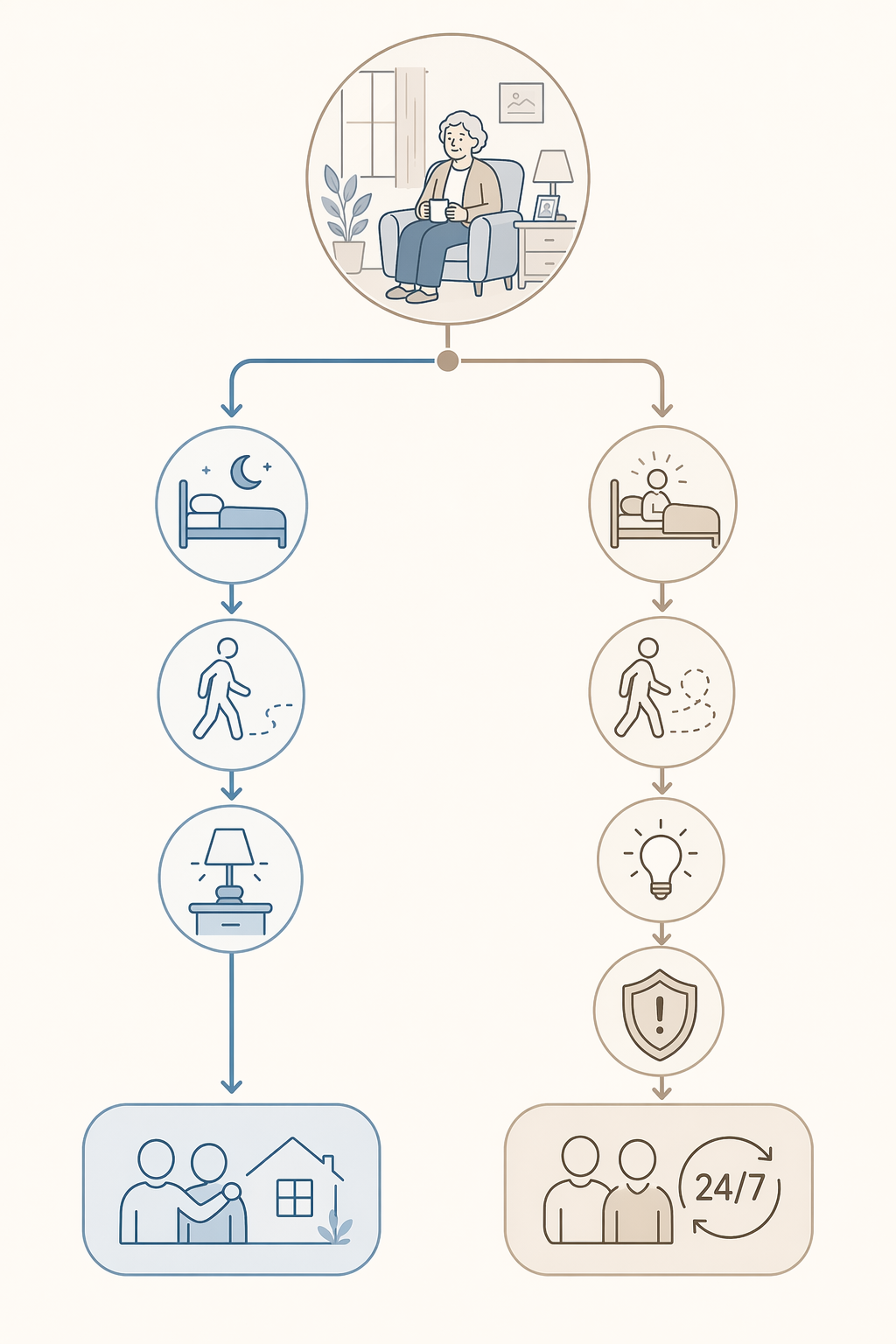
The flowchart above distills the decision into two primary branches. Use it as a starting point, not a substitute for a professional in-home assessment.
The left branch — live-in care — is appropriate when:
- The senior is medically stable and does not have a condition that requires active overnight monitoring.
- They sleep through the night with minimal assistance (one or two predictable bathroom trips).
- They do not wander or attempt to leave the home.
- They need consistent supervision and assistance with daily activities during waking hours.
The right branch — 24/7 awake care — is necessary when:
- The senior wanders, has a history of attempting to leave the home, or experiences sundowning.
- They have frequent nighttime needs (multiple bathroom trips, incontinence care, repositioning) that would prevent a live-in caregiver from getting restorative sleep.
- They are at high fall risk and cannot be left unsupervised at any time.
- They are recovering from a hospitalization or surgery and require active monitoring for complications, medication timing, or mobility assistance.
For families who have identified the need for 24-hour care and want to understand the tradeoffs between different staffing models — such as live-in caregivers versus 12-hour shifts — see our companion guide: Live-In Caregiver vs. 12-Hour Shifts: A Cost-and-Care Decision Framework for Families.
How to Get Started: Scheduling a Home Care Consultation
Once you have identified the warning signs and determined which care model fits your parent's situation, the next step is a professional in-home assessment. Most home care agencies offer this service at no cost. Here is what to expect and how to prepare.
What Happens During an In-Home Assessment
- A care coordinator or registered nurse visits the home to evaluate the senior's functional status, mobility, cognitive state, and home environment.
- They will ask about the specific warning signs you have observed — frequency of falls, nighttime behaviors, medication management, toileting needs, and nutritional status.
- They will assess the physical layout of the home: bathroom accessibility, stair safety, bedroom location, and any modifications needed (grab bars, shower chairs, bed rails).
- Based on the assessment, they will recommend a care plan that specifies the number of hours per day or week, the staffing model (live-in vs. awake shifts), and the specific tasks a caregiver will perform.
Questions to Ask a Home Care Agency
TheKey recommends asking the following questions before signing an agreement with any agency:
- How many caregivers should I expect to rotate through my parent's home? Consistency matters, especially for seniors with dementia who benefit from familiar faces.
- Can I interview each caregiver before they start? Some agencies allow this; others assign caregivers based on availability and skill matching.
- What happens if a caregiver cannot make their shift? Ask about backup protocols and how quickly a replacement can be dispatched.
- Can family members share caregiving duties with the professional caregiver? Some agencies allow a hybrid model where family handles certain hours and the agency covers others.
- Will a supervisor visit the home periodically to assess the quality of care? Regular supervisory visits are a sign of a well-managed agency.
- What is the caregiver screening process? Ask about background checks, training requirements, and whether caregivers are bonded and insured.
Preparing the Home for 24-Hour Care
Before care begins, take these practical steps to ensure the home is ready:
- For live-in care: Prepare a private sleeping space for the caregiver — a bedroom with a door, adequate storage, and reasonable privacy. This is not a luxury; it is a legal and practical requirement for the live-in model to function.
- For awake care: Ensure the home has adequate lighting in hallways, bathrooms, and the kitchen for overnight activity. Consider a night-light path from the bedroom to the bathroom.
- For both models: Create a central communication area — a whiteboard or notebook where the family and caregivers can share notes about medications, meals, behaviors, and any changes in condition.
- Secure any safety hazards: Remove loose rugs, ensure grab bars are installed in the bathroom, and check that smoke and carbon monoxide detectors are functioning.
For a deeper look at the decision between hiring through an agency versus finding an independent caregiver, see our guide: Agency vs. Independent Caregiver: A Decision Framework for Families. For a full breakdown of costs — including hourly rates, monthly budgets, and hidden expenses — see In-Home Senior Care Cost in 2026.
If you are uncertain whether 24/7 home care is sustainable long-term for your parent's specific condition, our guide on when home care isn't enough can help you evaluate the full range of options, from adding professional support to considering a transition to a facility.
Questions to bring to a clinician or OT
This is not medical, legal, or a family's final decision — only a framework. Bring these questions to a clinician, occupational therapist, or your local Area Agency on Aging.
Find Local HelpRelated reading
Noticed something outdated or inaccurate on this page? Flag a correction. We review every report against CDC, NIA, and AARP HomeFit guidance before updating a page.