When a Loved One with Dementia Refuses Medication: What to Do
Reviewed: 2026-07-05
When a Loved One with Dementia Refuses Medication: What to Do
Understand why your loved one with dementia may refuse medication and learn practical, immediate strategies to respond effectively. This guide helps you decode the underlying cause, apply targeted techniques, and know when to call the doctor.
By Editorial Team
new caregiver
experienced caregiver
long-distance caregiving
spousal caregiver
working caregiver
daily routines
medication management
personal hygiene
care coordination
first steps
ADLs
IADLs
The pill cup is on the table. Your parent says no, pushes it away, spits the tablet out, or looks at you and says you are trying to poison them. In that moment, the safest first move is usually not a better argument. Pause. Lower the pressure in the room. Check whether the dose is urgent or time-sensitive. If it is not immediately dangerous to wait, give space and try again later.
That may feel too simple when your stomach is tight and the clock says the medication is due. But escalation can turn one missed dose into a larger struggle. The Alzheimer's Association's medication safety guidance says plainly: if the person refuses medication, stop and try again later.[1]
Medication refusal in dementia is common enough that it should not be treated as a private caregiving failure. In a 2024 Japanese survey of family caregivers, 36.6% reported medication refusal among people with dementia; among those who reported medication management difficulties, refusal was one of the top three problems.[2] That study had a small caregiver sample and should not be read as a universal U.S. rate. It is still useful for one reason: it names what many families are quietly living through.
What to Do in the First Few Minutes
Before you decide what the refusal means, make the situation less combustible. A person with dementia may not be refusing the same thing you think you are offering. You may see a blood pressure pill. They may see a stranger handing them an unfamiliar object. You may know it is 8 p.m. They may feel cornered in a room that suddenly makes no sense.
Pause the attempt. Put the medication down or step back. Do not chase the pill, pry open the mouth, or keep repeating the same instruction.
Check urgency. Look at the medication label and your care plan. Some doses have more flexibility than others; some missed or delayed doses need prompt medical advice.
Reduce stimulation. Lower your voice, slow your movements, turn down noise, and give the person a few minutes without being watched.
Try once later if it is safe. Return with a calmer tone, a simpler sentence, and less audience.
Write down what happened. Note the medication, time, words used, behavior, possible triggers, and whether the dose was eventually taken.
If the medication is critical, if you are unsure how long it can be delayed, or if the person has already missed repeated doses, call the prescriber or pharmacist rather than trying to solve it by force at the table.
Decode the Refusal Before You Choose a Strategy
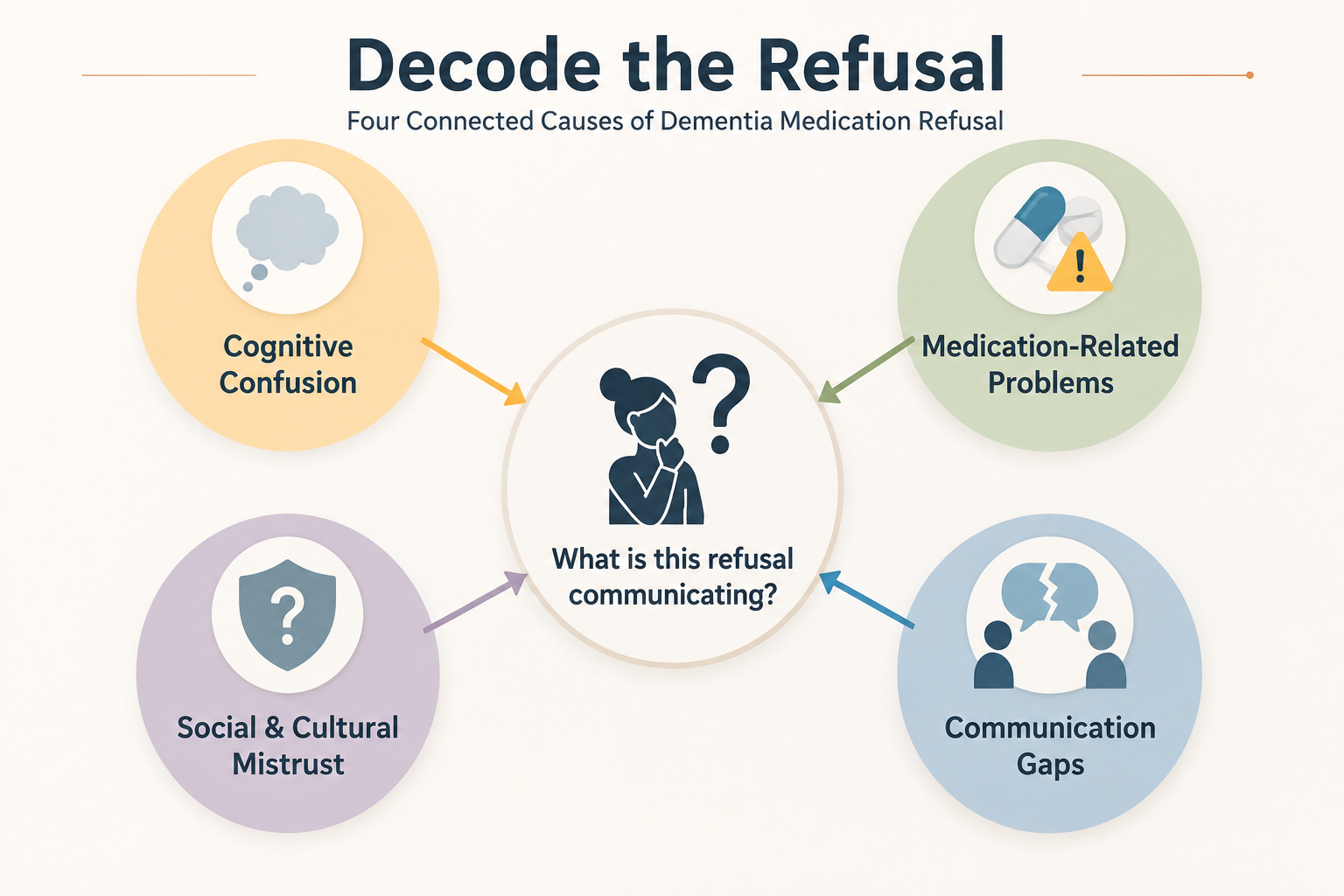
The question is not simply, “How do I get the pill in?” The better question is, “What is this refusal communicating?” A systematic review on medication adherence in people with dementia organized the causes into four broad domains: cognitive factors, medication-related factors, social or cultural factors, and knowledge or communication gaps.[3] Those categories matter because each one calls for a different response.
What may be underneath the refusal
What you might notice
What usually helps first
Cognitive confusion
They do not recognize the medication, forget why it matters, or think they already took it.
Simpler wording, routine cues, one step at a time, and a calmer retry.
Paranoia or mistrust
They accuse you, hide the pill, say it is poison, or become frightened by your insistence.
Back off, validate the feeling without agreeing to the false belief, and avoid confrontation.
Side effects or swallowing discomfort
They grimace, cough, gag, complain of nausea, or resist one specific pill more than others.
Call the prescriber or pharmacist to review side effects, formulation, timing, or alternatives.
Regimen complexity or loss of control
There are many pills, changing instructions, or a sense that medication time has become a power struggle.
Ask for a medication review, simplify routines where approved, and offer limited choices.
Communication gaps
The instruction is too long, too abstract, or delivered during pain, fatigue, noise, or sundowning.
Use fewer words, match the dose to a familiar routine, and choose a better time if allowed.
If Confusion Is Driving the Refusal
Cognitive changes can make medication feel unfamiliar even when the person has taken the same pill for years. They may not remember the diagnosis, the doctor's visit, the morning dose, or the reason the pill exists. A long explanation can make the room feel more threatening, not more rational.
Use one short sentence tied to something immediate: “This is your morning pill. Then we’ll have coffee.” If they ask again, answer again without adding a lecture. If they say they already took it, avoid arguing from the medication log as if you are proving a case. You can say, “I know it feels that way. This is the one for right now.”
Routine cues often work better than persuasion. BrightFocus Foundation suggests strategies such as staying calm, linking medication to an established routine, offering choices, and asking the clinician about alternative medication forms when appropriate.[4] The choice should be real but narrow: water or juice, now or after the first bite of breakfast, sitting here or at the kitchen counter. Too many options can create another decision the person cannot safely manage.
If Paranoia or Suspicion Is in the Room
A refusal that sounds accusatory is still often fear. Paranoia and suspicious thinking have been documented as reasons for medication refusal in moderate-to-late stage dementia.[3] The painful part for caregivers is that the accusation may be aimed at the person doing the most work: the daughter who organized the refill, the spouse who stayed up all night, the son who rearranged his job to be there.
Do not try to win a factual debate about poison, theft, or control. A frightened brain may hear your correction as more evidence of danger. Try acknowledging the feeling without confirming the belief: “That feels scary. I’m going to give you some space.” Then step away if the situation is safe.
UCLA Health's caregiver training materials on medication refusal emphasize de-escalation approaches for these moments.[5] In practice, that means the medication attempt may need to disappear for a while. Change the subject. Offer a drink. Move to a calmer room. Let another trusted person try later if that usually goes better. The point is not to trick the person; it is to stop turning medication time into a threat.
If the Medication Itself Is the Problem
Sometimes the refusal is more physically accurate than anyone realizes. A pill may taste bitter, stick in the throat, cause nausea, make the person dizzy, worsen constipation, or be associated with a previous frightening sensation. If the person refuses one medication again and again while accepting others, treat that pattern as information.
Medication-related factors, including side effects and regimen complexity, are part of the adherence problem in dementia.[3] Polypharmacy is also common in this population, with the review noting estimates ranging from 40% to 90% among people with dementia.[3] A full pill cup is not just an organizational nuisance; it increases the chances that something tastes bad, interacts poorly, duplicates another treatment, or no longer matches the person's current goals of care.
This is where a pharmacist can be unusually helpful. Ask whether the medication can be taken at another time of day, whether food changes absorption, whether a liquid, patch, sprinkle, smaller tablet, or crushable version exists, and whether any pill should not be crushed. Also ask whether the medication is still necessary. Do not stop, crush, split, or mix medications based on guesswork; many drugs have safety rules that are not obvious from the outside.
If Swallowing Has Changed
New coughing, choking, pocketing pills in the cheek, repeated throat clearing, or a wet-sounding voice after swallowing deserves more attention than a communication trick. Dementia can affect eating and swallowing over time, and a medication refusal may be the first sign the person is protecting themselves from discomfort or fear.
Call the prescriber if swallowing trouble is new, worsening, or causing missed medication. A clinician may need to assess for swallowing problems, review the medication form, or refer for further evaluation. Until you have guidance, avoid improvising with crushed pills in applesauce or thickened drinks unless you know the medication can safely be prepared that way.
If the Regimen Has Become a Daily Contest
A person who has lost so much control may use the pill cup as one of the few places left to say no. That does not mean every refusal can simply be honored without consequence. It does mean the way medication is offered can either preserve dignity or drain it.
Look for places to remove unnecessary friction. Can the prescriber reduce dosing frequency? Can refills be synchronized? Can the pharmacist provide blister packs or other packaging that makes the routine clearer? Can the most difficult dose be moved away from a time of day when the person is usually tired, agitated, or hungry? Any timing change should be cleared by the care team, especially for medications with narrow dosing windows.
The goal is not a prettier pill organizer. It is fewer moments in which the caregiver has to become the enforcer and the person with dementia has to defend the last scrap of authority they can reach.
When to Call the Doctor, Pharmacist, or Urgent Help
Not every refused dose is an emergency. Some can wait until the next safe attempt. Others should move quickly from kitchen-table problem to clinical question.
Call the prescriber promptly if refusal is repeated, increasing, or causing missed doses of medications the clinician has identified as important.
Call the pharmacist if you are considering crushing, splitting, mixing, changing timing, or using a different form of the medication.
Call the prescriber if you suspect side effects such as dizziness, sedation, nausea, new confusion, falls, constipation, or behavior changes after a medication change.
Seek medical advice quickly for new swallowing trouble, choking, repeated coughing with pills, or signs that pills are being held in the mouth.
Seek urgent help if the person may harm themselves or someone else, has severe sudden confusion, chest pain, trouble breathing, symptoms of stroke, loss of consciousness, or another acute medical concern.
When you call, be specific. “She refused her medicine” is a start, but “She has refused the evening heart medication three times this week, coughs when swallowing larger tablets, and became suspicious after the dose was moved to bedtime” gives the care team something to work with.
Be Careful With Hiding Pills in Food
Hiding medication in pudding, applesauce, or a favorite drink can sound merciful when everyone is exhausted. It can also cross ethical and safety lines. The Alzheimer's Society states that a person has the right to refuse medication and that capacity should be assessed by the prescriber; it also says covert medication should be a last resort and requires written approval from the prescribing clinician or pharmacist because disguising medicine in food or drink can affect how it is absorbed.[6]
That guidance is from the UK, and legal requirements vary by jurisdiction. The practical boundary is still clear for a U.S. family caregiver: do not secretly hide medication without involving the prescribing clinician or pharmacist. Refusal does not automatically mean the person lacks capacity, and incapacity is not something a family member should casually declare in the heat of a difficult dose.
There is also a trust cost. If the person discovers a pill hidden in food, future meals may become suspect. For someone already living with confusion or paranoia, that can make eating, drinking, and caregiving harder than the original medication problem.
What to Track After the Refusal
One refusal may pass. A pattern needs a record. Keep the notes plain and useful, not like a confession.
Medication name, dose, and scheduled time
Whether the dose was refused, delayed, spit out, vomited, or later accepted
What the person said or seemed afraid of
Possible physical clues, such as coughing, grimacing, nausea, sleepiness, dizziness, or pain
What was happening around the dose: noise, visitors, fatigue, hunger, bathing, sundowning, or a rushed caregiver
What helped, even a little
Bring that pattern to the prescriber or pharmacist. A care team can respond more safely to three days of concrete notes than to a desperate memory of every hard moment at once.
For the next dose, do not make the table feel like a rematch. Start smaller. Use fewer words. Offer the medication as part of a familiar routine if that is safe for the drug. If refusal returns, treat it as a signal to investigate: confusion, fear, discomfort, side effects, swallowing trouble, timing, too many pills, or a loss of control that has found its voice in one small cup.


Comments
Join the discussion with an anonymous comment.