
Caregiver decision guide
Earthquake Preparedness for Seniors and Elderly Adults
Standard earthquake advice assumes able bodies and quick reflexes, but seniors with mobility devices, daily medications, or cognitive decline need a fundamentally different approach. This guide helps caregivers assess vulnerabilities, senior-proof the home, build a 30-day emergency kit, and plan a device-specific response — with a downloadable checklist.
The first problem with earthquake preparedness for seniors and elderly adults is that the standard instruction assumes a body that can move quickly, get low, stay balanced, and remember what to do while the room is shaking. Many older adults cannot safely “drop, cover, and hold on” in the usual way. A parent who uses a walker may fall before reaching the floor. A wheelchair user should not be trying to transfer in the middle of shaking. Someone in bed should not be told to stand up and search for a doorway. Someone with dementia may not understand the instruction at all.
For an older adult, the real plan starts earlier. It starts with a plain vulnerability assessment: what would stop this person from protecting themselves, getting help, taking medication, breathing safely, seeing the floor, hearing instructions, or staying oriented after the quake? Once those limits are named, the home, supplies, helpers, and response position can be built around the person who actually lives there.
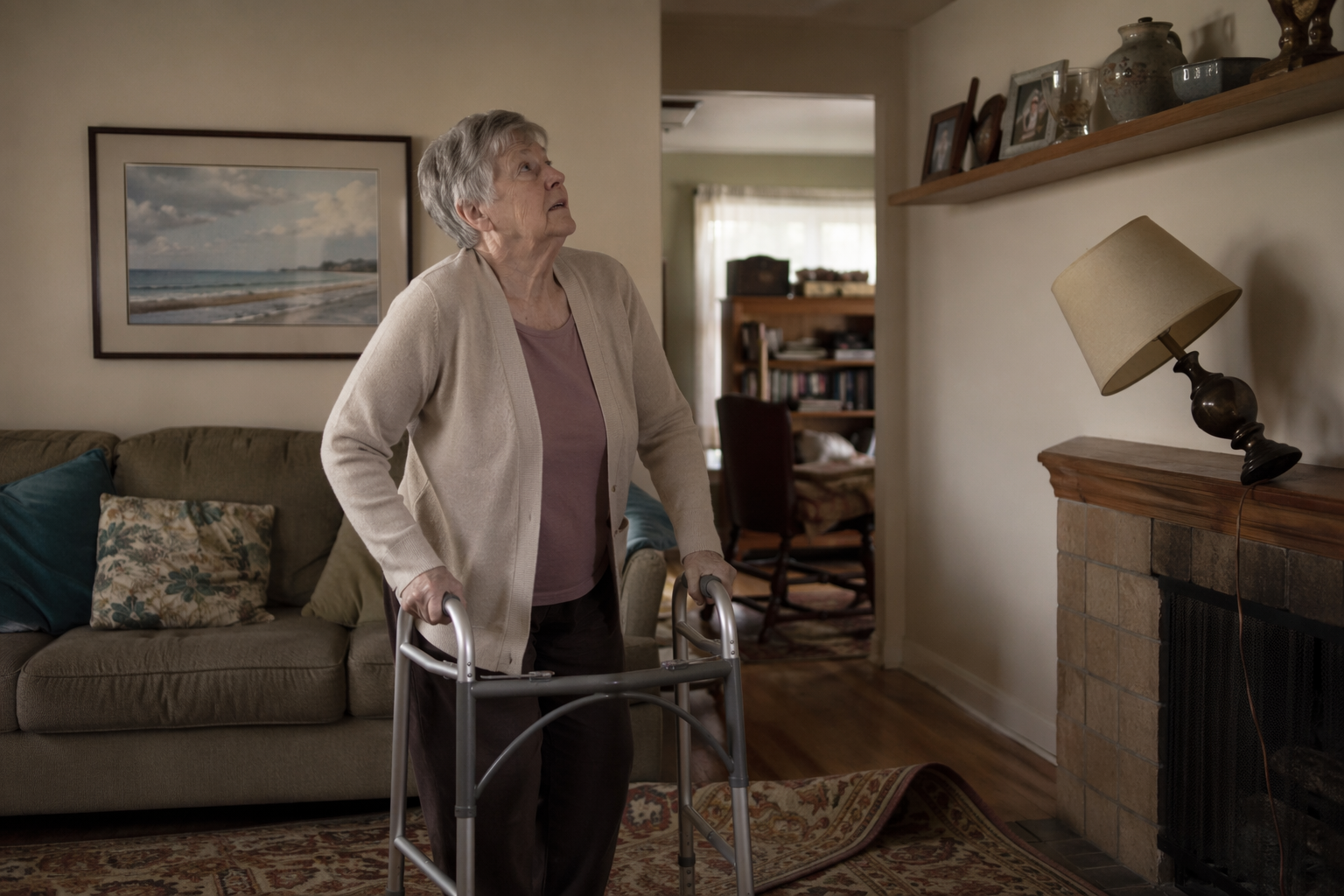
Start With What Your Parent Cannot Safely Do
A useful caregiver checklist does not begin with bottled water. It begins with the older adult’s ordinary day. Watch one morning and one evening if you can. Notice how they get out of bed, where the walker ends up, whether they hold furniture while walking, how they manage oxygen tubing, how many steps they take to reach the bathroom, whether they can open pill bottles, whether they hear the phone from another room, and whether they can read a printed instruction sheet without hunting for glasses.
The assessment should be specific enough that another helper could use it without guessing. “Mobility issues” is not enough. “Uses a four-wheel walker, cannot get up from the floor without assistance, and becomes unsteady when turning in the hallway” is useful. “Takes medication” is not enough. “Takes daily heart and diabetes medications, uses a weekly pill organizer, and needs help calling the pharmacy” changes the emergency kit and the helper plan.
| Look At | Ask | What It Changes |
|---|---|---|
| Mobility | Can they get low, stay balanced, transfer, or rise without help? | Response position, furniture placement, pathway width, evacuation help |
| Medication | What happens if refills, refrigeration, or reminders are interrupted? | Emergency supply, printed medication list, pharmacy contact plan |
| Vision and hearing | Can they see the floor at night and hear alerts or phone calls? | Lighting, large-print instructions, backup batteries, helper check-ins |
| Cognition | Can they follow a new instruction during stress or disrupted routine? | Simplified cues, supervision, identification, wandering prevention |
| Breathing and medical equipment | Do they use oxygen, CPAP, powered equipment, or charged devices? | Equipment anchoring, backup power questions, evacuation priority |
| Strength and reach | Can they lift supplies, open containers, and reach stored items? | Kit location, container weight, duplicate supplies in several rooms |
This is also where family assumptions tend to fall apart. A phone call after the quake is not a plan if cell service is overloaded, the phone is across the room, the hearing aids are dead, or the parent is on the floor. A closet full of emergency supplies is not a plan if the closet is blocked by a fallen bookcase. A printed checklist is not a plan if the person who needs it cannot read it in the dark.
The Caregiver Earthquake Checklist
Use this as the working checklist before shopping for supplies. Print it, write on it, and leave a copy with each nearby helper. The point is not to make the binder look complete. The point is to remove decisions the older adult should not have to make while frightened, injured, or without power.
- Name the person’s limits: mobility device, transfer ability, fall history, cognition, hearing, vision, oxygen or equipment dependence, medication needs, and evacuation barriers.
- Walk every room and remove the most likely injury sources: tall furniture, heavy wall items, objects over beds or recliners, unstable lamps, blocked paths, loose cords, and oxygen tanks that can tip.
- Build a senior-specific emergency kit with at least 30 days of medications, extra assistive items, glasses, hearing aid batteries, printed medical information, water, food, lighting, and hygiene supplies.
- Assign at least two nearby helpers who have keys, know the medical basics, and practice the plan with the older adult at least twice a year.
- Write the response position for the person’s actual situation: wheelchair, walker, sturdy chair, bed, oxygen use, or dementia-related confusion.
- Plan the first hour after shaking: injury check, medication access, gas or carbon monoxide risk, phone contact, safe movement, and whether evacuation is necessary.
Make the Home Safer Before Anyone Has to Move Fast
Earthquake Country Alliance identifies falling and moving objects as the greatest earthquake hazard, which matters even more for older adults who cannot reliably reach cover quickly or dodge items coming off shelves.[1] That shifts the caregiver’s attention from “Will Mom remember the drill?” to “What can hit her before she has a chance to do anything?”
Start where the person spends the most time: bed, recliner, favorite chair, bathroom path, kitchen table, and medication area. A heavy framed picture above a recliner is not sentimental during shaking. A tall bookcase near the path to the bathroom is not just furniture. A lamp on a narrow side table can become broken glass exactly where bare feet land after the lights go out.
Bedroom
- Move heavy art, mirrors, shelves, and wall-mounted objects away from the bed.
- Anchor dressers, wardrobes, bookcases, and televisions so they cannot fall across the bed or exit path.
- Keep shoes, glasses, flashlight, whistle, phone, and any walking aid in a fixed reachable place, not somewhere that depends on memory.
- Check the bed height. If the parent already struggles to stand, a quake is not the time to discover the bed is too low or the walker is parked out of reach.
Living Room
- Anchor tall furniture and remove heavy objects from high shelves, especially near the recliner or favorite chair.
- Replace unstable side tables with sturdier surfaces that will not tip when grabbed for balance.
- Clear walker and wheelchair routes so the person is not forced to make tight turns around decorative furniture.
- Keep a small duplicate supply pouch near the main sitting area if the older adult spends most of the day there.
Kitchen and Medication Area
The kitchen usually has glass, overhead cabinets, appliances, and the daily medication routine. Secure cabinet doors if contents could spill into walking paths. Move frequently used food, water, and medication-related supplies to reachable shelves. If the emergency food is stored above shoulder height, it may as well belong to someone else.
Bathroom and Hallways
- Keep the path to the bathroom clear enough for the actual mobility device, not just for a person walking sideways.
- Remove loose rugs, cords, and clutter that become harder to see after power loss.
- Install grab bars where the person already reaches for towel racks, counters, or door frames.
- Use plug-in security lights that turn on automatically during a power outage; the Illinois Emergency Management Agency notes that these lights can illuminate for 4 to 6 hours, which is exactly the kind of quiet fall-prevention measure that matters after shaking stops.[5]
Oxygen and Powered Equipment
Oxygen tanks need special attention because they can fall, roll, damage tubing, or create a barrier in a walkway. Earthquake Country Alliance recommends securing oxygen tanks with two straps.[1] Do not place tanks where a fallen table or chair can trap them. If the parent uses powered medical equipment, write down what happens when power is out: battery duration, charging routine, backup options, supplier phone number, and whether evacuation becomes medically urgent.
Build the Kit Around Medications, Senses, and Mobility
A standard emergency kit is a starting point, not a senior kit. The American Red Cross recommends that older adults keep at least 30 days of medications and extra assistive items such as a cane, eyeglasses, and hearing aid batteries in emergency supplies.[2] That 30-day medication minimum is not a small detail. Pharmacies may be closed, transportation may be interrupted, and the caregiver who usually solves refill problems may not be able to get there.
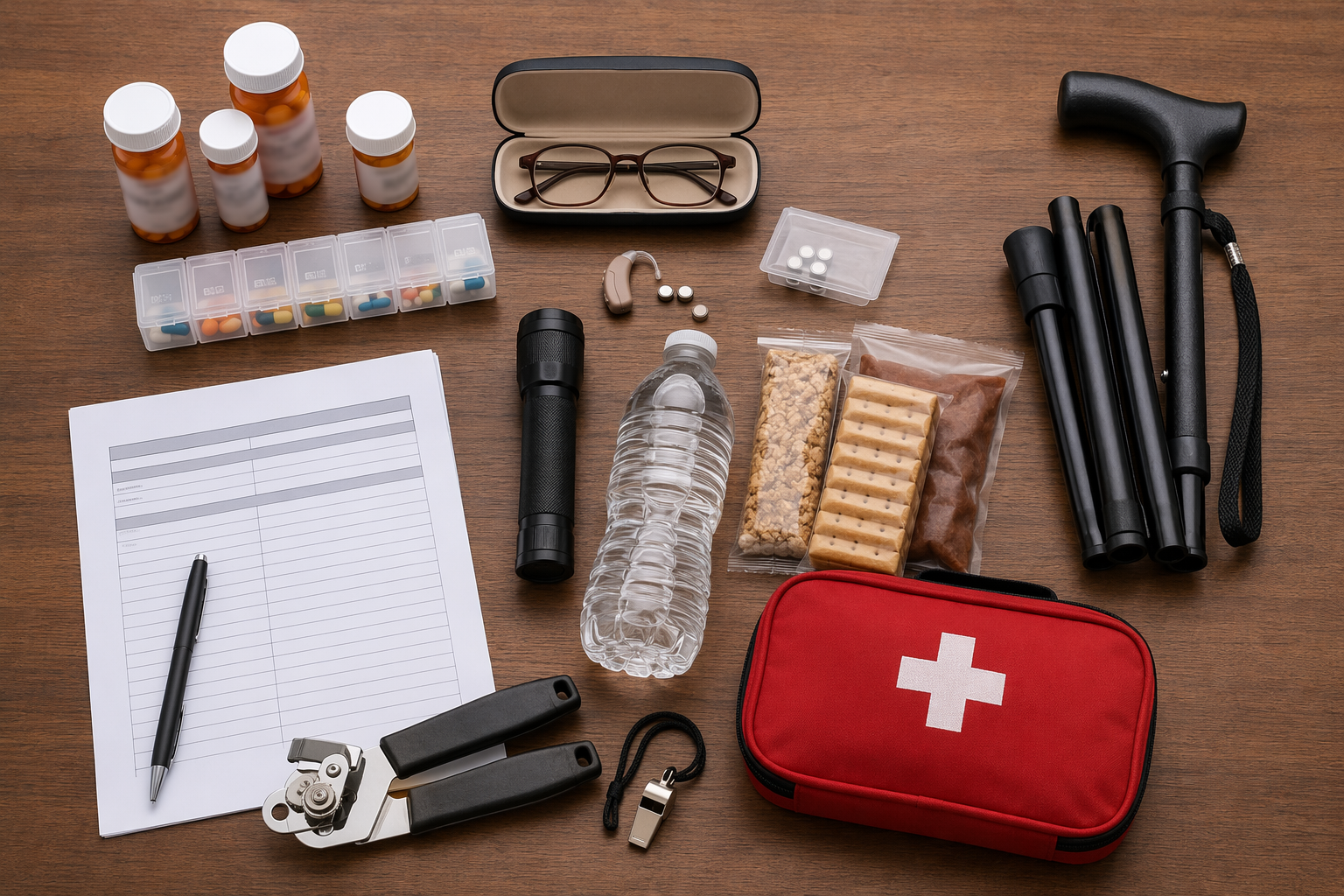
The kit should be stored where the older adult or a helper can reach it after furniture shifts. For many homes, that means one main kit plus smaller duplicate pouches near the bed and favorite chair. Use containers the person can open. A heavy bin with tight latches may look organized and still fail the person who needs it.
| Kit Category | Senior-Specific Contents |
|---|---|
| Medication and medical records | At least 30 days of medications when possible, current medication list, allergies, diagnoses, pharmacy, prescribers, insurance information, copies of advance directives if available |
| Assistive items | Spare cane or walker tips, extra eyeglasses, hearing aid batteries, denture supplies, magnifier, reacher, wheelchair charger or repair contacts if relevant |
| Lighting and signaling | Flashlights, spare batteries, whistle, plug-in outage lights, large-print instruction sheet |
| Food and water | Water and nonperishable foods the person can chew, swallow, open, and eat with dietary restrictions in mind |
| Hygiene and continence | Incontinence supplies, wipes, gloves, toilet paper, hand sanitizer, disposable bags, skin-protection products |
| Comfort and orientation | Warm layer, simple clock or calendar cue, familiar item for a person with dementia, printed family photos if helpful for reassurance |
Do not rely on a one-week pill organizer as the emergency medication plan. It can help with daily routine, but it does not solve refills, lost pills, refrigeration questions, or dose changes. Keep the printed medication list current enough that an emergency department, shelter nurse, or neighbor would not have to reconstruct the person’s care from memory.
Name the Nearby Helpers Before the Quake
Ready.gov advises older adults to build a support network of at least two people, exchange keys, share medical information, and practice the plan twice a year.[3] For an adult child who lives across town or in another state, this is the line between a plan and a hope.
Choose people who can realistically reach the home: a neighbor, nearby relative, building manager, faith-community contact, or paid caregiver. Give them permission in writing to check on the older adult. Make sure they know where the kit is, how to shut off obvious hazards if they have been trained to do so, where the medication list is kept, and what the parent’s normal behavior looks like.
- Helper 1 and Helper 2 both have keys or approved access.
- Both helpers know the parent’s mobility limits and safest response position.
- Both helpers have the caregiver’s phone number and an alternate contact.
- Both helpers know whether the parent uses oxygen, powered equipment, dementia medications, insulin, anticoagulants, or other time-sensitive care.
- The older adult has practiced what will happen when a helper knocks, enters, or calls out after an earthquake.
Practice should be modest and real. Have the parent sit in the actual chair, lock the actual wheelchair, reach for the actual flashlight, or point to the medication list. A calm five-minute rehearsal twice a year teaches more than a long lecture no one remembers.
What the Older Adult Should Do During the Shaking
This instruction has to be written for the body the person has. Earthquake Country Alliance’s accessibility guidance, Illinois emergency planning materials, and reduced-mobility safety guidance all emphasize adapting the response to the person’s mobility device instead of forcing a standard floor position.[4][5][6]
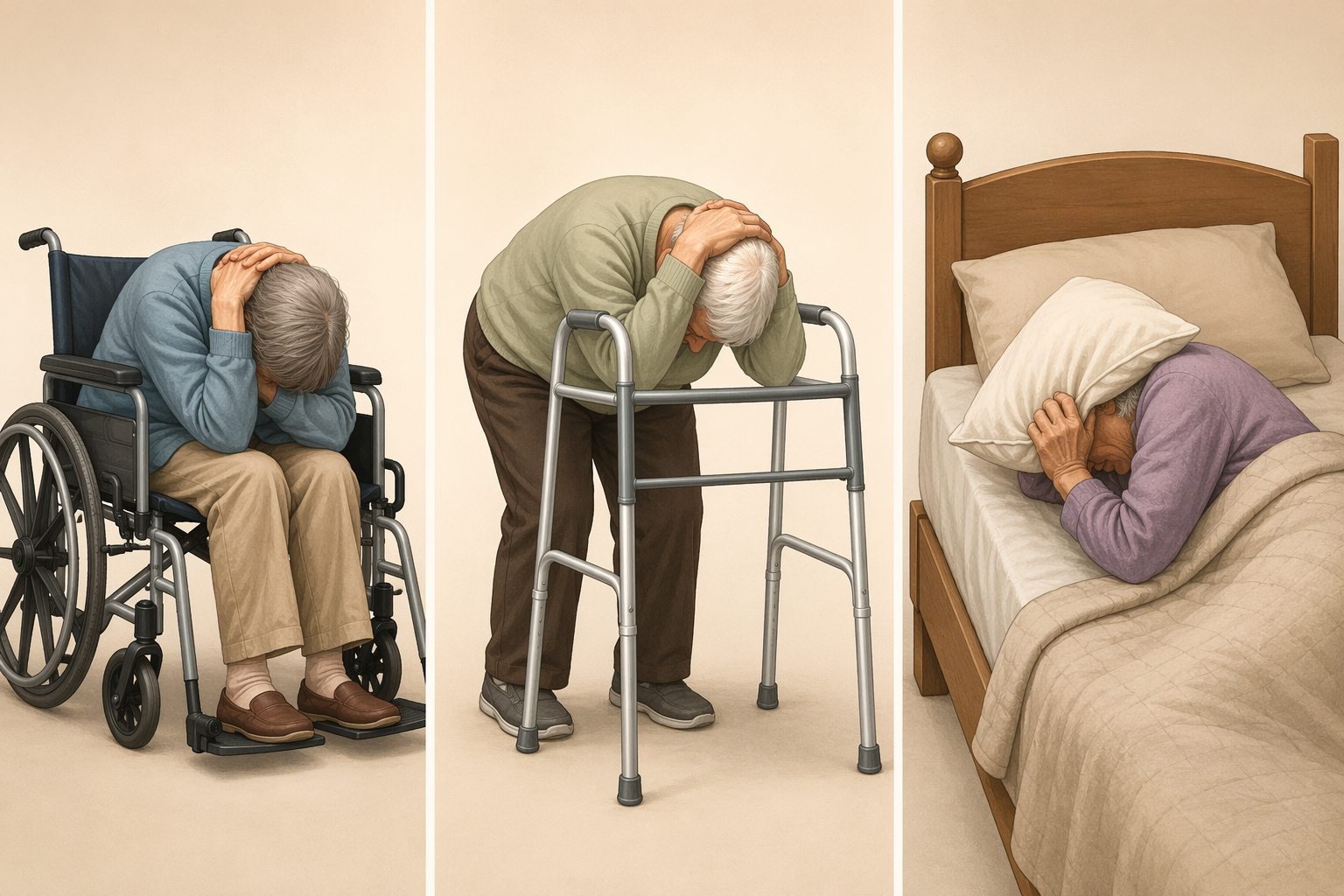
If They Use a Wheelchair
They should not try to get to the floor. The safer protocol is to lock the wheels, stay seated upright, bend forward if able, and cover the head and neck with arms or another available protective item.[4] If the chair has a lap belt that the person already uses safely, it should be fastened as part of ordinary positioning, not hunted for during shaking.
If They Use a Walker
A walker user should not rush across the room looking for a table. If they can do so safely, they should lower themselves as far as possible, bend over the walker, and cover the head and neck.[4][5] If lowering is unsafe, the plan should name a nearby sturdy chair as the destination before the quake ever happens. That chair should not be under a heavy picture, next to a tall cabinet, or surrounded by loose rugs.
If They Are Sitting in a Chair
If the person is already seated and cannot safely get down, they should stay in the chair, protect the head and neck, and avoid trying to stand while the floor is moving. The caregiver’s job is to make that chair a safer place ahead of time: away from windows, tall unsecured furniture, heavy wall decor, and objects that can fall from shelves.
If They Are in Bed
A bedridden person should stay in bed and cover the head and neck with a pillow.[4][5] Do not write a plan that requires them to stand, transfer, or roll to the floor. The bed area should already be cleared of overhead hazards, and a helper should know whether the person can call out, use a phone, press an alert button, or needs an in-person check.
If They Use Oxygen
The response plan should protect the person first and the tubing second. They should avoid standing or stepping over tubing during shaking. Tanks should already be secured, and the helper plan should include checking whether tubing is kinked, disconnected, or creating a trip hazard after the quake.
Communication Cannot Depend on One Phone Call
After a quake, the caregiver may be trying to call while the older adult is trying to hear a ringing phone across the room. Build redundancy into the plan: a charged mobile phone, a written contact card by the bed and main chair, a landline if the home still has one, a medical alert device if already used, and the two nearby helpers who know when to check in person.
Keep the contact sheet simple: name, address, date of birth, emergency contacts, doctors, pharmacy, medications, allergies, mobility needs, communication needs, and whether the person has dementia or another condition that may affect cooperation. Put one copy in the kit, one by the bed, and one with each helper.
Plan Evacuation for the Worst Doorway, Not the Best Day
Evacuation plans often sound clean until someone measures the hallway with a walker in it. Walk the route after imagining broken glass, a fallen lamp, no elevator, no power, and a parent who is frightened or in pain. If the older adult lives in an apartment, ask how stair evacuation works for residents with mobility limitations. If they use a wheelchair, write down who can assist and what equipment is needed. If they cannot be moved safely by family, the plan should say that instead of pretending.
Pack a go-bag that matches the evacuation reality: medication list, a smaller supply of essential medications, glasses, hearing aid batteries, phone charger, incontinence supplies, a warm layer, copies of documents, and any communication card the person may need if separated from family. For a person with dementia, add identification and familiar reassurance items, but do not rely on those items to prevent wandering.
Dementia Changes the Earthquake Plan
A person with dementia may not connect shaking, alarms, darkness, and unfamiliar helpers into a coherent emergency. They may resist leaving, try to return to a damaged room, remove needed equipment, or walk away after routines are disrupted. The Alzheimer’s Association states that 60% of people with dementia will wander at some point, and that if a person who wanders is not found within 24 hours, up to half suffer serious injury or death.[7]
That does not mean every person with dementia will wander after an earthquake. It means the plan should not assume a previously stable routine will stay stable after noise, displacement, sleep loss, or caregiver absence. Helpers need to know the person’s usual name preference, calming phrases, common exit-seeking patterns, and whether they may become more confused in darkness or crowds.
- Use simple one-step instructions: “Sit here,” “Hold this pillow,” “Wait for Anna.”
- Place identification on the person and in the go-bag, including caregiver contact information.
- Tell nearby helpers whether the person may hide, leave, refuse help, or become frightened by uniforms or sirens.
- Avoid sending unfamiliar people without context if a known helper can arrive safely.
- If evacuation is likely, identify dementia-capable supervision rather than assuming a general shelter environment will be manageable.
The First Hour After Shaking Stops
The first instruction after shaking is not “clean up.” It is “stay still long enough to check for injury and hazards.” Older adults may try to stand because they are embarrassed, cold, confused, or worried about the house. That is when post-quake falls happen.
- Check for pain, bleeding, dizziness, breathing trouble, confusion, or inability to move.
- Look before standing: glass, fallen objects, shifted furniture, loose cords, spilled medication, and oxygen tubing.
- Put on sturdy shoes before walking if shoes are reachable without unsafe bending.
- Confirm access to medications, glasses, hearing aids, phone, and mobility device.
- Contact the assigned helper network according to the written plan.
- Leave the home only if it is unsafe to stay or authorities direct evacuation, and use the planned route and support.
Carbon monoxide deserves its own warning because outages tempt people to improvise. The American Association for Geriatric Psychiatry notes that carbon monoxide causes 500 deaths and 15,000 emergency room visits annually in the United States, and that adults over 65 are especially vulnerable.[8] Generators, grills, camp stoves, and gas appliances should never be used indoors or in enclosed spaces.
Watch Recovery, Not Just Survival
After the obvious danger passes, caregivers still need to watch medication continuity, sleep, appetite, mobility, pain, confusion, and mood. A parent who seems “fine” on the phone may be skipping pills because the organizer spilled, avoiding the bathroom because the hallway is dark, or sitting all day because the walker was damaged.
Psychological distress is also part of recovery. The VA National Center for PTSD reports that older adults are 2.11 times more likely to develop PTSD symptoms after natural disasters.[9] The same body of research notes that most older adults show low or no symptoms, while a smaller portion develop chronic or delayed-onset symptoms; the useful caregiver takeaway is to keep watching over time instead of assuming the emotional effect is finished once utilities return.[9]
Escalate concerns when there is new confusion, worsening mobility, medication interruption, dehydration, breathing trouble, chest pain, repeated falls, unsafe wandering, severe insomnia, panic, or withdrawal from normal contact. The emergency plan should include the parent’s clinicians and pharmacy, not only family phone numbers.
What a Finished Plan Looks Like
A finished earthquake plan for an older adult names the person’s limitations in concrete language. It removes the objects most likely to injure them. It puts supplies where they can be reached. It includes at least 30 days of medications when possible, plus the glasses, batteries, mobility supports, hygiene supplies, and medical information that keep the person functioning. It assigns nearby helpers who can enter the home and know what to check. It gives the older adult a response position they can physically use when shaking starts.
That is the standard to use. Not whether the checklist looks complete. Whether it would still work for this parent, in this room, with this body, in the dark.
References
- Step 1: Secure Your Space, Earthquake Country Alliance
- Older Adults Emergency Preparedness, American Red Cross
- Older Adults, Ready.gov
- Earthquake Preparedness for People with Disabilities and Access and Functional Needs, Earthquake Country Alliance
- Planning Guide for Seniors — Earthquake Preparedness, Illinois Emergency Management Agency
- Earthquake Safety with Reduced Mobility, Midnight Sun Home Care
- Preparing for Emergencies, Alzheimer’s Association
- Older Adults and Disaster Preparedness and Response, American Association for Geriatric Psychiatry
- Impact of Disasters on Older Adults, VA National Center for PTSD
Questions to bring to a clinician or OT
This is not medical, legal, or a family's final decision — only a framework. Bring these questions to a clinician, occupational therapist, or your local Area Agency on Aging.
Find Local HelpRelated reading
Noticed something outdated or inaccurate on this page? Flag a correction. We review every report against CDC, NIA, and AARP HomeFit guidance before updating a page.