
Caregiver decision guide
Home Help for the Elderly: What Types Exist, What They Cost, and How to Choose
This guide explains the full spectrum of in-home care services for older adults—from companion visits to skilled home health care—along with current costs in 2026 and practical steps to assess needs, arrange care, and explore payment options.
Home help for elderly parents is easiest to misunderstand when everyone uses one soft phrase for very different kinds of work. A neighbor bringing groceries, an aide helping with bathing, a nurse checking a wound after surgery, and a physical therapist working on stairs are not interchangeable services. They are arranged differently, paid for differently, and expected to solve different problems.
That distinction matters because most older adults are already at home: 93% of adults 65 and older live in their own homes or apartments, according to Pew Research Center’s 2026 analysis.[1] Wanting to stay there is understandable. Making it work usually starts with a more ordinary question: which tasks are no longer safe, reliable, or manageable without help?

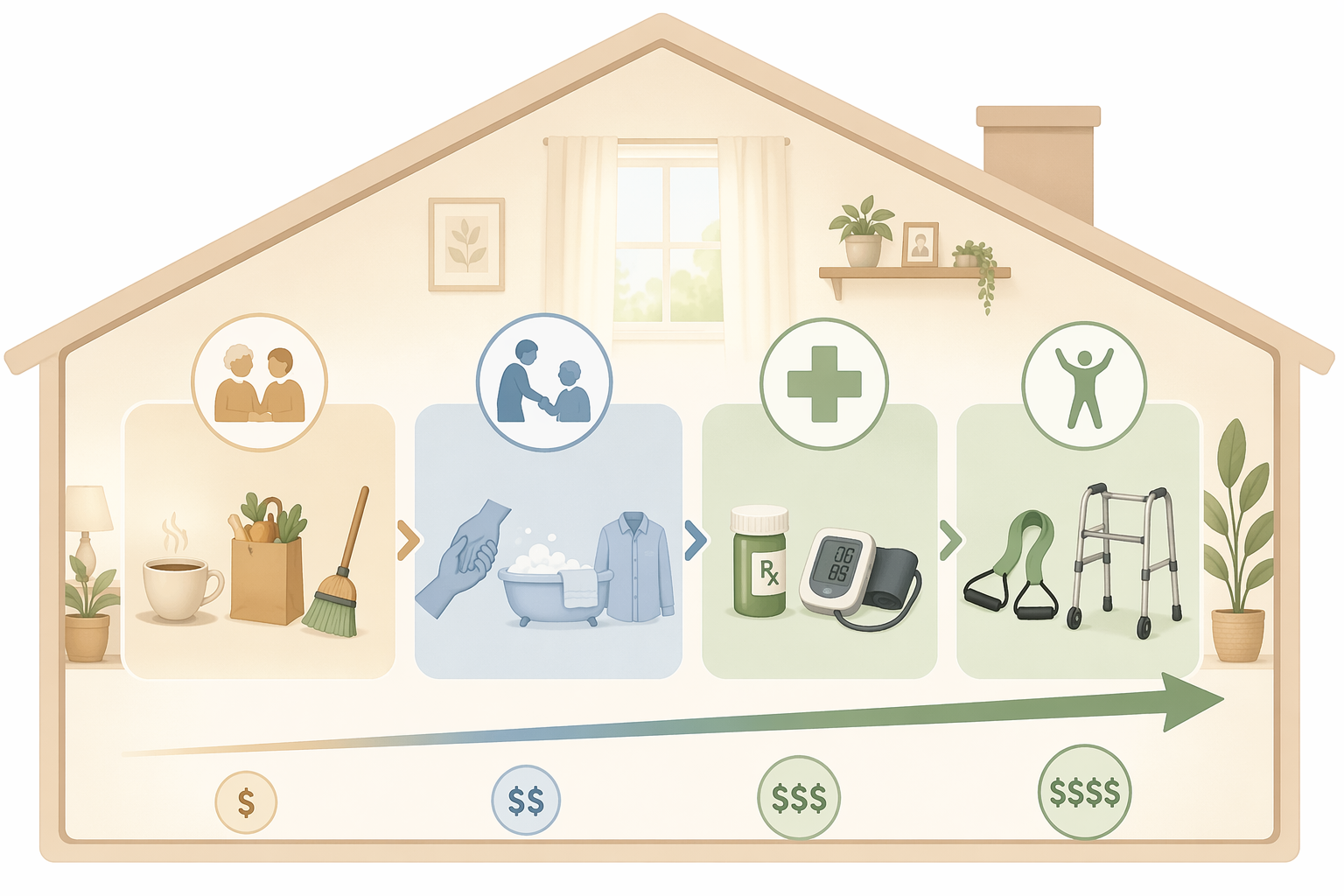
Quick reference: the home-help spectrum
Before calling agencies or comparing prices, sort the need by task. The 2026 national median cost for non-medical home care is $34 per hour, with reported state medians ranging from $25 per hour in Mississippi to $44 per hour in South Dakota.[2] That number is useful as a budget anchor, but it does not price every kind of care. Skilled medical care, therapy, public programs, and insurance rules sit in a different lane.
| Type of help | What it usually includes | Who may provide it | Cost and payment note |
|---|---|---|---|
| Companion or homemaker help | Conversation, light housekeeping, laundry, grocery shopping, errands, meal preparation, reminders, basic supervision | Companion, homemaker, home care aide, agency caregiver, or privately hired caregiver | Usually private pay unless a state, local, veterans, or community program applies; part of the non-medical home care market anchored by the $34/hour national median in 2026.[2][3] |
| Personal care or ADL assistance | Hands-on help with bathing, dressing, toileting, transferring, eating, grooming, and safe movement around the home | Home health aide, personal care aide, certified nursing assistant, or trained caregiver depending on state rules and agency model | Often private pay; may be covered by Medicaid waiver or other programs for eligible people, but rules vary by state.[3] |
| Skilled home health care | Medically necessary care such as nursing visits, wound care, injections, monitoring after illness or hospitalization, and care ordered as part of a clinical plan | Licensed nurse or other skilled professional through a Medicare-certified or otherwise licensed home health agency | Medicare may cover short-term skilled home health when medically necessary and ordered by a physician; it does not cover long-term personal care or homemaker help.[3] |
| Therapy services at home | Physical, occupational, or speech therapy after illness, injury, surgery, or a decline in function | Licensed therapists, usually through a home health agency or outpatient-at-home arrangement | May be covered when eligibility rules are met; not the same as ongoing household or companion help.[3] |
| Transportation, meals, and money-management support | Rides to appointments, delivered meals, bill-paying help, budgeting support, benefits paperwork, or help avoiding missed payments | Community programs, volunteers, private services, care managers, trusted family members, or agency add-ons | Often arranged separately from aide care; local Area Agencies on Aging can help identify available programs.[3] |
Start with tasks, not labels
Families often begin with the wrong question: “Do we need home care?” That is too broad to be useful. A better first pass is a written task list for a typical week, including what went wrong recently and what nearly went wrong.
- Meals: Is the refrigerator stocked? Are meals being skipped? Is cooking still safe?
- Household work: Are laundry, dishes, trash, bedding, and basic cleaning getting done?
- Transportation: Can your parent get to medical appointments, the pharmacy, groceries, and social activities?
- Personal care: Is bathing, dressing, toileting, grooming, or getting in and out of bed becoming difficult?
- Mobility and safety: Are there falls, near-falls, trouble with stairs, or unsafe transfers?
- Medication routine: Are pills missed, doubled, or taken at the wrong time?
- Medical recovery: Is there a wound, new diagnosis, surgery recovery, therapy plan, or hospital discharge order?
- Money and paperwork: Are bills unpaid, scams a concern, or insurance and benefits letters piling up?
- Social contact: Is your parent isolated, anxious alone, or going days without meaningful conversation?
Bring your parent into this sorting as early as possible, unless an emergency makes that temporarily impossible. The point is not to announce that help is arriving. It is to find the least intrusive support that actually solves the problem. Someone who refuses “a caregiver” may accept “help with laundry and a ride to the grocery store on Tuesdays.” Someone who insists they are fine may still admit that the shower has become frightening.
Companion and homemaker help: the lightest formal support
Companion and homemaker services are for the parts of daily life that keep a home running but do not require medical skill. The National Institute on Aging lists help such as household chores, shopping, meals, transportation, and personal assistance among services that can support older adults living at home.[3]
This level can be enough when the main risks are isolation, missed errands, poor meals, clutter, or a parent who is no longer driving. It can also give family caregivers a reliable set of eyes in the home, though that should be handled respectfully. A companion is not there to spy; they are there to make the week work better.
Be clear about boundaries when you arrange this help. Some homemaker services will prepare simple meals, change sheets, do laundry, and take out trash. They may not provide hands-on bathing, lifting, wound care, medication administration, or medical judgment. If your parent needs those things, call it what it is and price the correct service.
Personal care: when help becomes hands-on
Personal care is where many families hesitate, partly because the tasks are intimate. Bathing, dressing, toileting, grooming, eating, transferring from bed to chair, and safe movement through the house are often described as activities of daily living, or ADLs. When those tasks become unsafe or exhausting, companion care alone is usually not enough.
This is also where dignity needs more attention, not less. A parent may prefer a caregiver of a particular gender for bathing, may want help at a specific time of day, or may tolerate dressing assistance but not shower assistance at first. Those preferences are not minor details. They affect whether the plan survives the first week.
When interviewing an agency or independent caregiver, describe the actual body mechanics involved. “Needs help with bathing” could mean standing nearby outside the shower, washing hard-to-reach areas, transferring onto a shower chair, or full hands-on assistance. The staffing, training, and risk are different in each case.
Skilled home health is medical, usually temporary, and not the same as ongoing home care
Skilled home health care is the phrase to listen for after a hospitalization, surgery, new wound, medication change, stroke, serious illness, or sudden functional decline. It may involve a nurse, physical therapist, occupational therapist, speech-language pathologist, medical social worker, or home health aide as part of a medically directed plan.[3]
Medicare is often misunderstood here. Medicare may cover short-term, medically necessary skilled home health services when eligibility requirements are met and the care is ordered by a physician. It does not pay for long-term personal care, ongoing companion care, or homemaker services when those are the only services needed.[3]
That boundary can feel unfair, but ignoring it creates bad plans. If your parent needs wound checks for a limited recovery period, ask the discharge planner or physician about home health. If your parent needs help bathing three mornings a week indefinitely, you are usually looking at non-medical home care, Medicaid eligibility if applicable, veterans benefits if applicable, long-term care insurance if they have it, or private pay.
Therapy at home: recovery, function, and safety
Physical, occupational, and speech therapy can be part of skilled home health after a qualifying illness, injury, or hospitalization. Therapy is not simply “exercise help.” A physical therapist may work on walking, balance, transfers, and stairs. An occupational therapist may work on bathing setup, dressing techniques, kitchen safety, and equipment use. A speech-language pathologist may address swallowing or communication problems after certain medical events.
Therapy can also reveal that the home setup is part of the care problem. A parent may not need more hours of aide care as much as a safer shower entry, a different chair height, a walker that actually fits through the hallway, or a medication routine that does not depend on memory alone.
Transportation, meals, and money support are not side issues
Some of the most useful home help never looks like caregiving in the dramatic sense. Reliable rides can prevent missed appointments. Meal delivery can stabilize nutrition before a family needs daily aide care. Help with bills can prevent late fees, utility shutoffs, or confusion over insurance notices.
These services may come from different places: local aging programs, senior centers, faith communities, volunteer driver programs, private transportation, meal delivery programs, daily money managers, or family systems. The National Institute on Aging points families toward local resources such as the Eldercare Locator and Area Agencies on Aging for services that support older adults at home.[3]
What home help costs in 2026
For non-medical home care, the best simple national anchor is $34 per hour in 2026. But families should treat that as a starting point, not a quote. A Place for Mom reports state median hourly rates ranging from $25 to $44, and actual local prices can vary by city, agency, shift length, weekend coverage, minimum-hour rules, and whether the care requires more hands-on assistance.[2]
| Hours of non-medical help | What it might look like | Estimated cost at $34/hour |
|---|---|---|
| 6 hours per week | Two short visits for errands, laundry, meals, or companionship | $204 per week before any agency minimums or local rate differences |
| 12 hours per week | Three half-day visits for household help, meals, transportation, and check-ins | $408 per week before any agency minimums or local rate differences |
| 20 hours per week | Weekday morning or afternoon help with personal care and household tasks | $680 per week before any agency minimums or local rate differences |
| 40 hours per week | Full-time weekday coverage | $1,360 per week before any agency minimums or local rate differences |
Those estimates use one national median hourly rate to make the math visible. They are not a promise that care will be available at that price. A four-hour minimum, a higher local wage market, a weekend premium, or the need for two-person transfers can change the bill quickly.
Cost also changes the family conversation. “A little help” may sound modest until it means $400 to $700 a week. On the other hand, a small number of well-placed hours may prevent a family caregiver from missing work, reduce unsafe bathing attempts, or keep groceries and medication routines from collapsing.
Who pays: the plain version
Payment is where vague language becomes expensive. Ask first what kind of help is needed, then ask which payer might apply. The answer is different for homemaker help, personal care, skilled nursing, therapy, transportation, and meals.
- Medicare: May cover short-term skilled home health care when medically necessary, ordered by a physician, and eligibility requirements are met. It does not cover long-term custodial personal care, companion care, or homemaker help by itself.[3]
- Medicaid: May help pay for personal care or home- and community-based services for eligible people, but rules, covered services, waiting lists, and application paths vary by state.
- Veterans benefits: Some veterans and surviving spouses may qualify for programs that help with in-home support, depending on service history, health needs, income, assets, and local program rules.
- Long-term care insurance: Can help when a policy covers home care and benefit triggers are met, but many older adults do not have it. Pew reported in 2026 that only 21% of adults 65 and older have long-term care insurance.[1]
- Private pay: Many families pay out of pocket for companion, homemaker, and personal care services, especially when the need is ongoing and not medically skilled.
- Local and nonprofit programs: Meal delivery, transportation, respite, minor home repairs, caregiver support, and benefits counseling may be available through local aging networks, though availability varies.
For benefit questions, local guidance is not optional. Start with the Eldercare Locator, your Area Agency on Aging, the hospital discharge planner if there is one, the state Medicaid office, the VA if your parent may qualify, and the insurer or long-term care insurance company if a policy exists. National summaries can explain categories; they cannot determine your parent’s eligibility.
Agency or direct hire?
Once you know the task list and likely hours, you have to decide how to arrange the person who comes into the home. The two common routes are a home care agency or a privately hired caregiver. PayingForSeniorCare describes the tradeoff this way: agencies generally cost more but handle functions such as caregiver screening, payroll, taxes, insurance, scheduling, and backup coverage, while independent caregivers may cost less but leave more management responsibility with the family.[4]
| Decision point | Agency route | Direct-hire route |
|---|---|---|
| Screening | Agency usually handles hiring checks and training standards | Family must verify background, references, skills, and fit |
| Backup coverage | Agency may send a substitute if a caregiver is sick or leaves | Family must find backup or cover the shift |
| Supervision | Agency may provide care coordination and oversight | Family supervises directly or hires outside help to do so |
| Flexibility | May be limited by minimum hours, service areas, and staffing rules | May allow more customized arrangements if the right caregiver is found |
| Administrative burden | Agency generally handles payroll and employment administration | Family may become the employer and should understand tax, wage, and liability obligations |
| Cost | Often higher hourly rate | May be lower hourly cost, but with more responsibility and risk for the family |
This is not a moral choice. A family with complicated schedules, no nearby relatives, and a parent who needs reliable bathing help may need the structure of an agency. A family with a trusted local caregiver, simple companion needs, and someone able to manage payroll and backup may prefer direct hire. The mistake is choosing based only on the hourly rate and ignoring who will solve the problem when the caregiver cannot come on Friday morning.
What to ask before you start care
The first call does not need to be perfect, but it should be specific. “My mother needs help” will produce a sales conversation. “My mother needs standby help for showers twice a week, laundry, lunch preparation, and transportation to one appointment every Thursday” gives the agency or caregiver something real to price and staff.
- Which exact tasks can your caregiver provide, and which are outside your scope?
- Do you provide hands-on help with bathing, toileting, transfers, and mobility?
- Are caregivers trained for dementia, fall risk, mobility equipment, or personal care?
- What are your minimum shift lengths and cancellation rules?
- What is the hourly rate for weekdays, weekends, evenings, and holidays?
- Who supervises the caregiver, and how do we report concerns?
- What happens if the regular caregiver is sick, late, or not a good fit?
- Can the same caregiver come consistently, or should we expect rotation?
- Are you licensed, bonded, insured, or certified as required in this state?
- How do you involve the older adult in the care plan and schedule?
If the need follows a hospital stay, add a different set of questions: Was skilled home health ordered? Which agency received the referral? What services are included? When is the first visit? Who changes the dressing until then? What symptoms require a call to the doctor or a return to urgent care?
A simple way to sort the next step
Use the most urgent unsolved task to choose the next call.
| If the main problem is... | Start here |
|---|---|
| Loneliness, light meals, errands, laundry, or housekeeping | Companion or homemaker service; also check senior centers, meal programs, transportation programs, and Area Agency on Aging resources |
| Bathing, dressing, toileting, transfers, or unsafe walking | Personal care aide, home care agency, or qualified direct-hire caregiver |
| A wound, injections, new medical monitoring, or recovery after hospitalization | Physician, discharge planner, or Medicare-certified home health agency to ask about skilled home health eligibility |
| Weakness, balance problems, stairs, or trouble using the bathroom or kitchen safely | Ask the physician or discharge planner whether physical or occupational therapy at home is appropriate |
| Missed bills, confusing mail, or benefits paperwork | Trusted family system, daily money manager, benefits counselor, Area Agency on Aging, or legal/financial professional when needed |
| Family caregiver burnout | Respite care, scheduled aide hours, adult day services if available, or caregiver support programs |
If two or three rows apply at once, that is normal. A parent recovering from a fall may need skilled therapy for a limited period, personal care for bathing, and homemaker help for laundry and meals. Those services may come from different providers and different payment sources.
Expect the plan to change
Many families begin with a few hours a week of homemaker or companion help because that is the least disruptive way to stabilize daily life. Later, they may add personal care when bathing or dressing becomes harder. After an illness, injury, or hospitalization, skilled home health may enter for a limited time and then end while non-medical help continues.
The useful order is straightforward: identify the tasks, place them on the care spectrum, estimate cost using current local rates, check likely payment sources, and choose an arrangement that can be revised. That will not answer every future question, but it keeps today’s decision from being made in a fog.
References
- Most older adults who live at home want to age in place, but they aren’t entirely confident they’ll get to, Pew Research Center, February 2026
- In-Home Care Costs, A Place for Mom, 2026
- Services for Older Adults Living at Home, National Institute on Aging
- Agency or Independent Caregiver, PayingForSeniorCare.com
Questions to bring to a clinician or OT
This is not medical, legal, or a family's final decision — only a framework. Bring these questions to a clinician, occupational therapist, or your local Area Agency on Aging.
Find Local HelpRelated reading
Noticed something outdated or inaccurate on this page? Flag a correction. We review every report against CDC, NIA, and AARP HomeFit guidance before updating a page.