Hour-by-Hour Daily Care Routine for Elderly Parents: A Full-Day Schedule for Dementia vs. Physical Decline
A concrete, time-banded daily schedule for adult children and spousal caregivers caring for a parent at home. This guide provides two operational templates — one adapted for dementia, one for physical/mobility decline — plus overnight monitoring and paid-aide coordination, to reduce decision fatigue and build sustainable routines.
By Editorial Team
new caregiver
daily routines
ADLs
care coordination
dementia communication
working caregiver
📄
A printable version of this guide is available. Use your browser's print function (Ctrl+P / ⌘P) to save or print.
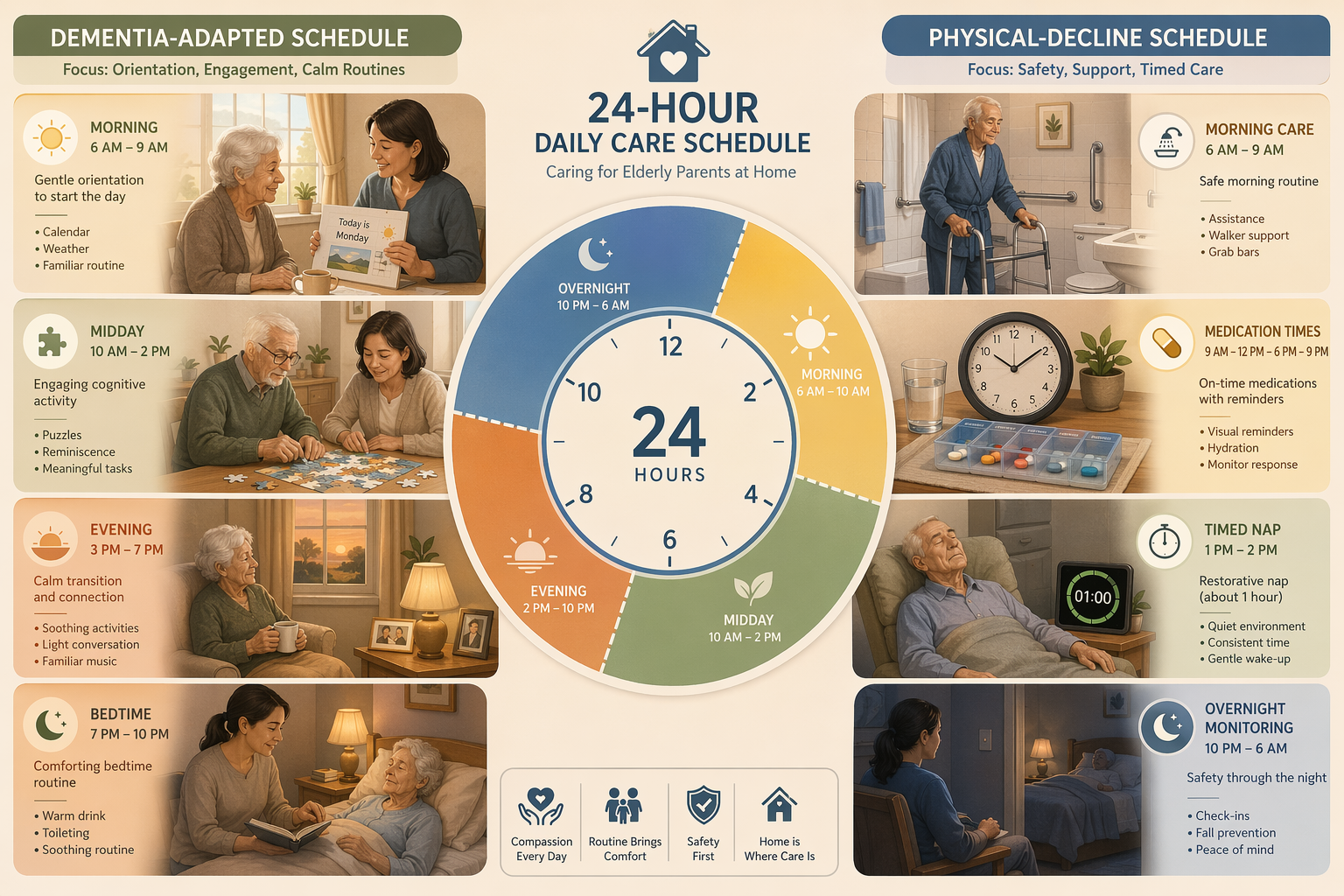
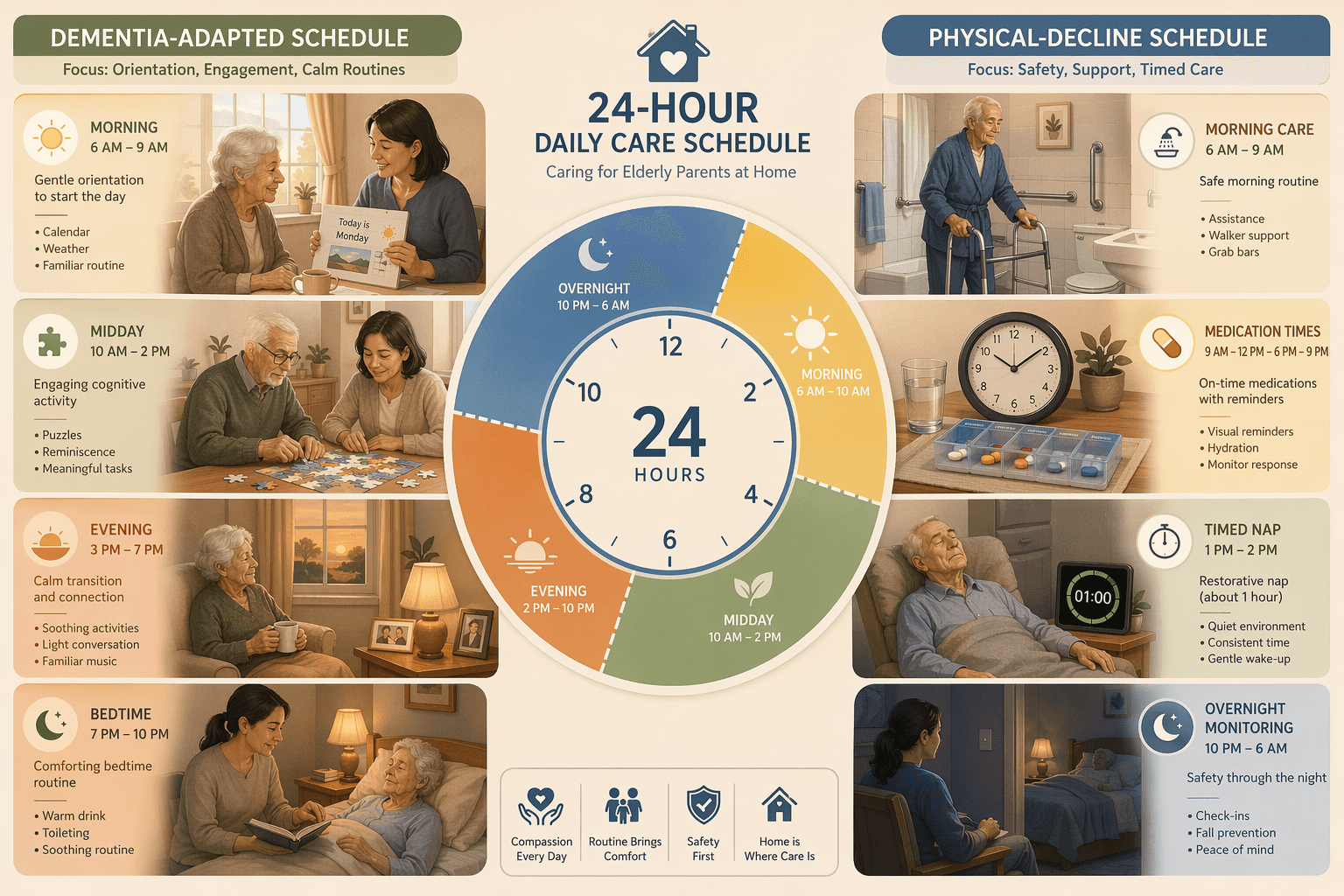
A 24-hour visual comparison of dementia-adapted and physical-decline daily schedules, with color-coded time bands for morning, midday, evening, and overnight periods.
Why an Hourly Schedule Matters More Than a Framework
If you are caring for a parent at home, you already know that the days blur together. You wake up, react to whatever needs attention, and fall into bed exhausted — often realizing you forgot to give the afternoon medication or that your parent hasn't had a glass of water since breakfast. This is not a failure of effort. It is a failure of structure.
The numbers make the case for a different approach. According to the AARP and National Alliance for Caregiving's 2025 report, family caregivers spend an average of 27 hours per week on caregiving duties. A separate 2026 survey of 1,029 family caregivers conducted by A Place for Mom found that 67% of caregivers report trouble sleeping with some regularity, and 47% say their physical health has declined since they started caregiving. When you are operating without a schedule, you are not just inefficient — you are putting your own health at risk alongside your parent's.
A structured, time-banded daily schedule does three things that a general framework cannot. First, it eliminates the micro-decisions that drain your mental energy throughout the day — what to do next, whether to push a task to tomorrow, whether you have time for a walk. Second, it creates predictable windows for critical care tasks like medication administration, repositioning, and wound care that are easy to forget in a reactive routine. Third, it builds in protected off-duty time for you, which directly addresses the burnout that 42% of caregivers report experiencing at least weekly.
Before You Build: Assess Your Parent's Condition and Your Own Time Pockets
The most common mistake new caregivers make is adopting a schedule designed for a condition their parent does not have. A parent with moderate Alzheimer's disease needs a fundamentally different daily rhythm than a parent recovering from a hip replacement, even though both may need help with bathing and meals. Before you implement any of the templates below, take 30 minutes to assess two things: your parent's primary condition type and your own available time.
Identify the Primary Challenge
Most older adults needing daily care fall into one of three categories. Some have a clear primary condition; others have a mix. The schedule you choose should be driven by the dominant challenge.
Three common condition profiles and how they shape the daily schedule.

Comments
Join the discussion with an anonymous comment.