
Caregiver decision guide
Beyond the Binary Choice: The Layered Home Intervention Path to Senior Care
Most families see senior care as a choice between staying home or moving to a facility. This guide presents a third path: a cumulative, layered approach combining home modifications, fall prevention systems, monitoring technology, and part-time in-home care. Learn how each layer extends safe home living and why the combined cost is less than 4–6 months of facility care.
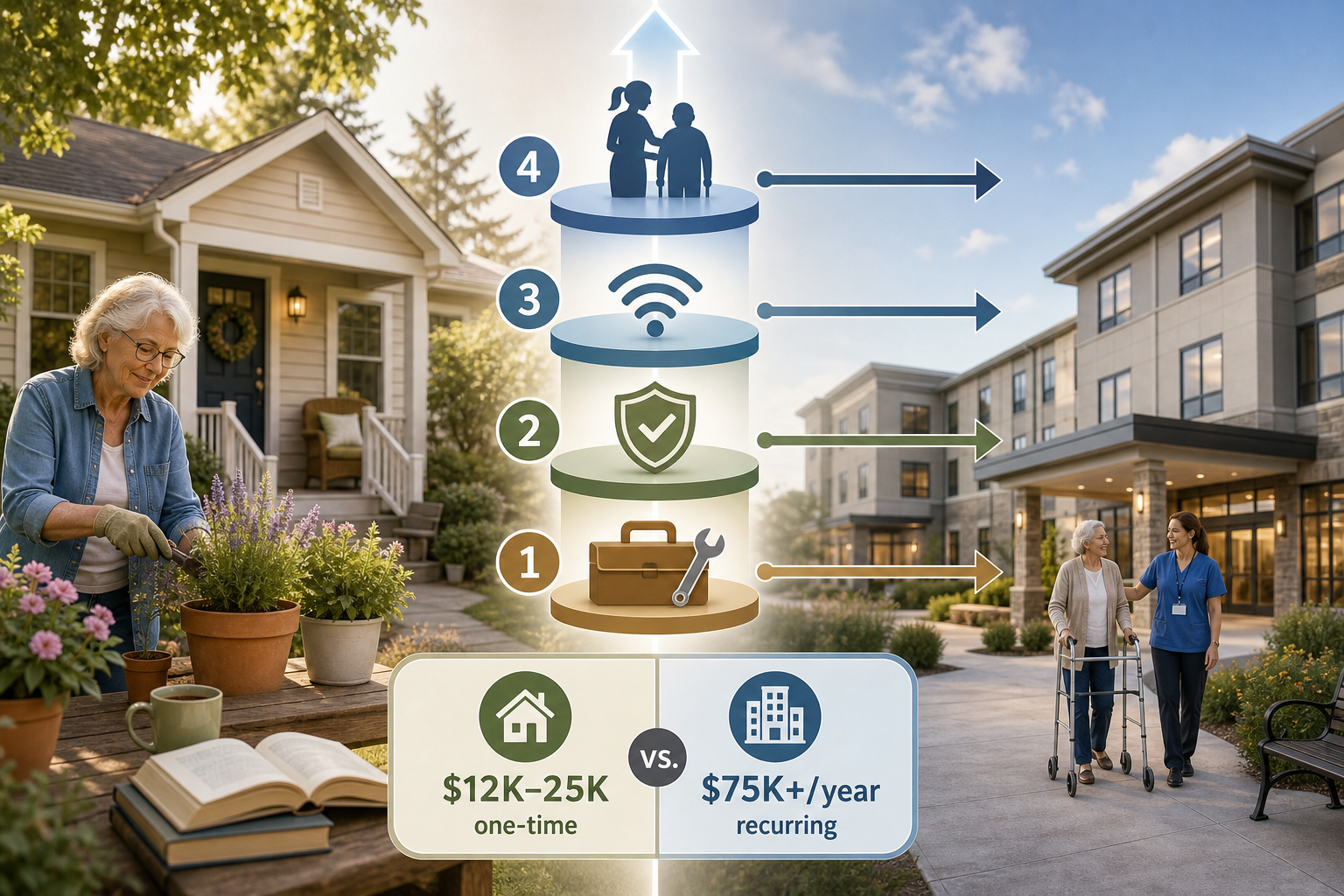
The Binary Choice Trap: Why 'Stay Home or Move' Is a False Dilemma
When a parent falls, receives a dementia diagnosis, or suddenly cannot manage daily tasks, families typically collapse into two options: keep things as they are and hope for the best, or start touring assisted living facilities. Both feel like dead ends. The first feels risky. The second feels premature and financially crushing.
There is a third path, and it is neither a compromise nor a half-measure. It is a coordinated, sequential investment in four layers of home-based intervention: structural home modifications, fall prevention systems, monitoring technology, and part-time in-home care. Each layer extends the period a person can live safely at home, and together they form a cumulative system that, for many families, can delay or entirely avoid facility placement for months or years.
The financial case is striking. The total one-time cost of the first three layers — the structural and technological foundation — falls between $12,000 and $25,000. The national median cost of assisted living in 2026 is $6,313 per month, or $75,756 per year. That means the entire layered investment costs less than four months of facility care. After that break-even point, every month of safe home living is a net financial gain for the family.
Layer 1: Home Modifications — The Structural Foundation
Home modifications are the bedrock of the layered approach. Without a physically safe environment, every other intervention — monitoring devices, alert systems, even paid caregivers — operates at a disadvantage. The goal of this layer is to eliminate the structural hazards that make independent living dangerous.
The scope of the problem is enormous. According to U.S. Census Bureau data cited in a 2025 systematic review of 20 studies on home modifications, only 10% of U.S. homes are adequately designed for an aging population. That means 90% of homes need at least some modification before they can safely support an older adult living independently. Despite this, only 18% of adults over 50 have made any home modifications, according to AARP data cited by Choice Mutual.
The modifications that matter most fall into a clear cost hierarchy:
- Low-cost upgrades ($25–$500): Grab bar installation ($200–$600 per bar), lever-style door handles, improved lighting, non-slip flooring in bathrooms.
- Mid-range projects ($1,000–$10,000): Walk-in shower or tub-to-shower conversion ($3,000–$15,000), comfort-height toilets ($300–$1,200), stair lifts ($2,500–$8,000).
- High-cost structural changes ($10,000–$50,000+): Doorway widening for wheelchair access, bathroom reconfiguration, whole-home accessible remodeling.
The evidence that these investments pay off is strong. A 2019 study by Carnemolla and Bridge, published in the journal HERD and included in the 2025 systematic review, found that weekly caregiving hours decreased by 42% after home modifications were completed. That is not a marginal improvement — it is the difference between a family caregiver being overwhelmed and being able to manage.
For a detailed breakdown of specific costs by room and project type, see our complete home modification cost guide.
Layer 2: Fall Prevention Systems — The Safety Net
Once the home's structure is safe, the second layer adds active and passive systems that prevent falls and ensure help arrives quickly when one occurs. Falls are the single greatest threat to aging in place. The CDC reports that 235,000 Americans over 65 visit emergency rooms each year for bathroom-related falls alone.
This layer combines two complementary approaches: environmental hazard removal and emergency response systems.
The evidence for environmental intervention is robust. A 2017 randomized controlled trial by Stark et al., included in the 2025 systematic review, found that home hazard removal reduced falls by 39% in the intervention group. A larger population-level study by Hollinghurst et al. (2022), which analyzed data from 657,536 older adults in Wales, found that home adaptations reduced the odds of a fall-related emergency admission by 3% per quarter after the intervention.
On the response side, medical alert systems — also called personal emergency response systems (PERS) — provide 24/7 access to help at a cost of $20 to $60 per month in 2026, according to SeniorLiving.org data. Home-based systems typically run $25–$35 per month, while mobile systems with GPS cost $10–$20 more. For a family already worried about a parent living alone, this is a low-cost insurance policy.
| Fall Prevention Component | Typical Cost | Key Evidence |
|---|---|---|
| Home hazard removal (professional assessment) | $200–$500 | 39% fall reduction (Stark et al., 2017 RCT) |
| Medical alert system (home-based) | $25–$35/month | 24/7 emergency response access |
| Medical alert system (mobile/GPS) | $35–$60/month | Coverage outside the home |
| Passive motion sensors (PIR) | $50–$150 per sensor | Early warning for unusual activity patterns |
For a complete framework that integrates fall prevention with home modifications and community services, see our three-layer fall prevention system guide.
Layer 3: Monitoring Technology — The Watchful Eye
The third layer adds continuous, unobtrusive monitoring that gives family caregivers something they desperately need: the ability to know that things are okay without having to call or visit every few hours. Modern monitoring technology has moved far beyond the emergency button. A 2022 scoping review of 30 studies, published in PMC, identified six distinct functions that in-home monitoring systems can perform:
- Daily activities monitoring — tracking movement patterns through the home
- Abnormal behavior detection — identifying deviations from established routines
- Cognitive impairment monitoring — detecting patterns that suggest confusion or memory issues
- Fall detection — automatic identification of fall events
- Indoor person positioning — knowing which room the person is in
- Sleep quality monitoring — tracking rest patterns
The primary sensor types used in these systems are passive infrared (PIR) motion sensors and contact sensors (placed on doors, cabinets, and refrigerators). Bed occupancy monitors add another layer of safety for nighttime wandering or falls. A basic system can start at around $200 in upfront equipment costs, while a comprehensive smart-home installation can exceed $2,500. Monthly monitoring fees typically range from $20 to $60.
| Monitoring Function | Sensor Type | What It Detects | Typical Cost Range |
|---|---|---|---|
| Daily activity | PIR motion sensors | Movement patterns, room transitions | $50–$150 per sensor |
| Abnormal behavior | PIR + contact sensors | Unusual inactivity, missed meals | $100–$300 per zone |
| Fall detection | Wearable or PIR array | Sudden impact or lack of motion | $200–$500 (wearable) |
| Sleep monitoring | Bed occupancy sensor | Time in bed, restlessness | $100–$250 |
| Door/window status | Contact sensors | Wandering, unexpected exits | $30–$80 per sensor |
For a detailed guide on selecting the right system for your situation, see our monitoring system decision guide. For a deeper analysis of how monitoring technology can reduce overall care costs, see our cost-benefit framework for monitoring.
Layer 4: Part-Time In-Home Care — The Human Element
The fourth layer introduces paid, part-time in-home care. This is deliberately the last layer because its effectiveness is multiplied by everything that comes before it. A caregiver who arrives at a home that is already structurally safe, equipped with fall prevention systems, and monitored by sensors can focus their time on what matters: companionship, medication reminders, meal preparation, and personal care — not hazard management.
The cost of part-time home care in 2026 is well documented. According to A Place for Mom data, the national median rate for private nonmedical home care is $34 per hour. At different weekly commitment levels, the monthly costs break down as follows:
| Weekly Hours | Monthly Cost (2026) | Typical Use Case |
|---|---|---|
| 7 hours/week | $1,031/month | Companionship, light housekeeping, medication check-ins |
| 15 hours/week | $2,208/month | Daily meal prep, bathing assistance, transportation to appointments |
| 30 hours/week | $4,416/month | Half-day coverage, significant ADL assistance, fall risk supervision |
| 44 hours/week | $6,478/month | Near full-time coverage, extensive personal care needs |
A 2026 analysis by U.S. News found that home care is cheaper than assisted living as long as the senior requires fewer than 40 hours of care per week. At 40 hours per week ($6,062/month at $35/hour), the cost approaches the assisted living median of $6,313/month. Below that threshold, home care is the clear financial winner.
The Cost-Benefit Calculation: Why the Combined Investment Beats Facility Placement
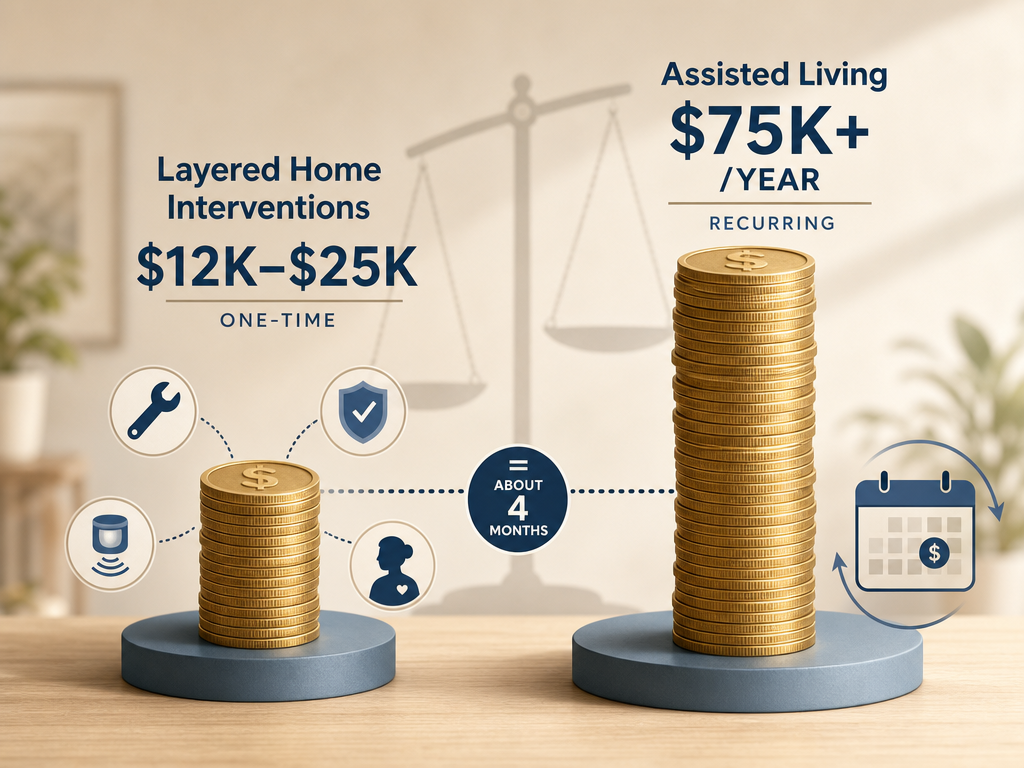
The central financial argument of the layered approach is straightforward: the combined one-time cost of Layers 1 through 3 — home modifications, fall prevention systems, and monitoring technology — is $12,000 to $25,000. Layer 4 (part-time home care) adds an ongoing monthly cost that, for most families, is significantly less than assisted living.
| Cost Category | Amount | Notes |
|---|---|---|
| Layers 1–3 (one-time investment) | $12,000–$25,000 | Modifications, fall prevention, monitoring tech |
| Layer 4 (monthly, 15 hrs/week) | $2,208/month | Part-time in-home care at $34/hr national median |
| Assisted living (monthly) | $6,313/month | National median, 2026 (SeniorLiving.org) |
| Assisted living (annual) | $75,756/year | National median, 2026 |
| Break-even point | 2–4 months | Time until layered investment pays for itself vs. facility |
Consider a concrete example. A family invests $18,000 in home modifications, fall prevention systems, and monitoring technology. They then add 15 hours per week of in-home care at $2,208 per month. Their total first-year cost is $18,000 + ($2,208 × 12) = $44,496. The cost of one year of assisted living at the national median is $75,756. The layered approach saves $31,260 in the first year alone — and every subsequent year saves $53,748 compared to facility placement.
For a deeper comparison of remodeling costs versus assisted living, see our complete decision guide on aging in place remodel cost vs. assisted living.
The Intervention Ceiling: When Home-Based Options Reach Their Limit
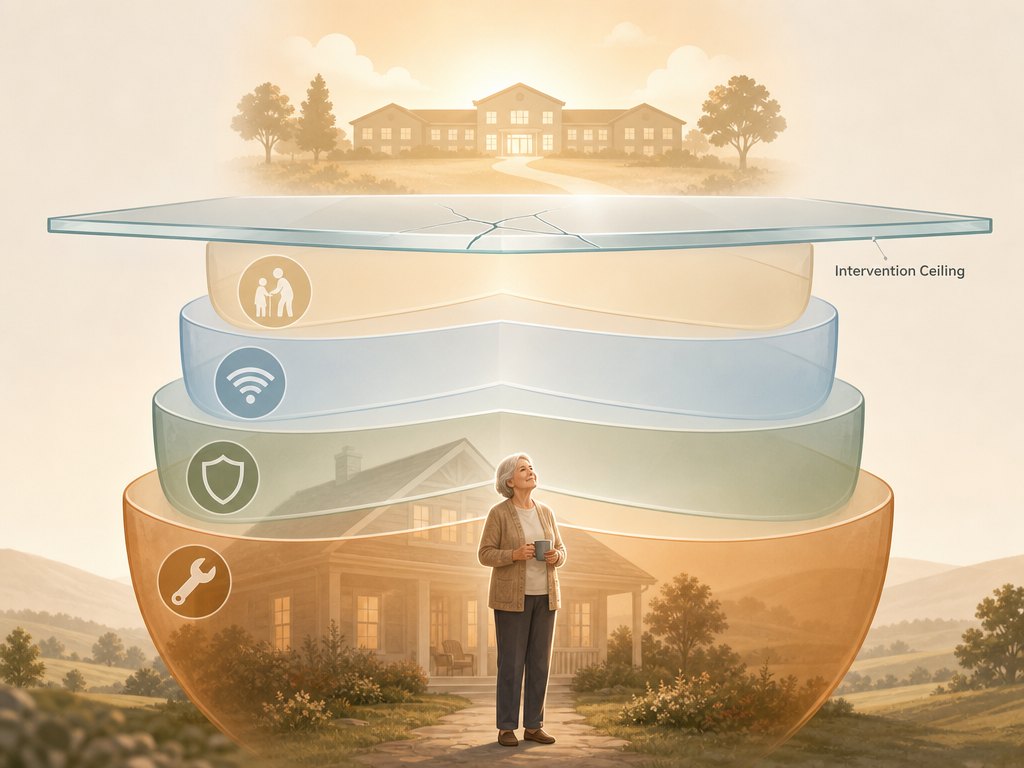
The layered approach is powerful, but it is not infinite. Every home-based intervention has a ceiling — a point at which even the best combination of modifications, fall prevention, monitoring, and part-time care cannot safely support the senior at home. Recognizing this ceiling is not a failure of the approach; it is a sign that the approach has been used to its fullest extent.
The intervention ceiling is typically reached when the senior's needs cross one or more of these thresholds:
- 24/7 skilled nursing needs: Wound care, IV medications, or complex medical management that exceeds what home health aides can provide.
- Severe mobility limitations: The senior requires two-person transfers or cannot be safely moved even with assistive equipment.
- Advanced dementia behaviors: Wandering that cannot be contained by monitoring, aggression that puts caregivers at risk, or complete dependence on others for all activities of daily living.
- Caregiver burnout: The family caregiver's health is deteriorating, or the cost of 40+ hours per week of paid care exceeds the cost of facility placement.
- Home structure limitations: The home cannot be modified to accommodate the senior's needs (e.g., multi-story home where a stair lift is not feasible, or a home with narrow doorways that cannot be widened).
When the ceiling is reached, the layered approach has not failed — it has succeeded in delaying facility placement for as long as safely possible. The family now transitions with the confidence that they have exhausted every reasonable home-based option. For guidance on matching care needs to the appropriate level of facility care, see our senior care options by level of need decision framework.
Your Action Framework: A Phased Decision Tree for Layering Interventions
The layered approach is designed to be implemented incrementally. You do not need to do everything at once. Start with the layer that addresses your most urgent concern, then build from there. The following decision tree provides a phased path for families at different starting points.
| Phase | Action | Typical Timeline | Estimated Cost |
|---|---|---|---|
| Phase 1: Safety Audit | Conduct a room-by-room home safety assessment. Identify fall hazards, inadequate lighting, and missing grab bars. Prioritize bathroom and stair safety. | 1–2 weeks | $0–$500 (DIY or professional assessment) |
| Phase 2: Structural Fixes | Install grab bars in bathroom and shower. Add non-slip flooring. Install stair lifts if needed. Address doorway width and threshold issues. | 2–8 weeks | $2,000–$15,000 |
| Phase 3: Fall Prevention | Install medical alert system. Add PIR motion sensors in key areas. Place contact sensors on exterior doors. Set up bed occupancy monitor if nighttime wandering is a concern. | 1–3 weeks | $300–$1,000 upfront + $20–$60/month |
| Phase 4: Monitoring | Deploy passive monitoring system with daily activity tracking. Configure alerts for abnormal patterns. Set up family caregiver dashboard or notification system. | 1–2 weeks | $200–$2,500 upfront + $20–$60/month |
| Phase 5: Part-Time Care | Start with 7–15 hours per week of in-home care. Increase hours as needs grow. Use monitoring data to identify the most valuable times for caregiver presence. | Ongoing | $1,031–$2,208/month (7–15 hrs/week) |
| Phase 6: Reassessment | Every 3–6 months, reassess the senior's functional status and the adequacy of the current layers. Adjust hours, add sensors, or consider the intervention ceiling. | Quarterly | Varies |
Families can enter the framework at any phase. If your parent has already had a fall, start with Phase 2 and Phase 3 simultaneously. If you are a long-distance caregiver, Phase 4 (monitoring) may be your first priority. The framework is flexible by design — the goal is not to follow a rigid sequence but to build a comprehensive system over time.
The layered intervention path is not a guarantee that facility placement can be avoided forever. For many families, it will delay placement by months or years, not prevent it entirely. But even a delay of six to twelve months represents tens of thousands of dollars in savings and, more importantly, additional time for the senior to live in the home they know and prefer. Over 90% of older adults want to age in place, according to AARP data. The layered approach gives families a realistic, evidence-informed path to honor that preference for as long as it is safe to do so.
Questions to bring to a clinician or OT
This is not medical, legal, or a family's final decision — only a framework. Bring these questions to a clinician, occupational therapist, or your local Area Agency on Aging.
Find Local HelpRelated reading
Noticed something outdated or inaccurate on this page? Flag a correction. We review every report against CDC, NIA, and AARP HomeFit guidance before updating a page.