Choosing a Medication Dispenser for a Parent with Dementia
This guide helps you choose the right medication dispenser for a parent with dementia by matching device type to their disease stage, medication load, and your caregiving distance — preventing safety risks and wasted money.
By Editorial Team
new caregiver
experienced caregiver
long-distance caregiving
spousal caregiver
working caregiver
daily routines
medication management
personal hygiene
care coordination
first steps
ADLs
IADLs
If you are looking for a medication dispenser for an elderly parent with dementia, the safest answer is not a brand name. It is a match: your parent’s current thinking ability, the medication schedule in front of you, and how quickly another person can notice when something goes wrong.
The old weekly pillbox usually fails quietly. A dose is still sitting there at dinner. Two Tuesday morning compartments are empty. Your parent says, with complete confidence, that they already took the blue pill, but no one can tell whether that was today or yesterday. That is the point when a dispenser stops being a convenience item and becomes part of the care plan.
Medication adherence problems in people with dementia are not rare or simple. A systematic review found reported non-adherence ranging from 17% to 100%, depending on the population studied and how adherence was measured, which is a wide range but still a clear warning: the home routine can break down in many different ways.[1]
Start With Three Questions, Not a Feature List
Before comparing alarms, locks, apps, and subscription plans, answer these three questions as plainly as possible:
What stage is your parent in right now: still able to follow a cue, confused by timing, or unable to safely self-administer without supervision?
How complicated is the medication load: one or two daily times, several daily times, many pills, changing prescriptions, or medications that do not fit in a dispenser?
How close is the caregiver system: someone in the home, daily visits, several helpers, or a primary caregiver who lives across town or farther away?
Those questions matter because dementia changes the meaning of an alarm. In early impairment, a sound or flashing light may be enough to prompt the right action. Later, the same alarm may become background noise, a source of agitation, or a cue your parent can no longer interpret. At that point, the dispenser must do more than remind; it must prevent access to the wrong dose and alert someone else.
Device tier
Best fit
Main safety job
Caregiver assumption
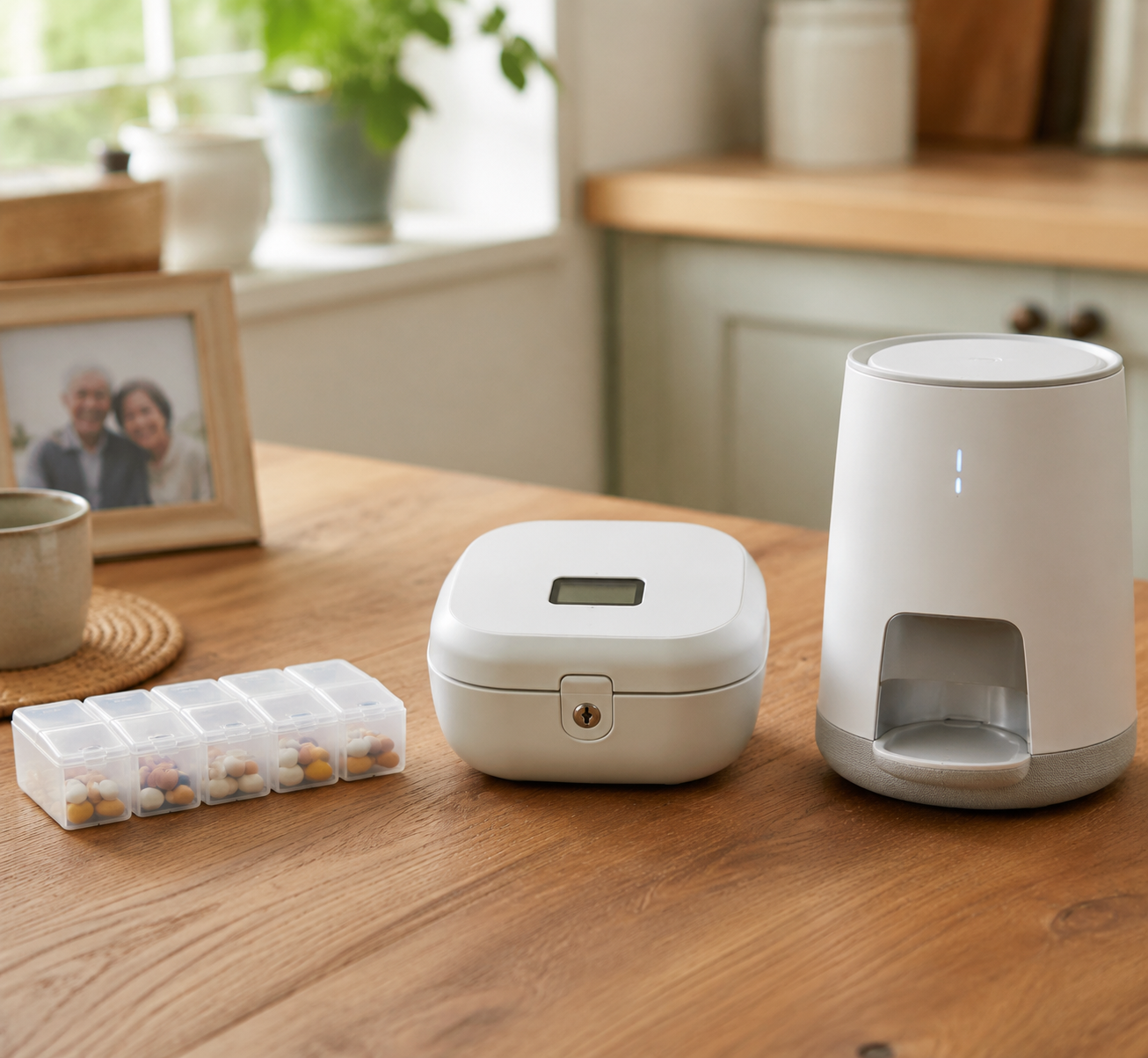
Alarm pill organizer
Early-stage dementia or mild cognitive impairment with a simple schedule
Reminds the person that it is time to take pills
Someone fills it correctly and checks it often
Locking timed dispenser
Moderate dementia, double-dosing risk, or several helpers involved
Releases only the scheduled dose and blocks access to the rest
Someone refills it and reviews missed or remaining doses in person
Smart dispenser with caregiver alerts
Advanced dementia, long-distance caregiving, or unreliable in-person checking
Combines timed dispensing with remote notification
Someone receives alerts and can act on them
Tier 1: Alarm Pill Organizer
An alarm pill organizer fits a narrow but real situation: your parent is in an early stage, still understands the purpose of the pills, and mainly needs a nudge at predictable times. It may be enough when the schedule is simple, the caregiver is in the home or visits daily, and no one has seen evidence of extra dosing.
The strength of this tier is simplicity. There is less to program, less to explain, and often less resistance from a parent who dislikes being monitored. For a parent who can still respond appropriately to a beep and open the correct compartment, that simplicity can be respectful and practical.
The weakness is also obvious: most alarm organizers do not stop your parent from opening the wrong compartment, taking tomorrow’s dose, or taking a second dose because they forgot the first one. They also do not tell you from work, or from another city, whether the dose was actually taken.
This tier starts to fail when the problem shifts from forgetfulness to unsafe access. If you are finding empty compartments ahead of schedule, hearing repeated arguments about whether a dose was taken, or relying on several family members who each assume someone else checked the box, an alarm organizer is probably below the risk level.
Tier 2: Locking Timed Dispenser
A locking timed dispenser is the middle tier many families should look at sooner than they do. It releases the scheduled dose at the scheduled time and keeps the remaining doses inaccessible. That one function addresses a failure that ordinary pillboxes cannot: the parent who may take the right medication at the wrong time, or take it again because the first dose has vanished from memory.
The need for capacity is not theoretical. In one study of people with Alzheimer’s disease or other dementias, 82% were taking five or more drugs, with an average of 7.7 drugs per patient.[2] A dispenser that looks neat online but cannot comfortably hold the real number of tablets, doses, and dosing times will become another workaround in the kitchen.
This is where families should inspect the refill workflow, not just the advertised capacity. Who fills the device? Can that person tell morning tablets from evening tablets without rushing? Does the tray support the number of dosing times your parent actually has? If a pharmacy changes a dose next month, who updates the dispenser before the next fill?
Locking also matters because home medication errors are often made by loving, attentive people under pressure. AHRQ PSNet reports that more than half of informal caregivers in one study reported making at least one medication error, with a self-reported average of 13.5 medication errors per caregiver per year.[3] That number should not be read as a moral failure. It is what happens when complex medication work is pushed into homes without pharmacy counters, barcode scanners, or shift handoffs.
A locking timed dispenser does not solve every error. It will not know that a blood pressure pill was discontinued unless someone changes the setup. It will not manage a medication that must be held for dizziness unless the caregiver has a plan. It will not prevent a refill mistake if the wrong pills are loaded. What it can do well is reduce unsupervised access to future doses.
Move up to this tier when the next likely mistake is double-dosing, dose-shopping from the box, or confusion among multiple helpers. Stay away from this tier as a stand-alone solution if no one can reliably fill it, check it, and respond when doses remain in the tray.
Tier 3: Smart Dispenser With Caregiver Alerts
A smart dispenser adds remote visibility. Depending on the model, it may notify a caregiver when a dose is dispensed, missed, delayed, or when the device needs attention. For a caregiver who lives separately, that change can be the difference between vague dread and a specific task: call now, visit tonight, ask the neighbor to check, or message the home aide.
This tier is most useful when in-person checking is not dependable enough for the risk. A parent may still live alone, but the medication routine no longer deserves to be invisible for twelve or twenty-four hours. Or a caregiver may be at work during morning doses and cannot keep stepping out to ask, “Did you take your pills?”
The alert is only as good as the response plan behind it. If a missed-dose message goes to three siblings and everyone assumes someone else handled it, the device has merely documented the gap. Choose one primary responder, one backup, and a rule for what happens after a missed dose. That rule should come from the prescribing clinician or pharmacist when timing matters.
The evidence for automatic dispensers is encouraging, but it should be kept in proportion. Four published case studies of people with Alzheimer’s disease who used automatic medication dispensers reported maintained adherence over 3 to 4.5 years, but those cases included continued caregiver support.[4] Another source summarizing an electronic dispenser study reported that 84% of nearly 100 participants said they would use an electronic dispenser again.[5] Those findings support the usefulness of dispensers in selected situations; they do not mean a device can replace supervision.
A smart dispenser may be too much if your parent becomes distressed by machines, cannot tolerate the sound, tries to defeat the lock, or has no caregiver who will monitor alerts. Technology can remove a failure point, but it can also create a new one if no one maintains the device, keeps it charged or connected, and updates it after medication changes.
Test the Choice Against the Actual Medication List
Before buying anything, put the current medication list beside the device requirements. Include prescriptions, over-the-counter drugs, supplements, eye drops, creams, inhalers, and anything taken only when needed. Families often shop from memory and discover too late that the dispenser only covers part of the routine.
Count dosing times, not just pill bottles. A seven-pill routine taken once daily is different from seven medications spread across breakfast, lunch, dinner, and bedtime.
Check compartment size with the largest real dose in mind. Large tablets, multiple capsules, and blister-pack conversions can change the fit.
Identify medications that should not be preloaded without clinician guidance, especially those that change based on symptoms or measurements.
Decide who updates the dispenser when a prescription is started, stopped, held, or changed.
The refill day is the hidden workload. A dispenser that takes forty careful minutes to fill may still be the right choice, but only if that time exists in someone’s week. If two people alternate refills, use one written medication list and one clear method for documenting changes. Memory is not a safe handoff system.
When the Dispenser Is the Wrong Tool
Some medication problems need hands, eyes, and clinical judgment, not a better box. A dispenser can organize scheduled solid pills. It cannot safely manage every medication routine in dementia care.
Frequent regimen changes: If medications are being adjusted every few days or weeks, the risk of loading yesterday’s plan into today’s dispenser rises.
As-needed medications: Pain pills, anxiety medications, sleep aids, and other PRN drugs often require judgment about symptoms, timing, and safety.
Liquids, injectables, drops, inhalers, and patches: These may need separate storage, reminders, or direct administration.
Swallowing problems or refusal: If your parent pockets pills, spits them out, forgets what to do with them, or becomes suspicious, dispensing is not the same as administration.
Unsafe living situation: Missed medications may be one sign that meals, hydration, stove use, wandering risk, or nighttime safety also need reassessment.
In these situations, ask the prescriber, pharmacist, home health nurse, or care manager to review the whole medication process. The answer may be medication simplification, pharmacy packaging, scheduled caregiver administration, home health involvement, or a higher level of daily support.
Cost and Coverage: Useful, but Not the First Decision
Cost matters, especially when dementia care already brings new expenses. As of AARP’s 2025 medication management guidance, standalone dispensers commonly range from $80 to $300, while subscription models with caregiver alerts may add about $30 to $45 per month.[6] Prices and subscription terms change, so treat those numbers as a planning range rather than a quote.
A cheaper dispenser is not cheaper if it allows the error you were trying to prevent. A more expensive one is not safer if no one can fill it correctly or answer the alerts. Cost should narrow the choices within the right tier, not push the family into the wrong tier.
Coverage is also uneven. Medicare generally should not be assumed to cover a medication dispenser as a household device, and connected systems that may fall under Remote Therapeutic Monitoring through Part B require clinical involvement and plan-specific verification.[6] Before relying on reimbursement, ask the prescribing office, the device vendor, and the insurance plan what is covered, who bills, what documentation is required, and whether monthly monitoring fees are included.
A Practical Way to Choose
If your parent still follows prompts, takes medications once or twice a day, and someone checks the organizer daily, start with an alarm pill organizer. Do not use it to manage double-dosing risk.
If your parent opens compartments early, forgets that a dose was already taken, or has several helpers whose coordination is imperfect, choose a locking timed dispenser. Its main job is to control access to future doses.
If you cannot see the dispenser often enough to know what happened, or if a missed dose needs a same-day response, choose a smart dispenser with caregiver alerts. Buy the alert system only if someone is clearly responsible for acting on it.
Choose the simplest dispenser that reliably prevents the next likely medication error. Do not buy below your parent’s dementia stage, and do not buy above the caregiver system’s ability to maintain it. The right device is the one that fits the person hearing the alarm, the medications in the tray, and the caregiver who will know when something has gone wrong.


Comments
Join the discussion with an anonymous comment.