Senior Care .com Websites Compared: Care.com vs. Caring.com vs. SeniorCare.com vs. A Place for Mom
For: adult childStage: early independence15 minutesReviewed: 2026-06-20
Senior Care .com Websites Compared: Care.com vs. Caring.com vs. SeniorCare.com vs. A Place for Mom
Confused by the many senior care websites with similar names? This guide compares Care.com, Caring.com, SeniorCare.com, and A Place for Mom side-by-side, explaining their different business models, costs, and which one is right for your family's specific situation.
By Editorial Team
new caregiver
care coordination
first steps
home care
senior living
Why Four Senior Care Websites Look the Same but Work Differently
You type "senior care" into a search bar, and within seconds you are staring at four nearly identical-looking websites: Care.com, Caring.com, SeniorCare.com, and A Place for Mom. Each promises to help you find care for an aging parent. Each has a clean interface and reassuring language. And each, you quickly realize, operates on a completely different business model — which means choosing the wrong one can cost you hours of wasted effort, unwanted phone calls, or money you did not need to spend.
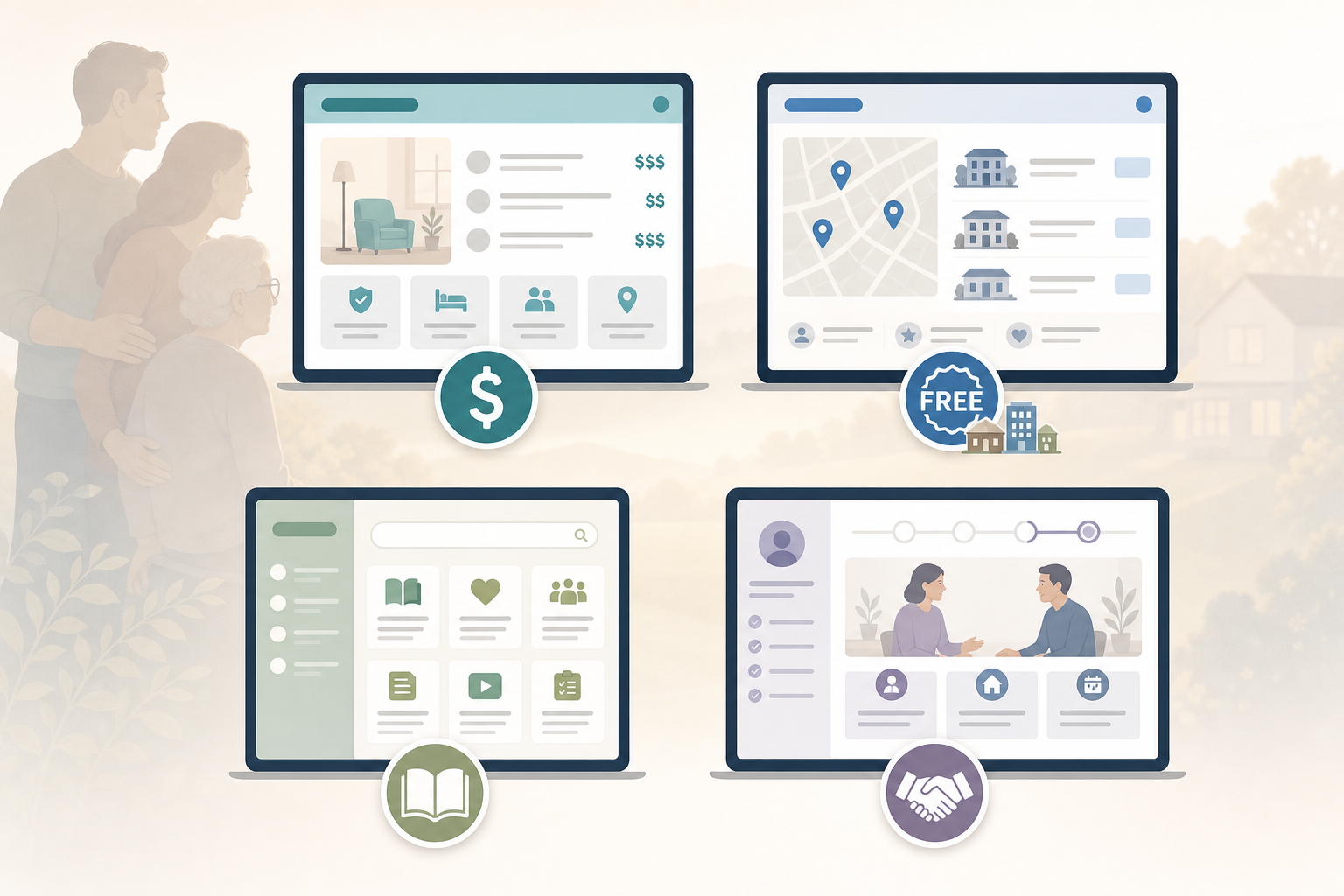
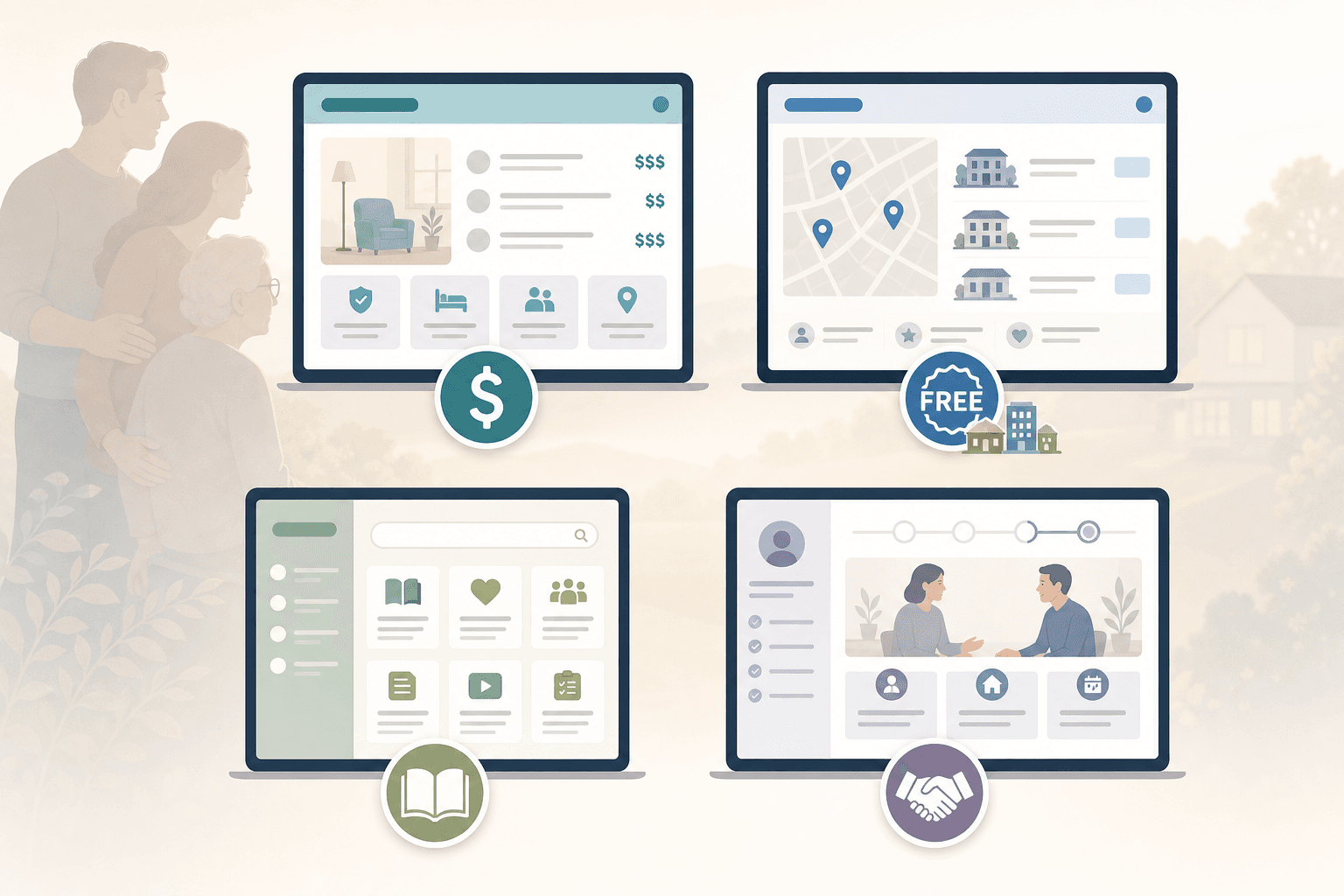
The core difference is simple: one is a paid marketplace where you hire individual caregivers directly. Another is a free referral directory that connects you to senior living communities and home care agencies. A third functions primarily as a resource library and provider listing hub. The fourth is a personalized placement service with dedicated advisors, funded by the communities it recommends. Understanding which is which — and which fits your specific situation — is the difference between finding help quickly and spinning your wheels.
Four platforms, four fundamentally different business models — knowing which is which saves time and money.
Quick-Reference Comparison: Care.com vs. Caring.com vs. SeniorCare.com vs. A Place for Mom
The table below distills the key differences at a glance. Use it as your starting point to identify which platform matches your primary need, then read the detailed sections that follow for the full picture.
Side-by-side comparison of the four major senior care websites.
Platform
Platform Type
Cost to Families
Primary Service
Revenue Model
Geographic Coverage
Care.com
Paid marketplace
$10.99–$38.99/month membership
Hire individual caregivers directly for in-home care
Membership fees from families; caregivers set own rates
21 countries, including U.S.
Caring.com
Free referral directory
Free to families
Connect families with senior living communities and home care agencies
Referral fees from providers when a placement occurs
Primarily U.S.
SeniorCare.com
Resource directory and provider listings
Free to families
Directory of Medicare-certified and non-medical providers; educational articles
Likely provider listing fees and advertising
U.S.
A Place for Mom
Personalized placement service
Free to families
Dedicated advisor matches families with senior living communities and care providers
Referral fees from communities when a placement occurs (pay-to-play)
U.S. and Canada
Care.com: The Paid Marketplace for Hiring Individual Caregivers
Care.com operates as a two-sided marketplace. Families pay a membership fee to access caregiver profiles and contact candidates. Caregivers — who may be certified nursing assistants, home health aides, or experienced individuals without formal credentials — set their own hourly rates. In 2026, those rates typically range from $17 to $50 per hour depending on location, experience, and the level of care required. Many experienced caregivers charge between $20 and $35 per hour.
Membership costs vary by subscription length. The annual plan works out to approximately $10.99 per month, the quarterly plan is about $25.99 per month, and the month-to-month option runs $38.99 to $39.99 per month. You must maintain an active membership to message caregivers and view their full contact information.
Care.com is best suited for families who want to hire a caregiver directly — often at a lower cost than going through an agency — and are comfortable managing the hiring process themselves. The platform handles an initial background check (Social Security number trace, national sex offender registry search, multi-jurisdictional criminal database check, and federal and county records), but it does not provide the same level of vetting, training, or backup coverage that a licensed home care agency would.
Caring.com: The Free Referral Directory for Senior Living and Home Care
Caring.com takes a fundamentally different approach. It is free for families to use. The site generates revenue by charging referral fees to senior living communities and home care providers when a family they refer becomes a client. With over 375,000 user reviews and a library of educational articles, it functions as a comprehensive research tool for families exploring their options.
The trade-off is that you are not just browsing a directory — you are entering a referral system. When you submit your information, Caring.com shares it with multiple partner providers in your area. Many users report receiving persistent follow-up calls and emails from both Caring.com and the facilities they are matched with, sometimes for weeks after they have made a decision.
Caring.com is a good fit for families who are early in their research and want to see a broad range of options — both senior living communities and in-home care agencies — without paying anything upfront. Its mobile app is a convenience that A Place for Mom does not currently offer. Just be prepared to manage the follow-up communications proactively.
SeniorCare.com: The Resource Directory and Provider Listings Hub
SeniorCare.com occupies a different niche entirely. Rather than operating as a marketplace or a referral engine, it functions primarily as a resource directory and provider listing hub. It catalogs Medicare-certified home health agencies, non-medical home care providers, assisted living facilities, and other senior services, alongside educational articles and guides.
SeniorCare.com is best understood as a research tool rather than a hiring or placement platform. You can use it to identify providers in your area, read about different care types, and gather names to investigate further. It does not match you with a dedicated advisor (as A Place for Mom does) or let you hire a caregiver directly (as Care.com does). Its value lies in the breadth of its listings and the educational context it provides.
A Place for Mom: The Personalized Placement Service with Dedicated Advisors
A Place for Mom is the most hands-on option of the four. Founded in 2000, it is one of the largest senior care referral services in North America. Like Caring.com, it is free for families — the company is compensated by senior living communities and care providers when a referral results in a placement. What sets it apart is the dedicated advisor model: a single person works with your family throughout the process, learning your parent's needs, preferences, and budget, then curating a list of matching communities.
This personalized support is invaluable for families who feel overwhelmed by the sheer number of options. Your advisor handles the legwork of checking availability, scheduling tours, and answering questions. However, the pay-to-play model means the recommended list is limited to communities that have a paid relationship with A Place for Mom. You may not see every option in your area, and the advisor's recommendations are naturally skewed toward partner communities.
Which Platform Should You Use? A Decision Framework Based on Your Situation
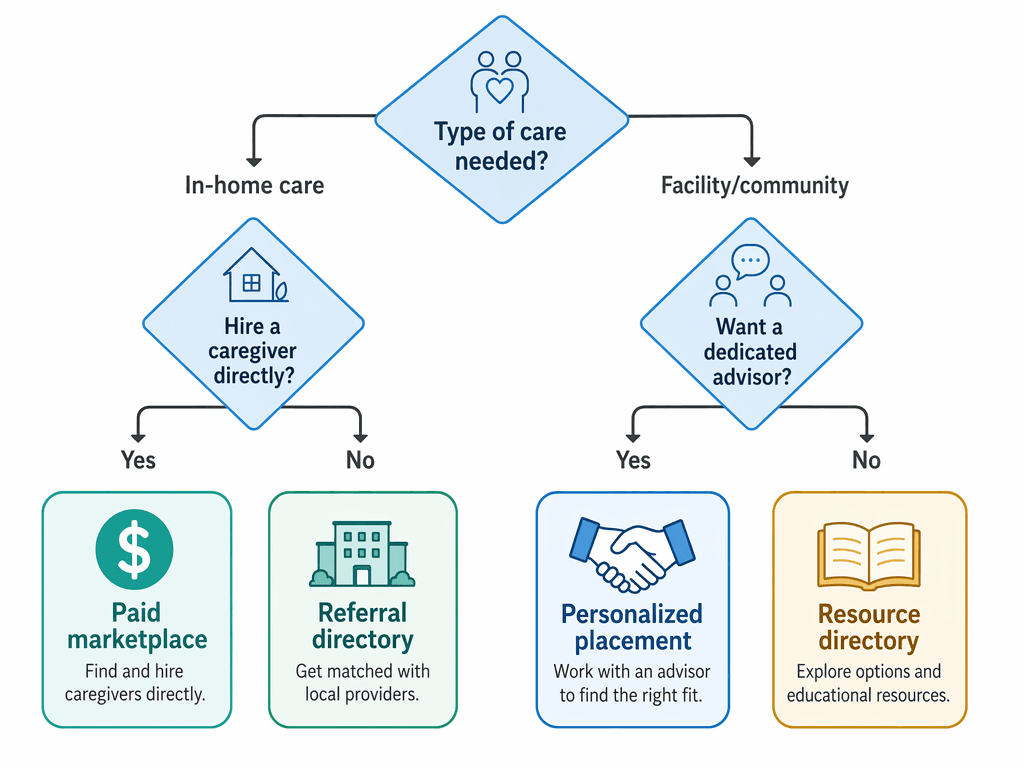
The right platform depends on three factors: the type of care you need, your budget, and how much hand-holding you want. The decision tree below maps the most common scenarios to the best starting point.
Decision flowchart matching your care situation to the right platform.
Scenario-by-Scenario Recommendations
You need in-home care and want to hire a caregiver directly: Start with Care.com. You will pay a monthly membership fee, but you can find caregivers at rates below what agencies charge. Be prepared to manage the hiring, scheduling, and tax responsibilities yourself.
You are exploring assisted living or memory care and want personalized guidance: Start with A Place for Mom. A dedicated advisor will narrow down options and schedule tours. Just remember that the list is limited to partner communities.
You are early in your research and want to see a wide range of options without paying anything: Start with Caring.com. Its extensive user reviews and educational content make it a strong research tool. Be ready for follow-up calls.
You want to browse provider listings and read educational articles without entering a referral system: Start with SeniorCare.com. Use it as a directory and research hub, then verify listings independently.
You need an agency for complex medical needs or dementia care: Skip the platforms and use our evidence-based framework for choosing a home care agency. Agencies typically charge 20-30% more than independent caregivers, but they handle vetting, training, scheduling, and backup coverage.
Red Flags, Hidden Costs, and What to Watch Out For
Each platform has trade-offs that are easy to miss when you are focused on finding help quickly. Here are the most important ones to keep in mind.
Care.com: Membership Fees and Background Check Limitations
The membership fee is an ongoing cost, not a one-time payment. If you do not find a suitable caregiver within a month or two, you may end up paying $40 or more before canceling. The background check, while useful, is not as comprehensive as what a licensed agency would conduct. It does not include fingerprinting, drug testing, or verification of professional references beyond what the caregiver provides. If you hire privately through Care.com, you are also responsible for payroll taxes, workers' compensation insurance, and complying with labor laws — responsibilities that an agency would handle for you.
Caring.com: Persistent Follow-Up Calls
The most consistent complaint about Caring.com is the volume of follow-up communications. Once you submit your information, it is shared with multiple partner providers, each of whom may contact you independently. Some users report receiving calls and emails for weeks after requesting that their information be removed. If you value a low-contact experience, consider using Caring.com's directory to research providers independently and contact them directly, rather than submitting your information through the referral form.
A Place for Mom: Referral Bias from the Pay-to-Play Model
A Place for Mom's advisors are knowledgeable and helpful, but they can only recommend communities that have a paid partnership with the company. This means the curated list you receive may exclude excellent facilities that simply choose not to pay for referrals. Always cross-reference your advisor's recommendations with independent research — check state inspection reports, read user reviews on multiple sites, and visit communities unannounced.
The Cost Reality: Independent Caregivers vs. Agencies
The national median cost for in-home care in 2026 is $35 to $36 per hour for a home health aide, with homemaker services averaging $33.99 per hour. These figures come from CareScout/Genworth data cited by SeniorLiving.org and The Senior List. Costs vary dramatically by state: from $23 per hour in Louisiana to $42 per hour in Washington. Agencies typically charge 20-30% more than independent caregivers to cover their overhead — vetting, training, insurance, and backup staffing.
For families considering hiring a private caregiver through Care.com for a loved one with dementia, the stakes are higher. The stage-of-disease decision framework for private caregiver vs. agency can help you weigh the trade-offs based on your parent's current needs and the progression of the disease.
Your Next Steps: A Practical Action Plan for Each Scenario
Where you start depends on where you are right now. Here is a quick action plan for the most common family situations.
Urgent Need: Post-Surgery Recovery or Sudden Decline
If you need care within days, do not start with a platform that requires weeks of research and interviews. Instead, read our crisis decision guide for short-term care. For immediate in-home help, a licensed home care agency can often have a caregiver in place within 24 to 48 hours. Once the crisis stabilizes, you can explore longer-term options through the platforms above.
Ongoing In-Home Care Needs
If you want to hire a caregiver directly and manage the relationship yourself: Start with Care.com. Use our step-by-step guide to navigate the hiring process. Budget for the membership fee and plan for payroll and tax responsibilities.
If you prefer the safety net of a licensed agency: Use our 8-step framework for choosing a home care agency. Agencies cost more but handle vetting, training, scheduling, and backup coverage.
Exploring Assisted Living or Memory Care
If you want personalized guidance: Start with A Place for Mom. Use their advisor to get a curated list, then independently verify each community through state inspection reports and independent reviews.
If you want to research broadly before talking to anyone: Start with Caring.com or SeniorCare.com. Browse listings and read reviews. Contact providers directly rather than submitting your information through the referral form to avoid follow-up calls.
Long-Term Planning (No Immediate Crisis)
Use all four platforms as research tools. Read the educational content on Caring.com and SeniorCare.com. Browse caregiver profiles on Care.com to understand local rates. Talk to an A Place for Mom advisor to learn about facility options — even if you are not ready to move. The more you know now, the faster you can act when the need becomes urgent.

Comments
Join the discussion with an anonymous comment.