Why Your Parent Resists Fall Prevention After the Hospital — and What Works Instead
This article explains why standard fall prevention education often fails after hospital discharge and provides evidence-based strategies caregivers can use — from understanding denial and fear to pre-emptive home modifications and when to involve an occupational therapist.
By Editorial Team
new caregiver
experienced caregiver
long-distance caregiving
spousal caregiver
working caregiver
daily routines
medication management
personal hygiene
care coordination
first steps
ADLs
IADLs
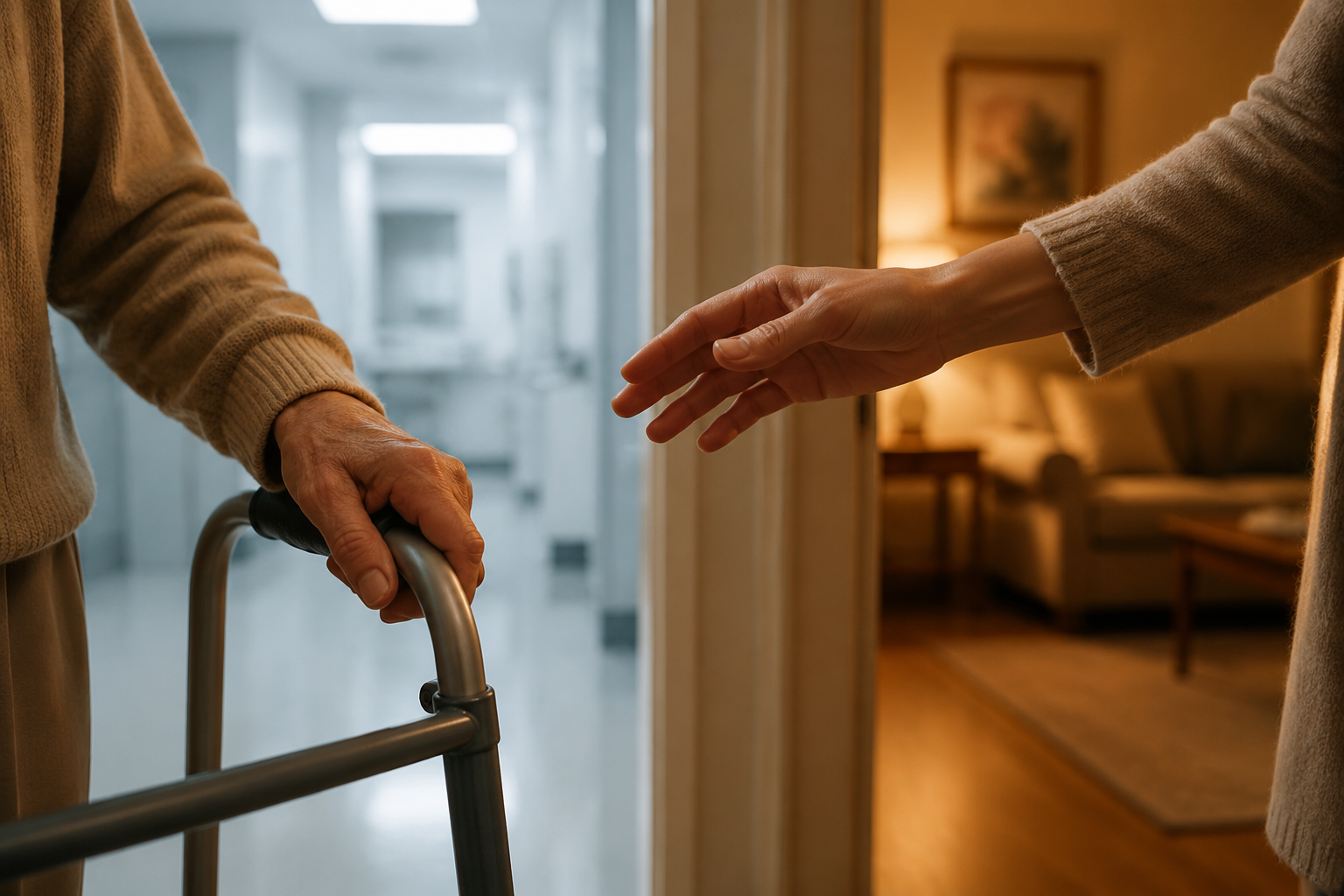
Your parent comes home from the hospital, lowers into the familiar chair, and announces that everyone has overreacted. The walker is “for old people.” The bathroom grab bar can wait. The rug by the bed has “never hurt anybody.” You are standing there with a folder of discharge papers, a medication list you are still trying to understand, and the awful knowledge that the next fall will probably happen when you are not in the room.
This is the hard part of post-hospital fall prevention at home: the instructions may be clear, but the person who needs to live with them may not accept the story those instructions tell. “High fall risk” can sound, to a parent, less like useful information and more like a demotion.
If you have already explained the danger and nothing changed, that does not mean you failed. One of the most useful studies for families is also one of the most sobering: in a randomized trial of older adults discharged from hospital, tailored fall prevention education did not reduce falls. The fall rate was 5.9 falls per 1,000 patient-days in both the education group and the control group. In the same study, 42.9% of participants fell within 6 months, 86.8% of falls happened at home, and 49.7% of falls caused injury.[1]
That finding matters because it takes some blame off the family. A pamphlet, a warning, or even a tailored conversation can be incomplete when the real problem is not information alone. The problem is timing, pride, fear, fatigue, medication changes, weak legs, a familiar house that is suddenly less forgiving, and a parent who is trying to remain the person they were before the ambulance, the surgery, the infection, or the bad spell.
Why “I’m Fine” Is Not Just Stubbornness
Families often hear denial as defiance. Sometimes it is. More often, it is a way to protect continuity. Your parent may not be refusing safety so much as refusing the sudden identity that comes with it: patient, risk, burden, person who needs equipment in the bathroom.
A 2020 scoping review of fall prevention after hospital discharge found that barriers were not only practical. Lack of motivation and self-denial of risk appeared as the most common barrier, cited in 47.1% of the studies reviewed. The same review identified family support as a key facilitator in 29.4% of studies, along with correcting inaccurate risk perceptions and reinforcing recommendations after discharge.[2]
That combination is familiar in real homes. The parent says, “I know my own house.” The daughter sees the loose mat, the narrow hallway, the new blood pressure pill, and the way her father now pushes off the table to stand. Both are looking at the same kitchen. They are not seeing the same risk.
Discharge instructions can also miss because they do not feel personal once the older adult is home. Shuman and colleagues reported that older adults may forget fall-related discharge instructions or experience them as generic rather than personally relevant.[3][4] That does not make the hospital conversation useless. It means the handoff is fragile. A tired person hears information in a medical setting, then has to apply it later in a bathroom, at 2 a.m., while trying not to wake anyone.
There is also the body that comes home from the hospital. Krumholz described “post-hospital syndrome” as a period of generalized vulnerability after hospitalization, often discussed around the first 30 days, shaped by factors such as deconditioning, sleep disruption, medication changes, poor nutrition, and psychological stress.[5] It is a useful model, not a diagnosis to put on your parent. It helps explain why someone who managed at home before admission may now be unsteady on the same route from bed to toilet.
Fear complicates the picture too. It can make a parent reject help because help feels humiliating, or it can make them move less, which may worsen weakness. In one study, older adults with pre-hospitalization anxiety were more likely to fall within 30 days of discharge, with an adjusted odds ratio of 1.89.[6] The practical takeaway is not to diagnose anxiety at the kitchen table. It is to notice that emotion is part of fall risk, not a side issue.
The First Week Deserves More Respect Than the Checklist Usually Gives It
The first days at home are not a gentle trial run. A 2025 cohort study, available through its PubMed abstract, reported the highest fall rate in the first 7 days after discharge, at 0.05 falls per 100 person-days; because the full methodology is not described in the abstract, that figure should be used cautiously, but it matches what many families see: the early period is when routines are unsettled and strength has not returned.[7]
This is why waiting for your parent to agree with every recommendation can be risky. Some decisions can respect autonomy and still happen before the first shower, the first middle-of-the-night bathroom trip, or the first attempt to carry coffee while using a walker. You do not need to turn the home into a facility. You do need to remove the hazards that ask too much of a tired body.
Timeframe
Caregiver focus
What this prevents
Before discharge or before arrival home, when feasible
Clear the walking path, set up lighting, place needed items at waist height, install the most obvious bathroom supports
The first unsafe trip through a familiar but unprepared space
First 24 to 72 hours
Watch transfers, bathroom trips, medication timing, dizziness, and whether the walker or cane is actually being used
A mismatch between the discharge plan and what the person can do when tired
First week
Adjust the bed-to-bathroom route, kitchen setup, footwear, seating height, and supervision plan
Repeated small losses of balance that everyone is tempted to minimize
After refusal, near-falls, or uncertainty
Bring in occupational therapy or another qualified professional for a home assessment
Guessing at modifications when the risk pattern is unclear
Change the Conversation Before You Change the House
A parent who refuses a walker may be hearing, “You are no longer competent.” A better opening is often narrower and more concrete: “The hospital stay took strength out of your legs. Let’s use the walker for the first week at night and when you first stand up. Then we can reassess.”
That phrasing does three useful things. It ties the change to a temporary recovery period rather than permanent decline. It names specific situations instead of making the whole person “high risk.” It also leaves room for review, which protects dignity better than a family decree.
Replace “You’re going to fall” with “The first week home is when your legs and medicines may surprise you.”
Replace “You need grab bars” with “This gives you something solid to use so you do not have to call me every time.”
Replace “The hospital said so” with “Let’s test the route from the bed to the bathroom together and see where it feels awkward.”
Replace “You can’t shower alone” with “For the first few showers, let’s make sure the setup works before you do it privately.”
Correcting risk perception does not require shaming. In fact, shame usually makes the conversation worse. The goal is to make the risk visible enough that the older adult can cooperate without feeling erased.
Prepare the Places Where Pride Meets Physics
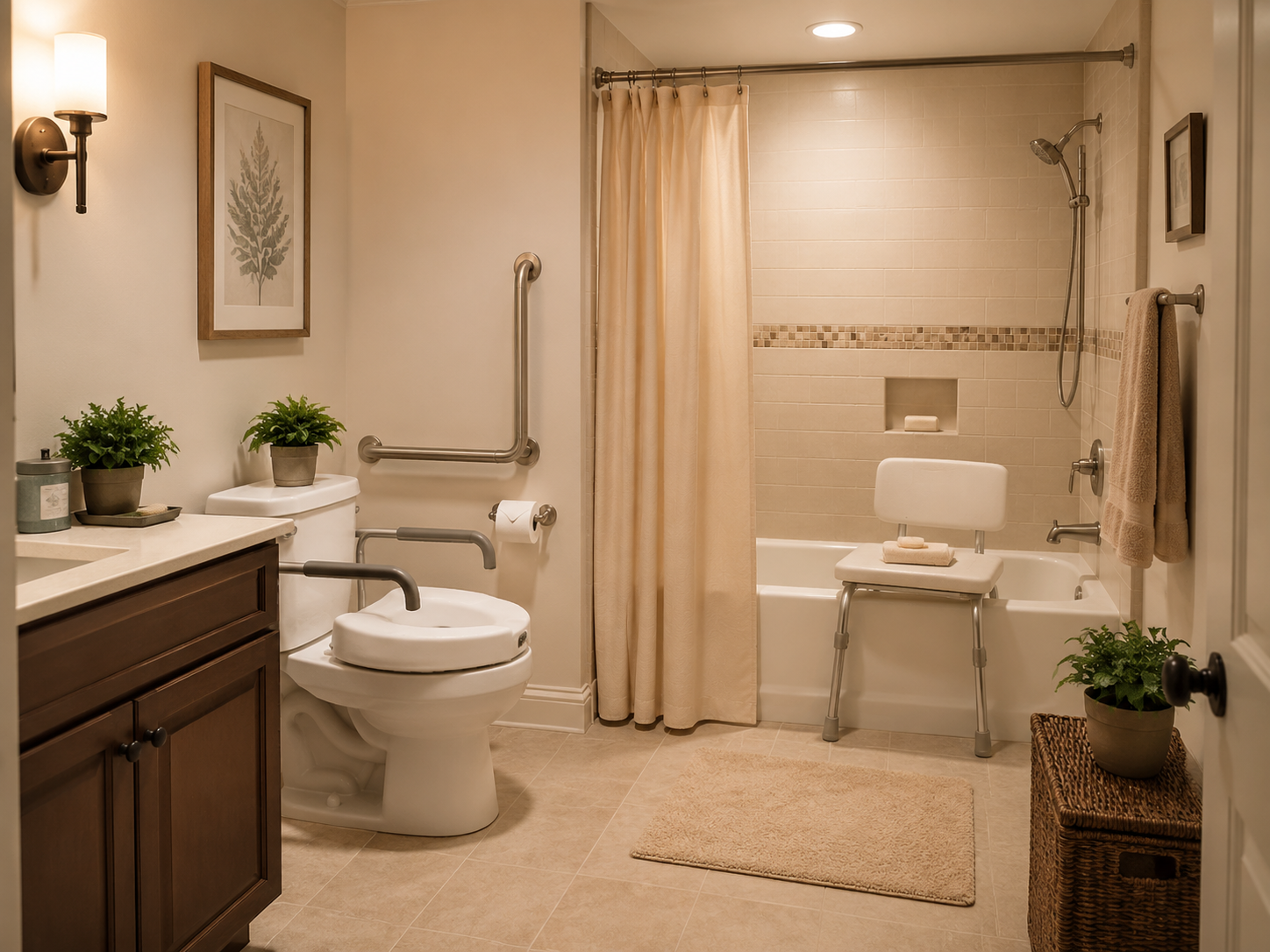
The bathroom is where many families should spend their first energy, because it combines wet surfaces, turning, clothing management, low seats, privacy, and urgency. It is also where an older adult may be least willing to ask for help.
If you can install or arrange low-controversy changes before your parent comes home, do it. Good lighting does not accuse anyone. A non-slip surface does not require a speech. A sturdy grab bar beside the toilet can be introduced as a convenience, not a verdict. An elevated toilet seat can reduce the work of standing before your parent has to admit that standing is harder.
For more detail than belongs in a discharge-week conversation, use a room-specific bathroom safety checklist for seniors. The point in the first week is not to debate every product or redesign the room. It is to make the most dangerous transfers less demanding.
Nighttime deserves its own pass through the house. A person who is careful at noon may be unsteady at 3 a.m., especially if new medicines cause dizziness or urgency. The bed-to-bathroom route should have lighting that turns on easily, a clear path, stable furniture, footwear within reach, and no rugs waiting at the edge of the bed. If this is the pattern worrying you most, a focused guide to nighttime fall prevention from bed to bathroom is more useful than a generic whole-house list.
The kitchen is usually the next place to simplify, not because every kitchen is equally dangerous, but because people resume habits there quickly. Reaching high shelves, carrying hot liquids, turning between counter and table, and stepping around pet bowls can expose the gap between “I’m home” and “I’m recovered.” A kitchen fall prevention checklist for older adults can help you decide what to move, what to clear, and what tasks should wait.
Use Family Support as Reinforcement, Not Surveillance
Family support helps when it makes the safer action easier to choose. It backfires when every interaction becomes a correction. A parent who feels watched may stop telling you about dizziness, near-falls, or bathroom urgency because they do not want the next privilege taken away.
Choose a few non-negotiables for the first week and make them concrete. The walker is used for night bathroom trips. The shower waits until someone is nearby. The new medication schedule is reviewed before anyone assumes the dizziness is “just age.” Meals and water are within easy reach. These are not lifestyle judgments; they are transition rules.
When more than one family member is involved, agree on the language. One calm message repeated by several people is better than three anxious lectures. If your parent trusts a sibling, neighbor, primary care clinician, physical therapist, or faith community friend more than they trust you on this subject, use that relationship. The Tzeng review’s emphasis on family support and follow-up reinforcement is not a license to nag; it is a reminder that one discharge conversation rarely carries the whole transition.[2]
Keep the Risk Calibrated
Not every older adult discharged from the hospital has the same fall risk, and not every home needs the same changes. Broad fall statistics can create urgency, but they should not turn into panic. The CDC reports that each year 3 million older adults are treated in emergency departments for fall injuries and 1 million are hospitalized because of falls.[8] Those numbers explain why clinicians take falls seriously. They do not tell you exactly which modification your parent needs by Tuesday.
Calibrated prevention asks better questions: Did your parent fall before admission? Are they weaker than usual? Are medicines new or changed? Are they rushing to the bathroom? Are they furniture-walking instead of using the device they were given? Are they avoiding movement because they are afraid? Are they alone overnight? A yes to any of those questions deserves attention; several yeses deserve a more formal plan.
CDC STEADI materials, including the Stay Independent brochure and Check for Safety checklist, can be useful prompts for that conversation, especially if you need a neutral tool that does not sound like it came from the most worried child in the room.[9][10] Use them as supports, not substitutes for watching how your parent actually moves through the home.
When the Walker, Cane, or Furniture Becomes the Argument
Assistive devices are often emotionally loaded. A cane may feel acceptable; a walker may feel like surrender. Some parents park the walker in the corner and hold the walls instead, which gives the family the false comfort of equipment being “available” while the real behavior remains unchanged.
Do not argue about the device in the abstract. Watch one transfer and one short route. Can your parent stand without rocking several times? Do they turn safely? Do they abandon the walker at the bathroom door because it does not fit? Do they carry objects in both hands? The answer may be a mobility habit, a home layout problem, or the wrong device for the task. A practical guide to maintaining mobility at home can help separate those issues.
If cost is slowing the family down, separate urgent safety changes from later aging-in-place projects. Night lighting, clearing paths, moving essentials, and improving bathroom transfers are first-week issues. Larger changes can be planned using a home modification cost guide or a broader aging-in-place decision framework. Do not let the perfect future remodel delay the grab bar that is needed now.
When to Bring in an Occupational Therapist
There is a point where family negotiation has done what it can. If your parent continues to refuse essential changes, has repeated near-falls, cannot transfer safely, wanders or rushes to the bathroom at night, or if you cannot tell which modification fits the person and the house, an occupational therapist can turn the argument into an assessment.
An OT can look at the actual sequence: getting out of bed, reaching the bathroom, sitting and standing from the toilet, showering, preparing food, carrying objects, managing thresholds, and using mobility devices in tight spaces. That is different from telling a family to “remove hazards.” It connects the person’s strength, habits, judgment, fear, and home layout.
Post-hospital fall prevention at home is not a lecture your parent must finally accept. It is a short-window care transition. The family’s job is to anticipate denial without mocking it, preserve dignity without pretending the risk is imaginary, prepare the most dangerous areas early, and bring in professional assessment when the home, the body, and the argument have become too complicated to manage by persuasion alone.

Comments
Join the discussion with an anonymous comment.