Power of Attorney for Caregivers: A Step-by-Step Checklist
For: adult childStage: early independenceReviewed: 2026-07-05
Power of Attorney for Caregivers: A Step-by-Step Checklist
This seven-step checklist guides family caregivers through getting a durable power of attorney for an aging parent—from assessing capacity urgency and starting the conversation to storing documents correctly—helping you avoid costly court-supervised guardianship.
By Editorial Team
new caregiver
experienced caregiver
long-distance caregiving
spousal caregiver
working caregiver
daily routines
medication management
personal hygiene
care coordination
first steps
ADLs
IADLs
If your parent still understands what they own, who they trust, and what authority they are giving away, this is the window to get a workable power of attorney in place. Once that understanding is gone, a signature may no longer be enough. At that point, families can end up in court asking for guardianship or conservatorship, a process elder-care sources consistently describe as slow, expensive, and stressful.[1]
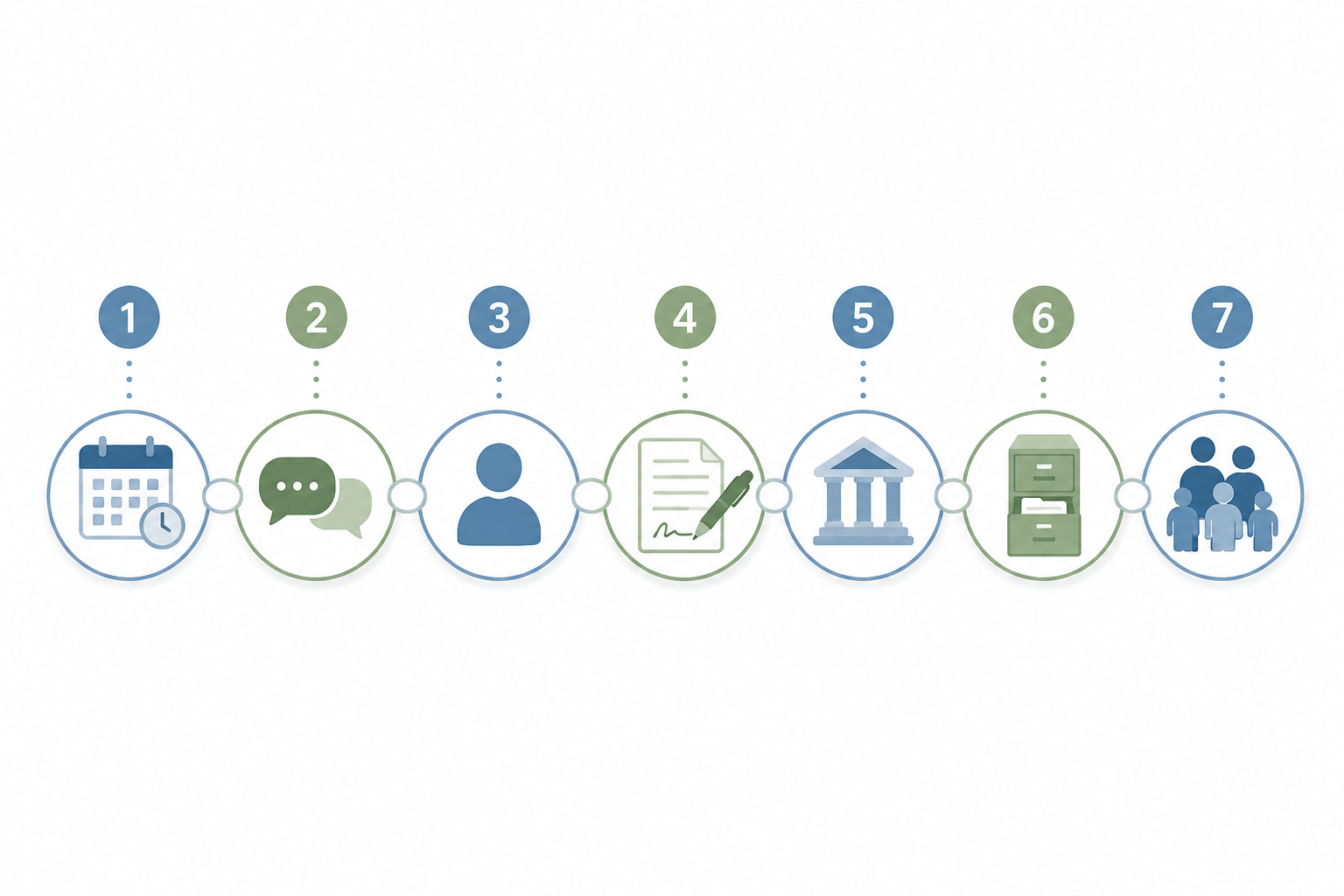
That is why a power of attorney caregiving checklist should start before the form. The form matters, but the sequence matters more: capacity, conversation, agent choice, correct signing, bank acceptance, medical access, and storage. A signed document that nobody can find at 10 p.m., or that a bank refuses at the counter, is not the same thing as a usable caregiving plan.
The seven-step power of attorney caregiving checklist
Step
What to do
Why it matters
1
Assess the capacity window
Your parent must be able to understand what they are signing.
2
Know which documents you are asking for
Financial POA, medical POA, durable authority, and HIPAA access do different jobs.
3
Have the conversation before the crisis writes the script
The parent is still the decision-maker while they have capacity.
4
Choose the agent and backup agent carefully
The agent will owe fiduciary duties and may have to explain decisions to family, banks, and care providers.
5
Draft and execute the POA correctly
State rules for forms, witnesses, notarization, and authority vary.
6
Activate it with banks, doctors, and key institutions
A technically valid POA can still stall if the institution has not reviewed it.
7
Store it where the right people can find it
Caregiving authority only helps if it is available when the hospital, bank, or sibling asks.
Only about one-third of Americans age 55 and older had a durable power of attorney in the 2020 Merrill Lynch/AARP data cited by AARP, even though 43% worried they did not have someone to advocate for them.[2] That number is useful because it explains why so many adult children discover the paperwork gap only after a fall, hospitalization, new diagnosis, unpaid bill, or locked account.
Step 1: Check whether your parent can still legally choose
Capacity is the first checkpoint because power of attorney is something your parent grants. You cannot create it for them after they no longer understand the decision. In practical terms, they need to understand that they are naming someone to act for them, what kinds of decisions that person may make, and that the authority can affect money, property, care, or health information.
A dementia diagnosis by itself does not automatically mean your parent cannot sign. A person may still have legal capacity if they can understand the document and the consequences at the time of signing, especially earlier in the disease process.[3] The problem is that capacity can become harder to prove as symptoms progress, and institutions may become more cautious if the document appears late in the story.
If your parent has recently had a fall, hospitalization, delirium episode, stroke, dementia diagnosis, or sudden financial confusion, do not start by downloading a random form and hoping. Start by asking whether they are clear enough to participate, whether a physician or attorney should evaluate capacity, and whether an elder law attorney should be involved quickly. If capacity is already doubtful, the next step may be legal advice about guardianship or conservatorship rather than a do-it-yourself POA.
For crisis-mode caregivers, this POA work should sit beside the immediate care timeline: medications, discharge instructions, insurance cards, emergency contacts, and who is allowed to talk to whom. The paperwork is not separate from caregiving. It is what lets the caregiving actually move.
Step 2: Know what you are asking your parent to sign
The phrase “get a POA” hides several different documents. Before the family conversation, use plain labels so everyone understands the job each paper is supposed to do.
Financial power of attorney: lets the named agent handle money and property tasks, such as paying bills, managing accounts, dealing with insurance, filing taxes, or selling property if the document grants that authority.
Medical power of attorney or health care proxy: lets the named person make health care decisions if your parent cannot make or communicate those decisions.
Durable power of attorney: remains valid after your parent becomes incapacitated. A non-durable POA generally stops working when the person becomes incapacitated, which is exactly when many caregivers need it most.[4]
HIPAA authorization: a separate medical privacy release that allows health providers to share information with the people your parent names. A medical POA alone may not give you routine access to records or conversations while your parent can still make decisions.[5]
Springing authority: a POA that becomes effective only after a specified event, often incapacity. It can sound reassuring, but it may create delays if institutions require proof before honoring it.
For caregiving, the usual goal is not one magic document. It is a set of documents that lets the right person pay the mortgage, manage insurance, speak with doctors, arrange care, and prove authority without arguing from scratch every time.
Step 3: Have the conversation while your parent is still in charge
The cleanest POA conversations happen before anyone is cornered by a discharge planner, a frozen bank login, or a sibling group text full of panic. Your parent should hear that the point is not taking over. The point is choosing who can help if they cannot sign, drive, call, remember passwords, or sit on hold with an insurance company.
There is an old but still widely cited conversation gap here: Arbor Company cites The Conversation Project’s 2013 survey finding that 90% of people said talking with loved ones about end-of-life care was important, while 30% had actually done it.[6] I would not treat that as a fresh 2026 measurement of every family, but it matches the pattern caregivers see: most people agree the conversation matters, and many still wait until the hospital bracelet is already on.
A useful opening is concrete: “If you were in rehab for three weeks and bills were due, who would you want the bank and insurance company to recognize?” That keeps the focus on your parent’s choice. It also gives reluctant parents a way to say what they fear: losing control, family conflict, being judged for finances, or being pushed into care they do not want.
Ask who they trust to handle money, health information, and care decisions.
Ask whether they want the same person for financial and medical authority.
Ask whether siblings or other relatives should receive copies or status updates.
Ask which decisions would feel like help and which would feel like overreach.
Write down follow-up questions for the attorney rather than trying to solve every legal issue at the kitchen table.
If your parent resists, slow down enough to separate the emotional objection from the administrative need. “I do not want to think about this” is different from “I do not trust that person” or “I do not understand what I am signing.” Each answer points to a different next step.
Step 4: Choose an agent who can do the boring, accountable work
The best agent is not automatically the oldest child, the closest child, or the child who sounds most confident in a family meeting. The agent needs judgment, availability, clean boundaries, and enough organization to keep records. This person may need to pay bills, track reimbursements, talk to banks, document care expenses, and explain decisions later.
An agent under a POA has fiduciary duties. Caregiving and legal sources describe those duties as acting in the principal’s best interest, avoiding self-dealing, keeping records, and using the parent’s money for the parent rather than for the agent’s convenience.[7][8] That sounds obvious until the agent is buying groceries for two households, moving money between accounts, or reimbursing mileage without receipts.
This is where sibling trust is either protected early or damaged later. If one child is the financial agent, another child may still need visibility. Visibility does not mean every sibling gets a vote on every pharmacy receipt. It can mean monthly summaries, shared access to non-sensitive care notes, or an agreement that major transactions will be documented before they happen.
Name a backup agent in case the first agent is unavailable, ill, conflicted, or no longer willing to serve.
Do not name co-agents casually; requiring two signatures can slow ordinary caregiving tasks if the document or institution requires joint action.
Avoid naming someone with active financial instability, untreated addiction, a history of family coercion, or a strong personal conflict with your parent’s wishes.
Make sure the agent has a secure way to store records, receipts, login instructions, institution letters, and copies of checks or transfers.
If the obvious helper is not the right fiduciary, say that plainly. A loving caregiver may be excellent at doctor visits and terrible at account reconciliation. A financially careful sibling may be the better financial agent even if someone else is the daily care coordinator.
Step 5: Draft and execute the document under your state’s rules
This is the point where precision matters and internet confidence can become expensive. State rules vary on witnesses, notarization, acceptable language, springing authority, and whether institutions must accept a particular form. CaringInfo notes that 28 states have adopted a universal power of attorney form, which also means 22 states have not.[7] A form that works cleanly in one state should not be assumed to work cleanly in another.
Many families should use an elder law attorney, especially when there is dementia, blended family tension, real estate, Medicaid planning concerns, estranged children, a business, significant assets, or disagreement about who should serve. A valid state form may be appropriate for simpler situations, but the signing rules still have to be followed exactly.
Use your parent’s legal name consistently with government ID and financial accounts.
Spell out whether the authority is durable, immediate, springing, limited, or broad.
Include real estate, tax, insurance, retirement, digital, benefits, and banking powers only as appropriate and allowed.
Follow your state’s witness and notarization requirements exactly.
Keep the original clean, complete, and unstapled if local practice or the attorney recommends that.
Do not leave the appointment with only a vague sense that “the paperwork is done.” Before you walk out, ask which documents are originals, which are copies, who should receive them, whether banks should get them now, and whether the medical POA needs a separate HIPAA authorization.
Step 6: Make banks and institutions recognize it before you need money moved
This is the step ordinary POA advice often skips. A valid signed document can still fail the caregiver in real life if the bank, brokerage, pension administrator, insurance company, or mortgage servicer has not reviewed it. Financial institutions may reject a POA or ask for their own form; the Consumer Financial Protection Bureau advises asking for the reason in writing and escalating to a branch manager or supervisor when needed.[9]
Do the bank work while your parent can still participate. Call each major institution and ask what it requires to put an agent on file. Some may want the original or certified copy. Some may want their internal POA form. Some may require the agent to appear in person with identification. None of that is fun to discover after your parent is in rehab and the mortgage autopay has failed.
Institution
What to ask
Bank or credit union
Do you accept outside POA documents, or do you require your own form?
Brokerage or retirement account custodian
What authority can the agent exercise, and are beneficiary changes restricted?
Mortgage servicer or landlord
What proof is needed for the agent to discuss payments or property issues?
Insurance company
Can the agent change billing, access claims, or update contact information?
Social Security or federal benefits
Does this agency require a separate representative payee or agency-specific process?
Health system
Where should the medical POA and HIPAA authorization be uploaded?
Keep a simple activation log: date submitted, institution, person spoken to, documents provided, whether accepted, and what is still missing. If a bank refuses the POA, ask for the written reason, keep the letter, and bring it back to the attorney if the explanation sounds wrong or circular.
Do the same for medical access
Upload the medical POA and HIPAA authorization to your parent’s primary care office, hospital portal, specialists, pharmacy, and assisted living or home care agency if applicable. Then test the system politely: can the named caregiver receive appointment information, medication questions, discharge instructions, or care-plan updates? The answer may differ depending on whether your parent still has capacity, what the HIPAA form says, and how the provider’s system is set up.
Step 7: Store the POA so it can actually be used
The original POA should not live in a mystery folder, a safe nobody can open, or an attorney’s office that only answers Monday through Friday. The agent needs access. The backup agent needs to know where access begins. Key family members need enough clarity that they do not waste the first day of a crisis searching drawers.
Keep the original financial POA in a secure but reachable place.
Keep certified or attorney-provided copies for banks and institutions that request them.
Put copies of the medical POA and HIPAA authorization in the emergency contact binder.
Upload medical documents to patient portals where possible.
Give the named agent and backup agent clear instructions for where documents are stored.
Write down the attorney’s name, phone number, and date the documents were signed.
A good emergency binder does not need to contain every private financial detail, but it should tell the caregiver where authority documents are, who is named, and who to call. For first responders and hospital staff, the medical documents matter most. For the agent trying to prevent late fees, overdrafts, or insurance lapses, the financial POA and account map matter most.
After signing: tighten the financial safety net
Once the POA is signed and accepted where it needs to be accepted, do not stop at the document. The next practical job is reducing confusion and exploitation risk. AARP, citing financial advisor Elliott Appel, recommends simplifying or consolidating accounts where appropriate and freezing credit at all three major credit bureaus as protective steps against elder financial exploitation.[10]
Consolidation does not mean sweeping every dollar into one account without tax, benefits, or investment advice. It means making the account landscape understandable enough that the agent can spot fraud, pay bills, and avoid missing required actions. If your parent has old savings accounts, paper statements going to the wrong address, unused credit cards, or investment accounts nobody has logged into for years, the POA conversation is a good time to map them.
Add trusted contacts to financial accounts where the institution allows it. A trusted contact is not the same as a POA agent; it gives the institution another person to contact if it suspects exploitation, cognitive decline, or trouble reaching the account holder.[10] It is a small step that can help a bank pause before a scammer drains an account.
Also check beneficiary designations. Pierro Law identifies outdated beneficiary designations as a common place where estate plans unintentionally conflict.[11] A POA does not automatically fix an old retirement account beneficiary, a payable-on-death bank designation, or a life insurance form signed decades ago. Whether an agent can change those designations depends on the document, state law, and institution rules, so this is another place to ask the attorney before acting.
A workable POA system
A workable power of attorney system is more than a signature. Your parent chose while they had capacity. The right agent and backup are named. The document is durable if it needs to survive incapacity. The medical POA has a separate HIPAA authorization. Banks and health systems have reviewed the documents before the crisis. The agent knows the fiduciary job and keeps records. The papers are stored where the family can find them.
That is the difference between “we have a POA somewhere” and “the caregiver can act tomorrow morning.”


Comments
Join the discussion with an anonymous comment.