When to Hire a Sitter for an Elderly Parent: 7 Signs It's Time and How to Start the Conversation
For: adult childStage: early independence15 minutes📄 PrintableReviewed: 2026-06-20
When to Hire a Sitter for an Elderly Parent: 7 Signs It's Time and How to Start the Conversation
Most families wait too long to hire a sitter because they dismiss early warning signs as normal aging. This guide helps adult children recognize the seven key signs that a companion could help — from loneliness and missed meals to caregiver burnout — and provides a practical conversation guide and trial-run approach for introducing help.
By Editorial Team
new caregiver
long-distance caregiving
adult children
companion care
difficult conversations
📄
A printable version of this guide is available. Use your browser's print function (Ctrl+P / ⌘P) to save or print.
Why Families Wait — and the Cost of Waiting
Most families don't recognize the moment when a parent crosses the line from "doing fine on their own" to "needs a little help." The transition is gradual. A sink full of dishes becomes a permanent fixture. The weekly phone call gets shorter. The refrigerator holds nothing but a jar of pickles and a half-empty carton of milk. These aren't crises — they're slow drifts, and they're easy to explain away as normal aging.
But the data suggests that normalizing these early warning signs carries real risk. Research from the University of Michigan indicates that one in three older adults (34%) reported feeling isolated from others in the past year. Meanwhile, more than 1 in 4 older adults in the United States is malnourished or at risk of malnutrition. These aren't separate problems — they feed each other. Isolation leads to skipped meals. Poor nutrition accelerates physical decline. Physical decline increases fall risk. And a single fall can unravel years of independence in a matter of hours.
A sitter — also called a companion or companion caregiver — is designed to fill exactly this gap. Under the Department of Labor's definition, companionship services involve fellowship and protection: conversation, games, crafts, walks, transportation, medication reminders, light housekeeping, and monitoring well-being. Care tasks like meal preparation or help with grooming are permitted, but they cannot exceed 20% of the companion's total weekly hours per the DOL's 20% care-task rule. This is not a medical role. It is a presence — someone who shows up, shares a meal, notices when something is off, and keeps the engine of daily life running.
The challenge is that most families don't call for this kind of help until after the crisis — after the fall, after the hospitalization, after the parent has lost significant weight. This article is designed to help you recognize the signs before that happens. The seven signals below are not about catastrophic decline. They are about the subtle, actionable changes that tell you a parent could benefit from a few hours of companionship each week.
A companion provides more than supervision — she offers genuine human connection that addresses the root cause of many age-related health risks.
Sign 1: Loneliness and Social Withdrawal
Loneliness in older adults is often invisible to family members who don't live nearby. The parent stops answering the phone because there's nothing new to report. They decline invitations because getting out feels like too much effort. They spend entire days without speaking to another person. To the parent, this feels like a natural contraction of life. To the adult child who visits once a month, it looks like a quiet afternoon.
But the health consequences of chronic loneliness are anything but quiet. The National Institute on Aging has found that social isolation and loneliness are linked to significantly higher risks of dementia, heart disease, and stroke. The University of Michigan's National Poll on Healthy Aging found that 34% of older adults reported feeling isolated from others in the past year — a figure that predates the pandemic and has only drawn more attention since.
A sitter addresses this directly. The core of companionship is fellowship — engaging the person in social, physical, and mental activities. That might mean playing cards, looking through old photo albums, taking a short walk around the block, or simply sitting together and talking. The activity matters less than the presence. For a parent who lives alone, a sitter's visit can be the only sustained human interaction they have all week.
Sign 2: Decline in Hygiene or Home Maintenance
When a parent stops keeping up with basic household tasks, it's easy to attribute it to laziness or a lower standard of cleanliness. But a decline in home maintenance is often one of the earliest behavioral signals that a person is struggling to manage the demands of daily life. Unwashed dishes, overflowing trash, expired food in the refrigerator, unpaid bills piling up on the counter — these aren't character flaws. They are signs that the cognitive or physical energy required to maintain a home has exceeded what the person has available.
This matters for safety as much as for dignity. Cluttered floors are fall hazards. Expired food can cause foodborne illness. Unpaid bills can lead to utility shutoffs. A home that is visibly deteriorating is a home where the risk of a serious incident is rising.
A sitter can help with light housekeeping — washing dishes, tidying common areas, organizing the kitchen, and ensuring that expired food is removed. These tasks fall within the DOL's definition of care tasks that are attendant to fellowship and protection. The sitter is not a housekeeper, but she can keep the home from sliding into a state that endangers the person living in it.
Dirty dishes or trash accumulating faster than they are cleared
Unkempt appearance, unwashed clothing, or noticeable body odor
Expired food in the refrigerator or pantry
Unopened mail piling up, especially bills and official documents
Cluttered floors, loose rugs, or obstacles in walkways that increase fall risk
Cooking for one is hard at any age. For an older adult, it can become genuinely difficult — lifting heavy pots, standing at the stove for extended periods, remembering to eat at regular intervals, and maintaining the motivation to prepare a meal when there is no one to share it with. The result is often a diet of convenience: toast, cereal, canned soup, frozen dinners, or simply skipping meals altogether.
The scale of this problem is larger than most families realize. More than 1 in 4 older adults in the United States is malnourished or at risk of malnutrition, according to data cited by SeniorLiving.org. Malnutrition in older adults is associated with weakened immune function, muscle loss, increased fall risk, slower recovery from illness or surgery, and higher rates of hospitalization.
Eating alone is a risk factor for both malnutrition and social isolation — and the two often reinforce each other.
A sitter can change this dynamic in two ways. First, by preparing simple meals — not elaborate cooking, but the kind of food a parent might have made for themselves when they had the energy. Second, and perhaps more importantly, by eating with the parent. Research shows that older adults who share meals with others report higher levels of happiness and life satisfaction, with an even stronger effect among those who live alone. A shared meal turns a nutritional intervention into a social one.
Sign 4: Missed Medications or Appointments
Managing medications is one of the most cognitively demanding tasks of daily life for an older adult. It requires remembering which pills to take, at what time, in what dosage, and whether they need to be taken with food. It requires refilling prescriptions before they run out. It requires keeping track of multiple bottles with similar-looking labels. When a parent starts missing doses, double-dosing, or letting prescriptions lapse, it is rarely because they don't care about their health. It is because the system has become too complex for them to manage alone.
Missed appointments are another common signal. A parent who used to drive themselves to the doctor may now find the logistics overwhelming — scheduling, transportation, paperwork, and the cognitive load of navigating an unfamiliar medical building. Rather than ask for help, they simply stop going.
A sitter can provide medication reminders (not administration — that requires a licensed professional) and transportation to appointments. Under the DOL framework, both medication reminders and transportation are within the scope of companionship services, provided they do not exceed 20% of the companion's weekly hours. For a parent who needs help getting to a weekly doctor's appointment and remembering to take their blood pressure medication, a few hours of companion care may be all that is needed to prevent a dangerous drug interaction or a preventable hospitalization.
Pill organizers that remain untouched from one visit to the next
Confusion about which medications to take and when
Missed or rescheduled doctor appointments without a clear reason
Expired prescriptions that have not been refilled
A parent who says they "don't need" medications that were previously important
Sign 5: A Recent Fall or Hospitalization
A fall or hospitalization is often the moment when a family's vague concern crystallizes into a clear need for help. But it is also a moment of vulnerability. The parent who has just been discharged from the hospital is weaker, more confused, and at higher risk of a second fall than they were before the incident. The recovery period is when the gap between "independent" and "needs full-time care" becomes most visible — and most dangerous.
A sitter can provide supervision and protection during this critical window. She can be present to ensure the parent doesn't attempt to get out of bed unassisted, doesn't miss a follow-up appointment, and doesn't skip meals because they are too tired to cook. This is not skilled nursing — it is the presence of a responsible adult who can monitor safety and well-being, call for help if something goes wrong, and provide the practical support that makes recovery possible at home.
Sign 6: Caregiver Burnout in the Family Member Currently Helping
Sometimes the clearest sign that a parent needs a sitter is not something the parent does — it is something the family caregiver feels. If you are the adult child or spouse who has been providing support, and you are exhausted, irritable, missing work, neglecting your own health, or dreading the next phone call, that is a signal. Not a signal of weakness. A signal that the current arrangement is not sustainable.
The National Institute on Aging defines respite care as short-term relief for primary caregivers — time to rest, travel, or spend time with other family and friends. Hiring a sitter for even a few hours a week is a form of respite care. It does not mean you are giving up or failing. It means you are recognizing that caregiving is a marathon, not a sprint, and that you need to preserve your own capacity to continue.
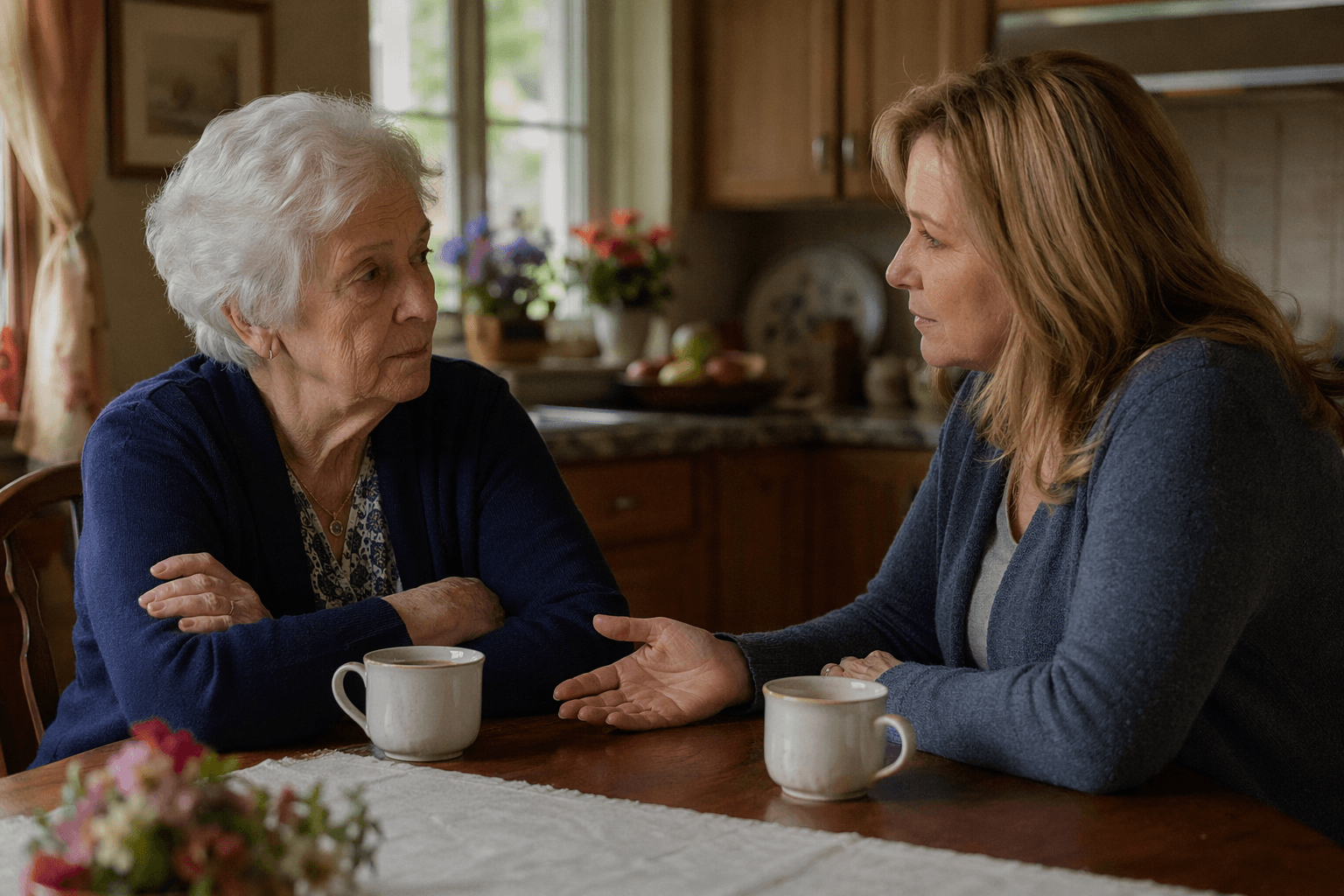
The conversation about hiring a sitter is often harder than the decision itself. A warm, patient approach can make all the difference.
Sign 7: Wandering or Unsafe Behaviors (Dementia-Specific)
For a parent with Alzheimer's disease or another form of dementia, the threshold for needing a sitter is different. The question is not whether they can manage daily tasks — it is whether they are safe to be left alone at all. Behaviors like leaving the stove on, wandering outside at odd hours, getting lost in familiar neighborhoods, or attempting to drive when they no longer have a license are clear signals that supervision is needed.
The Alzheimer's Association recommends checking whether sitters have dementia-specific training if the senior has memory impairment. A companion who understands the behavioral and psychological symptoms of dementia — sundowning, agitation, repetitive questioning, wandering — can provide engagement and supervision that reduces the frequency and intensity of these behaviors. She can redirect a parent who is trying to leave the house, prepare a calming activity during the late afternoon when sundowning often begins, and provide the consistent presence that people with dementia find reassuring.
Leaving the stove or oven on after cooking
Wandering outside the home at unusual hours, especially at night
Getting lost in familiar places, such as the neighborhood they have lived in for decades
Attempting to drive when they no longer have a valid license or safe driving skills
Confusion about time of day, leading to dressing for work at 3 a.m. or preparing dinner at 10 a.m.
How to Have the Conversation with a Resistant Parent
The hardest part of hiring a sitter is often not the logistics or the cost — it is the conversation. Many older adults resist the idea of having someone come into their home because they associate it with a loss of independence, a loss of privacy, or a judgment that they can no longer manage their own life. The resistance is not irrational. It is a defense of autonomy.
The most effective approach is to frame the sitter not as a caregiver but as a companion — someone who can help with the things the parent no longer enjoys, or someone who can keep the adult child from worrying. Use "I" statements that express your own feelings rather than criticisms of your parent's behavior.
"I would worry less if I knew someone was checking in on you a couple of times a week."
"I know you hate grocery shopping. What if someone came by to help with that and stayed for lunch?"
"You've always been the one who takes care of everyone. Let someone take care of you for a change."
"This isn't about me not trusting you. It's about me not being able to sleep at night because I'm so far away."
Start with a specific, limited need rather than a blanket arrangement. Instead of proposing "someone to help around the house," suggest "someone to drive you to your Tuesday physical therapy appointment and stay for a cup of coffee afterward." A concrete, time-limited request is much easier to accept than an open-ended commitment.
The Trial-Run Approach: Starting with 3–4 Hours a Week
The best way to reduce resistance — both from your parent and from your own anxiety — is to start small. A trial run of three to four hours, once or twice a week, is enough to test whether the arrangement works without feeling like a permanent commitment. It gives your parent time to get comfortable with a new person in their home. It gives the sitter time to understand your parent's routines and preferences. And it gives you time to evaluate whether the match is right.
A typical trial visit might include: the sitter arrives, shares a meal with your parent, helps with a simple task like organizing the kitchen or sorting mail, and engages in a shared activity — a card game, a walk, or looking through a photo album. The visit ends with the sitter noting any concerns (expired food, missed medications, changes in mood or mobility) and reporting back to you.
There is evidence that even small amounts of in-home care — helping with meals or light housekeeping — can extend independence. A few hours a week of companion care may be all that is needed to keep a parent safe, nourished, and socially engaged for months or years longer than they would manage alone.
Did your parent seem comfortable with the sitter, or were they tense or withdrawn?
Did the sitter take initiative — starting a conversation, suggesting an activity, noticing things that needed attention?
Did your parent eat a proper meal during the visit?
Did the sitter communicate clearly with you afterward about what happened and what they observed?
Did your parent express any interest in the sitter returning?
If the trial run goes well, you can gradually increase the hours or add additional visits. If it doesn't, you have lost nothing but a few hours and can try a different sitter or a different approach. The trial-run model keeps the stakes low and the focus on what matters most: your parent's comfort and safety.




Comments
Join the discussion with an anonymous comment.