New to senior care options? This guide explains the full range of services from in-home help to skilled nursing, with 2026 costs and a framework to match your parent's needs to the right level of support.
By Editorial Team
new caregiver
experienced caregiver
long-distance caregiving
spousal caregiver
working caregiver
daily routines
medication management
personal hygiene
care coordination
first steps
ADLs
IADLs
Most families do not begin with the phrase “senior care service.” They begin with a fall, a missed medication, a refrigerator full of spoiled food, a hospital discharge packet, or a parent who sounds fine on the phone but is clearly not managing the day well anymore. The hard part is that “getting help” can mean anything from four hours a week of homemaking to 24-hour nursing supervision. Those are not different versions of the same product. They solve different problems.
The first useful move is to stop shopping for a provider and name the level of need. A parent who needs rides and meal help is in a different situation from a parent who forgets to turn off the stove, cannot bathe safely, needs wound care, or is awake and disoriented at night. The right senior care service is the lowest level of support that safely covers current needs, with a plan to reassess as those needs change.
The Senior Care Service Continuum
Senior care services fall into two broad worlds: help that comes into the home or community during part of the day, and residential care where the older adult moves into a setting built around support. The National Institute on Aging separates in-home supports such as personal care, homemaking, home health, adult day services, and respite care from residential options such as assisted living, board-and-care homes, nursing homes, continuing care retirement communities, and hospice in home or facility settings.[1][2]
The parent is mostly safe alone but daily routines are slipping
Personal care at home
Help with bathing, dressing, toileting, mobility, meals, and supervision
The parent needs hands-on help but does not need ongoing skilled medical care
Adult day services
Structured daytime supervision, meals, activities, sometimes health-related support
The parent needs daytime oversight and the family caregiver needs predictable coverage
Respite care
Temporary relief for family caregivers at home, in a day program, or in a facility
The family can continue caregiving only if breaks are built in
Home health care
Skilled nursing, physical therapy, occupational therapy, wound care, or other physician-ordered services
The need is medical, time-limited, and requires licensed clinical staff
Assisted living
Housing, meals, personal care, medication support, activities, and staff availability
The parent needs daily help and a safer living setup but not 24/7 skilled nursing
Memory care
Residential care with dementia-oriented staffing, supervision, routines, and secure design
Cognitive impairment creates safety, wandering, orientation, or behavior risks
Skilled nursing facility
24-hour nursing care, rehabilitation, medical monitoring, and higher-acuity support
The parent has complex medical needs or cannot be safely supported in a lower-care setting
CCRC
A campus that may include independent living, assisted living, and nursing care
The family is planning for changing needs within one broader community
Hospice
Comfort-focused care for serious illness, at home or in a facility
The care goal has shifted from cure or rehabilitation to comfort and quality of life
This map matters because families often jump from a problem to the wrong category. “Mom is lonely” does not automatically mean assisted living. “Dad fell once” does not automatically mean a nursing home. But “Mom is lonely, forgetting medications, leaving burners on, and refusing to bathe” is no longer just a companionship problem.
Separate Nonmedical Help From Medical Care
The home care versus home health distinction is one of the most common places families get misled, usually unintentionally. Nonmedical home care helps a person live through the day: bathing, dressing, meals, laundry, transportation, companionship, reminders, and supervision. Home health care is clinical care ordered by a physician, such as skilled nursing, therapy, or wound care.[1]
That difference affects staffing, payment, and expectations. A home care aide may help a parent shower and prepare lunch. A home health nurse may check a surgical wound or teach medication management after a hospitalization. The nurse is not there to stay all afternoon because the family is worried about falls. The aide is not there to provide skilled nursing care.
Some families need both. After a hospital stay, a parent might receive short-term home health therapy while also paying privately for nonmedical aide hours. The services can overlap in the calendar, but they are not interchangeable.
Where Adult Day Services and Respite Fit
Adult day services are often overlooked because they do not sound as substantial as “moving somewhere” or “hiring an aide.” For the right parent, they can be exactly the missing piece: daytime structure, meals, social contact, and supervision while the family caregiver works or rests. Respite care serves a different purpose. It protects the caregiver’s ability to keep going, whether the break is a few hours, a weekend, or a short facility stay.[1]
These options are not consolation prizes. They are useful when the main risk is concentrated during certain hours rather than across the full day and night.
Residential Care Is Not One Thing
Residential senior care is where the vocabulary gets especially blurry. Independent living, assisted living, memory care, and skilled nursing are frequently discussed as if they sit on one neat ladder. In real life, the boundaries are shaped by staffing, licensing, medical need, cognitive risk, and how much unscheduled help a person needs.
Independent living is mainly housing with services and community features for older adults who can still manage personal care. Assisted living adds help with daily activities such as bathing, dressing, meals, and medication support. Board-and-care homes are smaller residential settings that provide room, meals, and personal care. Nursing homes provide a higher level of medical and personal care, including 24-hour nursing supervision.[2]
Memory care is not simply assisted living with a locked door. It is meant for people whose dementia-related needs require more supervision, more routine, and staff trained around cognitive impairment. A parent who is mildly forgetful may not need it. A parent who wanders, becomes frightened in the evening, cannot recognize unsafe choices, or needs repeated cueing through basic tasks may.
A continuing care retirement community, or CCRC, is a planning structure more than a single care level. It may let someone move from independent living to assisted living or nursing care within the same broader campus as needs change.[2] That can be valuable, but the contract, fees, and admission rules matter too much to treat “CCRC” as automatically safer or simpler.
Start the Assessment With What the Parent Actually Has to Do Each Day
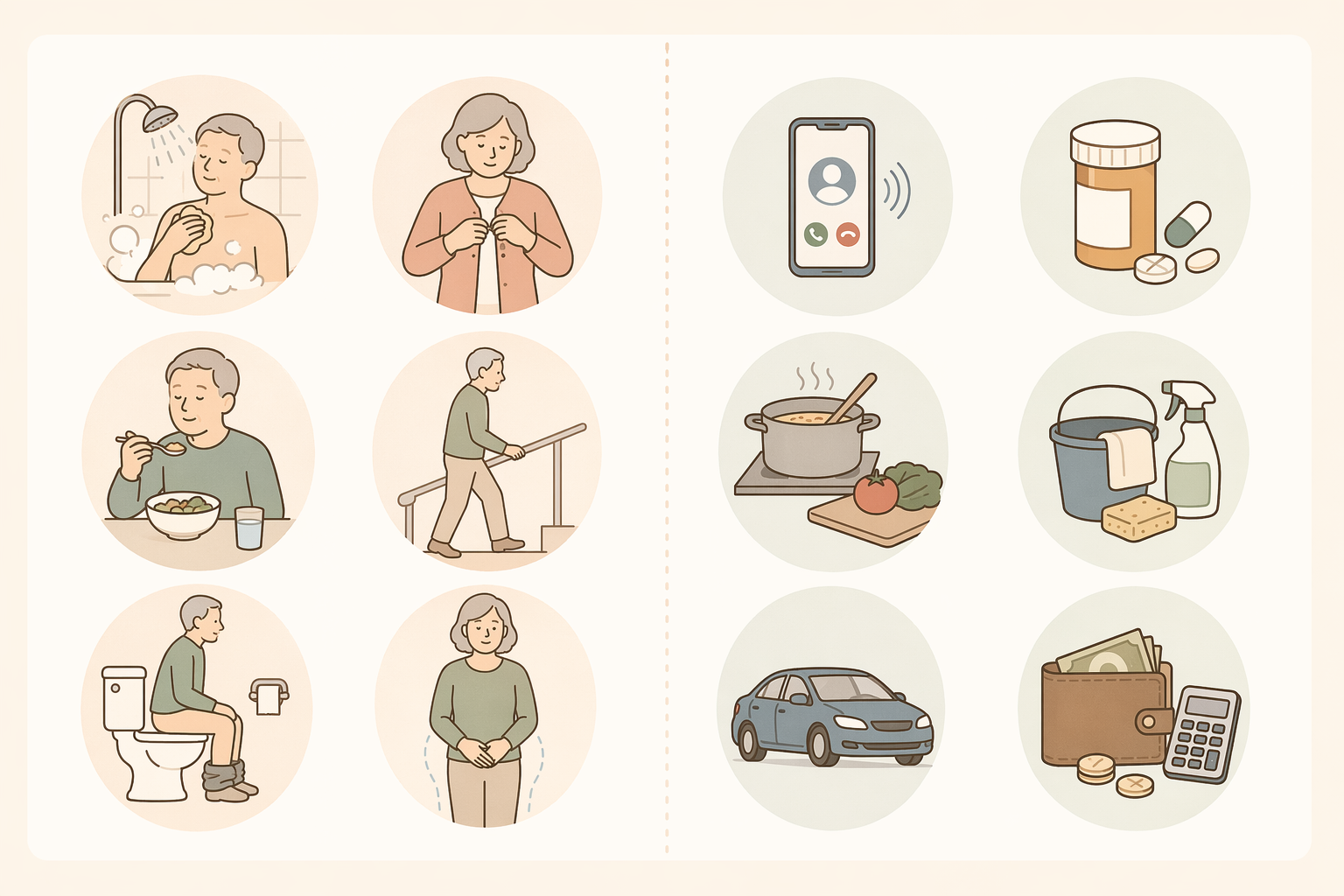
A care decision should begin with the parent’s ordinary day, not with a brochure. Can they get out of bed? Bathe? Dress? Use the toilet? Eat enough? Walk safely? Take the right medications at the right time? Prepare meals? Keep the house livable? Pay bills? Use the phone? Get to appointments? The National Institute on Aging points families toward warning signs such as changes in housekeeping, hygiene, weight, mood, memory, mobility, and medication management when deciding whether an older adult needs help.[3]
Care professionals often separate these tasks into ADLs and IADLs. ADLs are basic activities of daily living: bathing, dressing, toileting, transferring, continence, and eating. IADLs are instrumental activities of daily living: meals, medications, transportation, shopping, housekeeping, phone use, and money management. The distinction is not academic. Losing an IADL may mean a parent needs scheduled help. Losing multiple ADLs often means the parent needs hands-on personal care, not just reminders.
Home health, physician-directed services, skilled nursing, or coordinated medical management
Caregiver capacity
Who is available, when they are available, what they can safely do, and how long they can continue
Respite, added home care hours, adult day services, or a residential move
A parent can look “mostly fine” during a Sunday visit and still be unsafe Monday through Friday. Families should ask who is covering each risky hour, not just whether the parent can perform a task once while someone is watching. Bathing safely one time is different from bathing safely every week. Taking pills correctly when a daughter fills the organizer is different from managing medications alone.
Do Not Average the Good Days and Bad Days
The useful question is not “Can Dad still do this?” It is “Can Dad do this reliably, safely, and without exhausting the person quietly backing him up?” If the answer depends on the day, the weather, whether he slept, or whether someone reminded him three times, build the care plan around the less reliable version. That does not mean assuming the worst. It means not pretending the best day is the baseline.
This is also where parent resistance belongs in the discussion. Many older adults say no to help because they fear losing privacy, control, money, or their home. That deserves respect. It does not erase the medication errors, falls, unpaid bills, or caregiver collapse that may already be happening. The care plan has to hold both truths.
Match Common Need Patterns to Service Levels
The point of assessment is not to label a parent as independent or dependent. It is to narrow the field. Most families can start by placing the parent in one of several practical patterns, then adjust for local availability, budget, and medical advice.
The family is also expecting the clinician to provide long blocks of custodial supervision
Dementia with wandering, agitation, unsafe judgment, or repeated disorientation
Dementia-capable home care, adult day services, memory care
The home plan depends on one exhausted relative being alert at all hours
Complex medical needs, 24-hour nursing needs, or unsafe mobility with high assistance needs
Skilled nursing facility or medically supervised care
The family is trying to solve a nursing-level problem with companion care
Chronic illness is part of the reason this matching work matters. As of July 2025, the National Council on Aging reported that 93% of adults age 65 and older have at least one chronic condition, and 79% have two or more.[4] A diagnosis alone does not determine the care setting, but it changes what the family should watch. Diabetes, heart disease, arthritis, COPD, stroke history, and dementia can all affect mobility, medication routines, energy, judgment, and recovery after setbacks.
Social isolation deserves a place in the assessment, but it should not be used as a vague emotional shortcut to any one service. In a 2024 University of Michigan poll, 34% of older adults reported feeling isolated from others in the past year.[5] For one parent, that may point toward transportation, community programming, or companion visits. For another, isolation may be one sign among many that the home routine has become too fragile.
What Senior Care Services Cost in 2026
Cost numbers are only useful after the family knows what they are pricing. Four hours of weekly homemaking and daily hands-on care are both “home care,” but they do not create the same monthly bill. A private room in a nursing home and an assisted living apartment are both residential, but they are built for different levels of need.
Service type
2026 national cost figure
How to interpret it
Nonmedical home care
About $34-$35 per hour
Useful for estimating scheduled aide hours; monthly cost depends heavily on hours used
Assisted living
About $6,200 per month
A residential baseline; care fees and local pricing can change the final bill
Memory care
About $7,645 per month
Higher than standard assisted living because supervision and dementia-specific support are more intensive
Nursing home, semiprivate room
About $9,581 per month
Reflects a higher medical and staffing level than assisted living
Nursing home, private room
About $10,798 per month
Private-room pricing adds another layer to already high nursing facility costs
A Place for Mom lists a 2026 national median of about $34 per hour for in-home care, while SeniorLiving.org reports about $35 per hour.[6][7] U.S. News, drawing on CareScout cost data, reports 2026 monthly medians of about $6,200 for assisted living, $7,645 for memory care, $9,581 for a semiprivate nursing home room, and $10,798 for a private nursing home room.[8]
The home care math changes quickly. At $34-$35 per hour, eight hours a week may be manageable for some households. Forty hours a week begins to look like a residential-care budget in many markets. U.S. News describes the 40-hour point as a rough threshold where home care costs may approach or exceed assisted living costs, though local rates, care tiers, housing expenses, and family coverage can shift that comparison.[9]
That threshold is not a rule that says assisted living is always better after 40 hours. A parent may strongly prefer home, may have a mortgage-free house, may need care only during predictable blocks, or may require one-on-one dementia supervision that a residential base rate would not fully cover. The 40-hour marker is useful because it forces the family to stop saying “we’ll just add more hours” without doing the monthly math.
Home care has also been getting more expensive. AARP’s Public Policy Institute reported in June 2026 that home care costs rose 7.9% from May 2025 to May 2026 and 39% since 2021.[10] For a family building a plan around paid aide hours, that is not background noise. It affects how long a private-pay plan may last and how quickly a “small amount of help” can become a major household expense.
The Cost Question to Ask Before Comparing Prices
Before comparing monthly rates, write down what must be covered in a normal week: morning care, bathing, meals, medication reminders, transportation, fall-risk hours, evening confusion, overnight needs, family caregiver breaks, and clinical visits. Then price the care plan, not the label. A low hourly rate is not low if the parent needs coverage every day. A residential base rate is not complete if the parent will be charged for higher care levels, medication management, incontinence supplies, or private aides on top of the monthly fee.
Who Pays for Senior Care Services?
Payment is where many families discover that “medically necessary” and “needed to live safely” are not the same category. Medicare does not generally pay for nonmedical home care or assisted living. It can cover limited home health services when requirements are met, and it can cover skilled nursing facility care for a limited period after a qualifying hospital stay, up to 100 days.[8][9]
Medicaid may help with long-term services and supports, including home- and community-based services, but availability and rules depend heavily on the state. Some Medicaid HCBS waivers can cover in-home personal care or assisted living-related services, but families should not assume the same benefits, waiting lists, or eligibility rules apply across state lines.
Veterans and surviving spouses may have another possible source. The American Council on Aging lists the 2026 VA Aid & Attendance maximum for a single veteran at up to $2,424 per month.[12] Eligibility is specific, and the benefit may not cover the full cost of care, but it can materially change a private-pay plan.
Long-term care insurance depends on the policy. Some policies reimburse home care, assisted living, memory care, or nursing facility care after benefit triggers are met; others have limits that surprise families. Before assuming coverage, ask the insurer which services qualify, whether a licensed agency is required, what elimination period applies, and how cognitive impairment is handled.
Private pay remains the common reality for many families, especially at the beginning. That is why overbuying and underbuying both hurt. Paying for more care than a parent currently needs can drain resources too early. Buying too little can lead to falls, hospitalizations, medication mistakes, caregiver burnout, or a rushed move later.
Build a Shortlist by Eliminating the Wrong Levels First
A family does not need to understand every provider in town before taking the next step. It needs to eliminate the levels that clearly do not match the parent’s risk. Start with the current week, not the ideal future.
List the parent’s ADL and IADL gaps without softening them. Write “needs help bathing” instead of “could use a little help.”
Mark the unsafe hours. Morning transfers, evening confusion, overnight bathroom trips, and medication times matter more than a general statement that someone “checks in often.”
Separate medical tasks from daily living tasks. Skilled wound care, therapy, and nursing assessment belong in a different bucket from meals, laundry, and companionship.
Name the caregiver limit. If one adult child is covering every night after work, that is part of the care need, not a private weakness.
Price the realistic schedule. If the plan requires 30 or 40 paid hours a week, compare that to residential options rather than assuming home will always cost less.
Choose the lowest level that safely covers the identified risks, then set a reassessment trigger: another fall, new wandering, hospital discharge, medication failure, caregiver burnout, or a noticeable decline in bathing, eating, mobility, or cognition.
The United States has a large and growing need for this kind of planning. HHS has estimated that 56% of adults turning 65 between 2021 and 2025 will need long-term services and supports.[11] That does not mean every family should rush into a facility or hire round-the-clock care. It means the odds are high enough that families should use a deliberate framework instead of waiting for the next crisis to make the decision for them.
Once the family can say, “We are probably looking for personal care at home,” or “This is starting to look like memory care,” or “We need home health plus nonmedical support,” the search becomes much less chaotic. Provider interviews, agency vetting, facility tours, and payment applications come next. The first job is simpler and harder: match the parent’s real needs to the correct level of care.


Comments
Join the discussion with an anonymous comment.