
Caregiver decision guide
Beyond 'Senior Citizen Home': A Family Guide to 6 Senior Living Options in 2026
Most families search for 'senior citizen home' without realizing the term masks six fundamentally different facility types. This guide helps adult children understand the landscape—from independent living to skilled nursing—so they can match a parent's actual needs to the right setting and avoid costly mismatches.
Why "Senior Citizen Home" Is the Wrong Question
When a parent begins to struggle at home, the search often starts with a single, vague phrase: "senior citizen home." It sounds like a single category — a place where older adults go when they can no longer live alone. But that phrase is a relic. It masks a landscape of six fundamentally different facility types, each with its own care model, staffing requirements, regulatory oversight, and monthly cost. Searching with that term is like searching for "vehicle" when you need a minivan for a family of six — you will get results, but few of them will fit your actual situation.
The consequences of this terminological confusion are not abstract. Families who do not understand the distinctions often make costly mismatches: moving a parent into a nursing home when a board-and-care home would have been more appropriate, or choosing a standalone assisted living facility when a Continuing Care Retirement Community (CCRC) would have provided a smoother transition as needs evolve. These mismatches lead to disruptive and expensive facility transfers, emotional distress, and financial strain that could have been avoided with a clearer picture from the start.
This guide is designed for the early stage of research — before a crisis forces a rushed decision. It provides a structured overview of the six main types of senior living communities in 2026, a framework for matching your parent's actual needs to the right setting, and practical tools for touring, talking, and deciding. The goal is not to recommend one type over another, but to equip you with the vocabulary and decision logic to navigate the landscape with confidence.
The 6 Types of Senior Living Communities in 2026
Each of the six facility types serves a different population, offers a different level of care, and operates under different regulations. Understanding these distinctions is the first step toward a good match.
Independent Living
Independent living communities, sometimes called retirement communities or age-restricted communities, are designed for active older adults who need minimal to no assistance with daily activities. Residents typically live in private apartments or cottages and have access to communal amenities like dining, fitness centers, and social activities. According to the Federal Long Term Care Insurance Program (LTCFEDS), these communities are for "active adults 60+" and do not have onsite 24/7 caregivers. The average monthly cost is around $3,000, though this varies significantly by location and amenities.
Assisted Living
Assisted living facilities provide help with activities of daily living (ADLs) such as bathing, dressing, medication management, and mobility, but offer less intensive medical care than a nursing home. The National Institute on Aging (NIA) describes them as offering "help with daily care but less than a nursing home," typically serving 25 to 100 or more residents. They provide three meals a day, medication assistance, and 24-hour supervision. The average age of an assisted living resident is 87, and the median length of stay is 22 months, according to A Place for Mom.
Memory Care
Memory care units are specialized facilities or secured wings within assisted living or nursing homes designed for individuals with Alzheimer's disease or other forms of dementia. They feature structured routines, locked doors for safety, and staff trained in dementia care. The AARP notes that memory care offers "structured routines, locked doors for safety" and is distinct from general assisted living. Costs are higher than standard assisted living but generally lower than a nursing home.
Skilled Nursing Facilities / Nursing Homes
Skilled nursing facilities (SNFs), commonly called nursing homes, provide 24-hour hands-on nursing care, rehabilitation services, and medical supervision. The NIA states they offer "broad health and personal care" with 24-hour supervision and rehabilitation services. Medicare generally does not cover long-term stays in a nursing home; it covers only the first 100 days of skilled care after a qualifying three-day hospital stay. These facilities are appropriate for individuals with complex medical needs that require daily nursing attention.
Continuing Care Retirement Communities (CCRCs)
CCRCs, also called life care communities, offer a continuum of care on a single campus — from independent living to assisted living to skilled nursing. Residents typically pay a one-time entrance fee plus a monthly fee, and in return, they have guaranteed access to higher levels of care as their needs change without having to move to a different community. The LTCFEDS notes that CCRCs "reduce transition trauma" by allowing residents to age in place within the same community. This model works well for individuals who can afford the upfront cost and want the security of a predictable care trajectory.
Board and Care Homes
Board and care homes, also called group homes or residential care homes, are small facilities — typically with 20 or fewer residents — that provide personal care, meals, and a home-like environment. The NIA defines them as facilities with "20 or fewer residents" that offer "personal care" but generally no nursing or medical care. They are not covered by Medicare. These homes can be a good option for seniors who need some assistance but prefer a smaller, more intimate setting than a large assisted living facility.
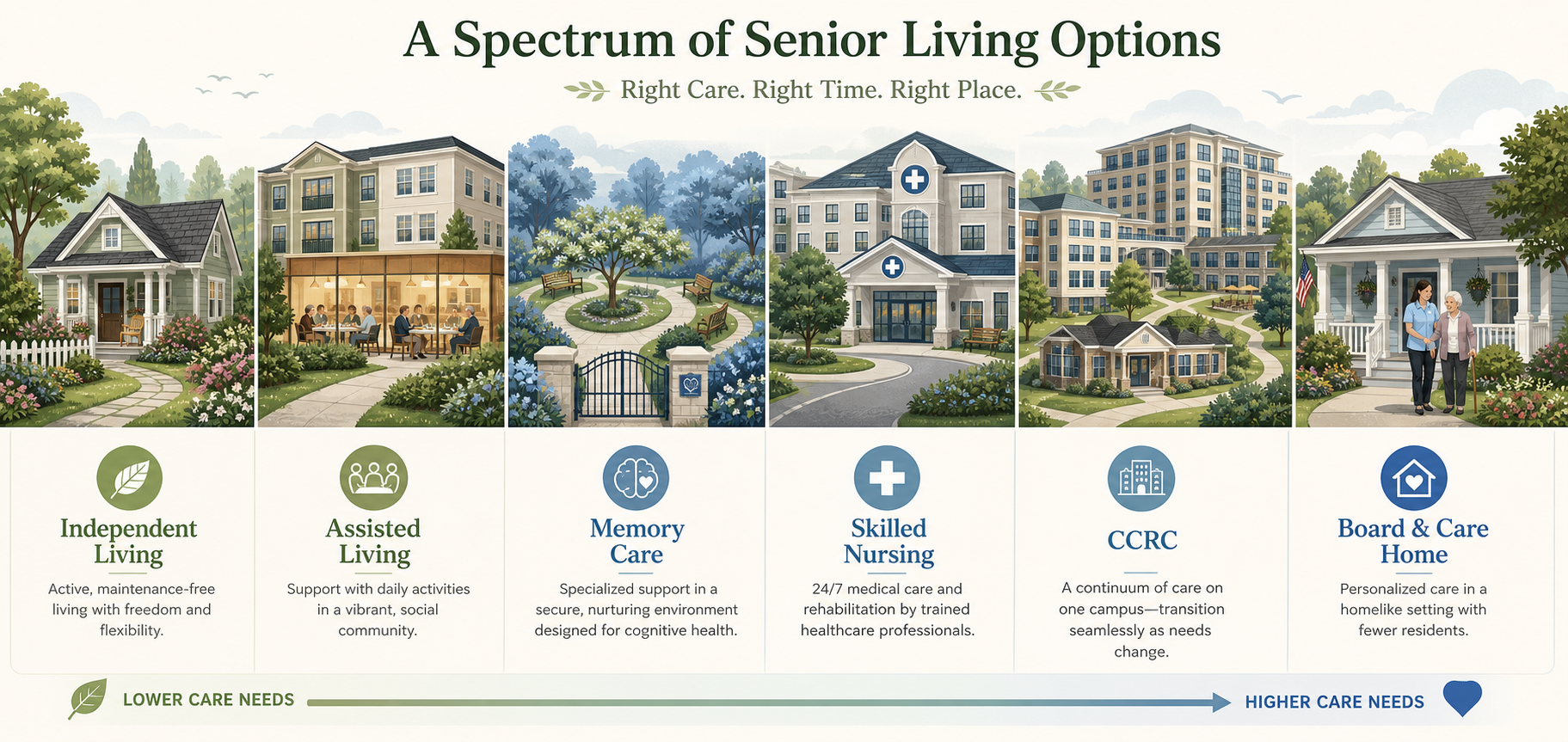
At-a-Glance Comparison: Care Level, Cost, and Who It's For
The table below provides a side-by-side comparison of the six facility types across the dimensions that matter most for decision-making: the level of care provided, the typical monthly cost range, and the ideal resident profile. Use this as a starting point to narrow down which types warrant further investigation.
| Facility Type | Level of Care | Typical Monthly Cost (2026) | Ideal Resident Profile |
|---|---|---|---|
| Independent Living | Minimal to none; social and lifestyle support only | $3,000 (LTCFEDS estimate) | Active older adults (60+) who need no help with ADLs but want community, amenities, and a maintenance-free lifestyle |
| Assisted Living | Help with up to 2 ADLs; 24-hour supervision; medication management | $5,419 median (A Place for Mom); $6,313 median (SeniorLiving.org) | Seniors who need daily assistance but do not require 24/7 nursing care; average age 87 |
| Memory Care | Specialized dementia care; secured environment; structured routines | Higher than assisted living, lower than nursing home (exact median varies) | Individuals with Alzheimer's or other dementias who need a safe, structured environment with trained staff |
| Skilled Nursing / Nursing Home | 24/7 nursing care; rehabilitation; medical supervision | $9,842 semiprivate / $11,294 private (SeniorLiving.org); $8,200 semiprivate (LTCFEDS) | Individuals with complex medical needs requiring daily nursing attention and supervision |
| CCRC | Continuum from independent to skilled nursing on one campus | Varies widely; one-time entrance fee ($50k–$500k+) plus monthly fee ($2k–$5k+) | Seniors who can afford upfront costs and want guaranteed access to higher care levels without relocating |
| Board & Care Home | Personal care in a small, home-like setting (20 or fewer residents) | Varies; generally less than assisted living | Seniors who need some assistance but prefer a small, intimate environment over a large facility |
How to Match Care Needs to the Right Setting: A Decision Framework
Rather than guessing which facility type fits, use a structured needs-assessment framework. The NIA recommends considering the person's current and future needs across several dimensions. Work through the following questions with your family and, if possible, with your parent's primary care provider.
- Current functional status: How much help does your parent need with ADLs (bathing, dressing, eating, toileting, transferring) and IADLs (medication management, meal preparation, housekeeping, transportation)? If they need help with 0–1 ADLs, independent living may be sufficient. If they need help with 2 or more ADLs, assisted living or a higher level of care is likely appropriate.
- Medical complexity: Does your parent have chronic conditions that require daily nursing oversight (e.g., diabetes management, wound care, post-surgery rehabilitation)? If yes, a skilled nursing facility may be necessary. If medical needs are stable and can be managed with weekly visits, assisted living may work.
- Cognitive status: Has your parent been diagnosed with Alzheimer's, dementia, or another cognitive impairment? If wandering, sundowning, or agitation are present, a secured memory care unit is likely the safest option. If cognition is intact, a general assisted living or independent living setting is appropriate.
- Projected trajectory: Is your parent's condition stable, slowly declining, or rapidly changing? If the trajectory is uncertain or likely to require higher levels of care within a few years, a CCRC may offer the best long-term value by avoiding a disruptive move later.
- Budget and payment sources: What is the monthly budget, and what payment sources are available (private pay, long-term care insurance, Veterans benefits, Medicaid)? If budget is tight, a board-and-care home may be more affordable than a large assisted living facility. If your parent may eventually qualify for Medicaid, ensure the facility accepts it.
What Each Type Costs in 2026 — and Why the Differences Matter
Cost is often the first question families ask, but it is also the most misleading if taken out of context. The $3,000–$5,000 monthly difference between assisted living and a nursing home is not arbitrary pricing variation — it reflects fundamentally different care models, staffing ratios, and regulatory requirements. Understanding what you are paying for is as important as knowing the number.
| Facility Type | Monthly Cost Range (2026) | Key Cost Drivers | Primary Payment Sources |
|---|---|---|---|
| Independent Living | $3,000 (LTCFEDS) | Amenities, location, apartment size | Private pay; some long-term care insurance policies may cover a portion |
| Assisted Living | $5,419 median (A Place for Mom); $6,313 median (SeniorLiving.org) | Level of care (tiered pricing), medication management, location | Primarily private pay; some states have Medicaid waivers for assisted living; long-term care insurance |
| Memory Care | Higher than assisted living; lower than nursing home | Specialized staff training, secured environment, lower staff-to-resident ratios | Private pay; some long-term care insurance policies with dementia riders; limited Medicaid coverage |
| Skilled Nursing (Semiprivate) | $9,842 (SeniorLiving.org); $8,200 (LTCFEDS) | 24/7 nursing staff, rehabilitation services, medical equipment | Medicare (first 100 days after hospital stay); Medicaid (long-term); private pay; long-term care insurance |
| Skilled Nursing (Private) | $11,294 (SeniorLiving.org) | Private room premium | Same as semiprivate; private pay for the room differential |
| CCRC | Varies widely; entrance fee $50k–$500k+; monthly $2k–$5k+ | Entrance fee model (refundable vs. non-refundable), level of care contract | Private pay; some long-term care insurance policies may cover the skilled nursing portion |
| Board & Care Home | Generally less than assisted living | Small scale, lower overhead, location | Private pay; some states may have Medicaid coverage for board and care |
Several important patterns emerge from this data. First, assisted living costs have been rising about 5% per year, according to A Place for Mom. Second, the gap between assisted living and nursing home costs — roughly $3,000 to $5,000 per month — reflects the difference between a setting that provides help with daily activities and one that provides round-the-clock nursing care. Third, the wide variation in CCRC costs (entrance fees from $50,000 to over $500,000) means that this option is only viable for a subset of families, but for those who can afford it, it offers the most predictable long-term cost structure.
Signs It's Time: Assessing Whether a Parent Needs a Higher Level of Care
Recognizing when a parent's current living situation is no longer safe or sustainable is one of the hardest parts of caregiving. The signs are often gradual, and families may normalize them over time. A Place for Mom identifies several key indicators that it may be time to consider a higher level of care.
- Trouble with ADLs: According to the CDC, 13.8% of adults aged 75 and older needed personal care assistance in 2024. If your parent is struggling with bathing, dressing, or toileting, it is a clear signal that daily help is needed.
- Medication errors: Misuse of prescription medications is a leading cause of emergency room visits for adults over 65, sending over 600,000 to the ER annually, per the CDC. Missed doses, double-dosing, or confusion about medication schedules are serious red flags.
- Poor nutrition or weight loss: If your parent is unable to cook, has lost interest in eating, or is losing weight unintentionally, it may indicate that meal preparation and nutritional support are needed.
- Isolation and loneliness: Withdrawing from social activities, no longer attending community events, or spending most days alone can accelerate cognitive and physical decline.
- Unsafe home environment: Cluttered walkways, expired food in the refrigerator, unpaid bills, or neglected home maintenance are signs that the current living situation is becoming unmanageable.
- Caregiver burnout: If the primary family caregiver is experiencing exhaustion, irritability, or health problems of their own, it is a sign that the current care arrangement is not sustainable.
- Doctor recommendation: If a physician has recommended a higher level of care, it is worth taking seriously. Medical professionals can often see risks that families have normalized.
How to Talk to a Reluctant Parent About Moving
One of the most emotionally charged aspects of this process is the conversation itself. Many older adults resist the idea of leaving their home, and their refusal often stems from fear, pride, or a deep desire to maintain independence. SeniorLiving.org and A Place for Mom offer practical strategies for navigating these conversations with empathy and effectiveness.
- Start early, before a crisis: The best time to have the conversation is months or even years before a move becomes necessary. Early discussions allow everyone to process the idea gradually without the pressure of an imminent decision.
- Have multiple discussions over weeks or months: One conversation is rarely enough. Plan for a series of talks, each building on the last. This gives your parent time to absorb the information and express their concerns.
- Listen and empathize first: Before presenting options, ask your parent what they are worried about. Acknowledge their feelings. A successful conversation, as A Place for Mom notes, is one where everyone's thoughts are respected.
- Reframe the benefits: Instead of framing the move as a loss of independence, emphasize what they will gain: social opportunities, freedom from home maintenance, three meals a day, and access to activities. SeniorLiving.org suggests focusing on "vibrant communities" and socialization.
- Give them choices: Offer two or three specific options (e.g., "Would you like to visit the community with the garden or the one with the art studio?") rather than a single ultimatum. Control over the decision is critical for acceptance.
- Bring in a trusted third party: A doctor, clergy member, or elder law attorney can sometimes say things that family members cannot. A recommendation from a physician carries significant weight.
- Try interim solutions first: If your parent is completely resistant, consider starting with in-home help, a medical alert system, or a short-term respite stay at an assisted living facility. Experiencing the benefits firsthand can change their perspective.
Your Touring Checklist: What to Look For at Each Facility Type
Once you have narrowed down the facility types that fit your parent's needs, the next step is to visit. The NIA provides a comprehensive Nursing Home Checklist that can be adapted for any facility type. Use the following questions as a starting point, and tailor them to the specific type you are visiting.
| Category | Questions to Ask | What to Look For |
|---|---|---|
| Staffing | What is the staff-to-resident ratio during the day and at night? What is the staff turnover rate? What training do staff receive? | Staff who are visible, engaged, and interact warmly with residents. Low turnover suggests a stable, well-managed facility. |
| Care Services | What services are included in the base rate? What costs extra (medication management, therapy, transportation)? How are care plans developed and updated? | A clear, written fee schedule. A process for reassessing care needs at regular intervals (e.g., every 6 months or after a change in condition). |
| Safety | Are grab bars installed in bathrooms and hallways? Are there emergency call systems in rooms and bathrooms? Is the facility secured for memory care residents? | Clean, well-lit hallways. Accessible emergency exits. Secure outdoor areas for memory care. No obvious tripping hazards. |
| Activities | What is the daily activity schedule? Are there activities tailored to different cognitive and physical ability levels? How often do residents go on outings? | A posted activity calendar with a variety of options. Residents who are engaged, not just sitting in hallways. |
| Meals and Nutrition | Can residents choose meal times and menu items? Are dietary restrictions accommodated? Is there a registered dietitian on staff? | A dining room that feels welcoming, not institutional. Menu options that look appetizing. Staff who assist residents who need help eating. |
| Medical Care | How often does a doctor visit? Is there a relationship with a nearby hospital? How are medication errors handled? | A clear protocol for medication management. Evidence of regular physician visits. A plan for medical emergencies. |
| Contracts and Costs | What is the move-in fee? What is the refund policy if the resident leaves within the first 30 days? Under what circumstances can the facility increase fees? | A contract that is written in plain language. No hidden fees. A clear explanation of what triggers a rate increase. |
When you visit, pay attention to the intangible details: Do residents look clean and comfortable? Do staff members greet residents by name? Does the facility smell clean? Is there a sense of activity and purpose, or does it feel沉闷 and empty? Trust your instincts. A facility that feels wrong during a tour will likely feel wrong after a move.
Questions to bring to a clinician or OT
This is not medical, legal, or a family's final decision — only a framework. Bring these questions to a clinician, occupational therapist, or your local Area Agency on Aging.
Find Local HelpRelated reading
Noticed something outdated or inaccurate on this page? Flag a correction. We review every report against CDC, NIA, and AARP HomeFit guidance before updating a page.