
Caregiver decision guide
Senior Travel Safety Tips During the 2026 Worldwide Caution
The 2026 State Department Worldwide Caution does not ban all international travel for older adults, but it demands preparation beyond typical senior travel advice. This guide helps caregivers assess real risk, enroll in STEP alerts, review travel insurance exclusions, and build medically grounded contingency plans for their parent's trip.
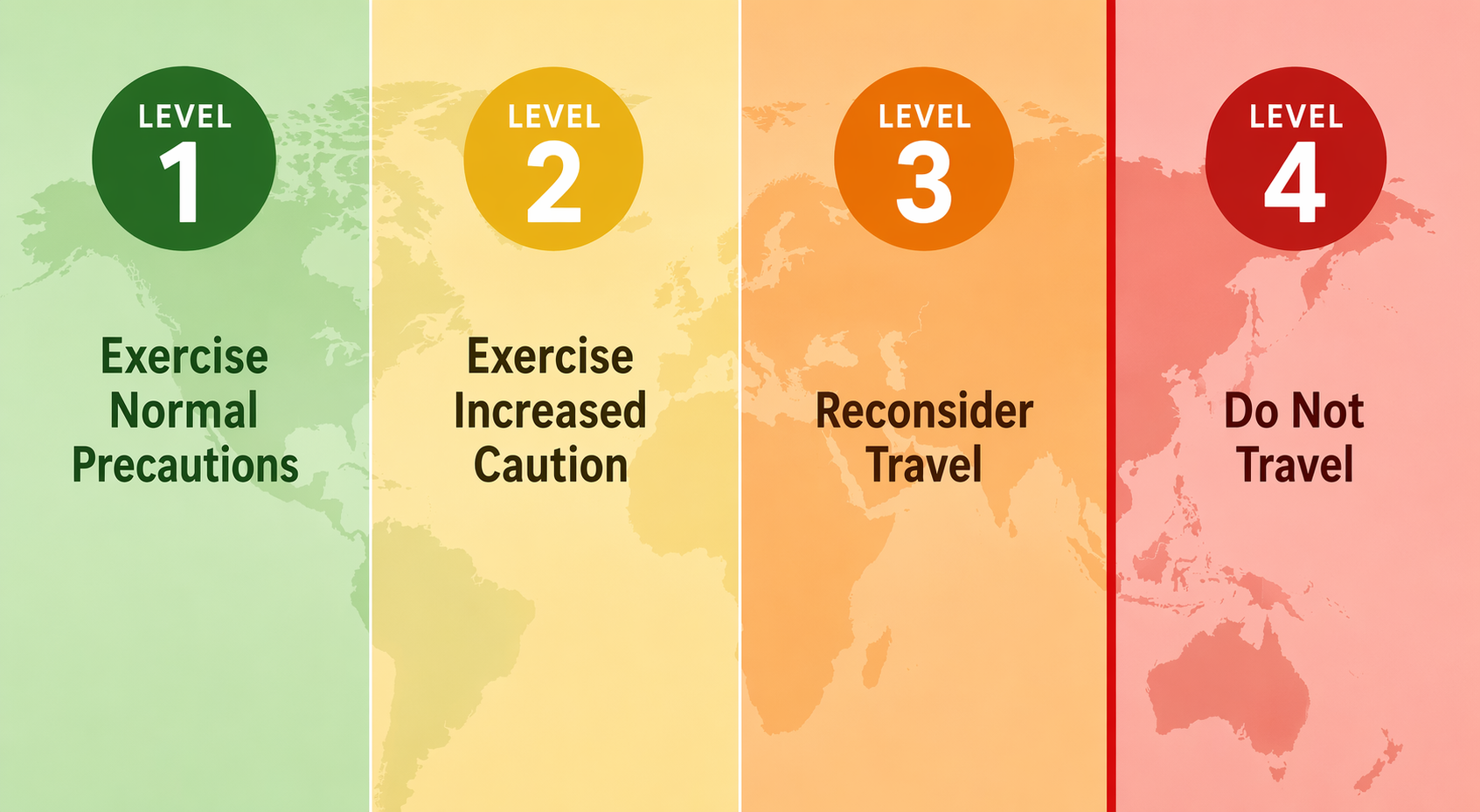
Seeing “Worldwide Caution” next to a parent’s international itinerary can make the whole trip sound reckless. It is not that simple. The 2026 Worldwide Caution is a Level 2 “Exercise Increased Caution” advisory, not a worldwide Level 4 “Do Not Travel” order, and it was first issued in March 2026 and renewed in July 2026, according to news coverage of the State Department notice.[1] For families looking for senior travel safety tips during worldwide caution, the first job is to separate a broad global alert from the actual advisory level for the country on the ticket.
That distinction matters because older adults are still traveling. AARP’s 2026 travel survey found that 64% of adults age 50 and older planned to travel in 2026, with average planned spending of $7,200; among those planning international trips, 83% had already chosen a destination.[2] The same survey found that cancellation concerns among travelers 50 and older rose from 24% to 36% year over year.[2] In other words, many families are not deciding between travel and no travel in the abstract. They are looking at a real reservation, a real passport, a real medication list, and a parent who may reasonably ask, “What exactly has changed?”

Start With The Advisory Level, Not The Family Argument
A Worldwide Caution asks U.S. citizens abroad to be more alert because security conditions can shift across regions. It does not replace the country-specific advisory for France, Japan, Egypt, Colombia, or wherever the trip actually goes. The family conversation should begin with the destination page, not with everyone’s anxiety level.
| Advisory Level | What It Means For A Parent’s Trip |
|---|---|
| Level 1 | Use normal preparation, but still enroll in alerts and review medical logistics. |
| Level 2 | Exercise increased caution; the 2026 Worldwide Caution is in this category.[1] |
| Level 3 | Reconsider travel; the burden of proof shifts toward whether this trip is necessary and manageable. |
| Level 4 | Do not travel; treat this as a firm boundary, not a preference. |
The current Level 4 list deserves special treatment. Kiplinger and silive.com both reported an 18-country “Do Not Travel” group in 2026, and the practical meaning is severe: government assistance may be limited in these destinations, and insurers may exclude coverage tied to these warnings.[3][4] A capable parent still has autonomy. A caregiver still gets to say, clearly, “I cannot be your backup plan for a destination where the U.S. government says do not travel.”
A Practical Triage Before Anyone Debates Cancellation
- Open the State Department country advisory for every destination and transit country, not just the final stop.
- Check the advisory level and the reason for the advisory, such as terrorism, civil unrest, crime, wrongful detention, health risk, or limited government services.
- Look for recent review dates or updates so the family is not relying on an old screenshot.
- Treat Level 4 as a stop sign; treat Level 3 as a serious reconsideration point; treat Level 1 and Level 2 as preparation categories, not automatic green lights.
- Repeat the check after any itinerary change, especially if a new connection, cruise port, border crossing, or overnight layover is added.
This is where many family conversations go wrong. “It is only Level 2” may be true for the worldwide notice, but the parent is not traveling to “worldwide.” They are traveling through specific airports, using specific ground transportation, and carrying specific health needs. The advisory level narrows the argument to something everyone can verify.
Enroll In STEP Before The Trip Becomes Complicated
The Smart Traveler Enrollment Program, usually called STEP, is free and allows U.S. travelers to receive security messages from the nearest U.S. embassy or consulate; coverage of the 2026 Worldwide Caution also emphasized STEP as the route for embassy-issued alerts.[1] This is one of the few travel tasks that directly answers the caregiver’s most uncomfortable question: if something changes while my parent is abroad, who tells them first?
The parent should be enrolled with the full itinerary, lodging details, phone number, email address, and emergency contact. If the trip has multiple countries, each stop should be included. If flights or hotels change, the enrollment should be updated. A caregiver can help enter the information without taking over the trip.
- Save embassy and consulate contact information in the parent’s phone and on paper.
- Decide who at home will monitor advisories while the parent is traveling.
- Agree on what kind of alert triggers a call, a route change, or a request to contact the tour operator.
- Keep the parent’s passport number, itinerary, insurance policy number, and medication list accessible to the emergency contact.
The point is not to make a parent feel tracked. It is to remove the lag between an official alert and a family trying to reconstruct the itinerary from text messages.
Read The Insurance Policy As If The Route Changes Tomorrow
Travel insurance often sounds reassuring until the family asks the exact question that matters: “What happens if the destination becomes Level 4, if flights are rerouted, or if a government warning affects the trip?” Kiplinger notes that standard travel insurance policies often exclude coverage in Level 4 countries or during government-mandated bans, and that “cancel for any reason” upgrades can cost 40% to 60% more.[3] That does not mean every policy works the same way. It means no one should assume the word “covered” applies to geopolitical disruption.
The caregiver’s useful role is to help ask questions before the parent pays final balances or boards the first flight. These questions are less dramatic than “Are you sure you should go?” and much harder to dismiss.
- Does the policy cover trip cancellation or interruption if the country advisory changes after purchase?
- Are Level 3 or Level 4 advisories excluded?
- Does coverage apply to terrorism, civil unrest, airspace closure, strike, border closure, or mandatory evacuation?
- Is medical evacuation included, and who decides whether evacuation is medically necessary?
- Are preexisting conditions covered, and was any waiver purchased within the required time window?
- If the parent buys “cancel for any reason” coverage, what percentage of the prepaid cost is reimbursed and what is the cancellation deadline?
Ask for answers in writing or save the chat transcript. A phone reassurance is not the same as policy language. If the parent is using a tour company, cruise line, travel agent, or credit card benefit, the same questions still apply because each layer may define cancellation, delay, evacuation, and exclusions differently.
Build The Medical Plan Around Delays, Not Just The Destination
Generic packing advice rarely confronts the scenario families actually fear: a parent is healthy enough to travel, but a missed connection stretches into two nights, a bag is checked by mistake, or a route change separates the traveler from the pharmacy they expected to use. Nearly 9 in 10 older adults take at least one medication daily, according to the National Council on Aging, citing CDC National Health Statistics System data.[5] That turns transportation disruption into a medical planning issue.

The medication plan should be boring, redundant, and documented. Prescriptions should stay in carry-on luggage, in original labeled containers when possible. The parent should carry a printed medication list with generic and brand names, dosages, prescribing clinician information, allergies, and major diagnoses. If any medication is time-sensitive, temperature-sensitive, sedating, injectable, controlled, or difficult to replace abroad, that needs a separate discussion with the clinician or pharmacist before departure.
- Ask the prescribing clinician how many extra days of medication are appropriate for the itinerary and likely transit delays.
- Check whether medications are legal in the destination and transit countries, especially controlled substances and certain sleep, anxiety, or pain medicines.
- Carry paper copies of prescriptions and a clinician letter when medication needs explanation at customs or security.
- Pack a small written schedule that accounts for time-zone changes, rather than assuming the parent will calculate dosing times while tired.
- Keep one medication list with the parent and one with the emergency contact at home.
Health coverage abroad deserves the same plain-language review. Original Medicare generally does not cover health care outside the United States, and Medigap foreign travel emergency coverage has limits, including a lifetime cap.[5][6] Families who assume care abroad will be billed and coordinated like care at home can be caught off guard by payment requirements, language barriers, hospital selection, and evacuation decisions.
This is also where routine preventive advice belongs, but only in proportion. HealthInAging advises older travelers to discuss vaccinations well ahead of travel, noting that some vaccines may need to be given at least 6 weeks before departure.[6] Mobility supports, fall risk, hydration, sleep, and airport wheelchair assistance are all worth planning, but they should connect to the actual trip: long layovers, unfamiliar stairs, cobblestones, heat, distance between gates, and the chance that a delay keeps the parent moving for more hours than expected.
Make An Emergency Communication Plan That Does Not Depend On One Phone
A family can do everything right and still face a changed gate, canceled route, civil demonstration near a hotel, lost phone, or parent who forgets to turn on international roaming. The plan should assume that one communication channel will fail.
- Set a check-in rhythm before departure, such as arrival texts, hotel check-ins, and a brief message after major transfers.
- Write down the parent’s phone number, email, hotel contacts, tour operator, airline record locator, and insurance emergency number.
- Give the parent a printed card with the emergency contact, embassy contact, insurance assistance line, allergies, medications, and primary diagnoses.
- Agree on what the caregiver is allowed to do if the parent misses a scheduled check-in, such as calling the hotel, tour leader, airline, or insurer.
- Choose one family spokesperson so three relatives are not separately calling the same embassy, hotel, or hospital.
The most useful boundary is set in advance: “If I do not hear from you after X event, I will take Y step.” That is not surveillance. It is consent-based backup.
When The Answer Is Go, Reconsider, Or Stop
A prepared decision does not always point in the same direction. Some Level 1 or Level 2 trips may be reasonable after STEP enrollment, insurance review, medical planning, and a workable communication plan. Some Level 3 trips may still look too fragile once the family sees the parent’s health needs, the route, and the exclusions. Level 4 should not be negotiated into a normal vacation because the advisory itself says not to travel, and the support systems around the traveler may be thinner exactly when they are needed most.[3][4]
| If This Is True | The Caregiver’s Next Move |
|---|---|
| Destination and transit points are Level 1 or Level 2 | Prepare carefully; do not treat the Worldwide Caution alone as a cancellation order. |
| A destination or transit point is Level 3 | Reconsider the trip with the parent, insurer, clinician, and travel provider before final payment or departure. |
| Any destination is Level 4 | Treat the itinerary as outside the family’s acceptable backup capacity. |
| Insurance excludes the risk most likely to disrupt the trip | Reprice or redesign the trip before assuming the family can absorb the loss. |
| Medication or mobility needs cannot withstand a delay | Change the itinerary, add support, or postpone until the medical plan is stronger. |
The caregiver’s role is not to win the travel argument. It is to make the hidden failure points visible before departure: the advisory level no one checked, the STEP alert no one enrolled in, the insurance exclusion no one read, the medication supply that only works if every flight is on time, and the emergency plan that exists only in someone’s head.
Older adults are not categorically barred from international travel during the 2026 Worldwide Caution. But “I still want to go” and “we know what we will do if conditions change” are different statements. The second one is the standard worth working toward.
References
- New travel alert: ‘Worldwide Caution’ urged by State Department, Cleveland.com, July 2026
- AARP 2026 Travel Trends survey, AARP, March 10, 2026
- 21 Countries the U.S. Says You Shouldn’t Travel to Right Now, Kiplinger
- Planning international travel in 2026? Here are the 18 countries the U.S. says you should never visit, silive.com, May 2026
- Safe Travel Tips for Older Adults, National Council on Aging
- Tip Sheet: Safe Travel Tips for Older Adults, HealthInAging
Questions to bring to a clinician or OT
This is not medical, legal, or a family's final decision — only a framework. Bring these questions to a clinician, occupational therapist, or your local Area Agency on Aging.
Find Local HelpRelated reading
Noticed something outdated or inaccurate on this page? Flag a correction. We review every report against CDC, NIA, and AARP HomeFit guidance before updating a page.