
Caregiver decision guide
Cyclospora Outbreak Safety Tips for Seniors and Caregivers
This guide helps seniors and their caregivers navigate the 2026 cyclospora outbreak — covering which foods to avoid, how to safely prepare meals, which symptoms warrant a doctor call, and what to ask about testing and treatment tailored to older adults.
Last reviewed: July 19, 2026.
If you are caring for an older parent during the 2026 cyclospora outbreak, the first decision is not whether every salad in America is unsafe. It is what changes before the next meal, what symptoms stop being “just a stomach bug,” and what words you may need to use at the clinic so the right test is ordered.
As of mid-July 2026, CDC had reported more than 1,645 confirmed domestically acquired cyclosporiasis cases, with more than 5,100 additional illnesses under investigation across 34 states; about 9% of confirmed cases had been hospitalized, and reported ages ranged from 2 to 95 years, with a median age of 44.[1][2] FDA has also described a separate five-state cluster in Indiana, Kentucky, Michigan, Ohio, and West Virginia linked to Taylor Farms shredded iceberg lettuce served at Taco Bell.[3]
Keep those two facts separate. The lettuce-linked cluster matters if your parent ate at an affected Taco Bell or has recalled or implicated lettuce in the refrigerator. It does not explain every case in the national rise. For the wider outbreak, public health investigators have not pinned every illness to one food, one restaurant, or one supplier.
For seniors, the danger is less about the parasite being uniquely aggressive in older bodies and more about what prolonged watery diarrhea does to a body with less reserve. Older adults are more likely to have chronic conditions, take medicines that affect fluid balance, and become dehydrated before anyone realizes the situation has turned. AARP’s senior-focused guidance highlights dehydration, delayed diagnosis, medication interactions, and missed testing as the issues families most need to watch.[4]

The senior-specific bottom line for today
Until the current outbreak is clearer, a careful household standard is reasonable: avoid recalled or possibly implicated raw lettuce, pause higher-risk raw produce dishes when a cooked option will do, use cooked meals more often, and treat watery diarrhea that lasts more than a couple of days as a medical call rather than a wait-and-see inconvenience.
CDC notes that adults 65 and older are generally at higher risk for severe foodborne illness; in CDC’s broader food safety materials, nearly half of people 65 and older with laboratory-confirmed illness from Salmonella, Campylobacter, Listeria, or E. coli are hospitalized.[5] That figure is not a cyclospora-specific hospitalization rate. It is a useful warning about the older body’s narrower margin when foodborne illness turns into dehydration, weakness, or medication problems.
| Household question | Practical answer during the outbreak |
|---|---|
| Should Dad eat the bagged salad already open in the fridge? | If it is recalled, implicated, unlabeled, or from a source you cannot verify, discard it. Do not try to wash it into safety. |
| Is rinsing lettuce enough? | No. Washing may reduce some contamination, but it does not reliably remove Cyclospora. |
| What is the safer dinner swap? | Cooked vegetables, soups, casseroles, cooked grains, pasteurized dairy, and fully cooked proteins. |
| When does diarrhea need a doctor call? | Call if watery diarrhea lasts more than 2 to 3 days without improvement or reaches more than 6 to 8 episodes in a day. |
| What should we ask the clinician? | Ask whether Cyclospora-specific stool testing or PCR is needed, and review medications before treatment. |
What to stop serving or buying for now
Start with the obvious exposure: any lettuce or salad product named in a recall, served by a restaurant named in an investigation, or matching a public health notice for your state should not be served to an older adult. If the package is gone and no one knows the brand, lot, or source, the safe answer is to throw it out. This is one of those moments when thrift has to lose to risk control.
The FDA’s July 2026 investigation specifically connects a five-state outbreak cluster to Taylor Farms shredded iceberg lettuce served at Taco Bell in Indiana, Kentucky, Michigan, Ohio, and West Virginia.[3] If your parent ate Taco Bell items with lettuce in those states during the period covered by the investigation, write that down with the date as closely as you can. If symptoms appear, that detail belongs in the call to the doctor.
For a deeper look at the lettuce issue, keep recalled lettuce poses serious risks for older adults handy as a separate reference. In the kitchen today, though, the instruction can stay plain: when a raw leafy green is recalled, implicated, or uncertain, do not serve it to a senior.
Restaurant salads deserve a lower threshold, too. A caregiver cannot inspect a restaurant’s supplier records from the passenger seat, and an older adult should not have to interrogate a cashier to eat lunch. During an active outbreak, it is reasonable to choose a cooked entrée, a hot side, or a sandwich without raw lettuce rather than trying to judge the safety of shredded greens at the counter.
Why “just wash it well” is not enough
Cyclospora is not handled like ordinary dirt on a tomato. CDC says cooking food to 158°F, or 70°C, kills Cyclospora, but washing fruits and vegetables does not reliably remove it.[6] That is the line families need on the refrigerator door, because it changes the meal plan more than a general reminder about clean hands and rinsed produce.
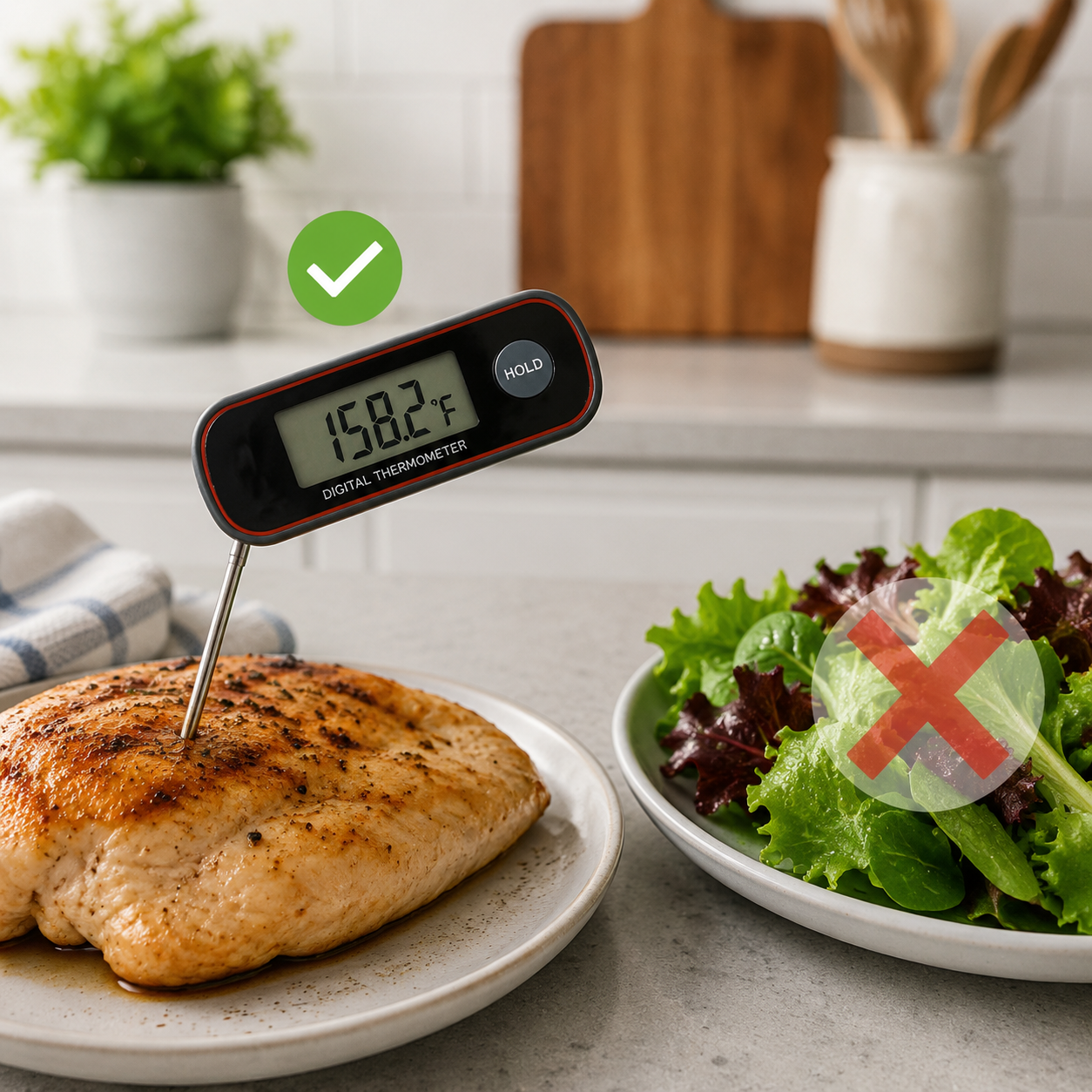
This does not mean every fresh food is forbidden. It means raw produce that cannot be cooked, peeled, or traced deserves more caution while investigators are still working. If your parent values independence in the kitchen, frame the shift as temporary outbreak housekeeping, not as a judgment on their cooking.
- Use cooked vegetables instead of raw salads when the meal does not depend on salad.
- Choose fruits that can be peeled by the person eating them, rather than pre-cut fruit from an uncertain source.
- Skip raw garnishes, shredded lettuce, and salad-bar toppings for now.
- Keep raw produce separate from ready-to-eat foods, utensils, and cutting boards.
- Use a food thermometer for cooked foods when temperature matters, rather than guessing by color or steam.
CDC’s safer food choices for adults 65 and older emphasize avoiding higher-risk foods and choosing safer preparations, such as fully cooked foods and pasteurized products.[7] If you want a broader kitchen routine beyond this outbreak, Protect Your Elderly Parent from Cyclosporiasis in the Kitchen can carry the day-to-day prevention work without crowding today’s urgent decisions.
What symptoms to track, and what changes the plan
Cyclospora commonly causes watery diarrhea, and symptoms can seem to improve and then return.[8] That waxing-and-waning pattern is one reason older adults may dismiss it. A parent may say, “I’m better today,” skip fluids, and then have another bad night.
Do not rely on memory here. Keep a simple note on the counter or in a phone: time of each diarrheal episode, vomiting, fever, food and fluid intake, urination, dizziness, confusion, and whether usual medicines were taken. This is not busywork. It gives the nurse or clinician something clearer than “she’s had stomach trouble all week.”
| Symptom or situation | What to do |
|---|---|
| Watery diarrhea for more than 2 to 3 days without improvement | Call the doctor or clinic. |
| More than 6 to 8 diarrheal episodes in one day | Call the doctor the same day. |
| Unable to keep fluids down | Seek urgent care or emergency guidance. |
| Persistent vomiting, high fever, blood in stool, or confusion | Go to the emergency department or call emergency services. |
| Dizziness, very little urination, unusual sleepiness, or new weakness | Treat as possible dehydration and escalate promptly. |
These escalation points align with AARP’s reporting, citing infectious disease specialist Dr. Luis Marcos, and with standard warning signs for dehydration or more serious illness.[4]
If you need a focused symptom guide to share with siblings or home aides, use Recognizing cyclospora symptoms in elderly loved ones so everyone is watching for the same changes.
Hydration is the part that cannot wait
For an older adult, dehydration is not only thirst. It may show up as weakness, dizziness, a fall, confusion, dry mouth, reduced urination, or a sudden inability to manage usual routines. A parent who is proud of “not making a fuss” may underreport diarrhea and drink less to avoid more bathroom trips.
Offer fluids in small, repeated amounts rather than one large glass that sits untouched. Broth, oral rehydration solutions, and other clinician-approved fluids may be easier than plain water for someone who is nauseated. If the person has heart failure, kidney disease, or a fluid restriction, ask the clinician how to balance rehydration with those limits instead of guessing.
The caregiver’s job is not to diagnose dehydration perfectly. It is to notice when the trend is moving the wrong way and call before the older adult is too weak to walk safely to the bathroom.
At the medical visit, say “Cyclospora” out loud
This is the testing gap families should know before they are sitting in urgent care. Routine ova-and-parasite stool exams may miss Cyclospora; CDC and clinical experts note that specific testing, such as modified acid-fast staining or molecular testing, may be needed, and multiple stool samples may be required.[4][9]
Use direct language: “There is a 2026 Cyclospora outbreak, my mother has had watery diarrhea for several days, and she may have eaten implicated lettuce. Should the stool test specifically include Cyclospora or PCR testing?” That sentence is not pushy. It is the difference between a general stomach-bug visit and a visit that accounts for the outbreak.
- Bring the symptom log, including the number of diarrheal episodes per day.
- Bring a current medication list, including over-the-counter drugs and supplements.
- Mention restaurant meals, recalled foods, bagged salads, and travel during the likely exposure period.
- Ask whether more than one stool sample is needed if the first test is negative.
- Ask what symptoms should trigger an emergency visit after you go home.
Treatment questions are different for older adults
The standard treatment for cyclosporiasis is trimethoprim-sulfamethoxazole, often shortened to TMP-SMX, but a caregiver should not treat that as a casual prescription detail. AARP’s senior-focused guidance flags important concerns with warfarin, diabetes medications, potassium-sparing diuretics, methotrexate, kidney issues, and sulfa allergy; people with sulfa allergy may need specialist input because alternatives are limited.[4]
This is not a reason to refuse treatment. It is a reason to make the medication conversation complete. If your parent takes warfarin, ask how blood-thinning risk will be monitored. If they take diabetes medicine, ask what to do if appetite is poor and blood sugar drops. If they take a potassium-sparing diuretic or have kidney disease, ask whether labs are needed. If methotrexate is on the list, say so clearly.
Older adults who manage their own appointments may want to write these questions before they call. It is easy to remember the diarrhea and forget the medication list when the receptionist is trying to find a same-day slot.
If you are coordinating care from another home
Long-distance caregiving during a diarrheal illness is awkward because the important facts are private, repetitive, and easy to minimize. Do not start by asking, “Are you okay?” Many parents will say yes because they are still standing. Ask for countable information: how many times since breakfast, whether they have urinated, whether they kept fluids down, whether they feel dizzy when standing, and whether anyone can check on them before bedtime.
If several relatives are involved, choose one person to keep the symptom log and one person to handle the clinic call. Duplicate calls and scattered texts can make a sick parent feel managed instead of helped. A shared Emergency Contact Binder or Long-Distance Caregiver's Emergency Response Plan helps because the pharmacy, medication list, primary doctor, insurance details, and nearest emergency department are already written down before anyone is tired or scared.
A calmer grocery and meal standard until the outbreak settles
For the next few days or weeks, depending on what public health officials report, build meals around foods that do not require trust in raw produce handling. Soups, stews, baked potatoes, cooked frozen vegetables, eggs cooked through, fully cooked fish or poultry, rice bowls with hot vegetables, and pasteurized dairy can keep meals normal without leaning on raw lettuce.
If your parent loves salad, do not turn dinner into a lecture. Offer a temporary substitution and name the reason: “Because this outbreak involves a parasite that washing does not reliably remove, let’s use cooked vegetables tonight.” That is clearer and kinder than hovering over the sink while someone rinses lettuce for the third time.
During the 2026 cyclospora outbreak, seniors do not need panic. They need a lower threshold for cooked foods, a firm discard rule for recalled or uncertain lettuce, daily hydration monitoring when diarrhea starts, Cyclospora-specific testing when symptoms fit, and a treatment conversation that includes the medicines older adults actually take.
References
- Domestically Acquired Cyclosporiasis Cases in Multiple U.S. States. CDC HAN Alert. July 2026.
- Investigation Update: Cyclosporiasis Outbreak, July 2026. CDC. July 2026.
- Investigation of 5-State Outbreak of Cyclospora Illnesses: Iceberg Lettuce, July 2026. FDA. July 2026.
- What Older Adults Should Know About Cyclospora. AARP.
- People at Risk: Older Adults. CDC.
- Preventing Cyclosporiasis. CDC.
- Safer Food Choices for Adults 65 and Older. CDC.
- Symptoms of Cyclosporiasis. CDC.
- Cyclosporiasis Outbreak 2026 Q&A. Johns Hopkins Medicine.
Questions to bring to a clinician or OT
This is not medical, legal, or a family's final decision — only a framework. Bring these questions to a clinician, occupational therapist, or your local Area Agency on Aging.
Find Local HelpRelated reading
Noticed something outdated or inaccurate on this page? Flag a correction. We review every report against CDC, NIA, and AARP HomeFit guidance before updating a page.