
Caregiver decision guide
How to Fly a Senior Safely from Seattle to Columbus
Plan a safe, comfortable non-stop flight for an older adult from Seattle to Columbus with this route-specific guide covering airport accessibility, Alaska Airlines policies, DVT prevention, the 3-hour time change, and ground arrival logistics.
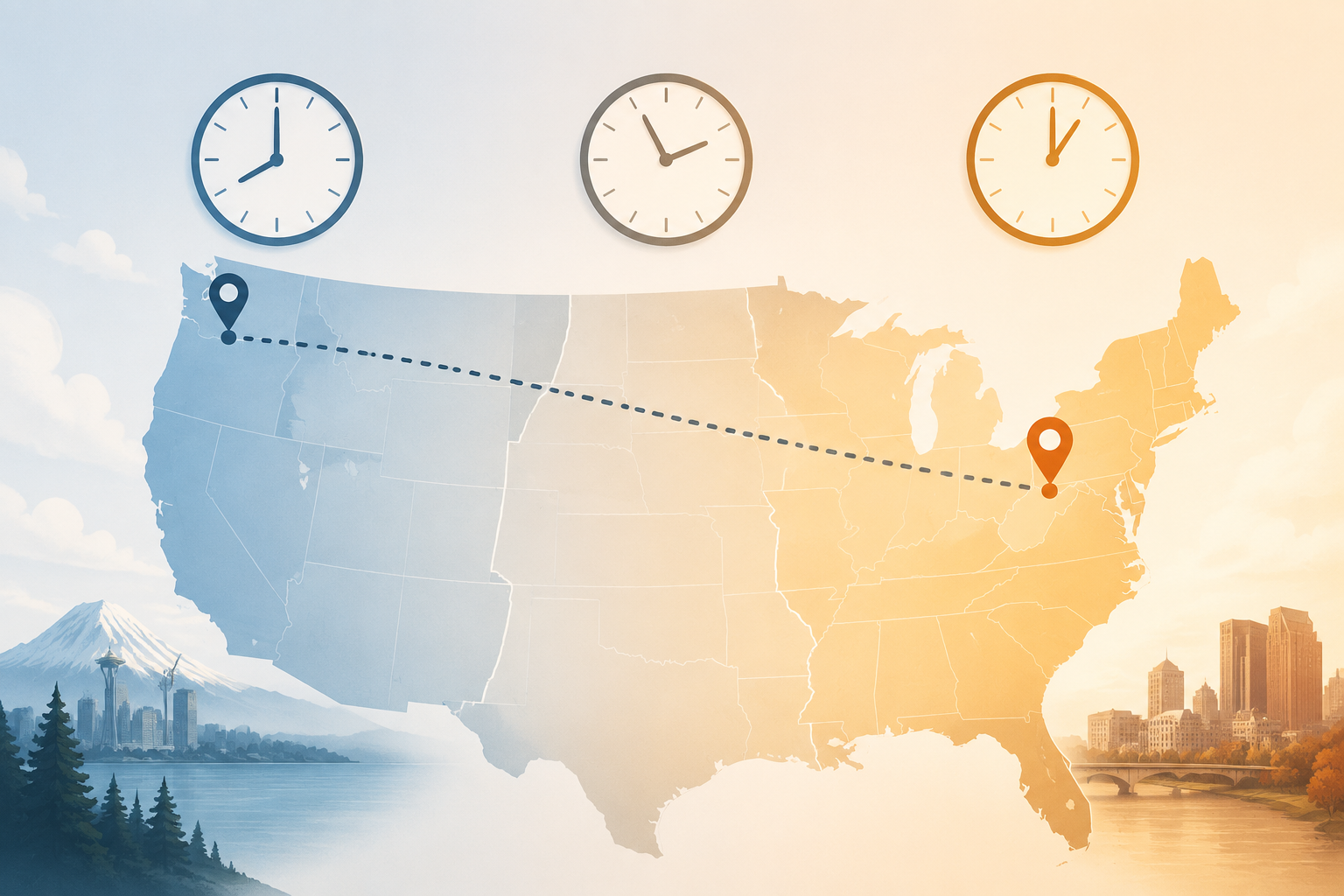
For a senior flying from Seattle to Columbus, the calendar matters more than the suitcase. The nonstop Alaska Airlines route is manageable in one day: scheduled flight time is about 4 hours and 27 minutes over 2,023 miles, with a 3-hour move from Pacific Time to Eastern Time.[1] That is short enough to avoid building the trip around an overnight layover, but long enough that mobility help, medications, movement, and arrival transportation should not be left to airport improvisation.
The three deadlines to put on the family calendar first are these: request Columbus airport’s Journey Care Kit at least 45 days before travel, call TSA Cares 72 hours before the flight, and confirm wheelchair assistance with Alaska Airlines at least 48 hours before departure.[2][3][4] If those are handled, the rest of the trip becomes a sequence of handoffs instead of a string of hopes.
Start With the Three Dates That Can Actually Break the Trip
A cheap fare is useful only if the support around it is ready. FlightsFrom lists Alaska Airlines as the nonstop carrier on SEA-to-CMH, and fare examples can fluctuate; January and October appeared among the cheaper months in July 2026, with examples around $267, but that should be treated as a moving fare clue, not a promise.[1]
| When to act | What to do | Why it matters on SEA-to-CMH |
|---|---|---|
| 45+ days before travel | Email CMH’s accessibility team to request the Journey Care Kit if the traveler may benefit from Sunflower Lanyards, a social story PDF, or sensory support. | This is the longest lead time in the whole trip and the easiest to miss. |
| 4–6 weeks before travel | Schedule a pre-travel health visit and review medications, mobility limits, compression socks, and the travel-day plan. | CDC recommends older adults see a healthcare provider 4–6 weeks before travel. |
| At booking or soon after | Book the Alaska nonstop, request wheelchair or mobility assistance, choose seats, and note pre-boarding needs. | Wheelchair service starts with the airline, not with a vague note to the airport. |
| 72 hours before departure | Call TSA Cares at 855-787-2227 if screening help is needed. | This gives TSA time to arrange Passenger Support Specialist assistance. |
| 48 hours before departure | Reconfirm Alaska Airlines wheelchair assistance and any mobility needs. | Alaska’s public wheelchair assistance page asks for 48-hour advance notice. |
| Before boarding day | Pre-arrange the Columbus pickup, including wheelchair-accessible taxi service if needed. | The older traveler should not be waiting at CMH while someone tries to solve transportation by phone. |
The 45-day Columbus deadline deserves special attention because it comes before many families feel like the trip is “close.” CMH says its Journey Care Kit, which can include Sunflower Lanyards, a social story PDF, and sensory support, must be requested at least 45 days before travel through the airport accessibility team.[2] This is not something to remember during online check-in.
Book the Nonstop, Then Make the Assistance Request Visible
For this route, the nonstop is the point. A connection may look cheaper on a fare calendar, but it adds a second gate, a second boarding process, and a second chance for wheelchair assistance to be late or unclear. The nonstop SEA-to-CMH flight keeps the day’s main challenge inside one airport departure, one flight, and one arrival.
After booking, make the mobility request directly with Alaska Airlines. Alaska’s wheelchair and mobility assistance page says travelers should provide advance notice; confirm the request at least 48 hours before departure.[4] I would not treat the original booking note as enough. Save the confirmation, and if another family member is handling pickup in Columbus, send that person the itinerary and the assistance plan rather than only the flight number.
Seat choice should follow the traveler’s body, not the family’s abstract preference. An aisle seat can make it easier to stand, stretch, and reach the restroom. A window seat may feel safer to someone who dislikes being bumped. First Class may be available on Alaska’s 737-900 and 737 MAX 9 aircraft, but it is only worth the upgrade if the extra room, earlier boarding, or easier positioning solves a real limitation for this traveler.[4]
Four to Six Weeks Out: Treat Health Prep as Part of the Itinerary
CDC guidance for older travelers recommends a pre-travel healthcare visit 4–6 weeks before departure.[5] For Seattle to Columbus, that visit does not need to become a dramatic clearance appointment unless the traveler’s health requires it. It should answer practical questions: can the traveler walk the jet bridge, should compression socks be used, how often should they stand, what symptoms would make travel unsafe, and what medication timing should look like after crossing three time zones?
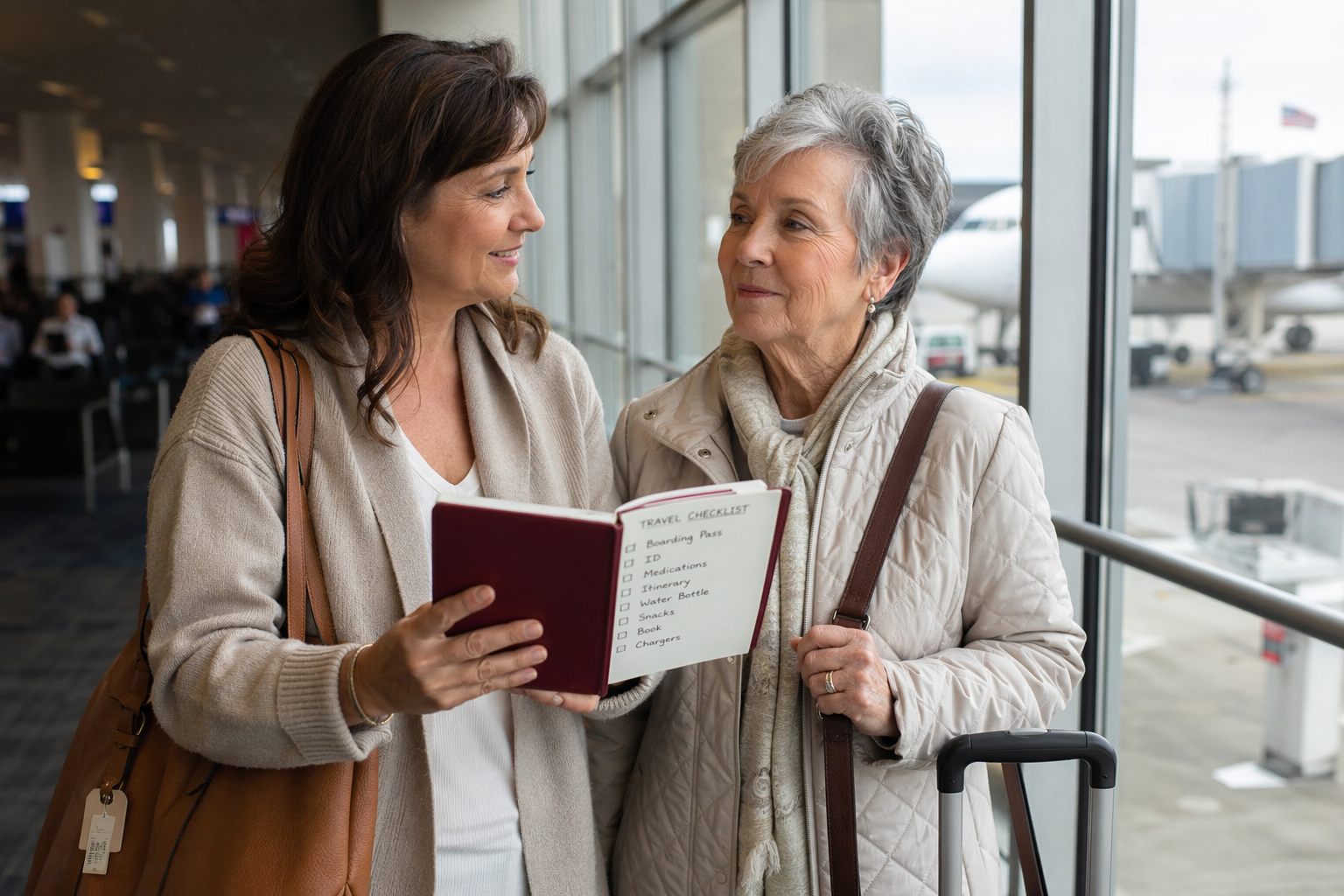
Medication deserves its own pass through the checklist. NCOA, citing CDC data, reports that nearly 9 in 10 older adults take at least one medication.[6] That makes the carry-on medication rule less of a travel tip and more of a safety rule: keep prescriptions, over-the-counter essentials, glasses, hearing aid supplies, chargers for medical devices, and a written medication list in the personal item or carry-on, not checked luggage.
- Pack medications in original containers when practical, with enough extra supply to cover delays.
- Put the medication list where the traveler and caregiver can both find it.
- Ask the clinician whether any dose timing should shift before or after arrival in Eastern Time.
- Keep mobility aids, hearing aids, glasses, and chargers out of checked luggage.
- Write down emergency contacts and the Columbus arrival address on paper, not only in a phone.
The 3-hour eastward time change should be handled as a scheduling issue, not overstated as a medical claim. The available sources confirm the Pacific-to-Eastern shift but do not support a broad statement about eastward travel being physiologically harder for all seniors. What is safe to say is simpler: if a Seattle bedtime of 9 p.m. becomes midnight in Columbus, the first evening can unravel quickly unless dinner, medications, pickup, and sleep are planned with the clock change in mind.
The Week Before: Confirm the Human Handoffs
One week out, the work is not to re-plan the trip. It is to make sure every person or system expected to help has the same facts. That means Alaska has the wheelchair request, TSA Cares has been called if screening support is needed, the traveler knows whether they want pre-boarding, and the Columbus pickup person knows where to wait.
SEA lists complimentary wheelchair service through Prospect Airport Services and gives 206-246-1550 as the number to call upon arrival.[3] That number belongs in the travel folder and in the phones of both the traveler and whoever is doing airport drop-off. It is still wise to request wheelchair assistance through Alaska first; the airport-day number is a backup for the actual curb-to-counter handoff.
If screening is the worry, call TSA Cares at 855-787-2227 at least 72 hours before departure.[3] This is especially useful when the traveler has a hidden disability, cognitive changes, medical devices, or anxiety about being separated from a companion. SEA also participates in the Sunflower Lanyard program for hidden disabilities, but a lanyard should not be treated as a substitute for arranging help when help is actually needed.[3]
At SEA: Move Slowly on Purpose
The departure plan at Seattle should be boring in the best possible way: arrive with enough time to find the Alaska counter, connect with wheelchair assistance if requested, use the restroom before the security line, and keep the medication bag physically with the traveler. SEA’s accessibility page notes services including wheelchair support, the Sunflower Lanyard program, Aira, and paid options such as CLEAR Concierge.[3] The useful question is not which service sounds best; it is which one removes a known friction point for this traveler.
Pre-boarding is not a favor to be declined out of politeness if the traveler needs more time. Alaska offers pre-boarding for seniors who request it, and that extra time can mean the difference between placing a cane safely, getting medications under the seat, and sitting down without a line pressing from behind.[4] If the senior wants independence, let them lead where they can: choosing when to stand, whether to use the restroom, and whether they want help with the overhead bin. Independence works better when the surrounding timing is protected.
On the 4h27m Flight: Prevent the Predictable Problems
A flight of about 4 hours and 27 minutes is not extreme, but it is long enough for stiffness, dehydration, bathroom timing, and clot-prevention questions to matter.[1] NCOA’s safe travel guidance for older adults includes moving during long trips, staying hydrated, and considering compression socks when appropriate.[6] The clinician should decide whether compression socks are right for the traveler; the caregiver can make sure they are packed, worn correctly, and not discovered at the bottom of a bag during boarding.
- Keep water accessible after security and during the flight.
- Stand or walk the aisle when the seatbelt sign is off, if the traveler can do so safely.
- Use the aisle seat if restroom access and movement matter more than leaning against the window.
- Avoid burying snacks, medications, glasses, or hearing aid supplies in the overhead bin.
- Tell the flight attendant early if the traveler may need extra time before landing.
This is also where the time change starts to show up. A midafternoon departure from Seattle can feel like evening by the time the traveler is moving through Columbus. Do not plan the first night as if the traveler is simply arriving in another neighborhood. Keep dinner simple, keep the medication schedule written down, and make the first evening a landing, not an event.
At CMH: Do Not Let Arrival Become the Hardest Part
Arrival is where a good flight can still become a bad day. CMH’s accessibility resources include airline wheelchair service, the Journey Care Kit, Aira visual assistance for blind or low-vision travelers, and universal changing tables.[2] But wheelchair service at arrival still needs to be tied to the airline request, and the pickup plan should already be decided before the plane leaves Seattle.
For ground transportation, Experience Columbus lists accessible taxi service at 614-239-8294, along with COTA bus information and other accessibility resources.[7] A pre-arranged ride is usually kinder than asking a tired older adult to wait while someone compares options at the curb. If a family member is picking up, decide whether they are meeting inside baggage claim or outside at a specific pickup point, and share that plan in writing.
The arrival person should know three things before the traveler boards in Seattle: whether wheelchair assistance is expected at CMH, whether checked luggage exists, and whether the senior traveler needs food, medication, restroom access, or quiet before getting in the car. The wrong time to discover any of that is after the plane has landed and everyone is tired.
Why This Much Planning Is Not Overdoing It
Caregiving logistics already affect travel decisions. AARP’s caregiving travel material reports that roughly half of adult caregivers have avoided a personal trip because of logistical difficulty.[8] AARP’s 2026 travel survey also points to continued travel interest among adults 50+, which fits what many families already know: older adults are not necessarily done traveling, but the margin for disorganized travel has narrowed.[9]
For this Seattle-to-Columbus trip, the useful advice is not a generic reminder to “arrive early.” The route works because it is nonstop, reasonably timed for a cross-country flight, and supported by concrete accessibility services at both airports. It becomes safe and comfortable when the caregiver and traveler work backward from dated confirmations: CMH support requested early, Alaska wheelchair assistance confirmed, TSA Cares contacted when needed, medications kept in the cabin, movement planned during the flight, and Columbus transportation settled before landing.
Once the traveler is in the car at CMH, has the medication plan for Eastern Time, and is headed to a quiet first evening, the trip has done what it needed to do. Not every outing for an older adult has to be treated like a crisis. It does have to be treated like a chain of handoffs, with no important link left to memory.
References
- Seattle to Columbus Flights, FlightsFrom
- Accessibility, Fly Columbus
- Port of Seattle Accessibility, Port of Seattle
- Mobility and Wheelchair Assistance, Alaska Airlines
- Senior Citizens, CDC Travelers' Health
- Safe Travel Tips for Older Adults, National Council on Aging
- Accessibility Guide, Experience Columbus
- Traveling With Your Loved One, AARP
- 2026 Travel Trends Survey, AARP
Questions to bring to a clinician or OT
This is not medical, legal, or a family's final decision — only a framework. Bring these questions to a clinician, occupational therapist, or your local Area Agency on Aging.
Find Local HelpRelated reading
Noticed something outdated or inaccurate on this page? Flag a correction. We review every report against CDC, NIA, and AARP HomeFit guidance before updating a page.