
Caregiver decision guide
Plan a Safe Senior Flight From Spokane to Honolulu
A step-by-step guide for caregivers planning a trip from Spokane to Honolulu with an aging parent — covering route logistics, airport accessibility, medication management, and the critical travel insurance decisions that can make or break the journey.
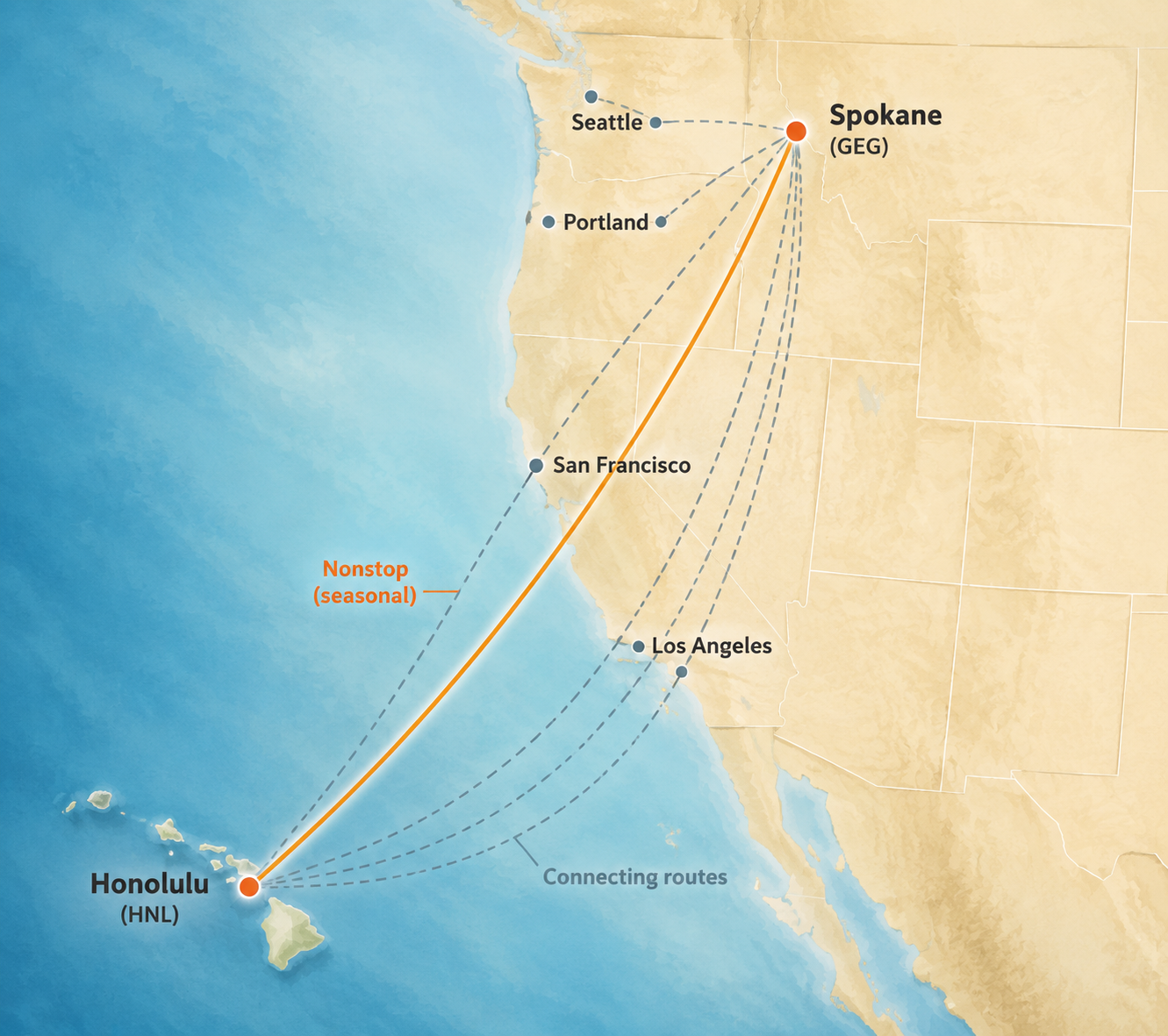
A Spokane-to-Honolulu trip with an aging parent is workable, but the first decision is not what to pack. It is whether the flight itself can be made humane. In 2026, Spokane does not have a year-round direct Honolulu flight. The useful exception is Alaska Airlines’ newly announced Saturday-only seasonal nonstop from Spokane International Airport to Honolulu, scheduled for Dec. 19, 2026, through Apr. 17, 2027, departing GEG at 9:00 a.m. and arriving at HNL at 2:03 p.m. on a Boeing 737 Max.[1] If your parent tires quickly, uses a walker, takes time-sensitive medication, or gets confused during long layovers, that seasonal window may change the whole plan.
| Decision | What to do before booking |
|---|---|
| Flight route | Use the Saturday seasonal nonstop if the dates work; otherwise assume a connection through SEA, PDX, SFO, or LAX. |
| Airport assistance | Reserve wheelchair or mobility help with the airline and airport support services 48–72 hours ahead. |
| Medication timing | Calculate whether the trip date creates a 2-hour or 3-hour shift from Spokane to Honolulu and ask a pharmacist about strict-timing drugs. |
| Travel insurance | Buy coverage early enough for any pre-existing condition waiver and look for at least $100,000 in medical evacuation coverage. |
| Arrival transfer | Arrange accessible pickup at HNL before the flight, not while standing at baggage claim. |
Start With The Route, Not The Island
The nonstop matters because it removes the most fragile part of the day: the handoff between flights. A direct Spokane-to-Honolulu flight is about 6 hours and 16 minutes over roughly 2,885 miles, while ordinary connecting itineraries usually stretch total travel to about 7–9 hours.[1] That extra time is not just a number on a reservation screen. It can mean another bathroom transfer, another medication decision, another boarding line, and another chance for the wheelchair request to get lost between carriers or terminals.
The catch is just as important as the opportunity. The Alaska flight is Saturday-only and seasonal. It does not solve a July trip, a midweek medical appointment workaround, or a family reunion date outside Dec. 19, 2026, to Apr. 17, 2027.[1] If the trip is discretionary and your parent can wait, waiting for the nonstop may be the kindest decision. If the timing is tied to health, family, or a narrow window of ability, plan the connection as if the layover is part of the care plan.
For connecting flights, Seattle, Portland, San Francisco, and Los Angeles are the usual routing possibilities. The best connection is not automatically the shortest one. A tight connection can be worse than a longer one if your parent needs a wheelchair escort, a restroom stop, food with medication, or time to stand and reset before boarding again. A very long connection can also become a problem if the airport assistance ends at the gate and your parent has to sit for hours without a good place to rest.
A practical booking filter
- Choose the seasonal nonstop first if the travel date, budget, and medical timing allow it.
- If connecting, avoid the last flight of the day when possible; delays leave fewer recovery options.
- Give mobility assistance enough connection time to work; do not assume your parent can hurry because the app says the gate is nearby.
- Ask your parent what they value most: fewer hours in transit, a morning departure, an aisle seat, or the least walking. The answer may not be the same as yours.
Reserve Help Before You Reach GEG
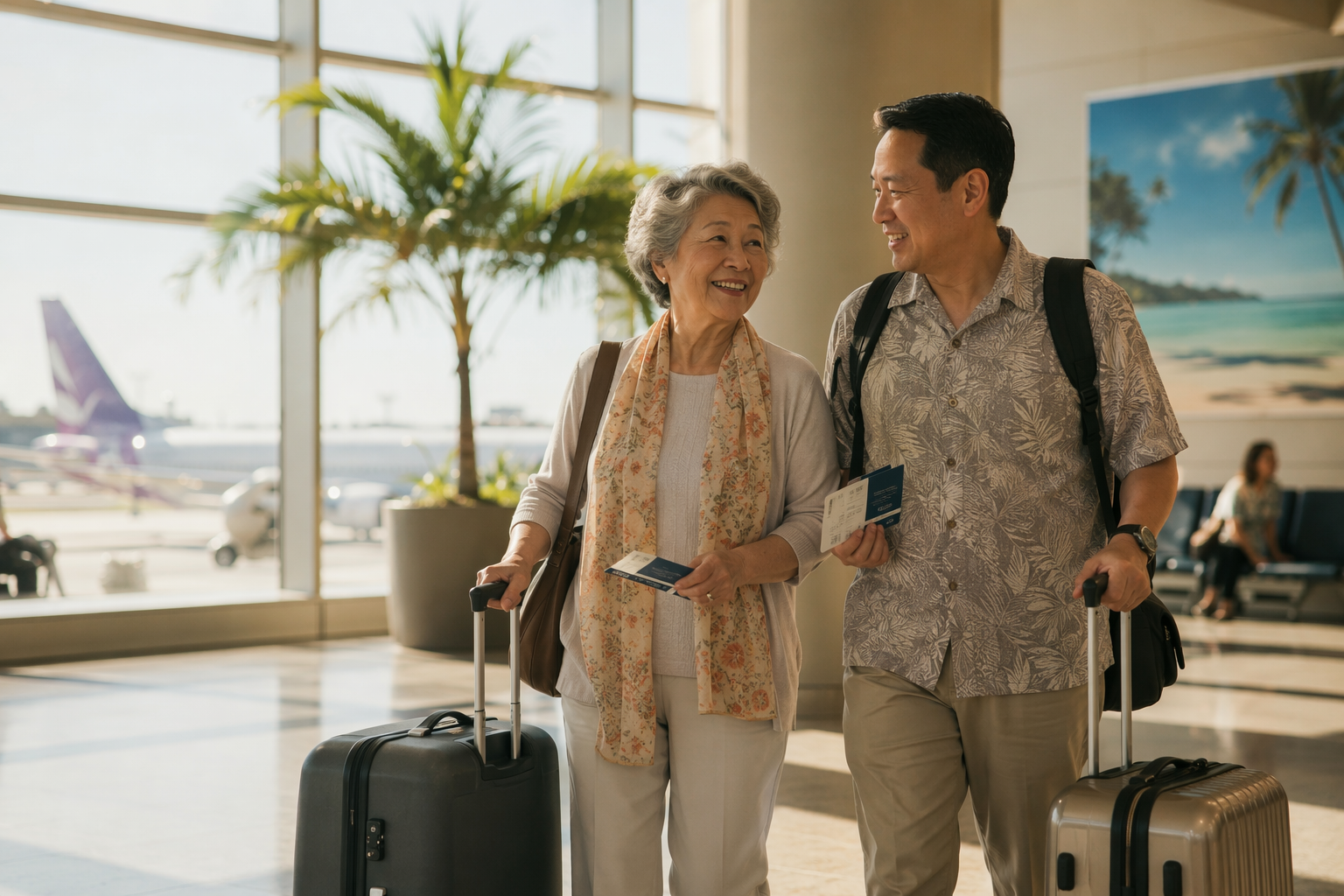
Spokane International Airport lists accessible parking, family restrooms, curbside wheelchair assistance through the airline reservation desk, TSA Cares support, and ABM Aviation assistance for travelers who need help moving through the airport.[2] The important part is timing. Do not wait until the curb and hope someone has an extra chair, an extra staff member, and an extra ten minutes.
Start with the airline reservation. Add wheelchair assistance to the passenger record when you book or as soon as the need is clear. Be specific: curb to gate, gate to aircraft door, help during a connection, and gate to baggage claim on arrival. If your parent can walk short distances but not long concourses, say that. If they cannot manage stairs, say that too. Vague requests create vague service.
Then use the airport-specific contacts. TSA Cares asks travelers to contact the program at least 72 hours before travel at 855-787-2227 for screening assistance.[2] Spokane’s accessibility page also lists ABM Aviation assistance at 509-499-7930.[2] Those calls are not overplanning. They are how you keep the morning from depending on whoever happens to be standing near the curb.
What the GEG morning should look like
The goal is a boring airport morning. Pull up with the confirmation numbers available, not buried in a text thread. Keep medications, ID, insurance cards, glasses, hearing aids, phone chargers, and one change of clothes in the carry-on. If a walker, cane, CPAP, or cushion is part of daily function at home, treat it as travel equipment, not optional luggage.
For families who want a more detailed packing structure, the medication and mobility-aid approach in Packing for a Senior Cruise? Start with Medication and Safety transfers well to this flight. The setting is different, but the principle is the same: anything that keeps your parent medically stable or physically steady belongs within reach.
Treat Medication Timing As A Clinical Task
Spokane to Honolulu is not a large international time jump, but it is enough to matter. During Pacific Daylight Time, from roughly mid-March to early November, Honolulu is 2 hours behind Spokane. During Pacific Standard Time, from roughly early November to mid-March, Honolulu is 3 hours behind Spokane. The correct adjustment depends on the actual travel date.
For many once-daily medications, a clinician may say the shift is manageable. For insulin, anticoagulants, Parkinson’s medications, seizure medications, some heart medications, and other strict-timing drugs, do not improvise in the aisle. Ask the prescribing clinician or pharmacist before travel how to handle the flight day, the first night in Honolulu, and the return day.
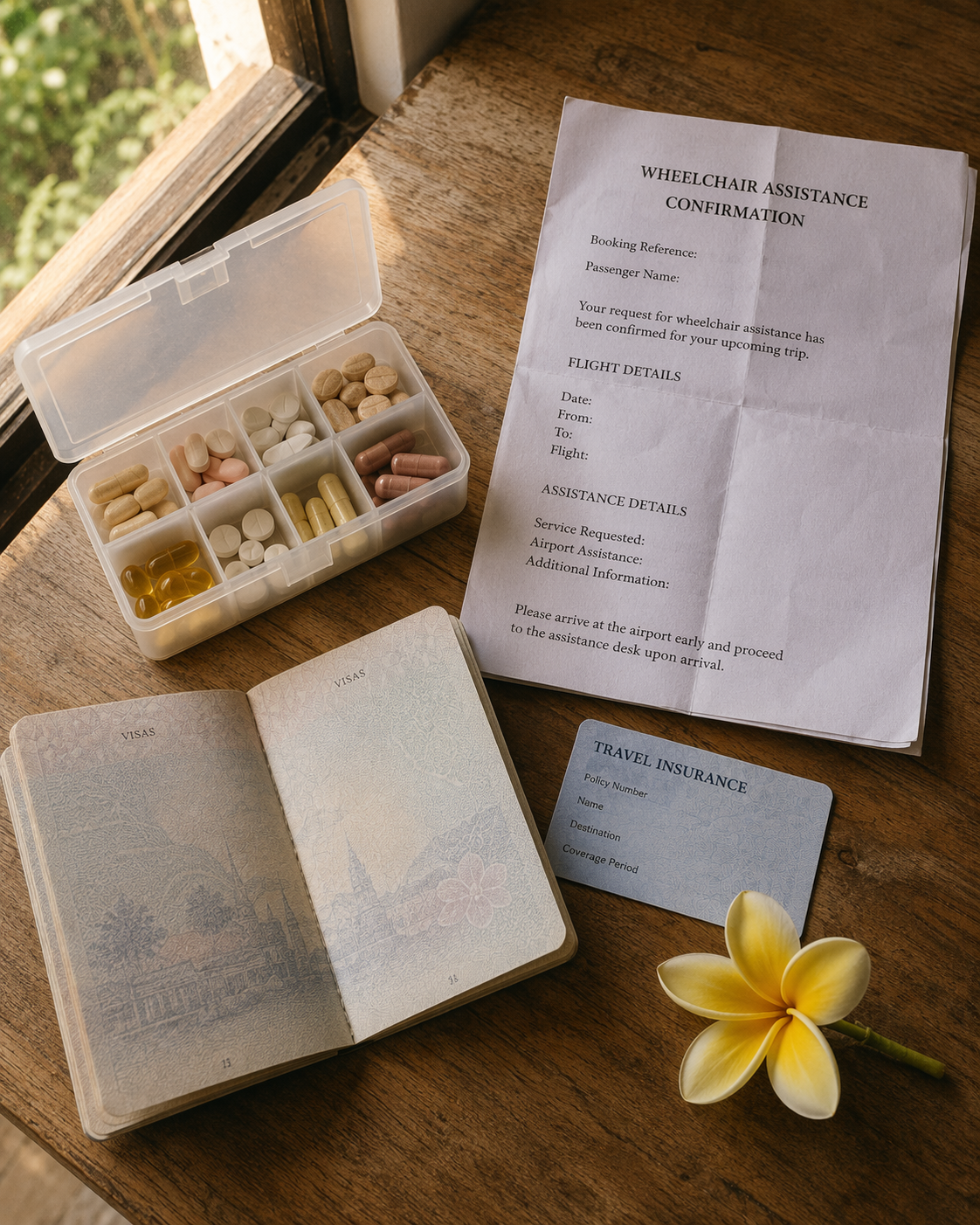
The simplest written plan is often the safest one. Put the medication name, usual Spokane time, adjusted Honolulu time, dose, and purpose on one sheet. Keep medications in original labeled containers when possible, and carry them on rather than checking them. If your parent uses a pill organizer, bring the prescription list too, because a loose organizer does not explain itself during a screening, delay, or clinic visit.
| Medication issue | Before-flight action |
|---|---|
| Strict timing | Ask pharmacist or prescriber how to shift doses for the exact travel dates. |
| Insulin or refrigerated medication | Confirm storage requirements and carry needed supplies in the cabin. |
| Blood thinners or fall risk | Ask what symptoms require urgent care during travel. |
| Parkinson’s or seizure medication | Write a dose schedule that covers airport time, flight time, and arrival evening. |
| Refills | Carry more than the exact trip count in case the return flight is delayed. |
Buy Insurance For The Problem You Actually Fear
For this trip, the scary insurance gap is not a missed luau reservation. It is a medical event in Hawaii that requires higher-level care, return to the mainland, or medical evacuation. Hawaii Guide’s 2026 travel insurance guidance describes medical evacuation costs from Hawaii to the mainland as commonly ranging from $12,000 to $50,000 or more, depending on distance, aircraft type, and medical staffing, and recommends looking for at least $100,000–$250,000 in medical evacuation coverage.[3]
That is a different question from whether a credit card says the trip is “covered.” Hawaii Guide notes that some premium credit-card travel protections may cap medical benefits around $2,500 secondary, while a single emergency room visit can exceed $2,200–$3,000.[3] Those figures are not close to evacuation-level exposure. If a parent has heart disease, a recent fall, oxygen needs, a cancer diagnosis, cognitive decline, or a fragile medication schedule, read the medical and evacuation sections of the policy before you relax.
The pre-existing condition waiver is where families can accidentally disqualify themselves. Hawaii Guide reports that many policies require purchase within 14–21 days of the first trip deposit to qualify for a pre-existing condition waiver.[3] If you put down airfare now and wait until the week before departure to compare policies, you may have missed the very window that matters.
- Look for medical evacuation coverage of at least $100,000, with $250,000 preferable for more medically fragile travelers.
- Check whether pre-existing conditions are covered and what purchase deadline applies.
- Confirm whether coverage is primary or secondary, especially if relying on a credit card.
- Save the assistance phone number offline and print the policy card for the carry-on.
- Make sure the traveling caregiver has authority and contact information to act if the parent cannot manage the call.
A typical comprehensive plan may cost about 5–6% of the trip cost, with Hawaii Guide giving an example of about $228 for a $5,000 trip.[3] That is still money, and not every family has much slack. But for a medically vulnerable traveler, insurance that cannot address evacuation is not the same product as insurance that can.
Make The Flight Physically Manageable
Once the route, assistance, medication plan, and insurance are in place, the in-flight job gets simpler: reduce strain and avoid preventable problems. Senior travel guidance from AARP and AgingCare emphasizes planning around the older adult’s stamina, health limits, and dignity rather than treating the trip like an ordinary vacation with a slower walker.[4][5]
Seat choice is not cosmetic. An aisle seat near the front can reduce walking distance and make lavatory trips less complicated. If your parent needs help standing, think through who will sit beside them. If they value looking out the window and can safely wait through a seatmate’s tray table and nap, ask before overriding that preference. A little agency matters on a trip where so much else is being managed for them.
For a flight of this length, compression socks, hydration, and periodic aisle walking are common recommendations for older travelers, including in long-flight guidance from Leisure Care.[6] They are not substitutes for medical advice, especially for someone with clotting history, heart failure, severe edema, or fall risk. If walking the aisle is unsafe, ask the clinician what seated movement is appropriate.
- Board early if it gives your parent time to settle without people pressing behind them.
- Keep the day’s medications under the seat, not in the overhead bin.
- Use a small written schedule instead of relying on memory after an early Spokane departure.
- Ask before helping with every movement; a parent who needs assistance may still want control over pace and privacy.
- Pack snacks that match medication and diabetes needs rather than counting on cabin service timing.
Plan The HNL Handoff Before Landing
Daniel K. Inouye International Airport lists skycap wheelchair service at the curb, accessible shuttle service between terminals, lift-equipped taxis at 808-831-2023, Roberts Hawaii accessible shuttle service at 808-439-8800, and a 24-hour medical clinic on site.[7] Those are useful services, but they are not a plan until someone has made the call, written down the pickup arrangement, and knows where the parent will wait.
On arrival, do not rush off the aircraft unless there is a true need. Let the wheelchair handoff happen. Confirm whether checked mobility equipment is coming to the jet bridge, oversized baggage, or regular baggage claim. If your parent uses a cane or walker at home but checked it because the airline required a gate-check process, the caregiver should not be halfway to the carousel before noticing it is missing.
The transfer from HNL to Waikiki or another Oahu destination is the wrong place to experiment. If your parent cannot climb into a standard taxi or van, arrange a lift-equipped taxi or accessible shuttle ahead of time using the airport-listed contacts.[7] If they can transfer with help, still think about luggage. One caregiver cannot safely steady a parent, watch a carry-on, manage checked bags, and negotiate a curb pickup all at once.
What can wait for another planning day
Oahu activity choices, hotel layout, beach access, mobility scooter rentals, and public transit can matter a great deal once the flight is settled. Hawaii Guide’s senior accessibility overview discusses low-impact activity planning and accessibility considerations for older visitors.[8] But those decisions should not distract from the first-order problem: getting from the Spokane curb to Honolulu ground transportation without relying on luck.
Public transportation fares and scooter rental prices can change, so verify them close to travel rather than building a medical or mobility plan around mid-2026 estimates. For this route, the durable decisions are the flight window, airport assistance, medication schedule, insurance coverage, and arrival transfer.
A Feasible Spokane-To-Honolulu Plan
If the trip can wait for the Saturday seasonal nonstop, that is the cleanest route for many seniors traveling from Spokane. If it cannot, choose a connection with enough time for the actual body traveling, not the fastest itinerary on the screen. Reserve wheelchair and screening help before travel. Build the medication schedule around the real 2-hour or 3-hour time change. Buy insurance early enough to preserve any pre-existing condition waiver, and make sure the policy can handle evacuation rather than only small medical bills. Arrange the HNL transfer before takeoff.
References
- Alaska Airlines adding seasonal flight to Honolulu — The Spokesman-Review, July 14, 2026
- Accessibility — Spokane International Airport
- Hawaii Travel Insurance: What You Actually Need — Hawaii Guide, April 2026
- How to Travel With Older Parents as a Caregiver — AARP
- 10 Travel Tips for Senior Travelers — AgingCare
- How to Survive Long Flights as a Senior — Leisure Care
- Persons With Disabilities — Daniel K. Inouye International Airport
- Hawaii for Seniors: Accessibility Tips & Low-Impact Activities — Hawaii Guide, April 2026
Questions to bring to a clinician or OT
This is not medical, legal, or a family's final decision — only a framework. Bring these questions to a clinician, occupational therapist, or your local Area Agency on Aging.
Find Local HelpRelated reading
Noticed something outdated or inaccurate on this page? Flag a correction. We review every report against CDC, NIA, and AARP HomeFit guidance before updating a page.