
Caregiver decision guide
Can Seniors See the Aurora from Home This Year?
The 2026 solar maximum makes northern lights visible from many northern US states without travel. This guide shows older adults how to use simplified forecast tools, plan safe outdoor viewing, and know when to stay warm indoors.
Yes: a senior near Minneapolis, Detroit, Portland, or another northern U.S. location has a real chance of seeing the aurora from home in 2026. Not every clear night, and not because the sky owes anybody a show. The chance comes from being in an active solar-maximum period, when stronger geomagnetic storms can push the northern lights down into places that usually hear about aurora more than they see it. The May 10-11, 2024 G5 storm made that plain when aurora was reported across the continental United States, including as far south as Florida.[1]
That 2024 storm should be treated as proof of possibility, not as a promise. Most useful nights for northern U.S. backyards will be more modest: Kp 5, Kp 6, or Kp 7 nights, with clouds, streetlights, the Moon, and the storm’s exact magnetic setup deciding whether a person sees curtains, a pale glow, or nothing at all. A good aurora forecast for senior stargazers starts by answering one homely question: what number makes it worth putting on boots?
Start With Your Own Kp Number
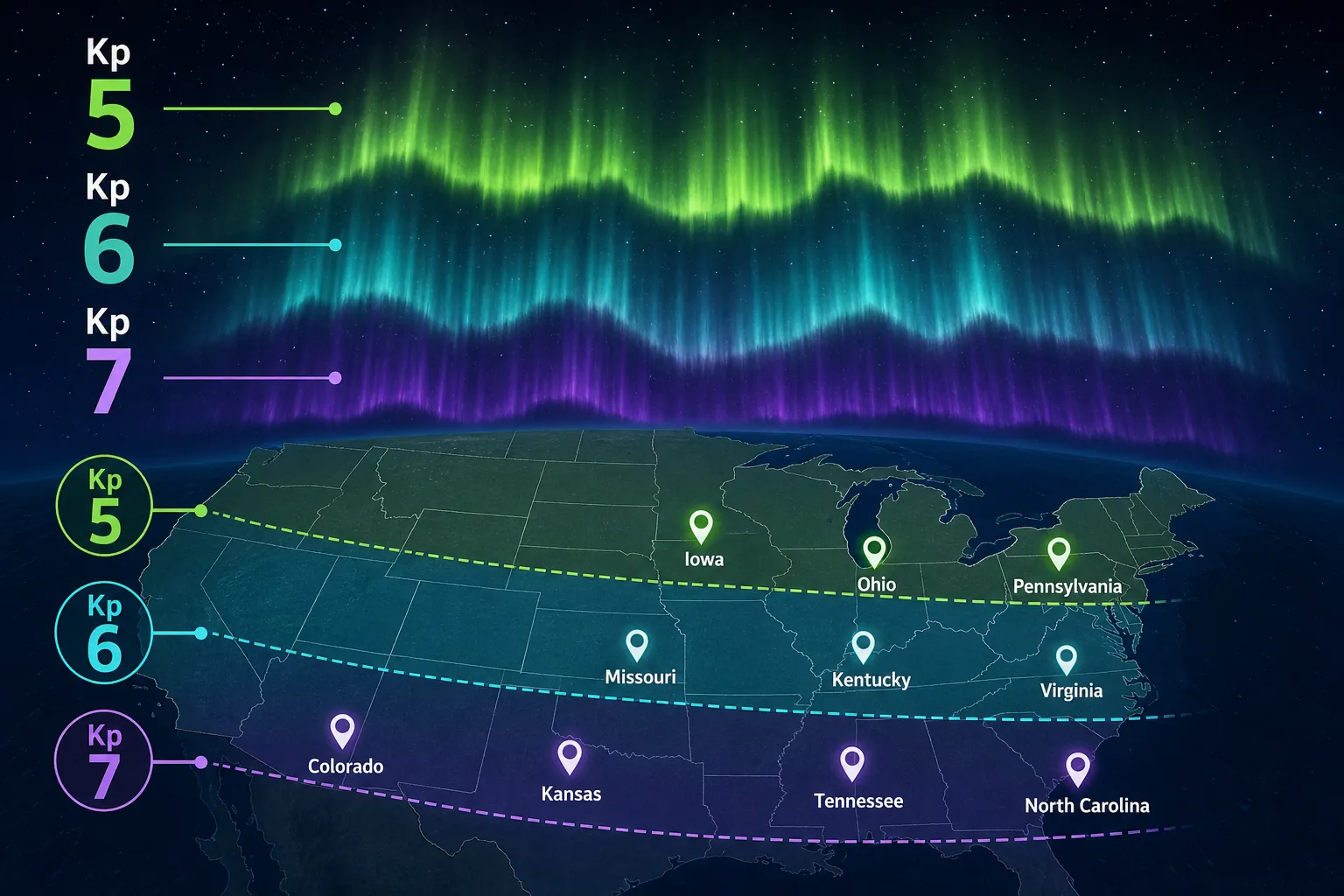
Kp is a 0-to-9 geomagnetic activity scale. Kp 5 and above counts as a geomagnetic storm, which is the range most backyard aurora-watchers in the northern United States care about.[2] You do not need to memorize the scale. You only need to know the rough Kp threshold for your location, then decide whether tonight’s forecast is high enough to bother with.
NOAA’s viewing guide gives a practical shortcut. At Kp 5, aurora may be visible as far south as Pennsylvania, Ohio, and Iowa. At Kp 6, the possible viewing line reaches Virginia, Kentucky, and Missouri. At Kp 7, it can reach North Carolina, Tennessee, Kansas, and Colorado.[2] Those are broad guideposts, not fence lines. A person north of those examples generally has a better chance than someone south of them, assuming the sky is clear and dark enough.
| If you live around | Start paying attention when the forecast reaches | What that means in plain terms |
|---|---|---|
| Northern Minnesota, northern Michigan, North Dakota, Montana, northern Maine | Kp 4-5 | You are far enough north that moderate activity may be worth checking, especially with a clear northern horizon. |
| Minneapolis, Detroit, Milwaukee, Buffalo, Portland, northern New England | Kp 5 | This is the first number that often makes a careful backyard check reasonable. |
| Chicago, Cleveland, Pittsburgh, Des Moines, southern New England | Kp 5-6 | You may need stronger activity, darker skies, and less cloud cover. |
| St. Louis, Louisville, Kansas City, Washington, D.C., parts of Colorado | Kp 6-7 | Possible during stronger storms, but not a casual every-month expectation. |
There is a small bit of sky geometry behind this. NOAA explains that when Kp is 0, the equatorward edge of the auroral oval sits around 66 degrees magnetic latitude, and each Kp level moves that edge roughly 2 degrees farther toward the equator.[2] For household use, that simply means each higher Kp number gives the aurora more room to reach south.
The number still does not guarantee a view. A Kp 6 forecast under thick clouds is not helpful. A Kp 5 night near bright parking lots may be less impressive than a Kp 5 night on a dark rural road. And some storms point their energy more favorably toward Earth than others. The Kp threshold tells you when to look harder, not when to stand outside indefinitely.
The Two Forecast Checks That Matter at 9:30 p.m.
A forecast routine should be short enough for a tired person to use after supper. The best version is not six open tabs and a pile of acronyms. It is one official forecast, one simple alert or sighting source, and one honest look out the window.
- Check your personal Kp threshold. If your area usually needs Kp 5 and tonight is Kp 3, go to bed without regret.
- Open NOAA’s 30-minute aurora forecast. It is free, requires no account, and is updated every 5 minutes using the OVATION Prime model.[3]
- Check a simplified alert or sighting source such as Hello Aurora. Its 2025 user reports topped 25,000 submitted sightings, which makes it useful for seeing whether real people are seeing anything near your region.[4]
- Look at your own sky. If the northern horizon is cloudy, foggy, icy underfoot, or washed out by nearby lights, the forecast may be right and your backyard still may not cooperate.
NOAA’s 30-minute map is especially useful because aurora forecasts change quickly. A storm that looked promising at dinner can fade by bedtime; another can brighten after the local news is over. For a senior who is deciding whether to step onto a porch or down a set of outdoor steps, current conditions matter more than a dramatic headline from the afternoon.
Hello Aurora and similar tools should not replace NOAA, but they can make the decision feel less lonely. If people north and west of you are submitting sightings, and your Kp threshold is being met, that is more useful than a vague “possible aurora tonight” notice. If the app is quiet near your region, it may be a night to keep expectations low.
A Simple Go, Wait, or Stay-In Rule
| Forecast and conditions | Best choice |
|---|---|
| Kp is below your threshold | Stay inside or check a webcam. |
| Kp meets your threshold, but clouds or ice are bad | Use a live camera feed and do not force the outing. |
| Kp meets your threshold, sky is clear, and footing is safe | Try one short outdoor viewing interval. |
| Kp is above your threshold and nearby sightings are appearing | Take it seriously, but still use short intervals and warm-up breaks. |
When to Look Without Turning It Into a Vigil
The best viewing window is usually 10 p.m. to 2 a.m. local time, centered around midnight.[2][5] That is not a friendly window for everyone. Some older adults take evening medications, use mobility equipment, or simply do not have the same balance at midnight that they had at noon. The sky may be active at 1:30 a.m.; that does not automatically make 1:30 a.m. a wise time to be outdoors alone.
Season helps, too. The Geophysical Institute describes aurora season as late September through late March, with March and September often showing about double the activity because of the Russell-McPherron effect.[5] In ordinary language, the weeks around the equinoxes deserve extra attention. They still need clear skies, a strong enough forecast, and safe footing.
Summer aurora is not impossible, especially during an active solar-maximum year, but northern twilight and bedtime routines can make it harder to use. Winter gives darker skies and longer nights, while also bringing the very problems that matter most for older viewers: ice, deep cold, stiff joints, and the trip back into the house.
Make the Viewing Spot Boring on Purpose
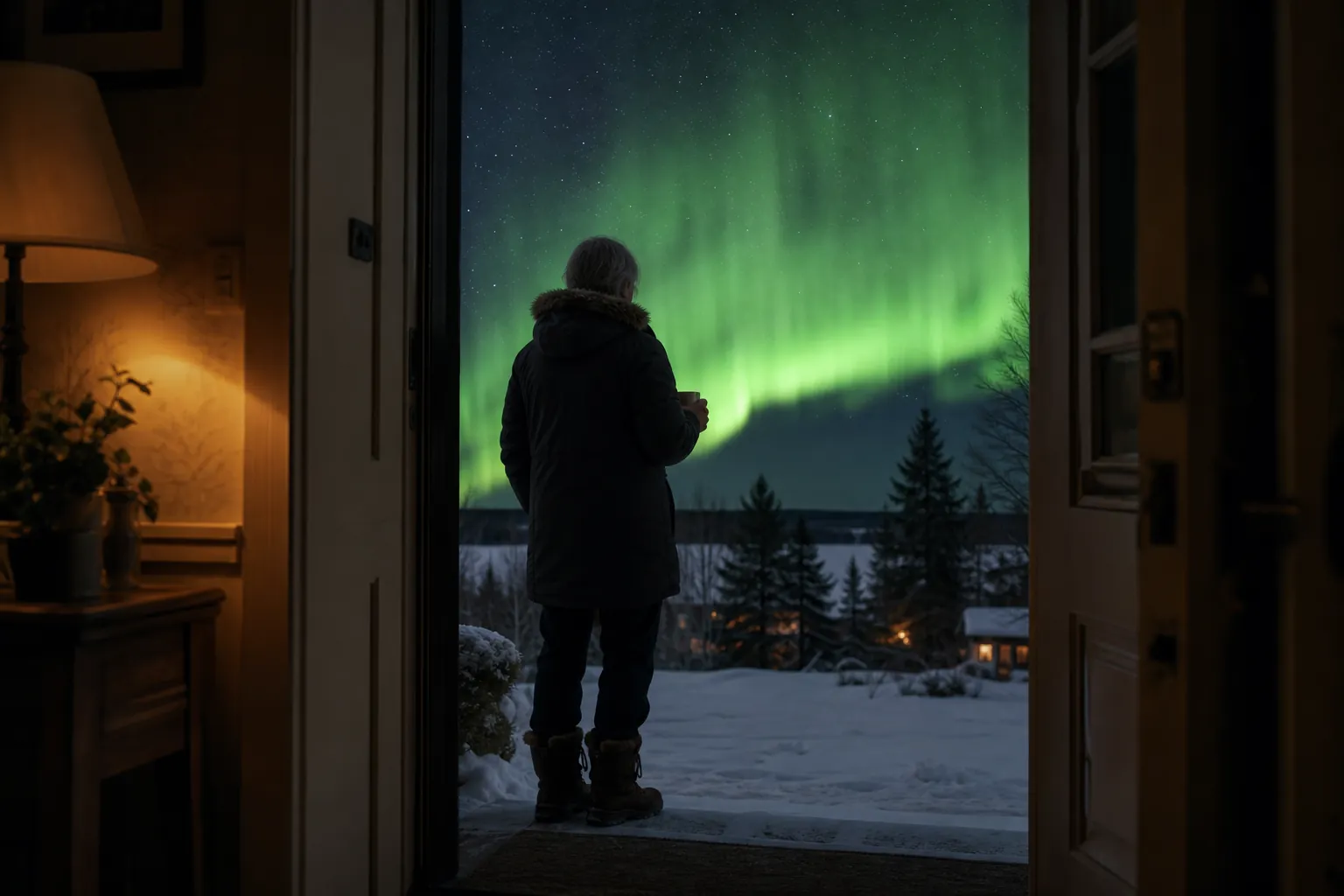
The safest aurora spot for many seniors is not a scenic overlook. It is the back door, a porch, a driveway, a cleared patio, or one flat place in the yard that has already been checked in daylight. The northern horizon matters, but not more than footing. A faint green glow is not worth a fall.
- Choose the viewing spot before dark, not after an alert arrives.
- Clear snow, salt ice, and move hoses, planters, cords, or uneven mats.
- Use a stable chair only if the ground is level and the chair will not slide.
- Keep a small flashlight or headlamp handy, preferably with a dim or red setting.
- Bring the phone, but do not let a photo attempt replace watching where your feet are.
A caregiver helping from another state can do more good with one practical phone call than with a string of excited texts. Ask where the parent will stand, whether the porch light can be switched off safely, whether the steps are dry, and whether there is a warm place to come back to. That is not fussing. That is making the outing possible.
Cold Is Part of the Forecast
The National Institute on Aging warns that older adults can lose body heat faster than younger adults and may not notice hypothermia developing. Its cold-weather guidance also recommends keeping indoor heat at least 68°F and limiting time in the cold.[6] Those warnings were not written for aurora viewing specifically, but they fit the situation plainly enough.
Use short viewing intervals. Fifteen to 20 minutes outside is enough for a first check, especially on a cold night. Come in, warm up, check the forecast again, and decide whether a second interval is sensible. There is no prize for standing in the driveway until fingers go numb.
- Dress before opening the door: warm layers, hat, gloves or mittens, winter socks, and shoes or boots with dependable traction.
- Keep the house warm enough to return to comfortably.
- Tell someone before going outside, even if the plan is only to stand on the porch.
- Skip the outing if dizziness, fatigue, new medication effects, poor balance, or icy steps are present.
- Come in at the first sign of shivering, clumsiness, confusion, unusual sleepiness, or numb hands and feet.
For a senior who uses a walker, cane, oxygen tubing, or a medical alert device, the plan should be even plainer: stay on the most familiar surface, avoid dark yard travel, and keep the viewing interval short. If the only good view requires crossing icy ground, it is not the good view.
What a Long-Distance Caregiver Can Set Up Ahead of Time
The best help is preparation that does not make the older person feel managed. Put the forecast tools where they are easy to find, agree on the personal Kp number, and make the safe viewing place ordinary before the sky gets interesting.
- Write the local Kp threshold on a kitchen calendar or note card: for example, “Check outside only when Kp is about 5 or higher.”
- Bookmark NOAA’s 30-minute aurora forecast on the phone, tablet, or computer.
- Set up one simple aurora alert app, then turn off noisy notifications that are not useful.
- Agree on a check-in rule: a quick call or text before and after going outside.
- Identify the indoor fallback before anyone is disappointed.
If several siblings or relatives are involved, one person should be the forecast watcher. Otherwise, every mild alert becomes a family broadcast and the senior gets pushed toward the door on nights that are cloudy, too cold, or below the local threshold. Help should reduce decisions, not multiply them.
Use Webcams as Participation, Not Defeat
Some nights are not outdoor nights. Clouds move in. The driveway glazes over. The forecast peaks after bedtime. A knee is sore, or the wind is mean. That is when a live all-sky camera is not a consolation prize; it is the safe way to stay part of the event.
The Geophysical Institute at the University of Alaska Fairbanks operates live all-sky cameras online, giving viewers a real-time look at aurora conditions from camera locations that are built for the job.[7] A laptop at the kitchen table, a mug of something warm, and a live camera feed can be the right choice on a night when the body says no and the sky says maybe.
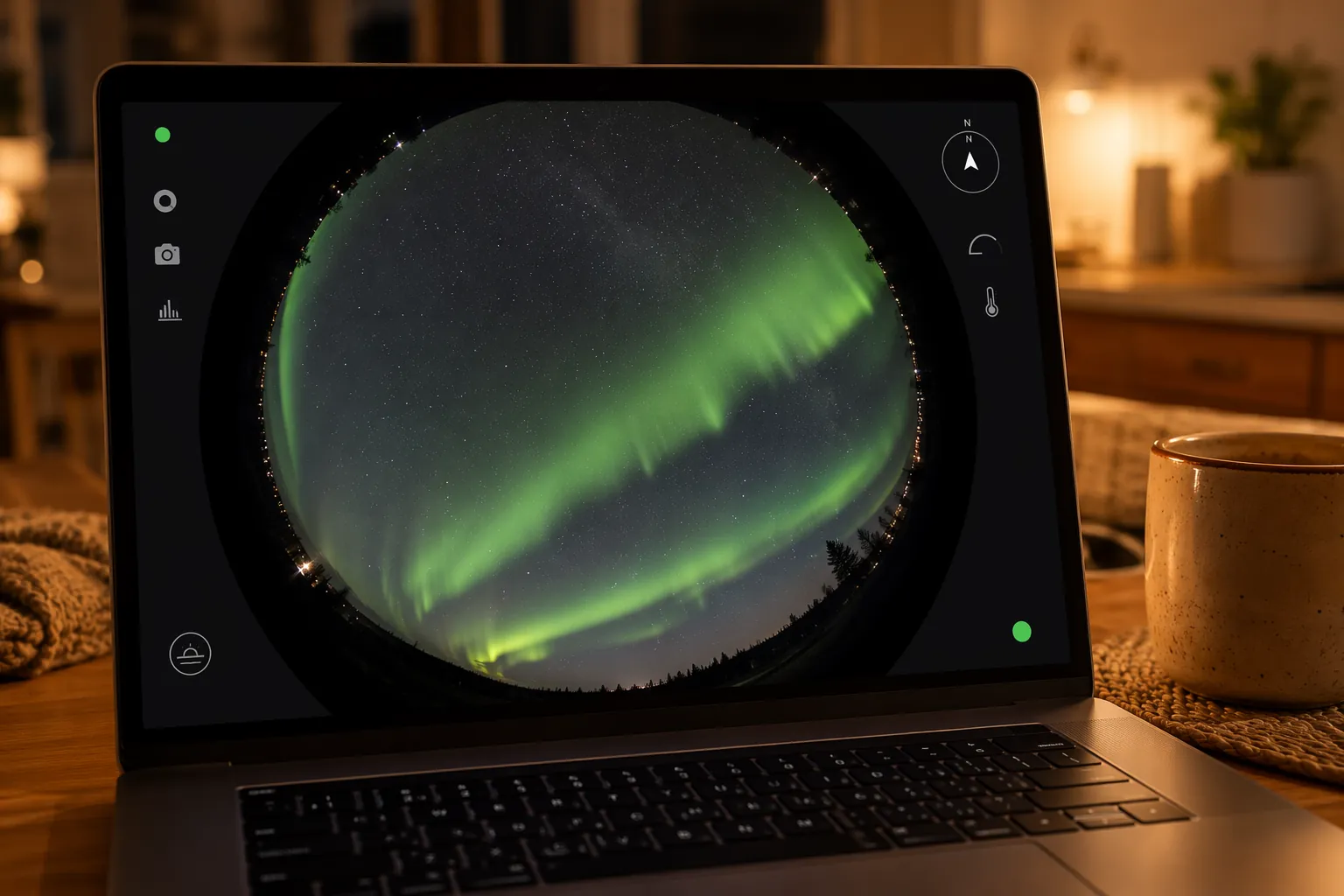
Webcams also help with judgment. If the all-sky cameras are glowing and your local sky is cloudy, you know the forecast was not foolish; your weather simply did not cooperate. If the cameras are quiet, it is easier to close the curtains and sleep without wondering whether you missed something grand.
What to Expect When It Works
A backyard aurora in the northern United States may not look like the photographs. Sometimes the camera sees more color than the eye. Sometimes the first sign is a gray-green band low in the north, or pale vertical streaks that seem too still until they begin to shift. During stronger storms, the glow can climb higher and become unmistakable. During weaker ones, patience and darkness matter.
Give your eyes time away from bright screens. Turn off unnecessary outdoor lights if it is safe to do so. Face north first, then check overhead if the storm is strong. A phone photo in night mode may reveal color before your eyes do, but take the picture from a stable place. The memory should not depend on balancing on a frozen step with one hand in the air.
The fair answer for 2026 is hopeful and bounded. Northern U.S. seniors do have a genuine local chance this year, especially when the forecast reaches their personal Kp threshold and the sky is clear. The better plan is the one that lets a person step outside briefly, warmly, and safely — and lets them stay inside without feeling they failed the night.
References
- G5 geomagnetic storm brings stunning auroras as far south as Florida, Space.com
- Tips on Viewing the Aurora, NOAA Space Weather Prediction Center
- Aurora - 30 Minute Forecast, NOAA Space Weather Prediction Center
- Hello Aurora Blog, Hello Aurora
- Aurora Forecast FAQ, Geophysical Institute, University of Alaska Fairbanks
- Cold Weather Safety for Older Adults, National Institute on Aging
- All-Sky Cameras, Geophysical Institute, University of Alaska Fairbanks
Questions to bring to a clinician or OT
This is not medical, legal, or a family's final decision — only a framework. Bring these questions to a clinician, occupational therapist, or your local Area Agency on Aging.
Find Local HelpRelated reading
Noticed something outdated or inaccurate on this page? Flag a correction. We review every report against CDC, NIA, and AARP HomeFit guidance before updating a page.