Short-Term Senior Care After Hospitalization: A Discharge-to-Home Playbook for Family Caregivers
A crisis-oriented playbook for adult children whose parent is being discharged from the hospital. Covers the 30-day SNF admission window, Medicare rules, decision trees for SNF vs. home care, costs families don't expect, and checklists for discharge planning conversations.
By Editorial Team
new caregiver
care coordination
first steps
medication management
daily routines
📄
A printable version of this guide is available. Use your browser's print function (Ctrl+P / ⌘P) to save or print.
The hospital discharge is a critical decision point. Preparation in the 48 hours before discharge can save families thousands of dollars and prevent readmission.
The Crisis Moment: Why the Hospital Discharge Is Your Most Important Caregiving Decision
The moment a hospital discharge planner says, "Your mother can go home tomorrow," the clock starts on a series of decisions that will shape the next three months of your family's life. Most adult children in their 40s and 50s arrive at this moment without knowing the basic rules that govern Medicare's coverage of post-hospital care — and the financial consequences of that ignorance can be severe.
Here is the single most important rule to understand right now: Medicare requires a qualifying inpatient hospital stay of at least three consecutive days before it will cover a stay in a skilled nursing facility (SNF). The clock starts ticking the day of admission — not the day of discharge — and time spent in observation status or the emergency room does not count toward the three-day requirement. If your parent was kept for "observation" rather than formally admitted as an inpatient, the SNF benefit will not be available, and you will not know this until you try to use it.
Even if your parent qualifies as an inpatient, you must act within a tight window. Medicare requires that the patient enter a Medicare-certified SNF within 30 days of leaving the hospital. This 30-day window is not flexible. If your parent goes home first and you decide a week later that they need more care than you can provide, the window is still open — but only if you act before day 31.
The pressure of this timeline is why the discharge planning conversation — the meeting with the hospital social worker or case manager before your parent leaves — is the single most important care coordination event you will face. Walk into that meeting without a plan, and you will make decisions under duress that cost you thousands of dollars and weeks of unnecessary stress.
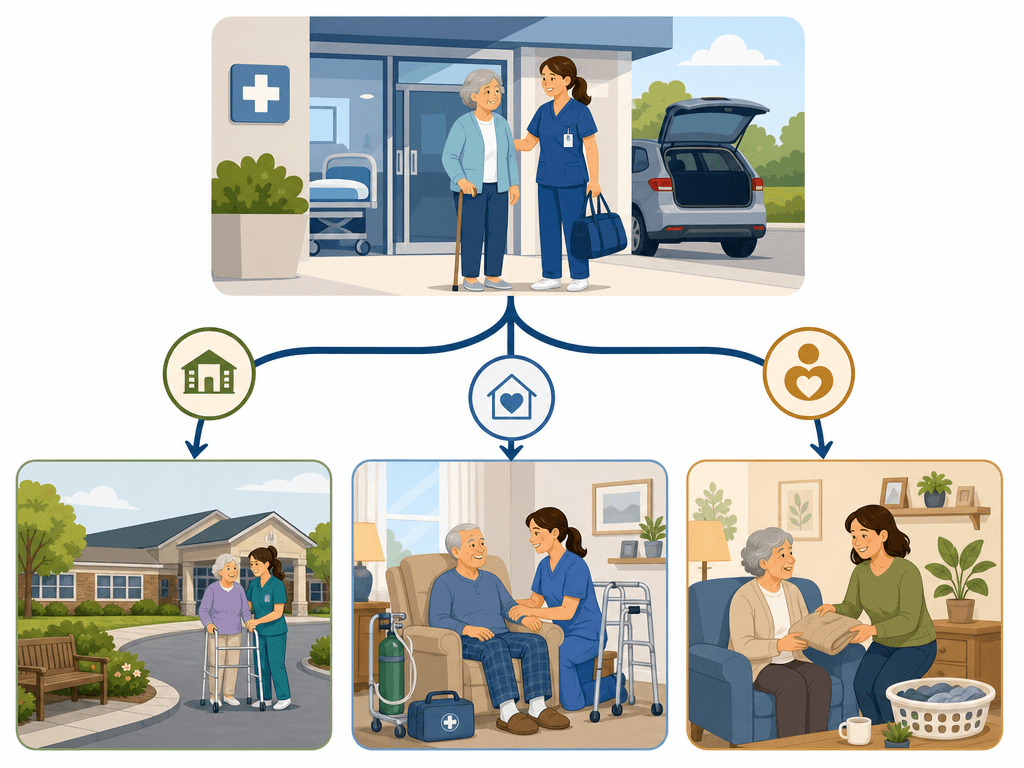
Decision Tree: Skilled Nursing Facility, Home with Home Health, or Home with In-Home Care?
The choice between a short-term SNF stay and going directly home depends on three factors: the patient's medical needs, their functional status (can they walk, bathe, and use the toilet safely?), and the support available at home. Use the following decision framework to determine which path fits your situation.
Three paths after discharge. The right choice depends on medical needs, functional status, and home support — not on what feels easiest in the moment.
Question 1: Does your parent need daily skilled care?
Skilled care means services that require a registered nurse, physical therapist, occupational therapist, or speech-language pathologist. Examples include intravenous fluids or medications, wound care, physical therapy after a hip replacement, or speech therapy after a stroke. If the answer is yes, the patient needs either an SNF or home health care — not just a home health aide.
If the patient needs daily skilled nursing or therapy, Medicare will cover the cost of an SNF stay for the first 20 days (after the Part A deductible). Alternatively, Medicare will cover home health visits from a skilled nurse or therapist if the patient is homebound and needs intermittent skilled care. The key distinction: SNF provides 24-hour care; home health visits are typically one to two hours per day, several days per week.
Question 2: Can your parent safely perform basic activities of daily living?
Activities of daily living (ADLs) include bathing, dressing, toileting, transferring from bed to chair, and eating. If your parent cannot perform these tasks safely without assistance, and you or another family member cannot provide that assistance around the clock, then home is not a safe destination without paid help.
Three post-discharge care paths compared by medical need, Medicare coverage, and typical duration.
Care Path
Best For
Medicare Coverage
Typical Duration
Skilled Nursing Facility (SNF)
Patients needing daily skilled nursing or therapy with 24-hour supervision
Days 1-20: $0 after Part A deductible; Days 21-100: $217/day copay (2026)
Up to 100 days per benefit period
Home with Home Health
Patients who are homebound and need intermittent skilled care (nursing or therapy)
Skilled visits covered at $0; no coverage for custodial care (bathing, dressing)
Typically 4-8 weeks of intermittent visits
Home with In-Home Care
Patients who need help with ADLs but do not require daily skilled nursing
Not covered by Medicare; paid out-of-pocket or via long-term care insurance



Comments
Join the discussion with an anonymous comment.