
Caregiver decision guide
Help for Elderly Parents: A 5-Step Roadmap for Adult Children Who Don't Know Where to Start
If you've just noticed signs that your aging parent needs help—missed medications, unpaid bills, or a fall—this structured five-step sequence gives you a calm, actionable starting point. From factual assessment to the first conversation, essential documents, and your own self-care as a caregiver.

You Just Realized Your Parent Needs Help — Now What?
It often arrives in a single, quiet moment. You notice the refrigerator is nearly empty. You find a stack of unopened bills. Your mother has lost weight you didn't see coming. Or a neighbor calls to say your father fell in the driveway. Suddenly, the vague worry you've carried for months crystallizes into a single, urgent question: What do I do first?
You are not alone in this moment. According to the AARP's 2025 Caregiving in the U.S. report, approximately 59 million Americans provided unpaid care to an adult family member or friend in 2024. That care added up to 49.5 billion hours of support, representing an economic value of $1.01 trillion. Most of those 59 million people started exactly where you are now — without a roadmap, without training, and with the sinking feeling that they have to figure it out alone.
The natural impulse is to panic and try to solve everything at once. That impulse is understandable, but it is also counterproductive. A deliberate, sequential approach — five concrete steps — will get you and your parent further than a week of frantic, scattered action. This guide gives you that sequence.
Step 1: Assess What You're Actually Seeing (Not What You Fear)
Before you can decide what to do, you need a clear picture of what is actually happening. The most reliable tool for this is the ADL (Activities of Daily Living) and IADL (Instrumental Activities of Daily Living) framework. It is used by occupational therapists, geriatric care managers, and the National Institute on Aging to separate objective observation from emotional reaction.
ADLs are the fundamental self-care tasks: bathing, dressing, eating, walking or transferring, and toileting. IADLs are the more complex skills needed to live independently: managing medications, handling finances, preparing meals, shopping, using transportation, and maintaining a home. When a person begins to struggle with one or more of these, it is a signal that support is needed.
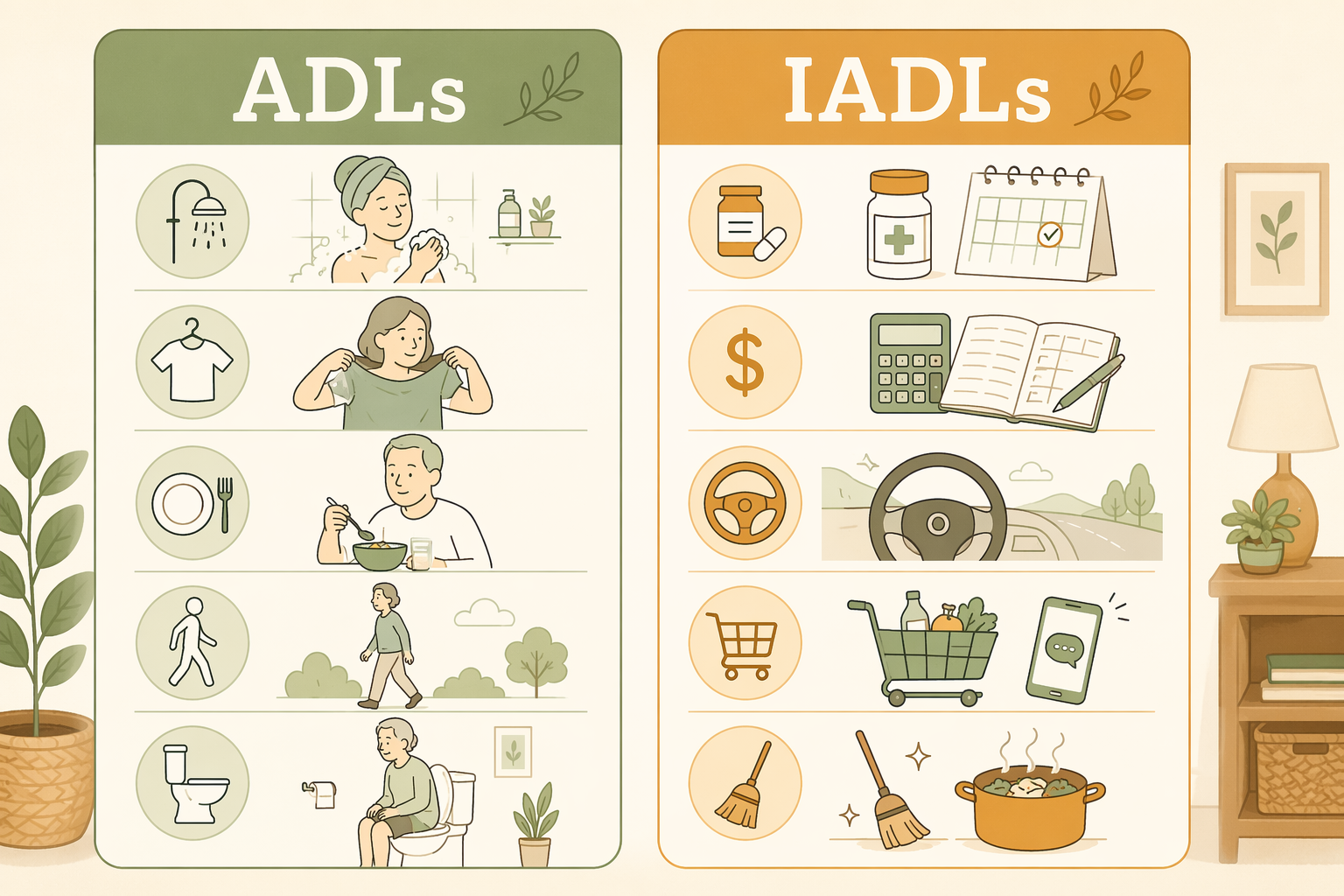
The table below organizes the most common signs of decline into the ADL/IADL categories. Use it as a checklist. Mark what you have observed directly — not what you worry might be happening, but what you have seen with your own eyes or heard from a reliable source.
| Category | What to Look For | Concrete Signs |
|---|---|---|
| Bathing & Hygiene (ADL) | Difficulty washing, dressing, or grooming | Body odor, unwashed clothes, untrimmed nails, bad breath, wearing the same outfit repeatedly |
| Eating & Nutrition (ADL) | Weight loss, poor appetite, or unsafe food practices | Spoiled food in the refrigerator, uneaten meals, reliance on processed snacks, unintentional weight change |
| Mobility & Transfer (ADL) | Trouble walking, standing, or getting out of a chair | Shuffling gait, using furniture to steady themselves, limping, unexplained bruises or cuts |
| Medication Management (IADL) | Difficulty taking the right pills at the right time | Pills on the floor, expired medications, disorganized pill organizer, missed doses or double-dosing |
| Household Management (IADL) | Neglect of home maintenance and cleanliness | Clutter, hoarding, spoiled food, urine odor, unopened mail, unpaid bills, collection notices |
| Financial Management (IADL) | Trouble handling money and paying bills | Overdrafts, bounced checks, unusual spending, falling for scams, forgetting to pay bills |
| Transportation (IADL) | Difficulty driving or using public transit | New dents on the car, getting lost in familiar areas, traffic tickets, accidents, giving up driving |
| Memory & Cognition (IADL) | Forgetfulness beyond occasional lapses | Repeating themselves, forgetting appointments, getting lost, poor decision-making, changes in personality |
The goal of this assessment is not to produce a clinical diagnosis. It is to give you a factual foundation for the conversation in Step 2. When you say, "Mom, I noticed the refrigerator has mostly spoiled food and you've lost about ten pounds," you are stating an observation. When you say, "I'm worried you're not taking care of yourself," you are stating an interpretation. The observation is harder to argue with.
Step 2: Open the Conversation — Scripts That Preserve Dignity
This is the hardest step, and it is also the most important. How you open the conversation will shape everything that follows. A respectful, collaborative opening preserves your parent's autonomy and dignity. An accusatory or panicked opening triggers defensiveness and resistance.
The National Institute on Aging offers a simple, effective template for the first conversation. The key is to lead with a specific observation and a question, not a judgment:
"Mom, it looks like you don't have much food in the house. Are you having trouble getting to the store?"
This approach works because it does three things at once: it names a concrete observation, it offers a face-saving explanation (trouble getting to the store, not neglect), and it asks a question rather than making an accusation.
Here are additional scripts for common situations, all built on the same pattern:
- For medication concerns: "Dad, I noticed your pill organizer still has pills from last week. Are you having trouble keeping track of everything?"
- For mobility or fall risk: "I saw you were holding onto the wall when you walked to the kitchen. Has your balance been feeling off lately?"
- For financial concerns: "Mom, I saw a few unopened bills on the counter. Is it getting harder to keep up with them?"
- For memory concerns: "You mentioned you went to the doctor yesterday, but your appointment card says it's next week. Are you having trouble keeping track of dates?"
- For general opening: "I've been thinking about how we can make sure you're safe and comfortable here at home. Would you be open to talking about what might help?"
Timing matters. Choose a quiet moment when neither of you is rushed, tired, or stressed. Avoid holidays, birthdays, or family gatherings where the pressure to maintain a cheerful facade is high. A weekday afternoon over coffee is often better than a formal "we need to talk" announcement.
If your parent refuses to acknowledge the problem — and many do — do not push. The Family Caregiver Alliance notes that the transition from child to caregiver is a major emotional shift for both of you. Allow yourself to mourn the change in the relationship, and recognize that your parent may need time to process it too. You can revisit the conversation in a few days or weeks. Sometimes the first conversation is just about opening a door; walking through it comes later.
Step 3: The Essential Document Fast-Track
Legal and medical documents are not the most urgent thing when you first notice a problem — but they become the most urgent thing the moment a crisis hits. If your parent is hospitalized and you do not have medical power of attorney, you may find yourself unable to speak with their doctors or make treatment decisions. If your parent becomes unable to manage their finances and you do not have durable power of attorney, you may need to go to court to gain authority.
The good news is that you only need a short list of documents to start. The National Institute on Aging provides a free Important Documents and Paperwork Checklist that covers the essentials. Focus on these four:
- Advance Directive (Living Will): A written statement of your parent's wishes for medical treatment if they cannot communicate. This covers life-sustaining care, resuscitation preferences, and end-of-life decisions.
- Durable Power of Attorney for Finances: Authorizes you (or another trusted person) to manage bank accounts, pay bills, file taxes, and handle financial decisions. "Durable" means it remains in effect even if your parent becomes incapacitated.
- Medical Power of Attorney (Healthcare Proxy): Authorizes you to make medical decisions when your parent cannot. This is separate from the financial POA and requires its own document.
- Will Location: You do not need to read the will now, but you need to know where it is. Ask your parent where they keep it and who the executor is. If there is no will, that is a separate conversation for another time.
Frame this conversation as practical planning, not a sign that you expect your parent to lose capacity. A useful script: "I'm putting together a folder of important documents for both of us, so if anything ever happens, we know where everything is. Can you show me where you keep your will and power of attorney papers?"
Step 4: Build a One-Week Action Plan for the Highest-Risk Gap
By now you have a factual assessment (Step 1), you have opened the conversation (Step 2), and you have identified the essential documents (Step 3). Step 4 is where you take action on the single highest-risk gap you identified in your assessment.
Do not try to fix everything at once. Trying to solve medication management, nutrition, fall risk, finances, and transportation simultaneously in one week is a recipe for burnout — for both you and your parent. Instead, ask yourself: If I could only address one thing this week, which one would prevent the most harm?
The table below shows the three most common high-risk gaps and a one-week action plan for each. Choose the one that matches your parent's most urgent need.
| Priority Gap | Days 1–2: Gather Information | Days 3–4: Make One Call or Appointment | Days 5–7: Implement One Small Change |
|---|---|---|---|
| Medication Safety | List every prescription, OTC drug, and supplement your parent takes. Note any missed doses, expired meds, or disorganized pills. | Call their primary care provider or pharmacist to request a medication review. Ask if any drugs increase fall risk or interact dangerously. | Set up a weekly pill organizer together. If your parent cannot manage it, ask the pharmacy about blister packs or automatic refills. |
| Fall Risk | Walk through each room using the NIA Home Safety Checklist. Identify tripping hazards (loose rugs, cords, clutter) and missing safety equipment (grab bars, non-slip mats, night lights). | Call an occupational therapist for a home safety evaluation, or contact your local Area Agency on Aging for a free or low-cost assessment. | Remove the single most obvious tripping hazard (e.g., secure a loose rug, install a night light in the bathroom path, or move a frequently used item to a lower shelf). |
| Nutrition & Hydration | Check the refrigerator and pantry for spoiled food. Note how much food is actually available. Ask your parent what they ate yesterday. | Call your local senior center or Meals on Wheels to ask about meal delivery options. Many programs offer low-cost or sliding-scale services. | Set up a weekly grocery delivery order together. If your parent is resistant, frame it as convenience: 'I'm already ordering for us, I'll just add a few things for you.' |
The goal of this week is not to solve the problem permanently. It is to make progress on the most dangerous gap and to build momentum. A single small success — a filled pill organizer, a removed tripping hazard, a delivered meal — changes the emotional dynamic from "we are in crisis" to "we can handle this one step at a time."
Step 5: Find Support for Yourself — This Is Structural, Not Selfish
If you have made it through Steps 1 through 4, you have already done more than most new caregivers do in their first month. But here is the truth that no one tells you at the beginning: caregiving is not a short-term project. It is a marathon that can last years, and your own health is the most important resource you have.
The data is stark. The Cleveland Clinic reports that more than 60% of caregivers experience symptoms of burnout — physical exhaustion, emotional withdrawal, irritability, sleep changes, and increased illness. The AARP's 2025 report found that 39% of family caregivers have stopped working to provide care, and the average caregiver spends $7,200 per year out of pocket. These are not signs of personal failure. They are signs that the caregiving system places an enormous burden on individual families, and that burden is unsustainable without support.

Here are five low-barrier steps you can take this week to support yourself:
- Join a caregiver support group. The Family Caregiver Alliance, the Alzheimer's Association, and many local Area Agencies on Aging offer free online and in-person support groups. Hearing from others who are in the same position reduces isolation and provides practical tips you will not find in any guide.
- Ask one person for one specific thing. Do not ask for general help ("let me know if you need anything"). Ask for something concrete: "Can you pick up my dad's prescription on Tuesday?" or "Can you sit with Mom for two hours on Saturday afternoon?" Most people want to help but do not know how.
- Research respite care options. Respite care provides a temporary break, from a few hours to a few weeks. Options include in-home respite (a home health aide comes to the house), adult day centers, and short-term stays at assisted living facilities. The Mayo Clinic notes that the Federal Family and Medical Leave Act (FMLA) may provide up to 12 weeks of unpaid leave per year for caregiving.
- Set one boundary this week. You cannot be available 24/7. Identify one time of day or one day of the week that is yours — and protect it. Turn off your phone. Take a walk. Have coffee with a friend. The boundary is not a rejection of your parent; it is a condition of your ability to keep showing up.
- See your own doctor. Caregivers often skip their own medical appointments. The Mayo Clinic reports that caregivers are at higher risk for depression, anxiety, and chronic health conditions. Schedule your annual physical, your dental cleaning, and any overdue screenings. Your health matters as much as your parent's.
Start Small, Iterate, and Come Back
You have a roadmap now. Five steps. You do not have to complete all of them this week, or even this month. Pick the one that feels most urgent or most doable, and start there.
Caregiving is not a single event. It is a journey that will evolve as your parent's needs change and as your own capacity shifts. The assessment you did in Step 1 will need to be repeated in six months. The conversation in Step 2 may need to happen again — and again. The documents in Step 3 may need to be updated. The action plan in Step 4 will shift as new gaps emerge. And the self-care in Step 5 is not a one-time task; it is a practice you will return to for as long as you are a caregiver.
This site has deeper resources for every step of this journey. When you are ready for the next stage, explore the Fall Prevention section for room-by-room safety checklists, the Memory Care section for dementia-specific guidance, and the Monitoring Technology section for product-neutral information on medical alert systems, fall detection, and home sensors. The Eldercare Glossary and FAQs are always here for quick reference.
You are not alone in this. You have a plan. You have a starting point. Take the first step.
Questions to bring to a clinician or OT
This is not medical, legal, or a family's final decision — only a framework. Bring these questions to a clinician, occupational therapist, or your local Area Agency on Aging.
Find Local HelpRelated reading
Noticed something outdated or inaccurate on this page? Flag a correction. We review every report against CDC, NIA, and AARP HomeFit guidance before updating a page.