
How Poor Air Quality Raises Fall Risk for Detroit Seniors
Learn why indoor air pollution in Detroit can increase fall risk for seniors by worsening chronic conditions that affect balance, and discover practical steps to improve air quality using HEPA filters and other low-cost interventions.
After a parent falls, the house starts looking different. The loose rug is obvious. So is the dim hallway, the bathtub without a grab bar, the shoes with slick soles, the stack of mail on the steps. Those fixes still matter. But in Detroit, there is another layer sitting in the same rooms, especially for older adults with COPD, heart disease, diabetes, or shortness of breath: the air they breathe most of the day.
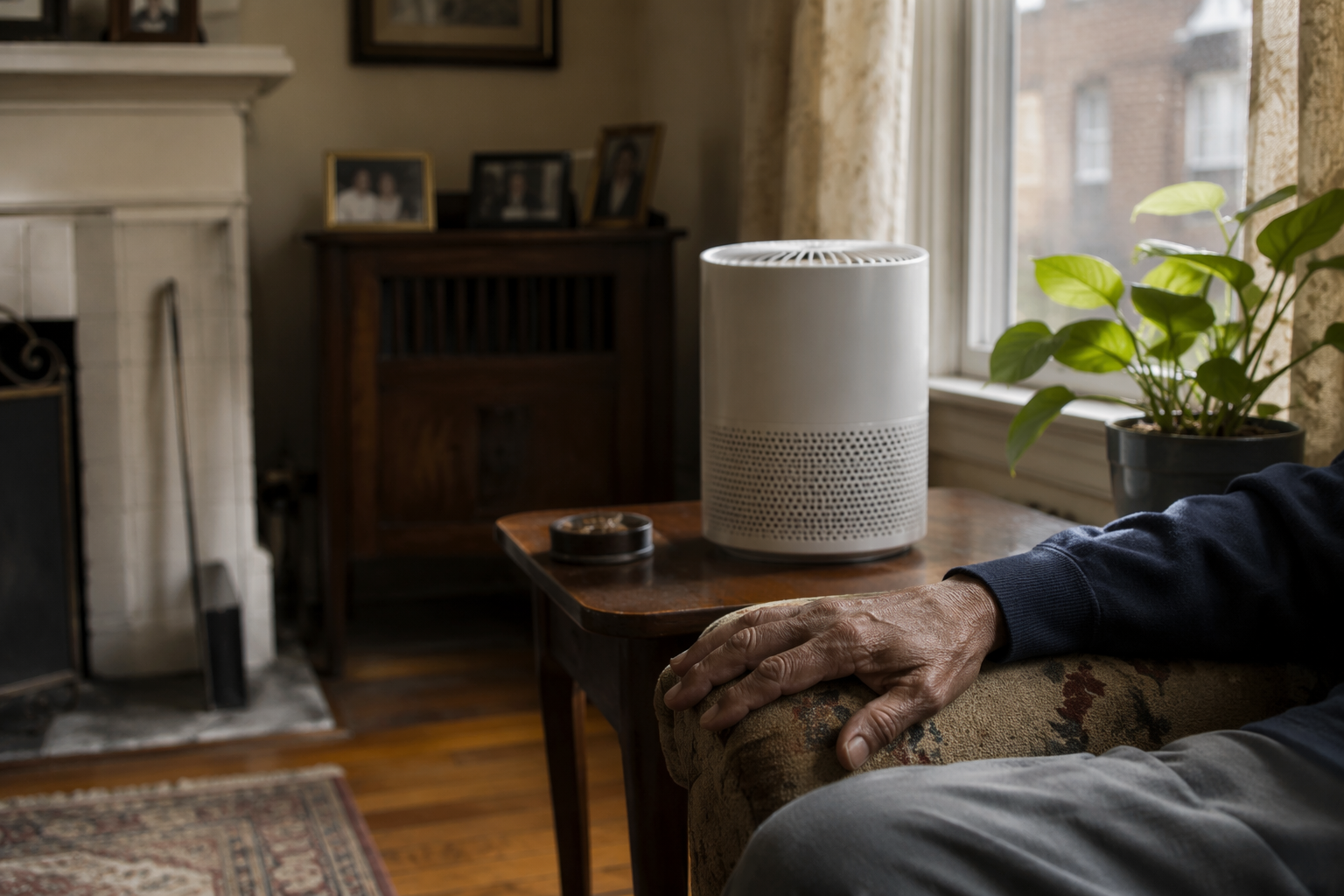
For seniors in Detroit, improving air quality belongs in the fall-prevention conversation because falls are not caused only by what catches a foot. They also happen when a person gets lightheaded standing up, tires out crossing a room, has lower oxygenation on a bad breathing day, or loses the mental sharpness needed to notice a hazard in time. AirNow notes that older adults can spend up to 95% of their time indoors, and indoor air can be 2 to 5 times more polluted than outdoor air.[1]
Why Detroit Caregivers Should Look Past the Floor
Detroit’s outdoor air is not a minor background issue. In the 2026 American Lung Association State of the Air report, Detroit received an F grade; the region ranked 9th worst nationally for year-round particle pollution and 11th worst for short-term particle pollution. Wayne County recorded 25 high-PM2.5 days between 2022 and 2024, including one day in the “very unhealthy” purple range.[2]
That matters indoors because older homes are not sealed laboratory boxes. Outdoor pollution comes in through gaps, open doors, leaky windows, exhaust pathways, and ventilation choices. Then indoor sources add their own load: cooking smoke, candles, incense, tobacco smoke, dusty furnace filters, poor bathroom ventilation, and particles stirred up from settled dust.
A caregiver can do all the standard visible fixes and still miss the room where a parent spends ten or twelve hours breathing air that aggravates the condition already making balance fragile. That does not mean air pollution is the direct cause of a specific fall. It means the body’s margin for error may be smaller on days when breathing, circulation, fatigue, and alertness are worse.
The Fall-Risk Pathway Is Indirect, but It Is Not Imaginary
PM2.5 is fine particle pollution small enough to get deep into the lungs. Ozone is a gas that can irritate the respiratory system. For older adults, AirNow identifies both particle pollution and ozone as concerns because they can aggravate heart and lung disease.[1]
That is where the fall connection becomes practical. A person with COPD who is breathing harder may move less steadily. A person with heart disease may fatigue sooner. A person with diabetes who is already dealing with neuropathy or circulation issues may have less reserve when pollution worsens inflammation or stress on the body. Dizziness, weakness, shortness of breath, and cloudy attention are not “air quality symptoms” in the way a cough is, but they are exactly the kind of symptoms that can turn a normal walk to the bathroom into a risky one.
The careful version of the claim is this: the physiological pathway from polluted air to worsened chronic conditions is well established, and those conditions affect balance, oxygenation, stamina, and cognitive clarity. The specific evidence proving that a HEPA filter directly reduces falls is still emerging. So indoor air work should be treated as a missing layer in fall prevention, not as a replacement for medical evaluation, physical therapy, medication review, or home safety changes.
For the usual home-safety work, it is still worth using a structured checklist rather than memory. A CDC STEADI-style home fall-prevention checklist covers the familiar items: lighting, stairs, bathrooms, rugs, clutter, shoes, and support surfaces. Indoor air quality sits beside that list because it changes the person moving through the house, not just the house itself.
The Detroit HEPA Study That Makes This Actionable
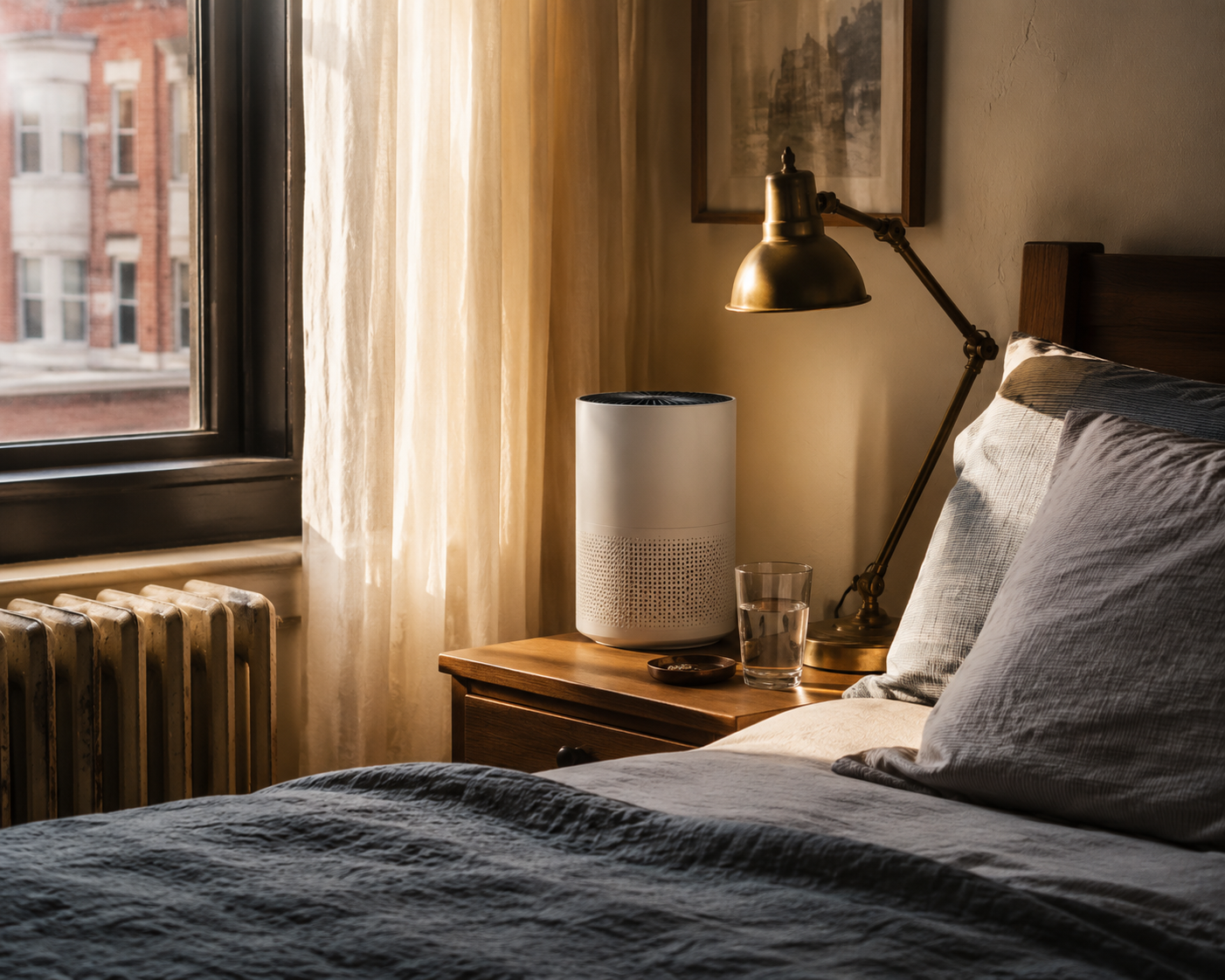
The most useful local evidence is the RAPIDS randomized trial in a Detroit low-income senior residential facility. Researchers tested portable air filtration from 2014 to 2016 and found that portable HEPA filters reduced indoor PM2.5 by 60% and personal PM2.5 exposure by 53%. The largest reductions happened during sleep hours: 62% with true-HEPA filtration and 46% with HEPA-type filtration.[3]
That sleep-hour result matters. The bedroom is often the easiest room to control, and it is where many older adults spend a long uninterrupted stretch of time. A portable unit in the room where a parent sleeps is not a whole-house renovation. It is a plug-in intervention with a measurable exposure effect in a Detroit senior setting.
The study’s old cost figures should not be used for shopping in 2026. Trial-era unit and filter prices reflected an earlier market. Current buyers should compare room size rating, true-HEPA filtration, noise level, filter replacement availability, and total filter cost before picking a model. A product guide such as how to evaluate home safety products for seniors is a better way to think through a purchase than buying the first purifier with a big box and a medical-sounding label.
A Practical Indoor Air Plan: Source Control, Ventilation, Air Cleaning
The EPA’s basic indoor air strategy has three parts: control the pollution source, improve ventilation, and use air cleaners when appropriate.[4] That order is useful because a filter should not be asked to solve a problem that could have been stopped at the source.
| Step | What It Means in an Older Detroit Home |
|---|---|
| Source control | Reduce particles created indoors: smoke, candles, incense, heavy frying without exhaust, dusty filters, and tracked-in dirt. |
| Ventilation | Bring in outdoor air when conditions are reasonable, but avoid treating an open window as automatically healthy on high-pollution days. |
| Air cleaning | Use a properly sized true-HEPA portable purifier in key rooms, or MERV 13+ filtration when the HVAC system can handle it. |
Start With the Sources You Can Actually Remove
The lowest-cost moves are not glamorous: stop indoor smoking, avoid candles and incense, run a kitchen exhaust fan that vents outdoors if the home has one, clean dust without just pushing it into the air, and replace dirty HVAC filters on schedule. If the parent uses a gas stove, the kitchen needs extra attention during cooking. If the bathroom fan barely works, moisture and pollutants hang around longer than they should.
Source control also includes what comes in from outside. Shoes, porch dust, basement dust, garage air, and open windows near traffic all matter. Nobody needs to turn a parent’s house into a sterile project, but fewer particle sources means the purifier and the lungs both have less work to do.
Use Ventilation With the Air Outside in Mind
Ventilation can lower indoor pollutant levels by bringing in outdoor air and exhausting stale indoor air, which is why the EPA includes it as a core indoor air strategy.[4] In Detroit, the catch is timing. Opening windows may help on a clean, mild day. It may be a bad tradeoff during wildfire smoke, ozone alerts, heavy traffic periods, or cold weather when windows only get cracked for a few minutes and then the house closes up again.
For caregivers, the practical habit is simple: check the outdoor Air Quality Index before deciding whether “fresh air” is actually the better air that day. On poor-air days, focus more on source control and filtration. On better days, short, intentional ventilation may help, especially after cooking or cleaning.
Choose Filtration That Matches the Room
For a portable unit, “true HEPA” is the phrase to look for. “HEPA-type” or “HEPA-like” may still reduce particles, but it is not the same standard. The EPA’s air cleaner guidance points consumers toward portable air cleaners with HEPA filters and HVAC filters rated MERV 13 or higher, while also noting that HVAC systems must be able to operate safely with the selected filter.[5]
- Put the first unit in the bedroom if the parent sleeps there nightly and keeps the door mostly closed.
- Check the room-size rating instead of assuming a small tabletop unit can clean a large living room.
- Choose a noise level the parent will tolerate while sleeping; a purifier that gets turned off does not help.
- Confirm replacement filters are easy to buy and affordable enough to replace on schedule.
- Avoid ozone-generating air cleaners, especially for someone with lung or heart disease.
If the home has forced-air heating or cooling, a MERV 13+ filter may help reduce particles through the HVAC system, but not every older system can handle the added airflow resistance. That is a question for an HVAC professional, not a place to guess. A portable true-HEPA unit is often the more straightforward first move because it can be matched to one room and watched for real-world use.
Where This Fits in a Fall-Prevention Plan
Indoor air quality work is most urgent when the parent has a chronic condition that already affects stamina, balance, or alertness. COPD, asthma, heart disease, diabetes, recent hospitalization, medication changes, and repeated complaints of dizziness or fatigue all raise the stakes. So does a bedroom that smells smoky, dusty, damp, or stale.
It also belongs on the list when symptoms seem to change with conditions: worse breathing after cooking, more fatigue on poor-air days, coughing at night, headaches in a closed bedroom, or more unsteadiness after a day spent indoors with windows shut. Those patterns should be brought to a clinician, especially if dizziness, shortness of breath, confusion, or near-falls are new or worsening.
Metro Detroit’s pollution burden is large enough to show up in regional health estimates: air pollution is linked to an estimated 721 premature deaths and 1,500 hospitalizations annually.[6] Those figures are not fall statistics. They are a reminder that air quality is not cosmetic. For an older adult already living close to the edge of safe mobility, breathing easier can be part of staying steadier.
A Reasonable First Week
A caregiver does not have to solve the whole house at once. Start where the parent spends the most time and where exposure is easiest to reduce.
- Check the bedroom first: dust load, odors, window condition, nearby particle sources, and whether the door can stay mostly closed overnight.
- Remove avoidable indoor particle sources before buying equipment.
- Use the outdoor AQI to decide when windows help and when they bring in more pollution.
- Consider a properly sized true-HEPA purifier for the bedroom, especially for a parent with lung, heart, or metabolic disease.
- Keep the regular fall-prevention work moving: grab bars, lighting, medication review, footwear, vision checks, mobility aids, and physical therapy follow-through.
The useful claim is not that an air purifier prevents falls by itself. It does not. The useful claim is that Detroit caregivers have a practical way to reduce a real exposure that can worsen the health problems tied to unsteadiness. If a parent has chronic conditions, spends most of the day indoors, and lives with poor local air quality, improving indoor air is a reasonable next layer to add to the fall-prevention plan.
References
- Older Adults, AirNow.gov.
- Detroit air quality report, Planet Detroit, April 2026.
- RAPIDS randomized trial in a Detroit low-income senior facility, PubMed Central.
- Improving Indoor Air Quality, U.S. Environmental Protection Agency.
- Guide to Air Cleaners in the Home, U.S. Environmental Protection Agency.
- Air, Planet Detroit.
Related reading
Noticed something outdated or inaccurate on this page? Flag a correction. We review every report against CDC, NIA, and AARP HomeFit guidance before updating a page.
Part of the Fall Prevention section.