
Bathroom Safety for Seniors: Hidden Hazards That Increase Fall Risk
Many common bathroom safety products create a false sense of security. This article identifies six specific hazards — from towel bars used as grab bars to suction-cup grips — that can actually increase fall risk, and explains evidence-based replacements and when to seek a professional home assessment.
The bathroom can look safe and still be set up for a fall. The towel bar is within reach. The rug is where wet feet land. The floor is clean. The clutter is gone. Someone has already spent money, already tried, already done the thing every generic checklist says to do: make a bathroom safer for seniors.
That is what makes the next fall feel so baffling. The problem is often not that nothing was done. It is that the fix failed at the exact moment it was needed: a bar pulled away, a rug shifted, a wet tile lost traction, a hand could not turn a knob quickly enough, or shampoo was stored where reaching for it turned into a balance test.
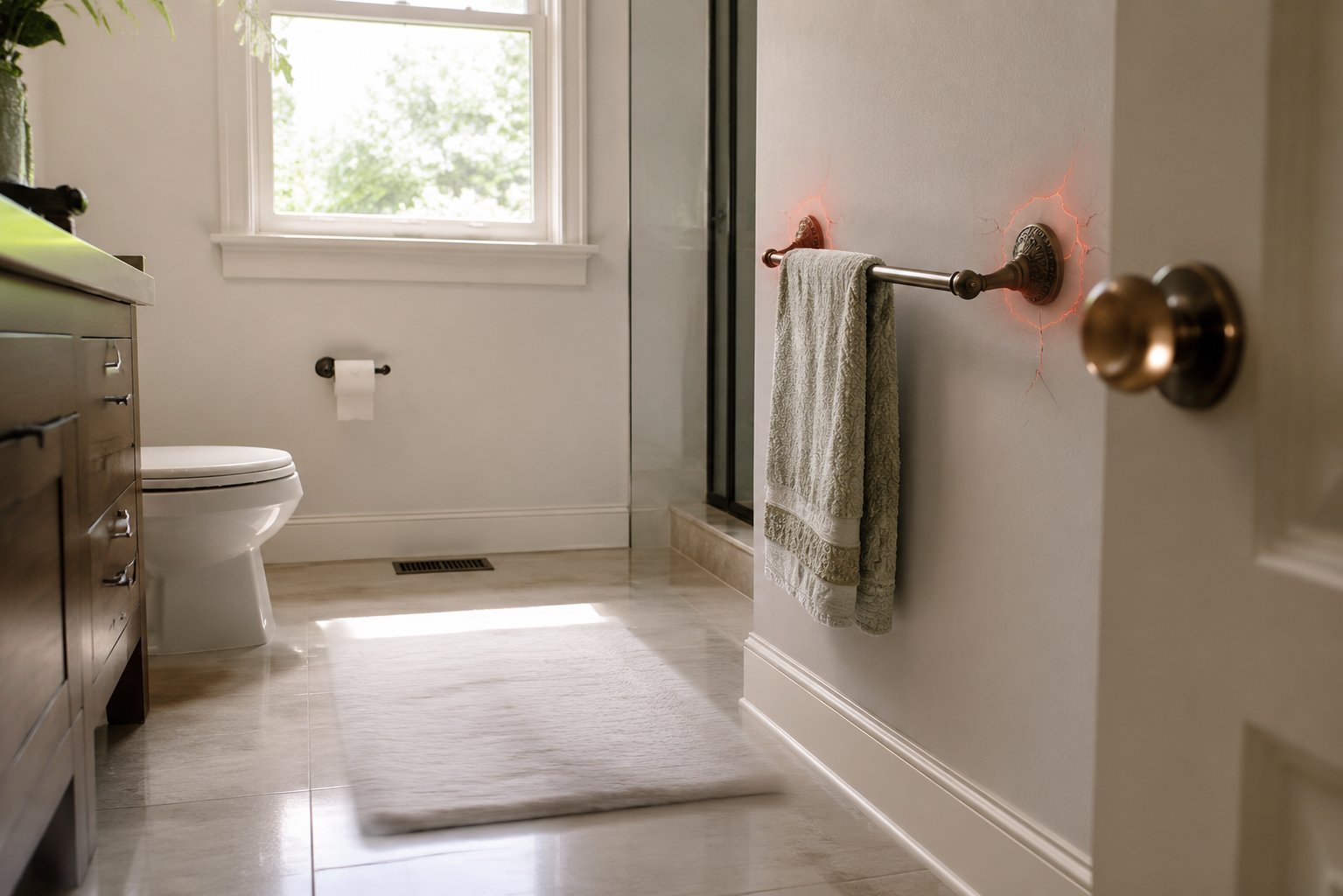
The more useful question is not “Did we buy safety products?” It is “What failure mode did each product actually introduce?”
The Towel Bar That Becomes a Handle in a Panic
A towel bar near the toilet or shower often looks like accidental safety. It is mounted at hand height. It feels solid when someone pulls a towel from it. If an older parent has used it for years to steady themselves, leaving it alone can feel reasonable.
But towel bars are made to hold towels, not a falling body. Many are fastened to drywall with small anchors or light screws. That may be enough for downward towel weight and routine tugging. It is not the same as resisting the sudden, angled force of a person losing balance and grabbing hard with one hand.
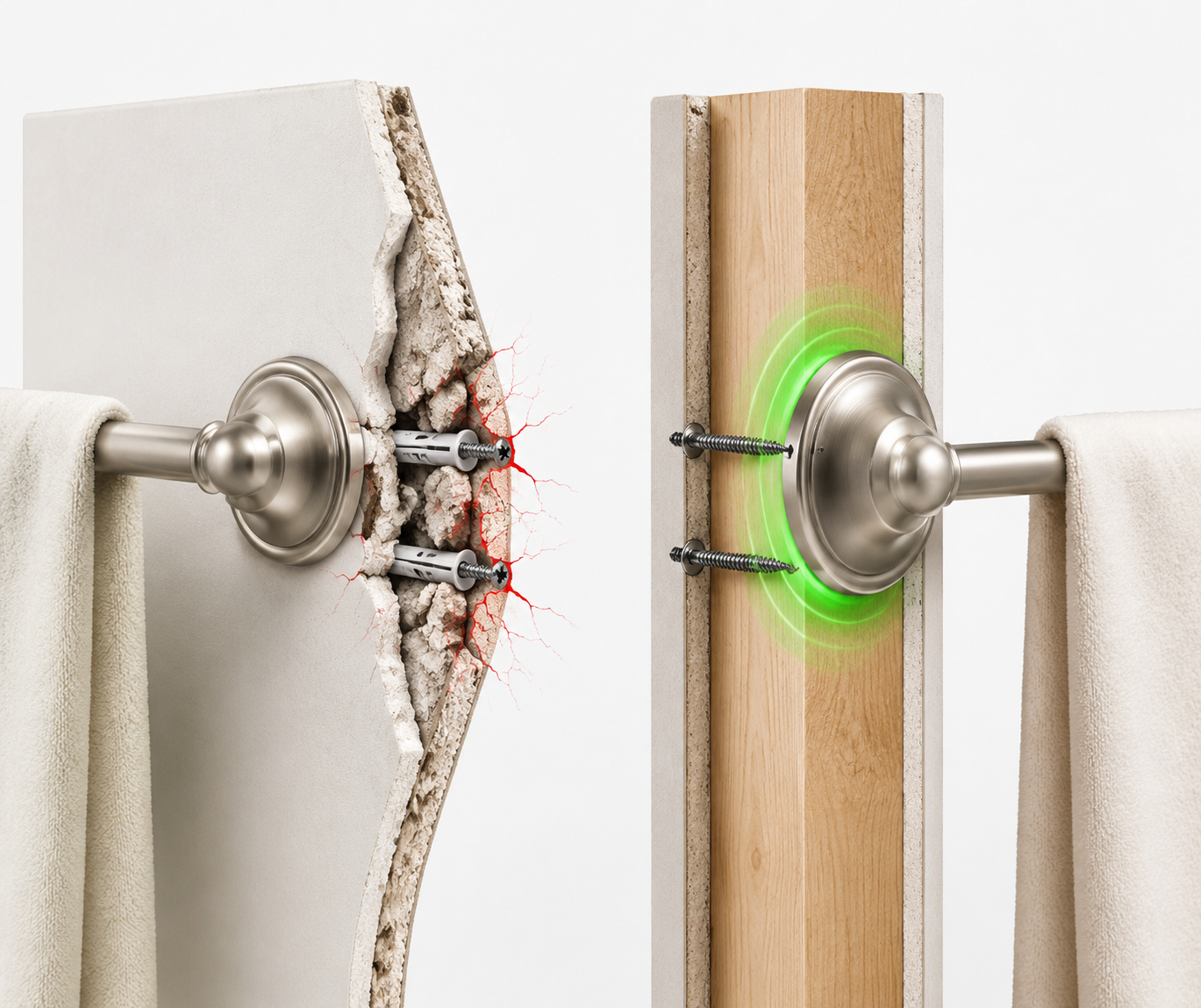
The distinction matters because a grab bar is not just “a stronger towel bar.” ADA design standards specify grab bar diameter, clearance, position, and mounting expectations so the hand can close around the bar and the bar can resist load when used for support. For accessible toilet compartments and bathing fixtures, grab bars are commonly specified at 33 to 36 inches above the finished floor, with outside diameters of 1.25 to 1.5 inches.[1]
For a home bathroom, the practical translation is simple: the bar must be where the person actually reaches, must be easy to grip, and must be anchored into framing or blocking that can take the load. If the wall was never prepared for a grab bar, a contractor may need to open the wall or use an appropriate anchoring system. This is where “I’ll just screw one in this weekend” can become risky, especially in tiled showers where the surface looks strong but the structure behind it is what counts.
| Looks Like Support | What Can Fail | Safer Replacement |
|---|---|---|
| Decorative towel bar | Mounting can pull out of drywall under sudden body-weight force | Grab bar anchored into studs, blocking, or an approved structural anchoring system |
| Thin bar with decorative ends | Hand may not wrap securely, especially when wet | Grippable bar with appropriate diameter and wall clearance |
| Bar placed where it looks neat | User reaches across the body or twists during transfer | Bar placed according to the person’s actual toilet, tub, or shower movement |
There is also a difference between steadying and arresting a fall. A lightly mounted object may seem fine when someone uses it gently while standing still. It can fail when the same person slips, lunges, and loads it diagonally. That is the moment families rarely test, and exactly the moment the bathroom demands a real grab bar.
The Suction-Cup Grip That Works Until the Bathroom Acts Like a Bathroom
Suction-cup grab bars are tempting because they solve three problems at once: no drilling, no contractor, no argument about making the room look medical. They can be useful as a visual cue or a light handhold for balance in very limited situations. The danger starts when they are treated as structural support.
Bathrooms are hostile to suction. Steam, humidity, soap residue, curved surfaces, grout lines, and textured tile can all interfere with the seal. Safety professionals and caregiver reports commonly warn that suction bars can detach over time or under load, and they should not be used as substitutes for permanently mounted grab bars.[2]
The most troubling part is that a suction bar often feels reassuring right after installation. Someone presses it on, flips the locking tabs, pulls once, and it holds. That quick test does not recreate a steamy shower, repeated use, a small leak in the seal, or a frightened sideways grab after a foot slips.
If one is already in the bathroom, the safest assumption is narrow: it is not a fall-arrest device. It should not be the handhold used to enter or exit a tub, rise from a shower chair, or recover from a slip. Replace it with a mechanically fastened grab bar in the transfer path. If drilling into tile or finding studs is uncertain, this is professional work, not a guess-and-hope project.
The Bath Rug That Solves Wet Feet by Creating a Moving Surface
A bath rug feels like common sense. Wet tile is slippery, so the rug goes where the person steps out. It also makes the room feel normal, warmer, less like a clinic. That matters. Older adults do not stop caring about how their home feels just because their family starts worrying about falls.
The failure is movement. A soft-backed rug can slide, bunch, curl at the edge, or shift under one foot while the other foot stays planted. For someone with slower reaction time or weaker hip strength, that small movement can become the whole fall. The National Institute on Aging’s home safety guidance tells older adults to remove throw rugs or secure them so they do not slip.[3]
The better replacement depends on the actual use. If the rug is only decorative, remove it. If it is there to manage water at the shower exit, use a low-profile, rubber-backed non-slip mat that does not curl and can be cleaned often enough that soap film does not defeat the backing. If the floor stays wet because of shower design, the mat is not the root fix; water containment, drainage, or the shower threshold needs attention.
This is also where pride can be handled without pretending risk is harmless. A bathroom does not have to look institutional to be safer. But a rug that moves is not a dignity-preserving compromise; it is a loose surface placed at the exact point where someone is wet, barefoot, and transitioning.
Glossy Tile That Looks Clean and Behaves Differently When Wet
Polished bathroom tile creates a quieter hazard because nothing appears broken. The floor may be new, expensive, and easy to wipe down. Dry, it may feel safe. Wet, the same surface can behave differently under a bare foot, slipper, cane tip, or walker leg.
Tile slip resistance is not just a matter of taste. The tile industry uses dynamic coefficient of friction, or DCOF, testing to describe how a surface performs under wet conditions. Commonly cited guidance uses DCOF of at least 0.42 for level interior spaces expected to be walked on when wet, while more demanding wet zones may call for higher slip resistance, such as 0.60 or above depending on application and conditions.[4]
That does not mean every older bathroom needs to be demolished. It does mean “beautiful tile” and “safe tile” are different questions. If a parent has already slipped on glossy tile, adding another mat may only move the hazard around. Options include replacing the tile with a slip-resistant surface, applying a suitable anti-slip treatment when appropriate, or using a professionally selected non-slip flooring solution in the wet path. The key is to solve wet-surface friction, not cover it with another object that can shift.
The Round Doorknob That Demands Grip at the Worst Time
Round knobs do not look like fall hazards because they are not on the floor. But they ask for a particular movement: close the fingers, grip, twist, and pull or push while standing. That is a lot to require from painful hands, especially when the person is tired, wet, rushing to the toilet, or trying to steady themselves with the other hand.
Arthritis makes that demand more than an inconvenience. CDC and National Council on Aging materials report that arthritis affects a substantial share of older adults, including 44 percent of people ages 65 to 74.[5] For those hands, a lever handle is not a luxury upgrade. It changes the required motion from grasp-and-twist to press-down, which is easier to perform with the palm, side of the hand, or a weaker grip.
This is usually a simple swap compared with wall-mounted support. Replace round bathroom and cabinet knobs with lever-style handles or easy-pull hardware. If privacy locks are involved, choose hardware that can be opened from the outside in an emergency so a caregiver is not fighting a locked door after a fall.
Toiletries Stored Where Reaching Becomes a Balance Test
A cleared bathroom counter can still hide a reach hazard. Shampoo on a high shower shelf, toilet paper stored near the floor, towels stacked in a low cabinet, or medicine kept above shoulder height all require the same risky sequence: reach, bend, twist, shift weight, and recover.
For a steady adult, that sequence is forgettable. For someone with neuropathy, dizziness, arthritis, low vision, or a walker parked outside the shower, it can be the difference between washing safely and reaching across wet tile. NIA room-by-room guidance emphasizes arranging the home so frequently used items are easy to reach and pathways remain clear.[3]
Move daily-use items to waist-to-chest height, inside the actual use zone. In the shower, that may mean a stable, wall-mounted dispenser or shelf placed where the person can reach without turning away from support. Near the toilet, it may mean toilet paper, wipes, and hygiene supplies within easy reach from the seated position. The test is not whether the bathroom looks tidy. The test is whether the person can complete the task without bending below the knees, reaching above the shoulders, or twisting while wet.
Why Bathroom Falls Deserve More Precision, Not More Panic
It is easy to find dramatic claims about senior falls and bathrooms. The more careful evidence is narrower and more useful. In one study of older adult falls in the home, 10.8 percent occurred in the bathroom, yet bathroom falls were 2.4 times more likely to result in injury than falls in the living room.[6]
That distinction matters. The bathroom may not be where every fall happens, but when a fall does happen there, the landing environment is unforgiving: tile, porcelain, metal edges, glass, and tight spaces. The same study found that falling backward and landing flat was 5.6 times more likely to cause injury than falling backward into a sitting position.[6]
This is why false support and false traction are such serious problems. A failing towel bar, suction grip, rug, or glossy tile does not merely fail to help. It can change the body’s path during the fall and remove the person’s chance to recover.
What to Replace First
If the bathroom already has “safety” items, inspect them by failure mode rather than by category. A grab bar is only useful if it is structurally mounted and placed where the person reaches. A mat is only useful if it stays put when wet. A handle is only useful if the hand can operate it without pain or twisting.
| Hidden Hazard | Immediate Action | When It Needs Professional Help |
|---|---|---|
| Towel bar used for support | Stop treating it as a handhold; plan a real grab bar | When studs, blocking, tile drilling, or placement are uncertain |
| Suction-cup grab bar | Use only as a light cue, not structural support | When it is in the transfer path for tub, shower, or toilet use |
| Soft-backed bath rug | Remove it or replace with a low-profile non-slip mat | When water routinely escapes the shower or tub area |
| Glossy tile | Treat wet traction as the problem, not clutter | When flooring, coating, or shower redesign is being considered |
| Round knobs | Replace with lever handles or easy-pull hardware | When locks, door swing, or emergency access are concerns |
| High or low storage | Move daily items to reachable zones | When the person’s actual movement pattern is hard to judge |
For readers planning larger changes, a more complete evidence review of bathroom modifications can help separate proven safety upgrades from cosmetic remodeling. See Bathroom Remodel for Elderly: An Evidence-Based Review before turning one failed fix into a full renovation.
The Highest-Yield Next Move Is an In-Home Assessment
A family member can spot obvious clutter. It is harder to judge reach distance, transfer path, grip strength, wet traction, lighting, fatigue, medication effects, and where a parent actually places a hand when they are scared. That is the value of an in-home occupational therapy assessment: the bathroom is evaluated around the person’s body, habits, diagnoses, and real movements, not around a product list.
NIA recommends talking with a doctor about fall risk and reviewing the home for hazards, and the home-fall study authors also point to home assessment and modification as part of fall-injury prevention for older adults.[3][6] Medicare coverage should be understood carefully: Medicare Part B may cover occupational therapy when it is medically necessary and ordered as part of a plan of care, often after an illness, injury, or functional decline. It should not be assumed to cover a purely preventive home safety visit with no qualifying medical need.[7]
If you are deciding whom to call first, The Occupational Therapist's Guide to Aging-in-Place Home Modifications and Should My Aging Parent See an Occupational Therapist or a CAPS First? can help sort assessment from installation. If structural work is needed after the hazards are identified, Choosing Between a CAPS Specialist and a General Contractor is the more practical next read.
Replace false safety with anchored, measured, reachable, slip-resistant solutions. Then let a trained person watch the movements your family cannot reliably reconstruct after the fall has already happened.
References
- 2010 ADA Standards for Accessible Design, U.S. Department of Justice, 2010
- Bathroom Grab Bars: Suction Cup vs. Permanently Mounted, Oakley Home Access
- Home Safety Checklist for Older Adults, National Institute on Aging
- ANSI A326.3 American National Standard Test Method for Measuring Dynamic Coefficient of Friction of Hard Surface Flooring Materials, Tile Council of North America
- Get the Facts on Arthritis and Aging, National Council on Aging
- Circumstances and outcomes of falls among high risk community-dwelling older adults, Injury Epidemiology, 2015
- Occupational Therapy Coverage, Medicare.gov
Related reading
Noticed something outdated or inaccurate on this page? Flag a correction. We review every report against CDC, NIA, and AARP HomeFit guidance before updating a page.
Part of the Fall Prevention section.