
Balance Exercises to Prevent Falls in Older Adults: An Evidence-Based Guide for Seniors and Family Caregivers
Structured balance and strength exercises are the most evidence-supported way to reduce fall risk in older adults — cutting falls by 15–58% depending on the program — yet most caregivers and seniors lack a safe, practical starting point. This guide explains what the research shows, how to begin at home, how to progress safely, and when to involve a physical therapist.
Why Falls — and Exercise — Matter More Than Most People Realize
Each year, more than 1 in 4 adults age 65 and older falls — yet fewer than half tell their doctor. Falls generate roughly 3 million emergency department visits and 1 million hospitalizations annually among older adults in the United States. Perhaps more sobering: falling once doubles the chances of falling again.
Those numbers are real, but they are not the whole story. The more important fact is that falls are not an inevitable consequence of aging — they are largely preventable, and the most powerful tool available is one that most people already have access to: structured, progressive exercise.
Across dozens of randomized controlled trials, balance and strength training programs have reduced fall rates in community-dwelling older adults by anywhere from 15% to more than 50%, depending on the program type and duration. No medication, no home modification, and no single piece of equipment comes close to that range of effect as a standalone intervention.
If you are an adult child reading this after a parent's fall or near-fall, the goal of this guide is to help you move from alarm to action — with a clear picture of what the evidence supports, what a safe starting point looks like, and how you can help. If you are an older adult reading this for yourself, the goal is the same: a practical, honest roadmap for building the balance and strength that protect your independence.
Why Balance Declines With Age — and Why Inactivity Accelerates It
Balance is not a single sense — it is a continuous negotiation between the brain, the muscles, and the body's sensory systems. Three things degrade this system as we age:
- Lower-limb strength decreases. The muscles of the legs and ankles that stabilize us during standing and walking lose mass and power over time, making it harder to recover from a stumble.
- Proprioception slows. Proprioception is the body's internal sense of its own position in space — it tells your brain where your feet are without you looking. Age-related changes in sensory nerve function make this feedback slower and less precise.
- Reaction time lengthens. Even when a stumble is detected, the window for a corrective response — a quick step, a reach for support — narrows as the nervous system's speed of processing declines.
These changes are real, but they are not fixed. What accelerates them most is physical inactivity — not aging alone. In multiple randomized controlled trials, control groups that received no exercise intervention consistently showed measurable declines in balance performance over the study period. The message from that finding is concrete: doing nothing is not a neutral choice. It is a choice to decline faster.
This is also why the exercises described later in this guide are designed the way they are. Heel raises and calf strengthening target the ankle muscles most responsible for postural sway correction. Single-leg stands train the proprioceptive system under controlled load. Sit-to-stand repetitions rebuild the leg strength needed to recover from a shift in center of gravity. Each exercise is a targeted response to a specific mechanism of decline.
What the Research Actually Shows: Evidence for Exercise and Fall Prevention
The evidence base for exercise as a fall prevention strategy is among the most robust in all of geriatric medicine. A 2019 Cochrane systematic review — the broadest synthesis of the evidence — found that exercise programs reduced fall rates in older adults by approximately 15% overall (rate ratio 0.85; DOI: 10.1002/14651858.CD012424.pub2). That 15% figure represents the average across a wide mix of program types and intensities. Specific, well-structured programs do considerably better.
A 2026 PRISMA-compliant systematic review of 27 randomized controlled trials — covering adults age 60 and older across a 2010–2025 search window — provides the most current quantitative picture. Because the included trials varied substantially in design, population, and outcome measures, the authors used narrative synthesis rather than pooled meta-analysis. The percentage ranges below should be read as directional trends supported by the evidence, not as single precise effect sizes.
| Exercise Type | Fall Reduction Range | Notes |
|---|---|---|
| Tai Ji Quan (Tai Chi) | 31–58% | Among the strongest individual programs; well-suited to group community delivery |
| Otago Exercise Program | 23–40% | Home-based; 17 exercises + walking; initiated with a physical therapist |
| Multimodal strength–balance training | 20–45% | Combines strength, balance, and aerobic elements; broadest protective effect |
| Perturbation-based reactive balance training | 50–75% (lab-induced falls) | Clinical setting only — not home-accessible; emerging evidence, not yet community-standard |
Beyond fall counts, the same review found meaningful functional improvements: faster Timed Up and Go performance, 15–35% gains in lower-limb strength, and 1.2–2.5 point improvements in Short Physical Performance Battery scores. Fear of falling — a clinically relevant risk factor in its own right — also decreased alongside physical improvements.
A complementary 2019 systematic review of 8 RCTs found that balance measures improved 16–42% from baseline across diverse exercise modalities, while all no-intervention control groups declined. Supervised programs consistently outperformed unsupervised equivalents in balance outcomes.
Two timing findings are especially practical for caregivers and older adults:
- Even 8–12 weeks of structured training produces meaningful balance and strength gains — you do not need to wait months to see results.
- Longer programs of 12–24 months produce sustained fall reduction. Short-term gains are real, but continuing the program is what locks them in.
Understanding Your Options: Exercise Types Explained
Not all exercise is equally effective for fall prevention, and understanding the difference matters when you are trying to choose a starting point.
Balance Training
Balance training involves progressively challenging the body's ability to maintain stability — standing on one foot, reducing the base of support, or removing visual cues by closing the eyes. It directly trains the proprioceptive and neuromuscular systems that deteriorate with age. This is the core of most fall prevention programs and the foundation of the beginner exercises described later in this guide.
Lower-Limb Strength Training
Exercises like sit-to-stand, heel raises, and side leg lifts rebuild the muscle strength needed to recover from a stumble and to maintain a stable gait. Strength training is most effective when paired with balance training — each reinforces the other.
Tai Ji Quan (Tai Chi)
Tai Ji Quan is one of the best-evidenced individual programs for fall prevention in older adults, with fall reductions of 31–58% across studies. It combines slow, controlled movements with weight shifting and postural awareness — exactly the neuromuscular skills that fall prevention requires. It is widely available in community settings, including senior centers and recreation programs, and is well-suited to older adults who prefer a group format or a mind-body approach. It is one strong option among several, not the only option.
The Otago Exercise Program
The Otago Exercise Program (OEP) consists of 17 strength and balance exercises combined with a walking program, performed three times per week at home. Studies show OEP participants experience a 35–40% reduction in falls. The program is specifically designed for older adults who have already experienced one or more falls, who are more frail, or who lack access to community exercise classes. It begins with 1–5 sessions with a physical therapist who prescribes the appropriate starting exercises, followed by independent exercise for up to one year with monthly phone check-ins. The Otago program is the strongest evidence-based home option for higher-risk older adults.
Multimodal Programs
Programs that combine strength training, balance training, and aerobic activity produce fall reductions of 20–45% and offer the broadest protective effect because they address multiple mechanisms simultaneously. For most community-dwelling older adults without significant frailty, a multimodal approach — mixing the beginner exercises below with regular walking — is a practical and well-supported starting point.
A Word on Walking
Walking is beneficial for cardiovascular health, mood, and general fitness — and it should be part of any active aging routine. But walking alone does not build balance or lower-limb strength sufficiently to reduce fall risk unless you are regularly walking up and down hills or stairs. A dedicated strength and balance program should accompany a walking routine, not be replaced by it.
Before You Start: Safety Setup and When to See a Doctor or PT First
Most healthy older adults can begin gentle balance exercises at home without a medical clearance visit. But a few minutes of preparation — and honest self-assessment — make the difference between a safe start and an unnecessary setback.
Home Setup Checklist
- Choose a location near a sturdy, fixed surface — a kitchen counter, a solid chair back, or a corner where two walls meet. This is your safety anchor for every exercise.
- Clear the floor area of rugs, cords, or anything you could trip over during the exercise.
- Wear well-fitting, non-slip footwear — not socks alone, and not loose slippers.
- If you are exercising alone, keep a phone within reach.
- Start every session with two hands on your support surface. Reduce support only when you feel stable and in control.
When to See a Doctor or Physical Therapist Before Starting
Seek a medical or PT assessment before beginning an exercise program if any of the following apply:
- You have fallen in the past year, or you fell recently and have not yet been evaluated.
- You currently use a walker or cane for mobility.
- You feel significantly unsteady when standing or walking.
- You have pain — from arthritis, an old injury, or another cause — that limits your ability to move.
- You have a condition affecting your legs, feet, or balance (such as neuropathy, Parkinson's disease, or significant vision loss).
- Fear of falling is already limiting your daily activities.
The CDC STEADI resources are organized separately for older adults, caregivers, and healthcare providers — a useful set of tools to bring into a conversation with a doctor or PT.
Beginner Balance and Strength Exercises to Start at Home
The exercises below are drawn from guidance by Johns Hopkins Medicine and the National Council on Aging. They target the specific deficits — lower-limb strength, postural stability, and proprioception — that drive fall risk. Each one is appropriate for older adults who are new to a balance program and have no acute pain or injury limiting their movement.
Start every session with two hands resting lightly on your support surface. As confidence grows, you will reduce that support — but never rush that step.
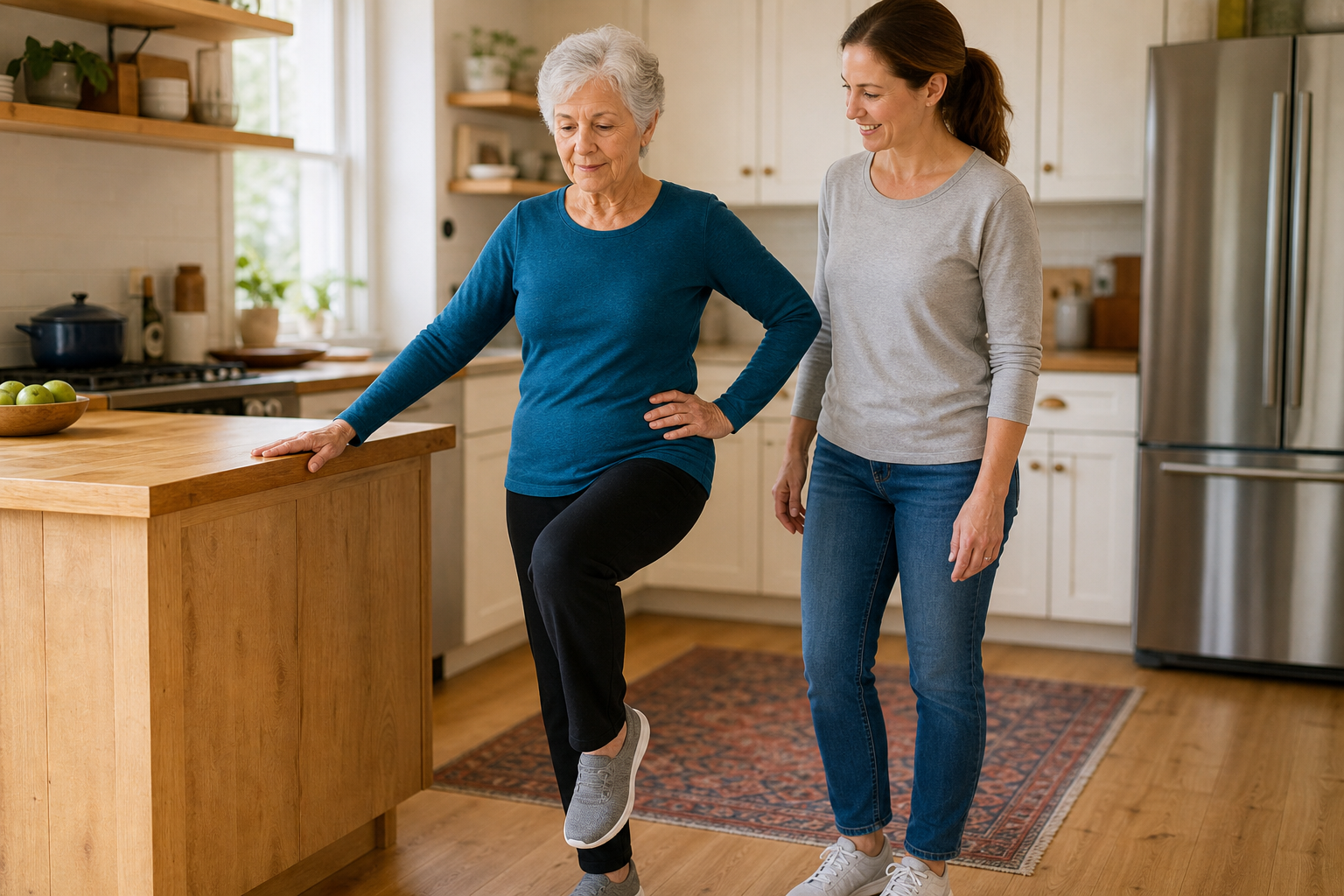
1. Sit-to-Stand
Why it matters: Rising from a chair is one of the most common moments when older adults lose their balance. This exercise rebuilds the leg strength and body mechanics that make it safer.
- Sit near the front edge of a sturdy chair with feet flat on the floor, hip-width apart.
- Lean your chest slightly forward over your toes — this shifts your weight in the direction you are moving.
- Squeeze your glutes and push through your heels to rise slowly to standing.
- Lower yourself back down with control — do not drop into the chair.
- Goal: 10 repetitions, twice daily. Work toward doing this without using your hands for support.
2. Four-Stage Balance Progression
Why it matters: This is the core balance training sequence recommended by Johns Hopkins Medicine. Each stage progressively reduces your base of support, challenging the balance system in a controlled, measurable way.
- Stage 1 — Feet shoulder-width apart: Stand with feet comfortably apart, hands on support. Hold 10 seconds, build to 30 seconds. 5 repetitions.
- Stage 2 — Feet together: Move feet so they are touching. Hold 10–30 seconds. 5 repetitions.
- Stage 3 — One foot slightly in front: Place one foot directly in front of the other (tandem stance). Hold 10–30 seconds each side.
- Stage 4 — Single-leg stand: Lift one foot slightly off the floor. Hold 10–30 seconds each side.
- Perform twice daily. Always have your support surface within reach. Progress to the next stage only when you can hold the current one for 30 seconds without grabbing for support.
3. Heel Raises
Why it matters: The calf muscles and Achilles tendon are critical for postural sway correction — the micro-adjustments that keep you upright. Heel raises strengthen this system directly.
- Stand behind a sturdy chair with both hands resting on the back.
- Slowly rise onto the balls of both feet, lifting your heels as high as comfortable.
- Hold for 1–2 seconds at the top, then lower slowly.
- Goal: 10–15 repetitions, twice daily.
4. Side Leg Lifts
Why it matters: Hip abductor weakness is a significant contributor to lateral instability — the sideways sway that often precedes a fall. Side leg lifts target this muscle group directly.
- Stand beside a chair or counter with one hand on the support.
- Keeping your back straight and toes pointing forward, slowly lift one leg out to the side about 6–12 inches.
- Hold for 1 second, then lower slowly.
- Goal: 10–15 repetitions per side, twice daily.
5. Step-Ups
Why it matters: Stepping up and down replicates one of the most common fall scenarios — navigating a curb, a threshold, or a single step. It builds leg strength and dynamic balance simultaneously.
- Use the bottom step of a staircase with a secure handrail.
- Step up with one foot, bring the other foot to meet it, then step back down one foot at a time.
- Lead with the stronger leg going up; lead with the weaker leg coming down.
- Goal: 10 repetitions per side, once daily. Always hold the handrail.
How to Progress Safely Over Weeks
Progression is the mechanism that makes exercise effective for fall prevention. A program that stays at the same difficulty level stops challenging the balance system and stops producing gains. The progression logic is straightforward: reduce support first, then increase repetitions, then introduce eyes-closed variants.
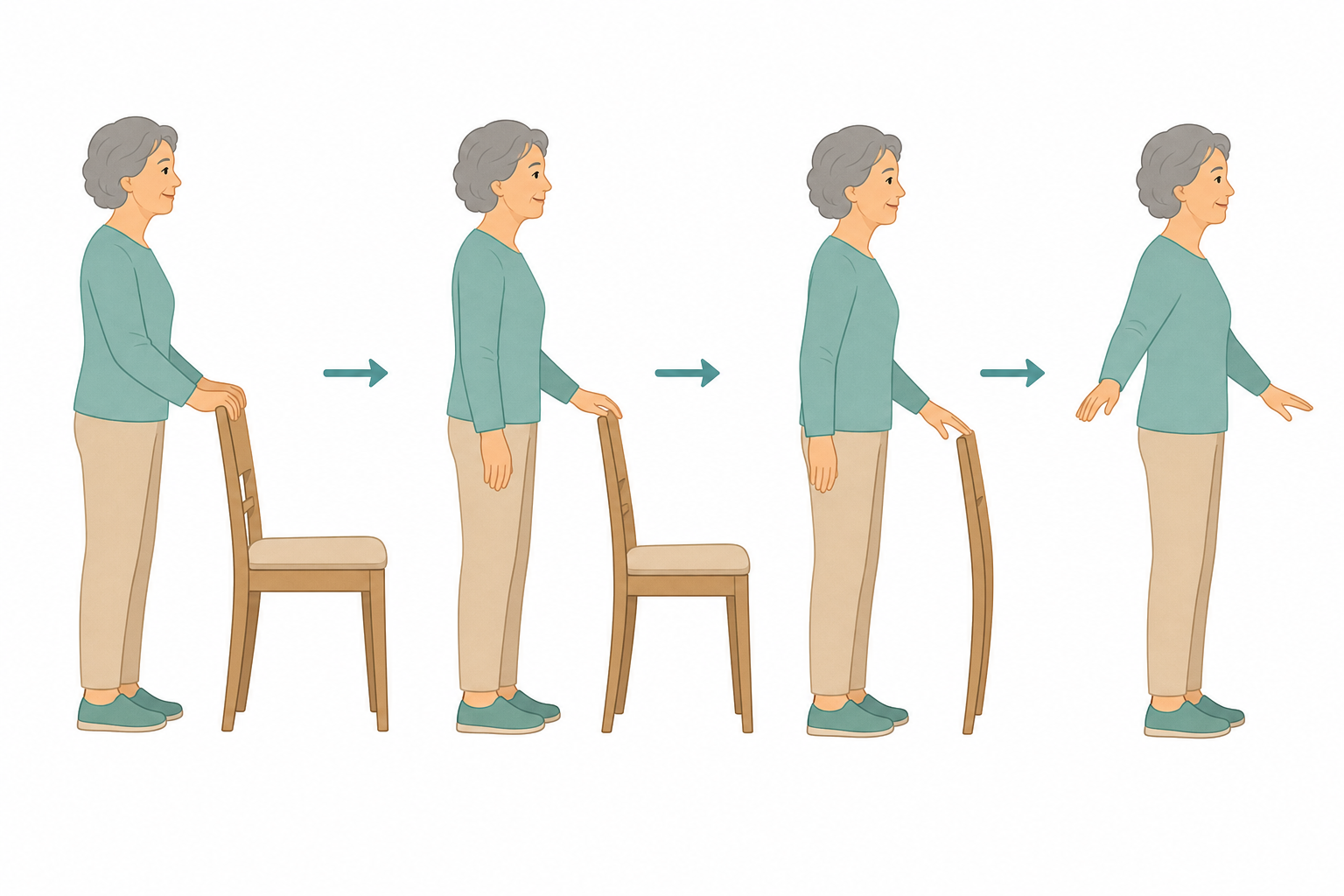
A 12-week randomized controlled trial of a structured Balance Exercise Circuit found that a progression from eyes-open positions to eyes-closed positions to exercises performed with obstacles was well tolerated by adults age 65 and older. Static balance improvements were significant, and — critically — the gains were maintained for at least 3 months after the training period ended without further exercise. This suggests that even a relatively short structured program can produce durable benefits.
| Weeks | Support Level | Eyes | Duration per Position | Frequency |
|---|---|---|---|---|
| 1–3 | Two hands on support | Open | 10–15 seconds | Twice daily |
| 4–6 | One hand on support | Open | 15–20 seconds | Twice daily |
| 7–9 | Fingertips only | Open | 20–30 seconds | Twice daily |
| 10–12 | No hands (arms slightly extended for safety) | Open, then eyes closed | 20–30 seconds | Twice daily |
| 12+ | No hands | Eyes closed or with minor distractions | 30 seconds | 3 or more days per week |
The World Health Organization recommends that adults age 65 and older include balance-focused activity on at least 3 days per week, alongside at least 150 minutes per week of moderate aerobic activity and muscle-strengthening activities on 2 or more days. The exercises in this guide, performed consistently, satisfy the balance component of that recommendation.
When to Refer to a Physical Therapist — and What to Expect
A home exercise program is a strong starting point, but it is not a substitute for individual clinical assessment. Physical therapists are trained to evaluate gait mechanics, identify specific balance deficits, review medications that may be contributing to fall risk, and prescribe a program matched to the individual's functional level. For some older adults, a PT assessment is not just helpful — it is the appropriate first step.
Indicators for PT Referral
- A fall in the past year, especially one that caused injury or significant fear.
- Fear of falling that is already limiting daily activities — avoiding stairs, reducing outings, or needing someone nearby to feel safe.
- Currently using a walker or cane, or being told by a doctor that one is needed.
- Pain from arthritis, an old injury, or another condition that limits the ability to exercise.
- Being classified as frail or having complex medical conditions that make self-directed exercise difficult to calibrate.
- Feeling significantly unsteady even during routine daily tasks like walking to the bathroom at night.
What a PT Fall-Risk Assessment Covers
A physical therapist's fall-risk assessment typically includes evaluation of gait speed and quality, lower-limb strength, static and dynamic balance, footwear, home environment, and a review of medications that may be contributing to dizziness or unsteadiness (with referral back to the prescribing physician as needed). The assessment results in a personalized exercise prescription — which exercises to start with, at what intensity, and how to progress.
The Otago Exercise Program specifically recommends that frail older adults receive their initial exercise prescription from a physical therapist — typically 1 to 5 sessions — before transitioning to independent home exercise with monthly phone check-ins. This model is a practical template for how PT involvement can be structured without requiring ongoing in-person visits.
How Family Caregivers Can Support an Exercise Routine
If you are an adult child managing a parent's fall prevention after a fall or near-fall, your involvement matters more than you might expect. Adherence to home exercise programs is one of the most consistent predictors of outcome — and adherence is where most programs fail. Here is what the evidence and clinical experience suggest actually helps:
- Exercise alongside them. Doing the exercises together — even if you are doing them for different reasons — substantially improves consistency. It removes the social isolation of solo exercise and provides a natural accountability structure.
- Set a consistent time. A fixed daily time — after breakfast, before the evening news — removes the decision-making friction that causes skipped sessions. Habit formation is more reliable than motivation.
- Use a simple tracking method. A paper calendar with a checkmark for each completed session is enough. Seeing a streak of completed days is a meaningful motivator, and it gives you a concrete record to share with a PT or doctor.
- Take fear of falling seriously. Fear of falling is a clinically recognized risk factor — it leads to activity restriction, which leads to greater physical decline, which raises actual fall risk. Exercise directly reduces fear of falling alongside physical balance improvement. If your parent is resistant to exercise because they are afraid of falling, that fear is the problem to address first, not a reason to skip the exercise.
- Model the Otago check-in structure. The Otago program's monthly phone check-in during the self-management phase is a useful template for long-distance caregivers. A brief call to review how the exercises are going, whether the routine is being maintained, and whether anything feels harder than it should can substitute for in-person oversight.
If your parent resists the idea of an exercise program, that is common and understandable. Resistance often comes from fear of injury, skepticism that exercise will help, or a sense that they are past the point where it matters. A low-pressure starting point — just the sit-to-stand exercise, twice a day, for one week — is more likely to build momentum than presenting a full program at once. Starting very small lowers the activation energy and provides an early win.
Frequently Asked Questions
Is it safe to start balance exercises after a recent fall?
Yes — with appropriate guidance. Exercise is one of the most effective ways to reduce the risk of a second fall, and the evidence supports starting a structured program after a fall rather than waiting. However, a recent fall is also a clear indicator for a PT assessment before beginning independently. A physical therapist can identify what contributed to the fall, rule out injury that might not be obvious, and prescribe a program calibrated to the current level of function.
How long before I see results?
Meaningful balance and strength gains are typically measurable within 8–12 weeks of structured, consistent training. Subjective improvements — feeling steadier, feeling more confident — often appear sooner. For sustained fall reduction, longer programs of 12–24 months produce the most durable outcomes. The evidence is clear that short-term gains are real, but continuing the program is what protects them.
What if my parent refuses to exercise?
Resistance to exercise is very common among older adults, particularly after a fall. The most frequent underlying reasons are fear of injury, embarrassment about limitations, skepticism about benefit, and a sense of loss of control. Acknowledging those feelings directly — rather than arguing about the evidence — tends to be more effective than presenting statistics.
Offering to do the exercises together, starting with just one or two simple movements rather than a full program, and framing it around a specific goal your parent values (being able to walk to the mailbox, play with grandchildren, stay in their home) can lower the resistance enough to get started. A first session with a physical therapist can also help — hearing the rationale from a clinician rather than an adult child sometimes makes a meaningful difference.
Is walking enough to prevent falls?
No. Walking is excellent for cardiovascular health and general fitness, and it should be part of an active aging routine. But walking on flat surfaces does not build lower-limb strength or challenge the balance system sufficiently to reduce fall risk. A dedicated balance and strength program — like the exercises described in this guide — should accompany a walking routine, not be replaced by it.
What is the Otago Exercise Program and who is it for?
The Otago Exercise Program is a structured, evidence-based home exercise program consisting of 17 strength and balance exercises plus a walking component, performed three times per week. It was specifically designed for older adults who have already fallen, who are more frail, or who lack access to community exercise programs. It produces a 35–40% reduction in falls among participants. The program begins with a physical therapist who prescribes the appropriate starting exercises, then transitions to independent home exercise with periodic check-ins. The NCOA's Otago program overview is a good starting point for finding a program in your area.
How many days per week should balance exercises be done?
The World Health Organization recommends that adults age 65 and older include balance-focused physical activity on at least 3 days per week. The beginner exercises in this guide are designed to be done twice daily — brief sessions of 10–15 minutes each — which comfortably meets and exceeds that minimum. Consistency across the week matters more than session length.
Key Resources for Getting Started
The following resources are authoritative, free, and designed specifically for older adults and family caregivers. They are practical next steps, not substitutes for the guidance in this article.
- CDC STEADI (Stopping Elderly Accidents, Deaths & Injuries) — Patient and caregiver brochures, a Chair Rise Exercise handout, and a Check for Safety home assessment. Resources are organized separately for older adults, caregivers, and healthcare providers.
- NCOA Falls Free CheckUp — A self-assessment tool from the National Council on Aging that helps older adults identify their personal fall risk factors and find local evidence-based programs.
- NCOA Otago Exercise Program Overview — Information on the Otago program, who it is designed for, and how to find a program near you.
- Johns Hopkins Medicine: Fall Prevention Balance and Strength Exercises — Video demonstrations of the sit-to-stand and four-stage balance progression exercises from a Johns Hopkins physical therapist.
Related reading
Noticed something outdated or inaccurate on this page? Flag a correction. We review every report against CDC, NIA, and AARP HomeFit guidance before updating a page.
Part of the Fall Prevention section.