
Kitchen Fall Prevention Checklist for Older Adults: A Zone-by-Zone Safety Guide for Caregivers
Nearly 1 in 5 in-home falls among older adults happens in the kitchen. This evidence-based checklist helps adult children and spousal caregivers identify and fix kitchen-specific hazards using a simple zone-by-zone approach with tiered priorities.
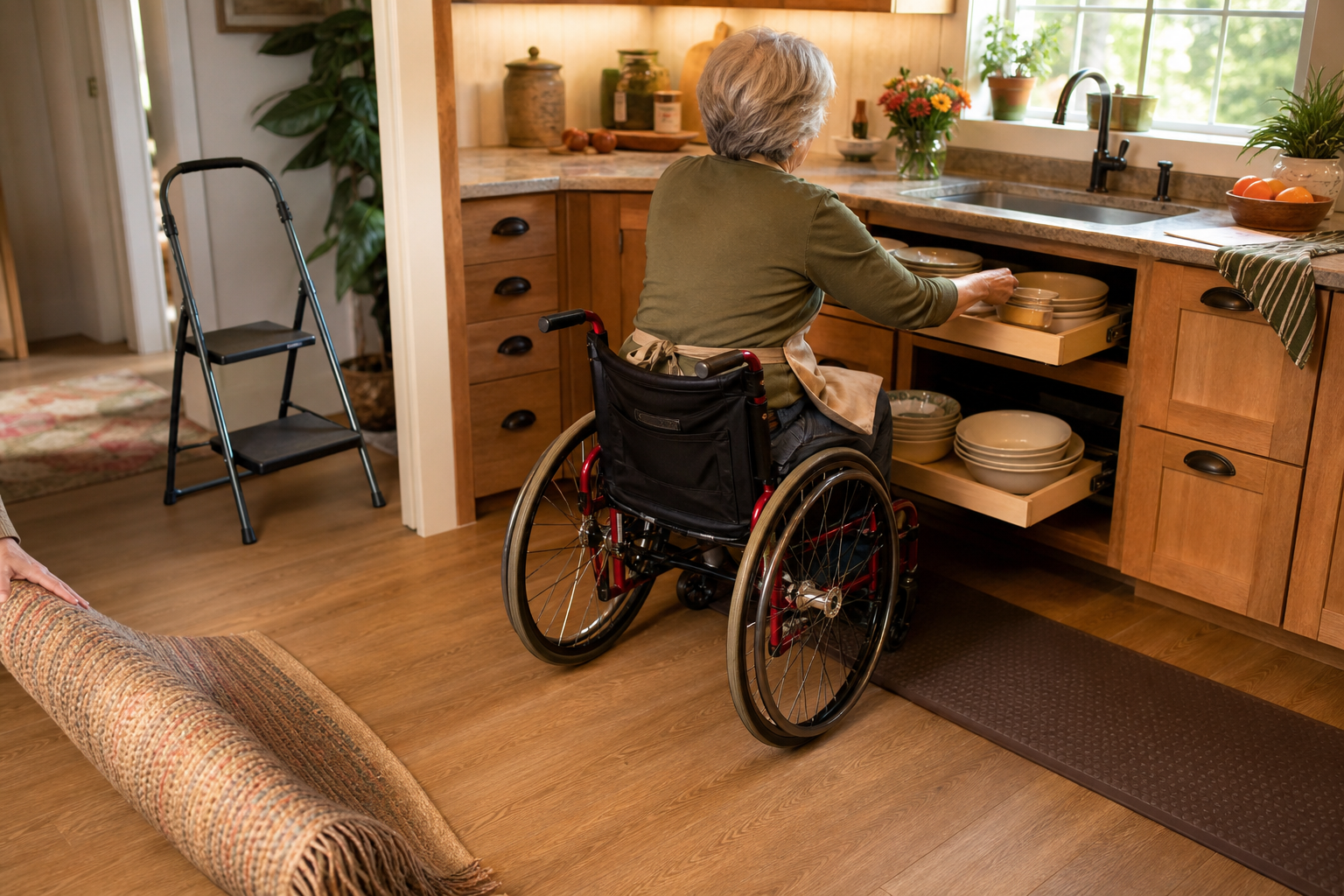
Why the Kitchen Is a High-Risk Zone for Falls
Each year, 1 in 4 older adults falls — and about 60% of those falls happen inside the home. According to National Health Interview Survey data cited by Lively, the kitchen accounts for roughly 19% of in-home falls, making it the third most common room after the living room (31%) and bedroom (30%). That figure rises to 5.6–8.1% when looking at kitchen-specific fall locations from hospital records, though the true share is likely higher because many minor kitchen falls go unreported.
The kitchen is uniquely hazardous because it combines several risks at once: hard tile or wood floors that provide no cushion if balance fails, hot surfaces and boiling liquids that turn a simple slip into a burn injury, overhead cabinets that force reaching, water and grease that create instant slippery surfaces, and the common habit of multitasking — carrying a hot pot while stepping around a pet or a damp spot. Unlike the bedroom or living room, the kitchen demands constant movement, grip, and attention, all of which can diminish with age or medication side effects.
When to Use This Checklist: Triggers for a Kitchen Walkthrough
A proactive kitchen walkthrough can prevent a future injury. Use this checklist at any of the following triggers:
- After a fall or near-fall — even if no injury occurred, a near-miss is a clear warning that something in the environment needs to change.
- After a hospitalization — falls often follow a hospital stay due to deconditioning, new medications, or reduced strength. The kitchen should be assessed before the older adult resumes normal activities.
- After a new diagnosis affecting mobility, balance, or cognition — conditions such as Parkinson’s, arthritis, stroke, or mild cognitive impairment can turn once-familiar tasks into hazards.
- Annually as part of routine home maintenance — even without a specific event, a yearly check catches gradual changes like worn flooring, faded lighting, or clutter that builds over time.
Zone-by-Zone Kitchen Fall Prevention Checklist
The following checklist is organized by kitchen zone. Each row lists the most common hazards found in that area, the recommended fix, and a rough cost indicator. Print this page or keep it open on your phone as you move through the room.
| Zone | Common Hazards | Recommended Fix | Cost Level |
|---|---|---|---|
| Floors | Throw rugs without non-slip backing; loose or cracked flooring; wet or greasy spills; extension cords crossing walkways | Remove all throw rugs or secure them with double-sided tape. Repair loose tiles or vinyl. Wipe spills immediately. Use non-slip mats near sink and stove. Replace extension cords with permanent wiring or reposition appliances. | Low (most fixes under $25) |
| Storage & Reach | Frequently used items stored on high shelves; heavy pots in overhead cabinets; lack of pull-out shelves; cabinet knobs that are hard to grip | Move everyday dishes, glasses, and cooking tools to waist-level cabinets. Install pull-out shelves or lazy Susans. Replace knobs with D-shaped or lever-style pulls. Use a step stool with a handrail and non-slip feet — never a chair or makeshift stool. | Low to moderate ($10–$100) |
| Lighting | Poor task lighting over countertops and sink; dark corners; lack of nightlights on the path to the kitchen | Install under-cabinet LED task lights. Increase wattage where safe (check fixture limits). Place motion-sensor nightlights along the route from bedroom to kitchen. Ensure light switches are reachable without stretching. | Low (under $50 for nightlights; $50–$200 for task lighting) |
| Stove & Appliances | Reaching across hot burners; easy-to-turn knobs; lack of automatic shut-off; fire extinguisher in hard-to-reach place | Position pan handles toward the back of the stove. Use burner covers or knob covers if cognition is a concern. Install an automatic shut-off device (e.g., stove timer or smart plug). Keep a fire extinguisher within easy reach, away from the stove (not above it). | Moderate ($30–$150 for safety devices; extinguisher $20–$40) |
| Sink Area | Slippery wet floor; hard-to-turn faucet handles; water temperature too high | Place a non-slip mat in front of the sink. Install a lever-handled faucet for easier grip. Set water heater to 120°F (49°C) max to prevent scalding. Clean up drips promptly. | Low to moderate ($20–$100 for faucet if DIY) |
| Daily Routines | Standing for long periods; carrying hot liquids while walking; wearing loose clothing near flames; leaving spills unattended | Prepare food while seated at a table or counter stool. Use a reacher or grabber for high items. Wear non-slip, well-fitting shoes. Avoid loose sleeves near the stove. Set a timer for cooking tasks. | No cost (behavior changes) or low ($10–$30 for reacher, non-slip mats) |
How to Prioritize: Do Now, Do Soon, Done
Not every fix needs to happen today. Use this three-tier priority system to decide what to tackle first.
- Do Now — immediate safety hazards that can cause a fall today: Remove throw rugs. Clean up spills. Replace burnt-out bulbs. Clear floor clutter and cords. Set water heater to 120°F. These actions take minutes and cost nothing or very little.
- Do Soon — modifications that require a purchase or installation but should be completed within a week: Install non-slip mats. Buy a step stool with a handrail. Replace cabinet knobs with D-shaped pulls. Add motion-sensor nightlights. Purchase a lever-handled faucet. These items are widely available online or at hardware stores.
- Done — check off after fixing: Once a hazard is addressed, note it on your checklist and move to the next zone. Celebrate the progress — each fix reduces risk.
Low-Cost Fixes vs. Higher-Investment Modifications
The table below groups common kitchen modifications by approximate cost. Prices are based on 2024 data (Reider et al.) and may vary by region and contractor rates. Most kitchen hazards need only low-cost fixes; higher investments are typically needed only for structural changes like countertop height adjustment or full cabinet replacement.
| Cost Tier | Examples | Approximate Cost (2024) |
|---|---|---|
| Under $25 | Nightlights, non-slip pads, suction-cup brush, knob covers, step stool with handrail (basic) | $5–$25 |
| $25–$100 | Motion-sensor nightlights, under-cabinet task lights, auto-shut-off outlet timer, lever-handled faucet (basic), pull-out shelf kit | $25–$100 |
| $100–$500 | Automatic stove shut-off device, professional installation of pull-out shelves, task lighting installation, faucet with professional installation | $100–$500 |
| Over $500 | Countertop height adjustment, full cabinet replacement with slide-out drawers, flooring replacement (non-slip), major rewiring for additional outlets | $500–$3,000+ |
When to Call an Occupational Therapist
A checklist can catch most hazards, but some situations call for a professional home safety evaluation. An occupational therapist (OT) can assess the individual’s specific physical abilities and recommend personalized modifications that go beyond generic advice. An OT can help with:
- Proper seating — finding the right chair or stool height for food preparation to reduce strain and fall risk.
- Energy conservation strategies — reorganizing work flow so the older adult does not need to walk long distances while carrying heavy items.
- Custom adaptive equipment — such as a silicone mat to prevent dishes from sliding, or a specially designed reacher for those with limited grip.
- Transfer techniques — safe ways to move between a walker, a chair, and the counter without losing balance.
To find an OT who does home assessments, start with the older adult’s primary care provider, contact the local Area Agency on Aging, or use the American Occupational Therapy Association’s finder. Some OTs are covered by Medicare Part B (with a physician’s referral) or through Medicaid waiver programs — always verify coverage before scheduling.
Where to Go Next: Internal Resources for a Safer Home
After you’ve addressed the kitchen, continue your safety walkthrough with these companion resources from CareWise Guide:
- Use our Home Fall Prevention Checklist for a complete room-by-room assessment of the rest of your parent’s home.
- The Bathroom Safety Checklist for Seniors covers the bathroom — the next highest-risk room after the kitchen.
- Our guide on Nighttime Fall Prevention: How to Make the Bed-to-Bathroom Route Safe provides a lighting and path plan for the most dangerous time of day.
For a deeper dive into the evidence behind these recommendations, explore the CDC STEADI patient resources and the NIA’s room-by-room fall prevention guide. Every step you take to make the kitchen safer is a step toward preserving independence.
Related reading
Noticed something outdated or inaccurate on this page? Flag a correction. We review every report against CDC, NIA, and AARP HomeFit guidance before updating a page.
Part of the Fall Prevention section.