
Bathing Assistance for Elderly: A Fall Prevention and Equipment Guide for Family Caregivers
Bathing is the highest-risk daily activity for older adults. This guide combines CDC injury data, ADA-referenced safety specifications, and an equipment decision framework to help family caregivers reduce fall risk while preserving dignity and independence.
Why Bathing Is the Most Dangerous Daily Activity for Older Adults
For family caregivers, few moments carry as much quiet anxiety as bath time. What was once a routine act of self-care can become a high-stakes event involving slippery surfaces, awkward transfers, and a real risk of injury. The data bears this out. According to a 2011 CDC study of nonfatal bathroom injuries in the United States, an estimated 234,094 people aged 15 and older were treated in emergency departments for bathroom-related injuries in 2008. Falls caused 81.1% of those injuries.
The risk is not evenly distributed. Injury rates climb steeply with age, from 58.8 per 100,000 people for those aged 15–24 to 515.3 per 100,000 for those aged 85 and older. For adults over 85, fractures occurred at a rate of 165.6 per 100,000, compared to just 5.8 per 100,000 for adults aged 25–34. Women are disproportionately affected, with an injury rate of 121.2 per 100,000 — 72% higher than the rate for men.
Where do these injuries happen? The CDC found that 68.3% of bathroom injuries occurred in or around the tub or shower, and 23.4% occurred on or near the toilet. For the oldest adults — those 85 and older — toilet-area injuries jumped to 51.7% of all bathroom injuries, reflecting the difficulty of transfers in that space. An estimated 80% of all in-home falls among older adults occur in the bathroom, a figure commonly cited by organizations like UCLA Health.
These numbers matter because they point to a specific, preventable pattern. The bathroom combines hard surfaces, water, confined spaces, and the need to transition between standing and sitting — a combination that is uniquely hazardous for someone with reduced balance, strength, or mobility. The good news is that a systematic approach to equipment and setup can dramatically reduce that risk.
The Five Essential Bathroom Safety Modifications
Before selecting any specific bathing equipment, it is important to establish a baseline of safety in the bathroom itself. These five modifications form the foundation of a fall-resistant bathing environment. They work together: one modification alone is rarely enough, but the combination addresses the most common injury pathways identified in the CDC data.
1. Grab Bars at the Right Height and Rating
Grab bars are the single most effective structural modification for bathroom safety. The ADA Accessibility Standards specify that grab bars must be installed 33 to 36 inches above the floor and must be able to withstand 250 pounds of force at any point. These specifications serve as the best-practice benchmark for residential bathrooms, even though private homes are not legally required to meet ADA standards.
Placement matters as much as height. Occupational therapists recommend a horizontal bar near the toilet for standing and sitting transfers, a horizontal bar inside the shower or tub area for steadying, and a vertical bar at the shower entrance for support during entry and exit. A 2004 Home Safety Council report found that only 19% of U.S. homes had grab bars installed — a figure that is almost certainly outdated but suggests that most homes still lack this basic protection.
2. Non-Slip Surfaces
Water, soap, and smooth surfaces create the classic slip-and-fall scenario. Non-slip adhesive strips or a rubber bath mat with suction cups should be placed in the tub or shower floor. Outside the shower, a non-slip bath mat (not a loose throw rug) provides a stable surface for stepping out. Loose rugs are a trip hazard and should be removed entirely from the bathroom.
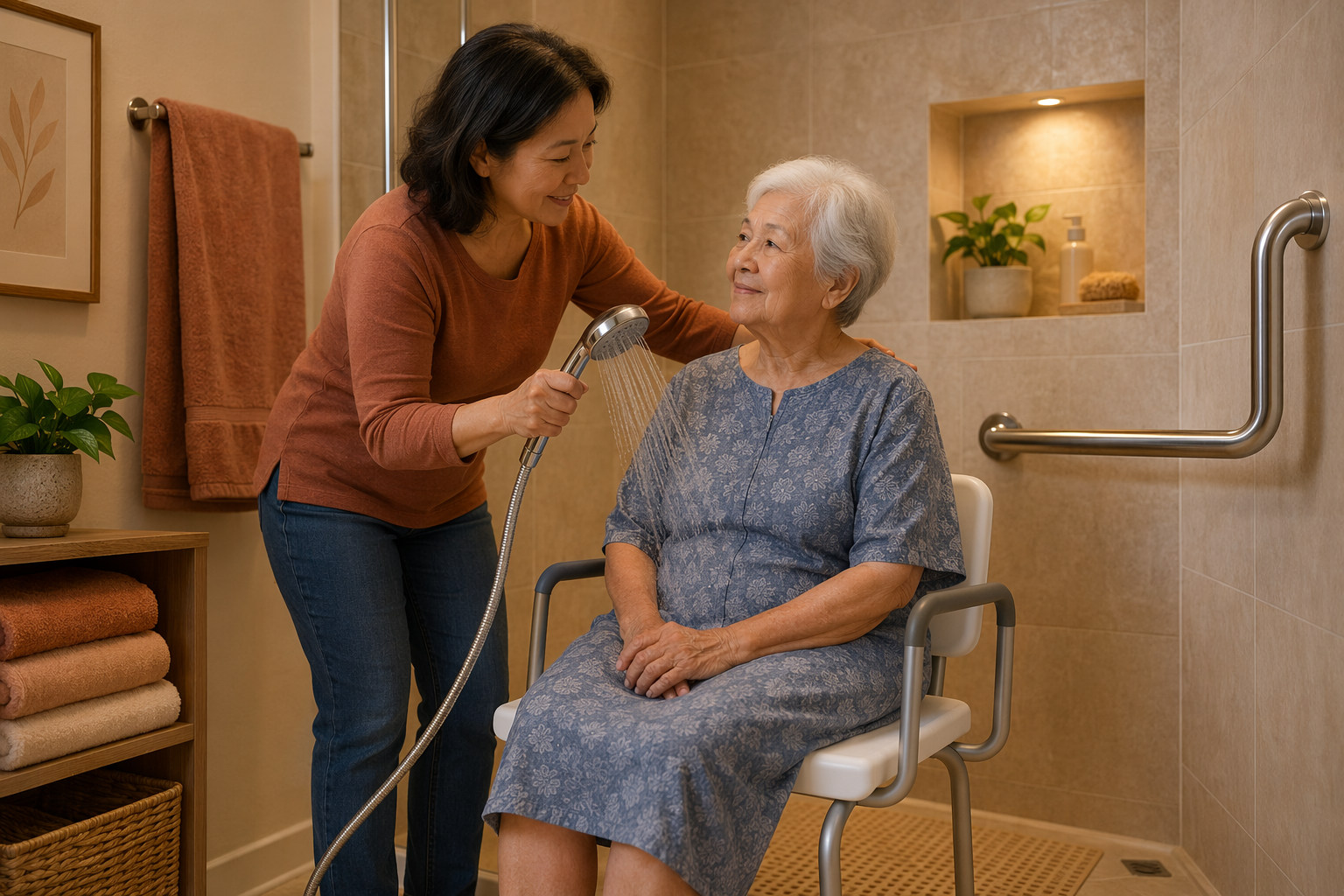
3. Shower Chair, Transfer Bench, or Tub Bench
Standing in the shower is not safe for an older adult with balance concerns, leg weakness, or a history of falls. A seated bathing solution is essential. The choice between a shower chair, a transfer bench, or a tub bench depends on the person's mobility level and the type of bathing fixture — this is covered in detail in the next section.
4. Handheld Showerhead
A fixed overhead showerhead forces the bather to position themselves under the stream, which can be difficult or dangerous for someone who is seated. A handheld showerhead with a flexible hose allows the caregiver or the older adult to direct water precisely where it is needed while remaining seated. The ADA requires handheld shower units in accessible bathing rooms, and they are widely available with easy-grip handles and slide bars for height adjustment.
5. Proper Lighting
Dim lighting obscures hazards and makes it harder to judge distances during transfers. The bathroom should have bright, even lighting. A night light or motion-activated light is especially important for middle-of-the-night bathroom trips, which are a common fall scenario. The light switch should be accessible from the doorway so the room is lit before anyone steps inside.
How to Choose the Right Bathing Equipment: Shower Chair vs. Transfer Bench vs. Tub Bench
Once the basic safety modifications are in place, the next decision is selecting the right seated bathing solution. The wrong choice can create new hazards — a stool that is too low, a bench that does not fit the tub, or a chair without arms for someone who needs upper-body support for transfers. The following table compares the three main options based on key features, best-use scenarios, and limitations.
| Feature | Shower Chair (with arms) | Tub Transfer Bench | Shower Stool |
|---|---|---|---|
| Best for | Walk-in showers or large tubs; users who can step over a low threshold but need seated stability | Standard tubs with a high wall; users who cannot safely step over the tub edge | Small showers or limited spaces; users with endurance deficits who need brief seated rest |
| Key feature | Arms and backrest provide support for transfers and stability during bathing | Legs straddle the tub wall; user sits on the bench outside the tub, then slides over into the tub | No arms or backrest; compact and lightweight |
| Transfer method | User stands or uses a grab bar to turn and sit down inside the shower | User sits on the bench outside the tub, then lifts legs over the tub wall while seated | User stands or uses a grab bar to turn and sit down inside the shower |
| Stability level | High — arms and backrest provide multiple points of support | Very high — eliminates the need to step over the tub edge entirely | Moderate — no arm or back support; user must have good seated balance |
| Space required | Moderate; needs room for the chair and caregiver access | Requires the tub deck to be clear; bench extends outside the tub | Minimal; fits in small shower stalls |
| Limitation | Not suitable for tubs with high walls; user must still step over the edge | Heavier and bulkier; may not fit all tub shapes | Not suitable for users with poor balance or who need arm support for transfers |
Related reading
- Grab Bars for Bathroom Safety: A Complete Installation Guide for Family Caregivers
- Home Fall Prevention Checklist for Older Adults: A Room-by-Room Guide for Family Caregivers
- Fall Prevention at Home: How to Build a Complete Aging-in-Place Safety System Using CDC STEADI, Home Modifications, and Community Services
Noticed something outdated or inaccurate on this page? Flag a correction. We review every report against CDC, NIA, and AARP HomeFit guidance before updating a page.
Part of the Fall Prevention section.