
Stair Safety for Seniors: When Small Fixes Are Enough — and When It’s Time for a Stair Lift
A practical decision framework for family caregivers: learn which low-cost stair modifications can prevent most falls, understand the clinical signs that a stair lift may be needed, and get a clear checklist to know when stairs are no longer safe.
The Stair Fall Problem by the Numbers
Stairs are the most dangerous piece of architecture in most homes. Each year in the United States, approximately 1 million patients are treated in emergency departments for stair-related injuries, according to a 2017 analysis of NEISS data covering 1990–2012. Among adults aged 60 and older, stair-related ED visits accounted for 30.8% of all stair injury visits between 2014 and 2023.
The consequences for older adults are disproportionately severe. For those 61 and older, fractures are the most common injury type, occurring in 34.7% of stair-related ED visits. Soft tissue injuries account for 22.3%, and sprains or strains for 16.3%. The lower extremities are the most frequently injured body region at 30.6%.
These stair-specific numbers sit inside a larger fall crisis. The CDC reports that more than one in four older adults falls each year, and falling once doubles the chance of falling again. In 2021, falls caused over 38,000 deaths among adults 65 and older, making falls the leading cause of injury death for that age group. Emergency departments recorded nearly 3 million visits for older adult falls that same year. The total health care cost of non-fatal older adult falls reached $80 billion per year based on 2020 data, with 67% paid by Medicare.
The key takeaway for families: stair falls are not rare events, and they are not minor. When an older adult falls on stairs, the odds of a fracture are roughly one in three. That reality makes the decision about stair safety — whether to modify the stairs or stop using them — one of the most consequential home safety choices a caregiver will make.
Low-Cost Stair Safety Fixes ($0–$200)
Before considering a stair lift or major renovation, start with the environmental baseline. The American Academy of Orthopaedic Surgeons (AAOS) states that simple changes to the inside of your house can cut your risk of falling in half. While that figure is a general estimate for all home modifications, not stair-specific changes alone, the stair-focused interventions below address the most common environmental hazards identified by the CDC, the National Institute on Aging (NIA), and the Mayo Clinic.
Dual Handrails: The Single Most Important Fix
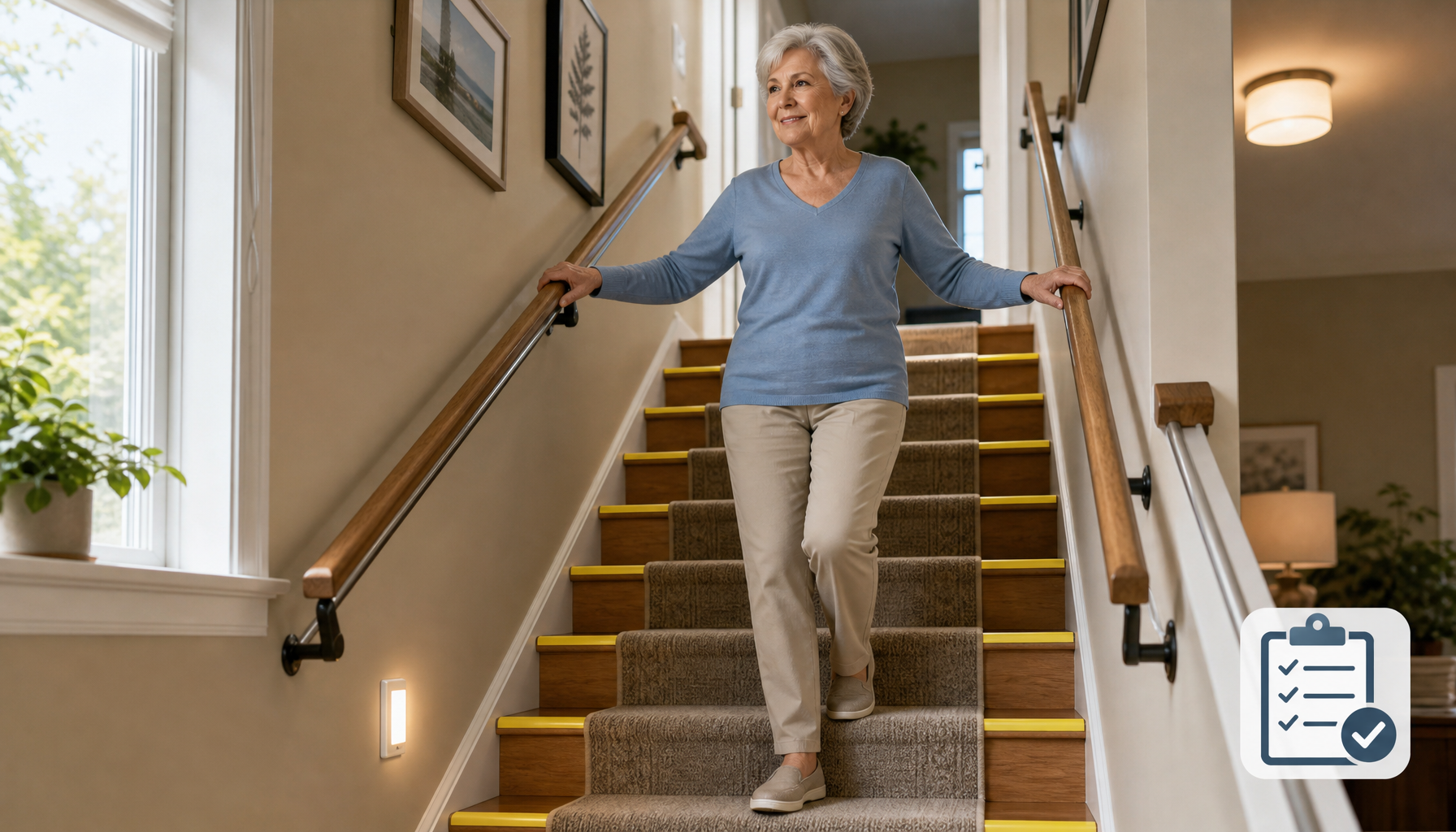
The NIA recommends handrails on both sides of any stairway. Many homes have a handrail on only one side, or none at all. A second handrail provides stability for both ascending and descending, and it allows the user to maintain two points of contact at all times. The handrails must be securely anchored — able to support the full weight of a person pulling themselves up. A loose handrail is worse than no handrail because it creates a false sense of security.
Cost: A basic handrail kit costs $30–$80. Professional installation adds $100–$150 if you cannot mount it securely yourself.
Lighting Upgrades: Top and Bottom Switches, Motion Sensors
Poor lighting is a primary environmental hazard on stairs. The AAOS recommends light switches at both the top and bottom of stairs. The NIA adds that motion-activated lights are a valuable upgrade, especially for older adults who may not remember to flip a switch or who navigate stairs at night.
Cost: A three-way switch installation runs $50–$150. Plug-in motion sensor lights cost $15–$40. Hardwired motion sensors with professional installation run $100–$200.
Non-Slip Treads and Contrast Edge Marking
Bare-wood steps are slippery, especially in socks or smooth-soled slippers. The AAOS recommends putting non-slip treads on each step. The NIA suggests no-slip strips on tile and wooden floors. Additionally, the AAOS notes that solid colors show step edges more clearly than patterned, dark, or thick carpeting. Applying high-contrast edge tape to the nosing of each step — typically a bright color like yellow or white against a dark step — helps compensate for age-related declines in depth perception and contrast sensitivity.
Cost: Non-slip treads cost $2–$10 per step. Contrast edge tape costs $5–$15 per roll. Total for a 14-step staircase: $30–$80.
Decluttering and Surface Repairs
The NIA advises keeping stair areas tidy. Objects left on stairs — shoes, mail, packages, pet toys — are tripping hazards that are easy to overlook. The AAOS adds that loose stairway carpeting or boards should be repaired immediately. A wobbly step or a loose carpet edge can catch a foot and cause a fall even when all other conditions are good.
Cost: Free (decluttering) to $50–$150 (carpet tack-down or board repair by a handyman).
Low-Cost Fix Checklist
- Install handrails on both sides of the stairway. Verify they are securely anchored.
- Add light switches at both the top and bottom of the stairs. Consider motion-activated lights.
- Apply non-slip treads or strips to every step.
- Mark step edges with high-contrast tape.
- Remove all objects from the stairs. Keep the area clear at all times.
- Repair loose carpeting, boards, or handrails immediately.
Mid-Range Modifications ($200–$2,000)
If the low-cost fixes are in place but the stairs still feel unsafe, or if the older adult has begun to show early signs of balance or gait difficulty, mid-range modifications can provide additional safety without the expense of a stair lift. These upgrades address the structural and visual environment of the stairs more comprehensively.
Stair Carpet Replacement
The AAOS specifically warns against patterned, dark, or thick carpeting on stairs. Solid, low-pile carpet in a color that contrasts with the wall and the step edge makes each step visually distinct. Worn or frayed carpet should be replaced because it can catch a foot or cause a slip. Replacing stair carpet is a moderate investment but can dramatically improve both traction and visual clarity.
Cost: $400–$1,200 for a 14-step staircase, including materials and professional installation.
Hardwired or Sensor-Activated Lighting
Plug-in motion sensor lights are a good low-cost start, but hardwired sensor-activated lighting provides more reliable coverage. The NIA recommends good lighting with light switches at the top and bottom of stairs. Hardwired motion sensors that automatically illuminate the stairwell when someone approaches eliminate the need to find a switch in the dark — a critical feature for older adults who get up at night.
Cost: $200–$500 for professional installation of hardwired motion sensor lighting.
Handrail Extension Beyond Top and Bottom Steps
Standard handrails often end at the top and bottom steps, leaving the user without support during the most critical moments of transition — stepping onto or off the staircase. Extending handrails 12 to 18 inches beyond the top and bottom steps gives the user something to hold onto while they establish their balance before starting the climb or after reaching the landing. This is a simple modification that many handymen can complete in an hour.
Cost: $50–$200, depending on the handrail material and whether a new rail section needs to be matched to the existing one.
The Stair Lift Decision: Clinical Indicators and Costs
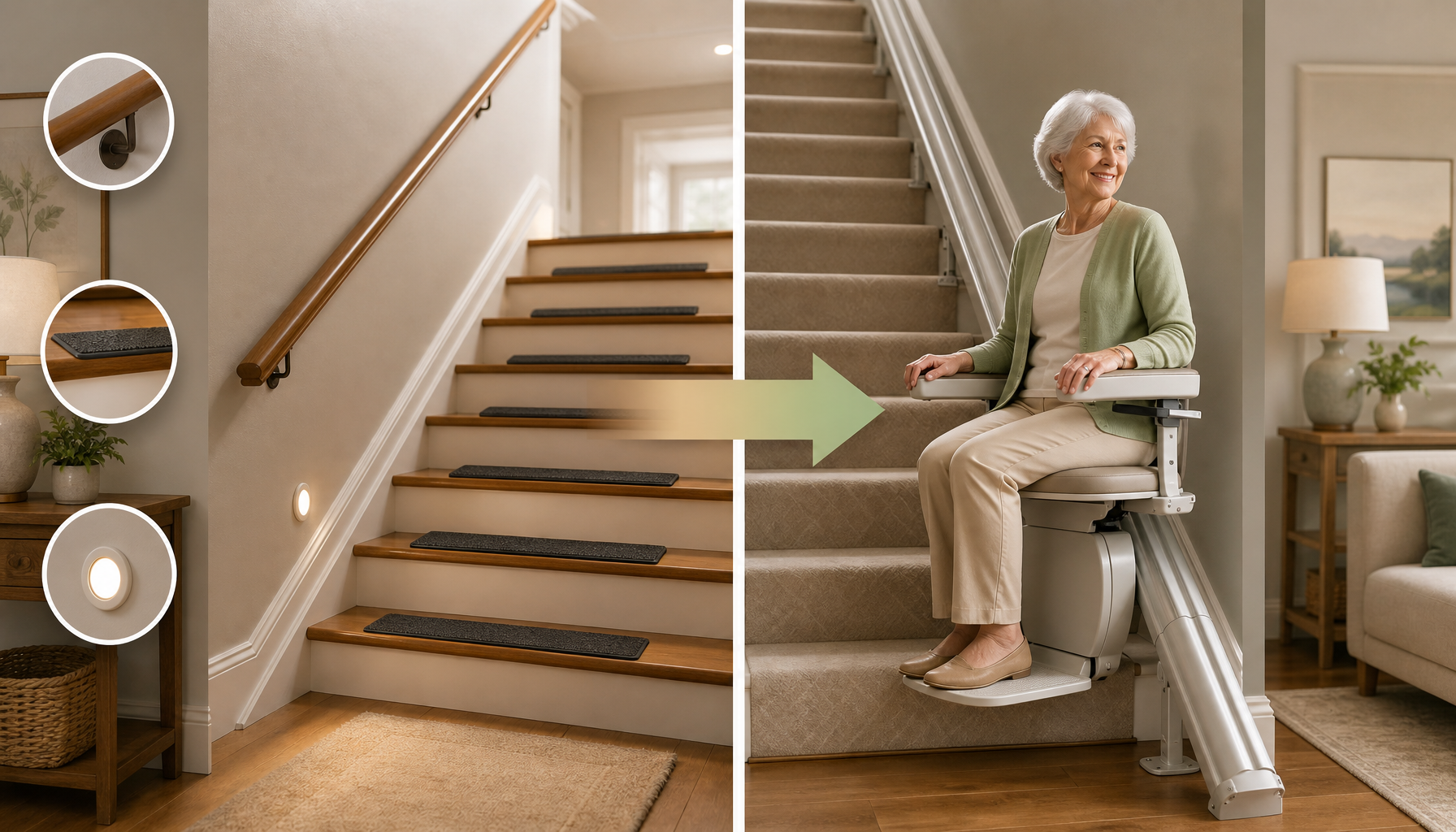
When low-cost and mid-range modifications are in place but the older adult still struggles with stairs — or has already fallen — a stair lift becomes the safer option. The decision to install a stair lift is not about convenience; it is about preventing a fall that carries a one-in-three chance of fracture.
Clinical Indicators That a Stair Lift May Be Needed
The CDC identifies several conditions that increase fall risk, including lower body weakness, difficulties with walking and balance, use of certain medicines, and vision problems. When these factors combine with stair negotiation, the risk multiplies. Research cited by Caring Village (Choi et al., 2023, Journal of Applied Gerontology) found that taking four or more prescription drugs — especially psychotropics such as sedatives, tranquilizers, and antidepressants — significantly increases stair fall risk.
The following table summarizes the key clinical indicators that suggest a stair lift should be considered, even after low-cost fixes are in place.
| Clinical Indicator | Why It Matters for Stairs | Source |
|---|---|---|
| Lower body weakness | Reduces the ability to lift the foot high enough to clear each step; increases reliance on handrails for pulling rather than balance | CDC |
| Balance impairment or gait difficulty | Makes it harder to maintain stability during the weight shift required for each step | CDC |
| Taking 4+ medications, especially psychotropics | Increases fall risk on stairs due to dizziness, sedation, and slowed reaction time | Choi et al., 2023 |
| History of a fall (anywhere) in the past year | Falling once doubles the risk of falling again; a stair fall in this group is more likely to result in serious injury | CDC, NCOA |
| Vision changes affecting depth perception or contrast sensitivity | Makes it difficult to judge step height and edge location, even with contrast marking | Caring Village |
If the older adult exhibits two or more of these indicators and regularly uses stairs, a stair lift should be discussed with their primary care provider or a physical therapist. The presence of a single strong indicator — such as a recent stair fall or significant lower body weakness — may be sufficient to warrant the investment.
Stair Lift Costs and Medicare Coverage
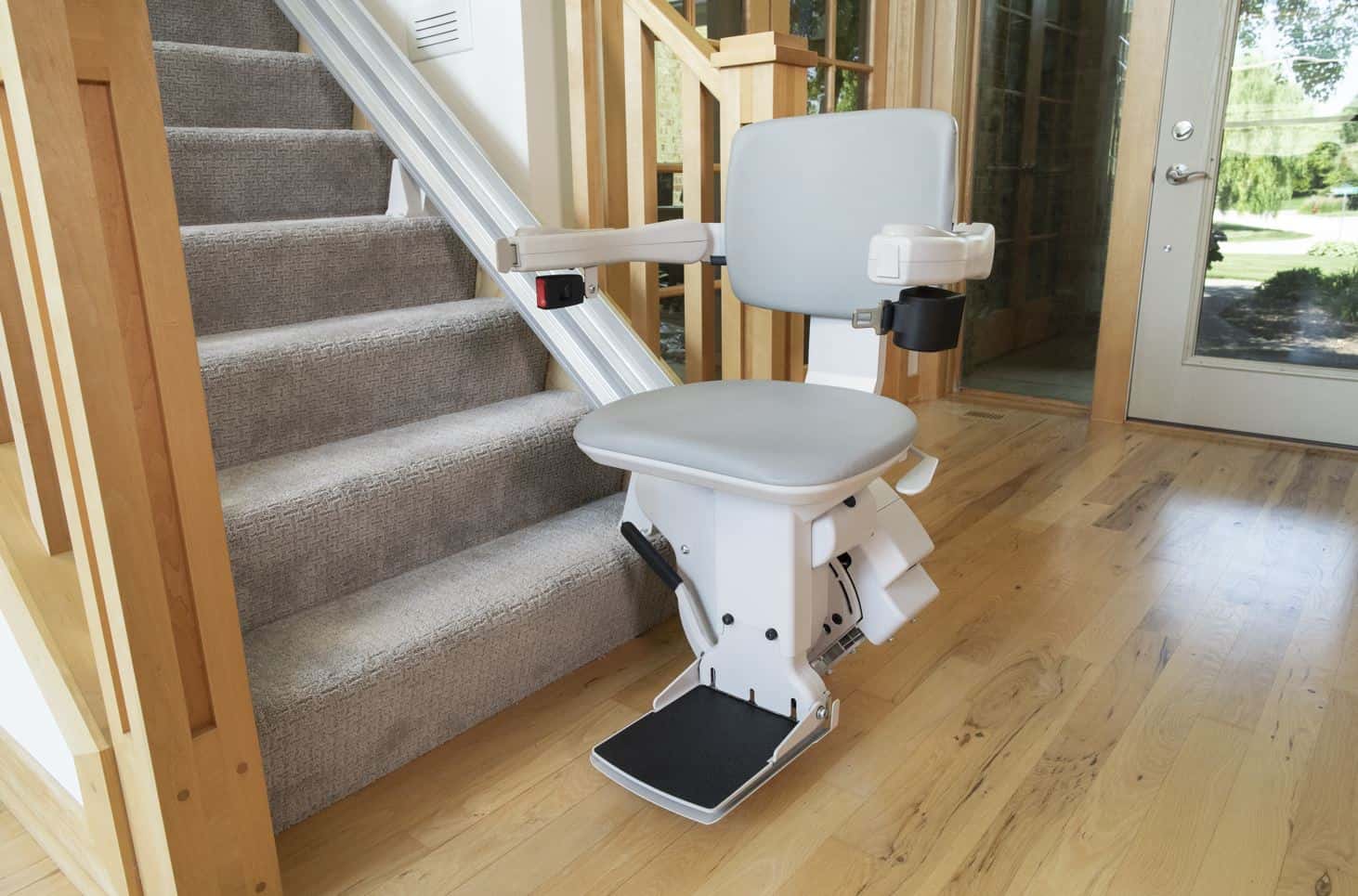
According to the National Council on Aging (NCOA), straight stair lifts (for stairs with no landings or curves) cost between $2,500 and $5,000 installed. Curved stair lifts, which require a custom rail, cost up to $15,000. These prices include the unit, rail, and professional installation.
Original Medicare (Part A and Part B) does not cover stair lifts. However, some Medicare Advantage plans (Part C) may offer coverage for home modifications, including stair lifts, with benefits ranging from $1,000 to $5,000. Coverage varies by plan and by state, so the only way to know is to call the plan directly and ask about home modification benefits.
For a detailed breakdown of stair lift costs, installation considerations, and funding options beyond Medicare, see our Stair Lift Cost and Funding Options for Aging in Place: A Family Caregiver's Guide.
Red Flags: When to Stop Using the Stairs Entirely
There are situations where no amount of modification makes stairs safe. These are the red flags that indicate the older adult should stop using the stairs immediately, even if a stair lift has not yet been installed. In these cases, the priority is to rearrange the living space so that everything needed — bedroom, bathroom, kitchen, medications — is on one floor.
- A fall on the stairs within the past six months, especially if it resulted in injury or required medical attention.
- Inability to lift the foot high enough to clear each step without catching the toe, even with handrail support.
- Dizziness or lightheadedness when standing up or when looking down the stairwell.
- Vision changes that make it difficult to see step edges clearly, even with contrast marking and adequate lighting.
- Use of a walker or cane that cannot be safely carried or used on the stairs. (Note: using a walker on stairs is extremely dangerous and should be avoided.)
- A clinical diagnosis of a condition that affects balance or gait, such as Parkinson's disease, peripheral neuropathy, or post-stroke weakness, combined with any stair use.
Professional Resources: Getting a Home Safety Assessment
The decision framework in this article is a starting point, not a substitute for a professional evaluation. The NIA recommends that if you have fallen, your doctor might suggest an occupational therapist, physical therapist, or nurse visit your home to assess safety. An occupational therapist (OT) can conduct a comprehensive home fall-risk assessment that evaluates not just the stairs but the entire home environment, the older adult's functional abilities, and the interaction between the two.
The AAOS also references occupational therapists as key professionals for fall prevention strategies. An OT assessment typically takes one to two hours and results in a prioritized list of modifications, from low-cost fixes to structural changes. Some OTs specialize in home safety and can provide detailed recommendations for stair modifications or stair lift suitability.
For structural modifications like stair lift installation, a CAPS-certified remodeler (Certified Aging-in-Place Specialist) can evaluate the staircase and provide a professional installation quote. The NCOA recommends consulting a physical or occupational therapist for a professional home fall-risk assessment before buying a stair lift.
To find local resources:
- Contact your local Area Agency on Aging (AAA) for referrals to occupational therapists and home modification programs.
- Ask your primary care provider for a referral to an occupational therapist who performs home safety assessments.
- Search for CAPS-certified contractors through the National Association of Home Builders (NAHB) directory.
- Check with your state's Medicaid waiver program or Veterans Affairs office for potential funding for home modifications and stair lifts.
Related reading
Noticed something outdated or inaccurate on this page? Flag a correction. We review every report against CDC, NIA, and AARP HomeFit guidance before updating a page.
Part of the Fall Prevention section.