
How to Prepare for Floods and Prevent Falls in Older Adults
Floods create hidden fall hazards for older adults that standard preparedness guides miss. This article explains the specific risks — from flooded entryways to disabled mobility aids — and gives caregivers phase-specific actions to prevent falls before, during, and after a flood.
Emergency preparedness for older adults during flooding has to answer a question that most checklists only brush past: can your parent safely move through the house when the floor, the light, and the mobility aid have all changed at once?
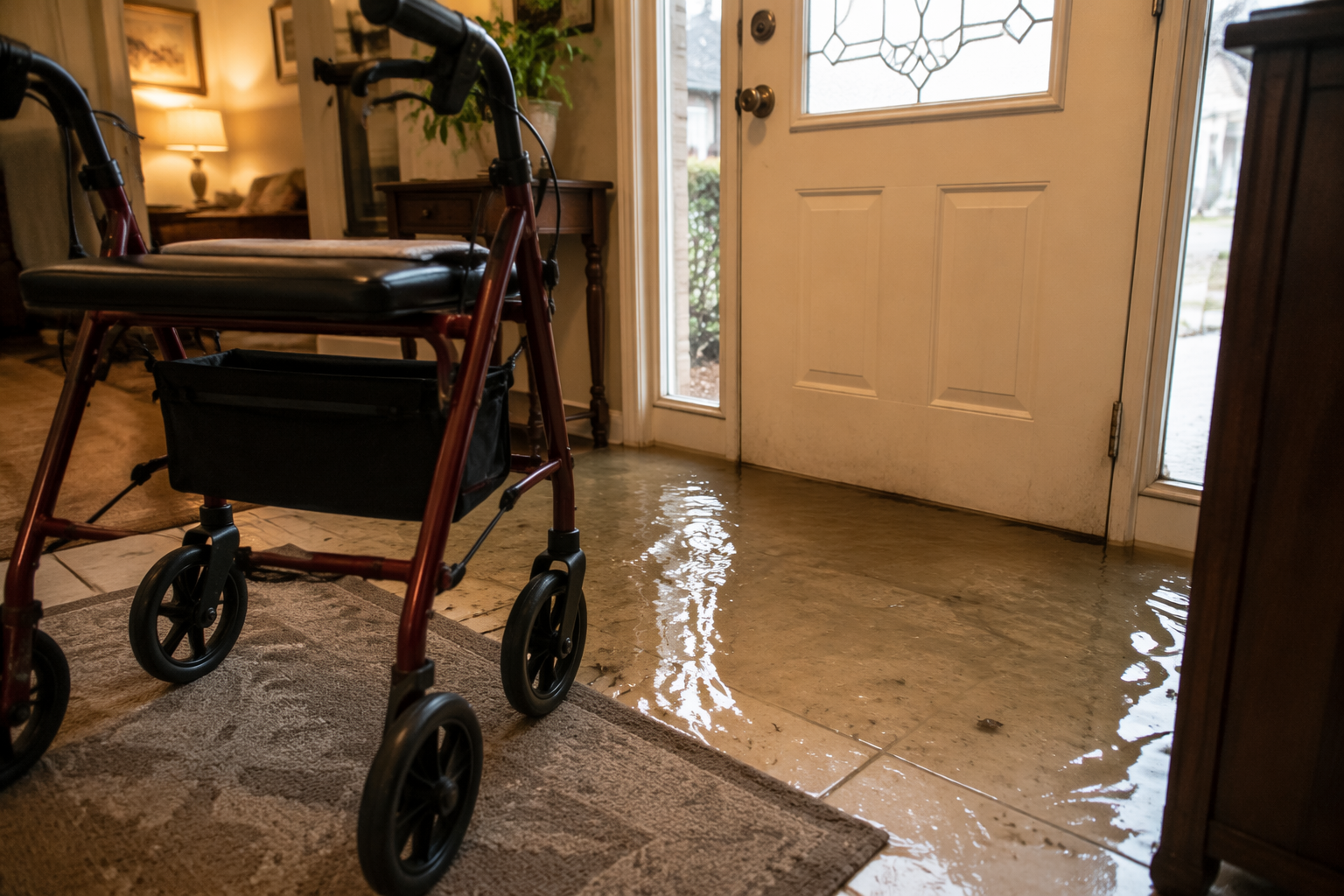
Food, medications, documents, and evacuation contacts still matter. But a parent who uses a walker may be injured long before anyone opens the emergency kit — at the front threshold, beside the bed, in a dark hallway, or on a bathroom floor that looks mostly dry but has a thin film of mud on it. Floodwater turns familiar routes into unfamiliar surfaces.
The first adjustment is simple and uncomfortable: do not judge floodwater by how shallow it looks. General flood-safety guidance warns that 6 inches of fast-moving water can knock a person down and 12 inches can carry away a vehicle. For a wheelchair user, Vantage Mobility advises treating even 3 inches of moving water as dangerous, with 6 inches as the upper limit only when a caregiver is assisting.[1] A walker or cane does not make moving water safer. It gives the water more surfaces to push, more rubber tips to slip, and more points where a foot, wheel, or frame can catch on something the caregiver cannot see.
Why Floods Raise Fall Risk After the Water Recedes
A July 2025 Harvard and Columbia study gives some scale to a pattern caregivers often recognize only after a bad week. Researchers analyzed 4.5 million hospitalizations among older adults across 72 flood events from 2000 to 2016 and found that flooding was associated with a 1.7% increase in hospitalization rates for injuries in the fourth week after a flood event. The same analysis found increases in hospitalization rates for skin infections and nervous system conditions as well.[2][3]
That finding does not prove that floods directly caused every injury or that falls explain the whole increase. It does make one thing hard to dismiss: the danger period does not end when the rain stops. Cleanup, re-entry, temporary repairs, wet surfaces, and disrupted routines are part of the emergency for an older adult, especially one who already needs support to stand, transfer, or recover from a stumble.
The wet-surface connection deserves particular attention. The National Council on Aging reports that 72% of older adult falls happen on or around wet surfaces.[4] A flooded home is not one wet spot near a shower or sink. It can be a whole route of damp flooring, buckled rugs, slick thresholds, wet handholds, and dim rooms.
Before a Flood: Prepare the Route, Not Just the Kit
The broader kit work — medication lists, contact numbers, insurance papers, evacuation plans — belongs in every household plan. If that part is still unfinished, use a room-by-room companion such as How to Flood-Proof Your Older Parent's Home Room by Room, an emergency contact binder, and a first-hour response plan for long-distance caregivers. For fall prevention, though, start with the walking path.
Walk the route your parent would actually use in a warning, not the route that looks cleanest on paper. Bed to bathroom. Recliner to front door. Bedroom to interior stairs or higher ground. Kitchen to garage. Front step to vehicle. If the path depends on a throw rug staying flat, a lamp staying plugged in, or a swollen door opening smoothly, it needs a backup.
- Clear hallways and entryways of low items that could disappear under murky water: shoes, baskets, pet bowls, extension cords, footstools, and loose mats.
- Move or tape down rugs along evacuation and bathroom routes; a rug that is harmless when dry can slide, curl, or hide a raised edge after water enters.
- Place flashlights where the older adult can reach them from the bed, chair, bathroom, and main exit, not only in a kitchen drawer.
- Keep canes, walkers, crutches, wheelchair chargers, and backup batteries near the person, not in a garage or closet that may flood first.
- Identify at least one higher-ground waiting spot with a chair, light source, phone access, and room for a walker or wheelchair to turn.
- Practice the hardest transfer before the storm season: bed to wheelchair, chair to walker, wheelchair to vehicle, or walker to emergency transport.
The Red Cross specifically advises older adults to plan for assistive devices, mobility needs, accessible transportation, and support networks as part of emergency preparedness.[5] For a caregiver, that means the walker is not an afterthought to grab once the bag is packed. It is part of the evacuation route.
Flooring deserves one more pass. Some floors are chosen because they are more forgiving during everyday falls, but floodwater can cancel out that advantage quickly. A cushioned or compliant surface that has lifted, softened, shifted, or collected grit is no longer behaving like the floor you planned around. Mark the safest dry zones ahead of time: rooms without loose rugs, thresholds with the least height change, and surfaces that can be cleaned without becoming slick.
During a Flood: Movement Is the Decision
Once water is in or around the home, the most important fall-prevention decision may be to stop your parent from making “just one quick trip.” A quick trip to the bathroom, window, garage, or porch can put an older adult into moving water, a dark hallway, or a threshold where the floor level is no longer visible.
If water is moving across the walking path, treat it as unsafe for a person using a walker or cane. A walker needs stable contact at all legs or wheels. A cane needs a predictable floor. A wheelchair needs enough traction to turn, brake, and avoid catching a caster on hidden debris. Floodwater interferes with all of that before it looks dramatic.
| Situation | Fall-prevention judgment |
|---|---|
| Water is moving across the entryway or driveway | Do not have the older adult walk or roll through it unless emergency responders or trained helpers are directing the movement. |
| The parent wants to reach a different room | Inspect the route first; if you cannot see the floor, assume submerged cords, rug edges, thresholds, or debris may be present. |
| Power is out at night | Keep the person seated or in bed until lighting is in place along the entire route, including the destination. |
| The walker, cane, or wheelchair is in another room | Bring the device to the person if it is safe for the caregiver to do so; do not ask the older adult to cross water to reach it. |
| Evacuation is likely | Move early, while the route is dry or supervised, rather than waiting until water reaches the doorway. |
Higher-ground positioning is not just about avoiding floodwater. It is also about reducing the number of transfers. If your parent can wait in a dry, lit area with a firm chair, shoes on, mobility aid beside them, medications nearby, and a phone or alert device within reach, you have removed several chances for an unsupervised stand.
Shoes matter during this phase. Bare feet and slippers are poor matches for wet tile, grit, and unseen debris. If there is time and it can be done without rushing, have the older adult wear closed-heel, non-slip shoes before movement begins. If bending to put on shoes would create its own fall risk, help while the person is seated and stable.
Wheelchair users need a battery and transfer plan, not just a charged device. Vantage Mobility recommends preparing backup batteries and thinking through accessible evacuation routes before flooding occurs.[1] In the moment, keep the chair, charger, cushion, transfer board, and any positioning supports together if possible. A powered chair left in a lower-level room may become unusable exactly when the person has the least margin for improvising.
When the Caregiver Is Not There
For long-distance caregivers, the dangerous call is often the calm one: “I think I can get to the bathroom,” or “I just need to check the door.” Give your parent a short script before storm season, because long explanations do not work well in a power outage.
- Stay seated if water is visible on the floor.
- Do not walk to look outside.
- Keep the walker, cane, phone, shoes, and flashlight within reach.
- Call the named neighbor, family member, building manager, or emergency number before moving.
That script is not meant to make the older adult helpless. It gives them permission to wait when every habit in the house tells them they should get up and handle things.
After a Flood: Re-Entry Is a Fall-Risk Inspection
The home may look less frightening after the water drains. That is when caregivers get pulled into cleanup mode and older adults try to reclaim normal movement. Do not let the first walk through the house become the inspection. Inspect first, then decide whether your parent can move.
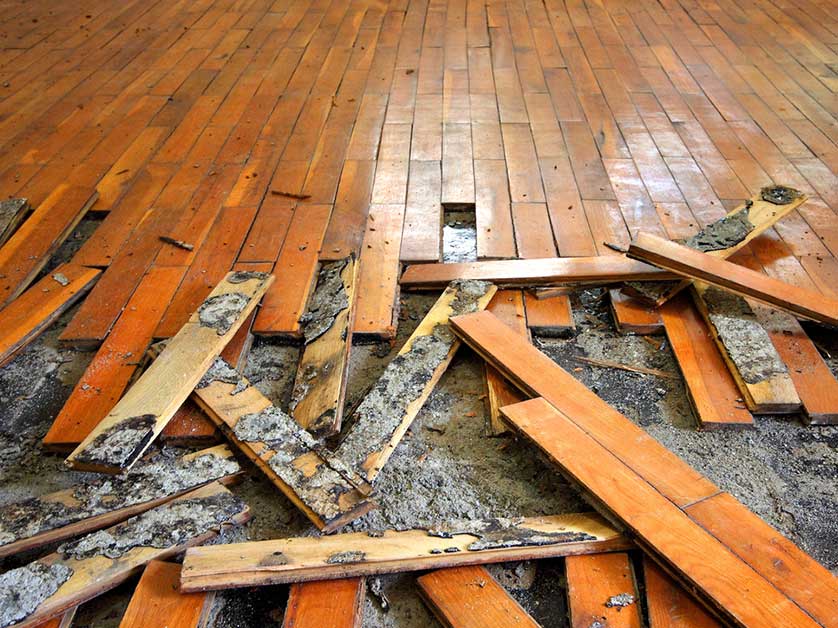
Start at the route your parent will need first: entry to chair, chair to bathroom, bed to bathroom, kitchen to medication storage. Look for changes that matter under a foot, cane tip, walker wheel, or wheelchair caster.
- Warped boards, lifted vinyl, buckled laminate, swollen thresholds, or soft spots that shift under weight.
- Rugs that feel heavy, ripple at the edges, slide on damp flooring, or hide mud and debris underneath.
- Thin films of mud on tile, wood, ramps, porch steps, bathroom floors, and garage entries.
- Loose transition strips, popped nails, lifted floor vents, displaced mats, and cords moved during cleanup.
- Damp grab bars, railings, doorknobs, chair arms, toilet safety frames, and transfer poles.
- Poor lighting from outages, tripped breakers, unplugged lamps, wet outlets, or missing night lights.
A floor can pass a visual check and still fail a mobility check. Press gently with your own shoe before asking your parent to step. Test whether a walker tip skids. Check whether a wheelchair caster tracks straight or drags mud into a turn. If the surface feels tacky, greasy, soft, gritty, or uneven, keep the older adult off it until it is cleaned, dried, repaired, or professionally assessed.
Clean the Mobility Aid Before It Becomes the Hazard
Walkers, canes, crutches, and wheelchairs pick up the flood the way shoes do. Mud dries inside wheel treads. Small stones wedge into rubber tips. Wet grips become slick. Brakes lose their clean bite. A caregiver may mop the hallway and still hand over a walker that has turned into a delivery system for grit and slippage.
- Wipe and dry hand grips, brake handles, armrests, push rims, seats, and transfer surfaces.
- Inspect cane and walker rubber tips for embedded glass, gravel, mud, cracks, or looseness.
- Clean walker wheels, wheelchair casters, and rear wheels until they roll without wobbling, dragging, or leaving slick residue.
- Test brakes on a dry, level surface before the older adult transfers into or leans on the device.
- Replace damaged tips, glides, brakes, or wheels rather than trying to stretch their use through cleanup.
If the device has been submerged, treat it as questionable until the manufacturer, supplier, therapist, or repair provider can advise you. That is especially important for powered wheelchairs and scooters, where water damage may not be visible from the outside.
Temporary Fall-Proofing While the House Is Half Fixed
The awkward period after a flood can last longer than the visible emergency. Fans are running. Furniture is stacked in odd places. Contractors, relatives, and insurance adjusters are moving through the home. The older adult may be sleeping in a different room, using a different bathroom, or trying to navigate around drying equipment. This is not normal home life, even if everyone is tired of calling it a disaster.
Shrink the usable home instead of trying to make every room passable. Choose one dry sitting area, one sleeping area if needed, and one bathroom route. Keep those paths lit, uncluttered, and inspected. Block off rooms with questionable flooring rather than relying on reminders. Remove soggy rugs completely. Use stable chairs with arms for transfers, not folding chairs or soft seats dragged into place during cleanup.
Bathroom trips deserve their own plan because urgency makes people stand before they think. If the usual bathroom route is wet, dark, or uneven, arrange a safer temporary option with clinical guidance when possible. Do not improvise a commode location on a slick surface or in a cramped corner where the walker cannot fit.
Electrical safety also affects fall prevention. If lights, outlets, lift chairs, stair lifts, adjustable beds, or powered mobility devices may have been exposed to water, do not ask the older adult to compensate by walking farther in the dark or transferring without equipment. Bring in qualified help rather than turning equipment failure into a mobility test.
A Caregiver's Flood-Fall Checklist
If you need one working sequence, use this one. It is narrower than a full emergency plan on purpose.
| Phase | What to check first | What to prevent |
|---|---|---|
| Before flooding | Routes, lighting, mobility aids, transfer plans, accessible shelter options | A rushed evacuation through clutter, darkness, or an unreachable walker |
| During flooding | Visible water, movement of water, higher-ground position, device location, phone access | A short unsupervised walk through shallow water or a dark hallway |
| After flooding | Flooring, rugs, thresholds, mud film, assistive devices, grab surfaces, lighting | Re-entry onto surfaces that look dry but do not support safe movement |
For storm-related room checks that overlap with flood preparation, the companion guide How to Prepare for Storms and Prevent Falls in Elderly Adults can carry more of the weather and power-outage planning. The flood-specific habit is to inspect every necessary movement as if the surface, lighting, and equipment have changed — because they probably have.
Floods do not create one fall hazard. They create a chain: a damp grip, a loose rug, a dark hall, a swollen threshold, a walker tip packed with grit, a caregiver who is exhausted and trying to make the house feel usable again. Break the chain early. Keep your parent off questionable surfaces, inspect the route before each necessary movement, clean and test assistive devices before use, and bring in professional help when flooring, electrical safety, or mobility needs exceed what a family caregiver can safely judge.
References
- Flood Safety Tips for Wheelchair Users, Vantage Mobility
- Flooding increases hospitalization risks in older adults, Harvard T.H. Chan School of Public Health
- Large study uncovers specific impacts of flooding on older adult health, Columbia University Mailman School of Public Health
- Emergency Preparedness 101: What to Do Before, During and After a Disaster, National Council on Aging
- Older Adults, American Red Cross
Related reading
Noticed something outdated or inaccurate on this page? Flag a correction. We review every report against CDC, NIA, and AARP HomeFit guidance before updating a page.
Part of the Fall Prevention section.