
Why Older Adults Avoid Fall Prevention Programs — and How to Help Them Say Yes
Many older adults skip fall prevention programs due to pride, fear, or practical barriers. This article helps caregivers understand the real reasons behind the refusal and provides evidence-based strategies to encourage participation.
You found a reasonable class, printed the schedule, checked the location, maybe even confirmed that insurance or a local agency can help with the cost. Then your parent looked at it for three seconds and said, "I'm fine."
That answer can feel maddening because fall prevention programs for older adults are not an abstract wellness idea. They are one of the few practical things families can do before the next emergency. But refusal is common enough that it should not be treated as a personal failure, either yours or your parent's. In a 2025 Journal of the American Geriatrics Society study, 73% of older adults surveyed had never participated in a fall prevention class, and only about one-third had ever had a fall risk assessment. Providers were not especially confident about follow-through: only 27% believed patients followed through on fall prevention recommendations.[1]
So the problem is not simply that families have failed to find the right brochure. There is an engagement gap. Many older adults who might benefit from fall prevention never enter the first room, never complete the first assessment, and never let the conversation get past the word "fall."
The Refusal Is Often About Identity, Not Information
Caregivers often respond to refusal by adding more facts. They mention statistics, broken hips, emergency rooms, and what happened to a neighbor. Sometimes that is necessary. More often, it lands in the wrong place.
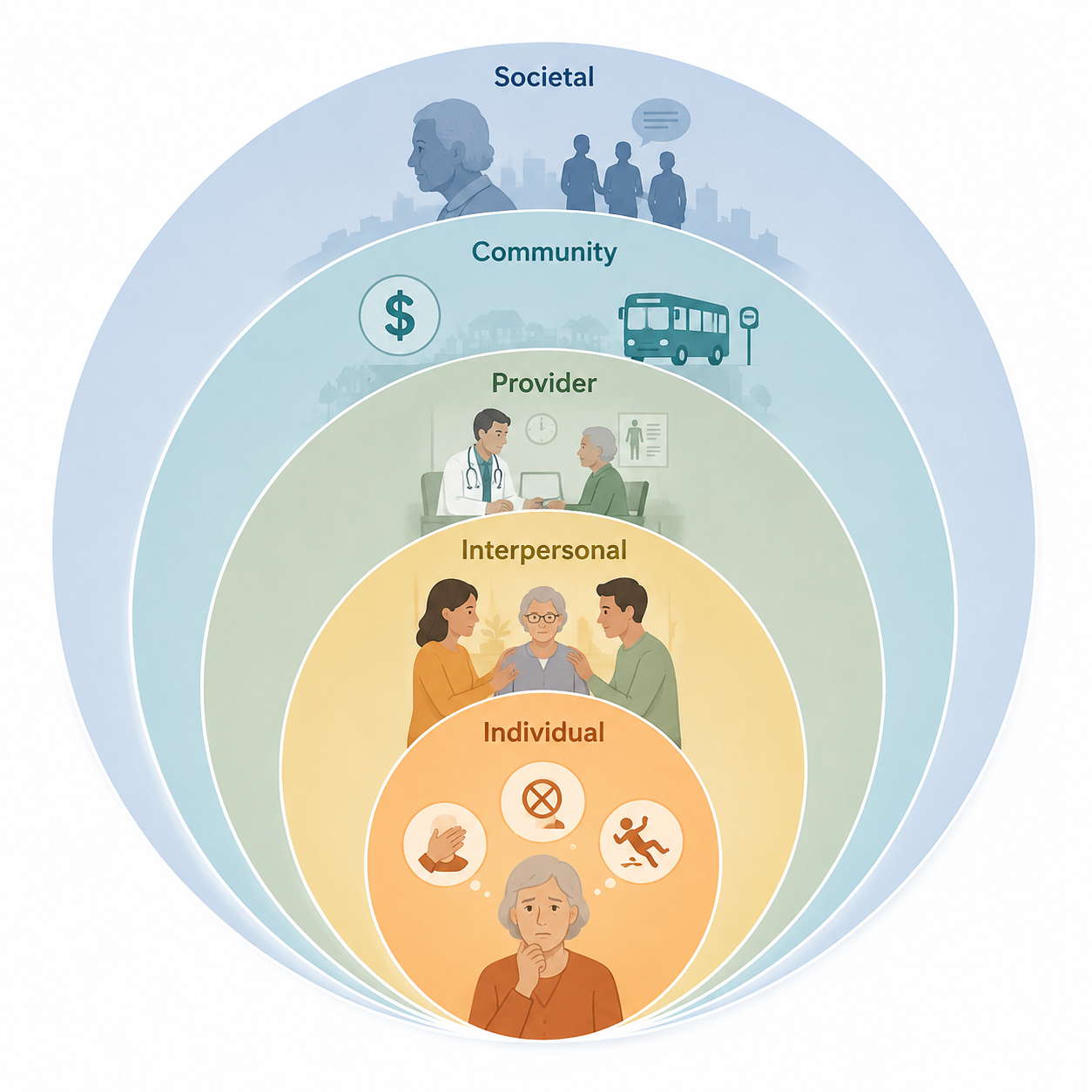
The Wiseman study identified individual barriers such as denial, pride, fear of being a burden, avoidance of discomfort, embarrassment, sensitive masculinity, and age-related stigma.[1] Those are not small obstacles. They sit right where an adult child is most likely to press: "You need help."
A parent may hear that sentence as something much larger than a suggestion about exercise. They may hear, "You are fragile now." They may hear, "I am taking over." They may hear, "Your body is no longer trustworthy." The caregiver may be thinking about balance and leg strength; the parent may be defending adulthood.
This is why the label matters. A class called "fall prevention" may be accurate, but for some older adults it sounds like a public admission of decline. Sitting in a room under that label can feel different from taking a strength class, working with a physical therapist, or doing exercises to keep driving, gardening, walking to church, or getting downstairs to the laundry.
None of this means the refusal is harmless. Pride does not make a fall less dangerous. It only explains why a direct appeal to danger may harden the answer instead of changing it.
What You May Be Hearing at Home
The words are usually ordinary. "I'm careful." "I don't need that." "Those classes are for old people." "I don't want everyone watching me." "I'm not paying for that." "Your father never needed any of this." The useful work is listening for the barrier underneath the sentence.
| What they say | What may be underneath | A better first response |
|---|---|---|
| "I'm fine." | Denial, fear, or a wish to end the conversation before it becomes humiliating. | "I know you are managing a lot. I am not trying to take over. I want us to look at one thing that could help you keep doing what you already do." |
| "Those programs are for people worse off than me." | Age-related stigma or embarrassment about being grouped with frailer adults. | "Then let's look for something that is framed around strength and balance, not a class that makes you feel labeled." |
| "I don't want to go sit in a group." | Fear of being watched, compared, corrected, or exposed. | "Would you be more open to starting at home with a therapist or a short routine first?" |
| "I don't want to be a burden." | Concern that accepting help will create more work or dependency. | "A fall would create more disruption than trying one appointment. This is one way to keep things smaller." |
| "I have always handled myself." | Pride, masculinity, or a sense that accepting help means surrendering competence. | "That is exactly what I am trying to protect. This is about keeping your independence, not questioning it." |
The point is not to diagnose your parent from one sentence. It is to stop answering every refusal as if it were a request for more evidence. Sometimes the next useful move is not another article, another statistic, or another warning. It is a cleaner sentence that leaves your parent's dignity intact.
Family Can Accidentally Make the Barrier Higher
There are two family mistakes that seem opposite but can lead to the same dead end.
The first is minimizing. A parent falls, and everyone rushes to soften it: "It could happen to anyone." "The rug caught your foot." "You were tired." Sometimes that is emotionally kind in the moment. But the Wiseman study identified family normalization of falls as an interpersonal barrier in its focus group findings.[1] That does not prove every family who reassures a parent will reduce follow-through, and the study sample was predominantly well-educated and midwestern, so the findings should not be stretched beyond what they show. Still, the pattern is worth taking seriously. If every fall is treated as a fluke, prevention starts to sound unnecessary.
The second mistake is taking over. Adult children may move fast because the risk feels urgent: calling the doctor, choosing the class, arranging transportation, announcing the plan. The intention may be protective. The effect can feel like surveillance.
A better middle path is to name the concern without making the parent the problem. "The fall scared me, and I do not want us to ignore it. I also do not want to make decisions over your head. Can we ask Dr. Patel what she recommends and then choose from there?"
That sentence does three things at once. It refuses to pretend the fall was meaningless. It gives the parent a role in the decision. And it moves the recommendation toward a clinician, where it may carry more weight.
Use the Clinician Without Turning the Visit Into an Ambush
The provider conversation matters. CDC STEADI, the CDC's fall prevention initiative for healthcare providers, emphasizes screening, assessment, and intervention for older adults at risk of falling. Its materials cite evidence that older adults are more likely to follow through on fall prevention when a healthcare provider personally recommends it.[2]
For caregivers, this is one of the most practical levers available. It also has to be handled carefully. If your parent arrives at an appointment and discovers that you have privately briefed the doctor, listed every near-fall, and arranged a referral without warning, the visit can feel like a setup.
A more workable approach is to ask permission before the appointment, even if the permission is limited. "I would like to ask the doctor one question about balance and fall risk. I will not make it the whole appointment. Is that okay?" If the answer is no, you can still ask your parent to raise it: "Would you be willing to ask whether a balance assessment makes sense?"
If you do attend the visit, keep the request narrow and factual. Do not open with a courtroom speech. Try: "She had one fall in the bathroom and two times recently where she grabbed furniture to steady herself. Could you assess fall risk and recommend what would be appropriate?" Then stop talking long enough for the clinician to address your parent directly.
That last part matters. The recommendation needs to belong to the doctor-patient relationship, not to the adult child who has been pushing at the kitchen table for three weeks.
Make the First Yes Smaller
A parent who refuses a 12-week class may not be refusing all prevention. They may be refusing the size of the commitment, the publicness of the setting, the name of the program, the drive, the cost, or the feeling that saying yes once means losing control of every next decision.
So shrink the ask. Instead of "I signed you up," try "Would you try one session and then decide?" Instead of "You need fall prevention," try "Would you be willing to have someone check your balance and suggest exercises for staying steady at home?" Instead of "This is what we are doing," try "What would make this tolerable enough to try once?"
The word "tolerable" can be useful because it does not demand enthusiasm. Many caregivers wait for their parent to agree that the program is a good idea. That may never happen. A first yes may sound more like reluctant consent to a limited trial.
- If embarrassment is the barrier, ask about an at-home option or a one-on-one evaluation before a group class.
- If pride is the barrier, connect the program to independence: stairs, showering, walking outside, driving, cooking, or staying in the home.
- If fear of burden is the barrier, explain that prevention is meant to reduce disruption, not create a new family project.
- If discomfort avoidance is the barrier, ask what part sounds unpleasant: pain, fatigue, travel, being corrected, or being watched.
- If distrust of your suggestion is the barrier, move the recommendation to the clinician and let your role become logistics.
The tone is not cosmetic. A sentence that preserves choice can keep the conversation alive long enough for action to happen.
Choose an Entry Point That Matches the Resistance
This is where program choice does matter, but not as a catalog exercise. The best first option is often the one that removes the specific reason your parent is saying no.
When Group Classes Are the Problem
For an older adult who refuses a group setting, a home-based option may open a door that a community class closes. The Otago Exercise Program is designed for frail older adults and is delivered by a physical therapist. It includes 17 strength and balance exercises and is associated with a 35% to 40% fall reduction for frail older adults, according to the National Council on Aging's evidence-based program catalog.[4]
That does not make Otago the right fit for everyone. It does make it useful when the main objection is public participation, transportation, or feeling exposed in front of peers. The conversation can become, "Would you be willing to start at home with a physical therapist?" That is a different ask from, "Will you attend a fall prevention class?"
When Technology Feels More Appealing Than a Class
Some older adults are more open to a structured, tech-forward approach than to a class they associate with frailty. NCOA lists GaitACTIVE as a gamified treadmill training program with fall rate reductions up to 70%.[4] That figure should be treated as program-specific evidence, not a promise that any technology-based balance program will produce the same result.
For the right person, though, the framing may matter. "This is gait training" may land better than "This is fall prevention." The goal is not to disguise the purpose. It is to start from a version of the activity your parent can accept without feeling diminished.
When Cost or Transportation Is the Stated Objection
Cost is real, and so is transportation. The Wiseman study identified cost, transportation, and lack of awareness as community-level barriers.[1] At the same time, cost is not always the immovable barrier families assume. NCOA reports that evidence-based falls prevention programs can return $8.36 to $38.04 per dollar spent, and notes that many programs are available free or at low cost through public funding streams such as Administration for Community Living support.[3]
Those return-on-investment figures come from NCOA's analysis of program data, and the public summary does not provide full confidence intervals or enough detail to treat the numbers as a universal guarantee. The practical takeaway is narrower: it is worth checking local aging agencies, senior centers, health systems, and community organizations before assuming the only option is an expensive private program.
If transportation is the barrier, do not start with a lecture about priorities. Start with logistics. Ask whether the problem is driving at night, parking, distance from the entrance, weather, fatigue after class, or not wanting to depend on someone for rides. Different barriers need different fixes. A ride from you may solve one problem and create another if your parent experiences it as another loss of independence.
What to Stop Saying
Some caregiver sentences are understandable and still unhelpful. They come from fear, exhaustion, and the memory of the last fall. They also tend to push the conversation straight into defense.
| Instead of | Try |
|---|---|
| "You need this." | "I want you to have the strongest chance of staying in your home and keeping your routine." |
| "You are going to fall again." | "The last fall scared me, and I do not want us to ignore something that may be preventable." |
| "I already found a program for you." | "I found two options. Would you be willing to look at them and reject what does not fit?" |
| "Everyone your age should do this." | "This is about what helps you keep doing the specific things you care about." |
| "The doctor agrees with me." | "The doctor recommended this because your balance and strength are worth protecting." |
The replacement sentences are not magic scripts. A parent can still say no. But they reduce the chance that the conversation becomes a referendum on whether they are old, weak, stubborn, or being managed by their child.
When They Still Refuse
There is a point where pushing harder can damage trust without producing participation. That point is especially hard to accept when the risk is visible: the hand on the wall, the furniture walking, the skipped shower because the tub feels uncertain, the parent who insists everything is normal while quietly shrinking their world.
If your parent will not join a program, keep the door open and narrow the next step. Ask the clinician for a fall risk assessment. Ask whether medication review, vision checks, physical therapy, footwear changes, or home safety changes are appropriate. If a recent fall triggered the urgency, the first few days may need more immediate triage before any program conversation can succeed. If home hazards are part of the picture, home modifications can move in parallel with exercise and balance work.
The standard is not perfect persuasion. You cannot force sincere participation in fall prevention programs for older adults, and pretending otherwise only sets families up for blame. What you can do is stop making the conversation about weakness, bring in a trusted provider, remove practical friction, and offer an entry point that lets your parent act without feeling publicly reduced by the act of accepting help.
References
Related reading
Noticed something outdated or inaccurate on this page? Flag a correction. We review every report against CDC, NIA, and AARP HomeFit guidance before updating a page.
Part of the Fall Prevention section.