
How Fear of Falling Creates a Dangerous Cycle in Older Adults
Falls can trigger a cycle of fear and reduced activity that actually makes another fall more likely. This article helps family caregivers recognize the signs of maladaptive fear of falling and learn evidence-based strategies to interrupt the cycle before it leads to functional decline.
The X-ray is clear. The bruise is fading. Everyone has repeated some version of “thank goodness it wasn’t worse.” Then, quietly, life starts getting smaller.
The mailbox can wait until someone else is home. The laundry basket stays at the bottom of the stairs. Church feels like too much walking from the parking lot. A parent who used to move through the house without thinking now grips the back of a chair, then the edge of the counter, then the doorway. To the family, it can look like recovery and decline are happening at the same time.
That pattern has a name: a fear-of-falling cascade. One fall creates fear. Fear leads to activity restriction. Less activity weakens legs, balance, and endurance. Weakness makes another fall more likely. Another near-miss or fall confirms the fear, and the person’s world narrows again.
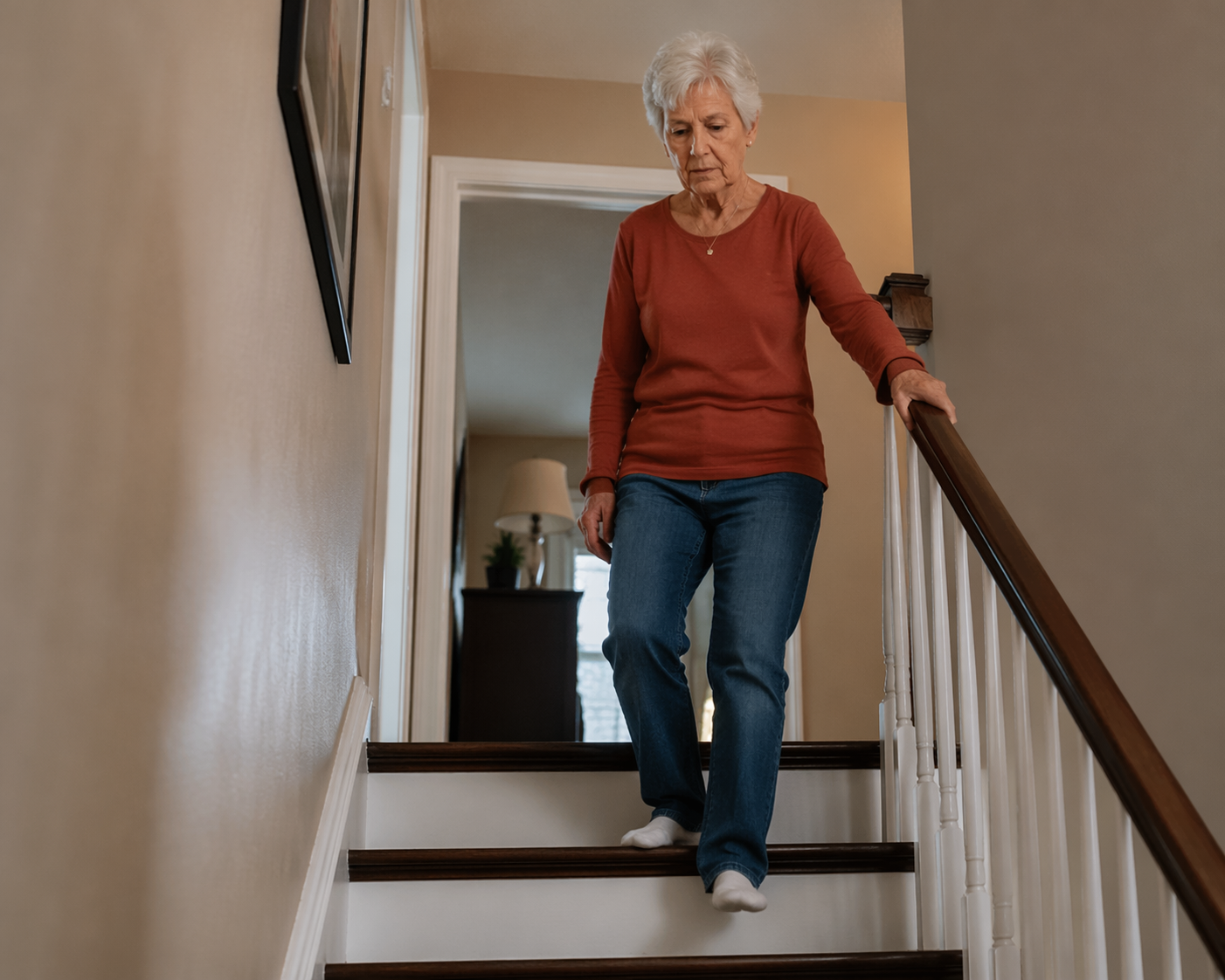
For family caregivers, this is one of the most important parts of fall prevention in older adults because it is easy to miss. The visible injury may heal while the person’s confidence, strength, and independence keep slipping. The problem is not that fear exists. Falling once does raise the chance of falling again; the CDC states that one fall doubles an older adult’s chance of another fall.[1] Some caution after a fall is sensible. The question is whether caution is protecting movement or replacing it.
Fear of falling is also not rare. A 2021 scoping review found that fear of falling affects 20% to 39% of community-dwelling older adults who have never fallen, and 40% to 73% of those who have already fallen.[2] That wide range matters less than the direction of the pattern: after a fall, fear becomes much more common, and it can change behavior even when the medical chart says the injury is resolved.
Why a Parent Can Look “Fine” and Still Be Losing Ground
A fall interrupts more than a walk across the kitchen. It interrupts trust in ordinary movement. Before the fall, a parent may have stood up, turned, stepped over a rug, and reached for a shelf without narrating each motion. Afterward, those same movements can feel like a series of hazards.
At first, the changes can seem reasonable. They stop carrying a full laundry basket downstairs. They ask someone else to bring in packages. They sit down to dress. These adjustments may prevent immediate risk, especially if pain, dizziness, or poor lighting contributed to the fall. But the cascade begins when temporary adjustments become a new daily boundary.
The body adapts quickly to less movement. Fewer walks mean less endurance. Avoided stairs mean less leg strength. Skipped outings mean less practice with curbs, doors, crowds, uneven pavement, and the small balance corrections that keep people steady in real life. The parent may feel safer because they are doing less, while their actual reserve is shrinking.
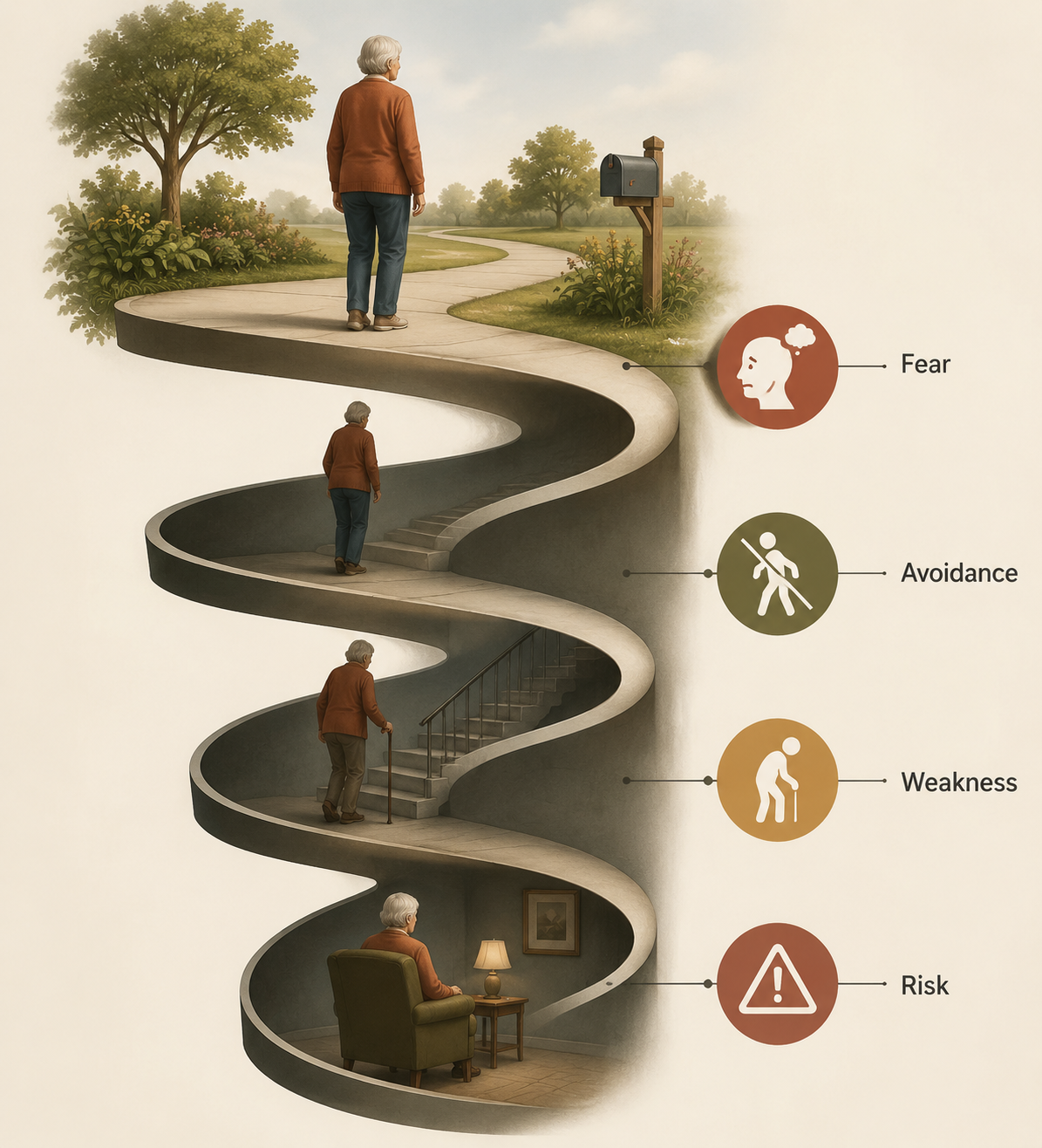
This is why “she’s just being careful” can be both true and incomplete. Carefulness after a fall may prevent a reckless choice. But if it leads to days spent mostly sitting, then carefulness starts borrowing strength from tomorrow.
The research matches what many families notice at home. Fear of falling has been found to independently predict future falls, functional decline, short-term mortality, and cognitive decline, even after accounting for fall history itself.[2] That does not mean fear alone causes every later problem. It does mean fear deserves attention as its own risk signal, not merely as an understandable emotion after an accident.
When Fear Is Protective, and When It Becomes Disabling
A parent who pauses before icy steps is not in trouble because they paused. A parent who uses the handrail after a fall is not “giving in.” Fear becomes a concern when it starts removing ordinary activities that help maintain strength, balance, social connection, hygiene, and confidence.
One useful boundary is functional restriction. Is the person still moving through the day with safer supports, or are they abandoning parts of the day altogether? There is a difference between using a shower chair while bathing and avoiding bathing because the bathroom feels dangerous. There is a difference between switching to a smaller grocery trip and no longer entering a store.
Clinical tools try to capture this boundary more formally. In the cited review, high fear of falling measured by a Falls Efficacy Scale score above 27 was associated with a 175% increase in incident mobility disability and a 62% increase in developing poor physical performance over two years.[2] A family caregiver does not need to administer a scale at the kitchen table. The practical lesson is simpler: when fear starts predicting lost mobility, it has moved beyond a passing worry.
Signs families can see before the next fall
- A routine narrows: the parent stops checking the mail, walking the dog, attending services, visiting neighbors, or going into stores.
- Movement becomes furniture-based: they move from chair to table to counter instead of using an appropriate assistive device.
- Stairs, bathing, dressing, or getting into a car become delayed, negotiated, or avoided.
- Exercise disappears, including the small informal exercise of errands, cooking, gardening, or walking to another room.
- They ask for repeated reassurance before movements they used to do automatically.
- Family members start reorganizing the whole household around avoidance without asking whether the avoidance is temporary or growing.
That last sign often belongs to the caregiver as much as the parent. An adult child who watched a fall, or found a parent afterward, may start saying no before the parent does: don’t go downstairs, don’t walk outside, don’t shower until I’m there. The instinct is loving. It can also teach the parent that ordinary movement is no longer safe unless someone else is supervising it.
Interrupt the Cycle Where It Is Actually Happening
The right response depends on which part of the cascade is strongest. A parent who is frail and unsteady needs a different plan from one whose main limitation is fear and avoidance. A home with poor lighting creates different work from a medication list that includes dizziness as a side effect. “Stay active” is too vague for a person who is already afraid of the hallway.
| Part of the cycle | What it may look like at home | Intervention that fits |
|---|---|---|
| Weakness and poor balance | Shorter walks, difficulty rising from a chair, avoiding stairs | Targeted strength and balance exercise, often with clinician or physical therapist guidance |
| Fear and activity avoidance | Declining outings, needing reassurance, giving up normal routines | Structured confidence-building programs such as A Matter of Balance |
| Environmental triggers | Fear around bathrooms, rugs, stairs, thresholds, dim rooms | Home safety modifications matched to the actual hazard |
| Modifiable health contributors | Dizziness, poor vision, hearing problems, unsafe footwear, uncertain device use | Medication review, sensory checks, and assistive-device assessment |
For frailty and balance loss: rebuild capacity deliberately
When the fall has exposed real weakness, the answer is not a pep talk. It is progressive, targeted exercise that fits the person’s current ability. The Otago Exercise Program was designed for frail older adults and is reported by the National Council on Aging and CDC falls-prevention materials to reduce falls by 35% to 40%.[3] That makes it different from a general suggestion to “walk more.” It is a structured balance and strength program, usually most appropriate when someone needs individualized progression rather than a casual class.
For a caregiver, the practical move is to ask a clinician or physical therapist whether the parent needs supervised strength and balance work, especially after a fall with new gait changes, repeated near-misses, or visible difficulty rising, turning, or stepping. The goal is not to erase caution. The goal is to give the body enough capacity that caution does not require withdrawal.
For fear and avoidance: practice confidence, not denial
Some parents are physically able to do more than they are doing, but fear has become the gatekeeper. In that situation, arguing rarely helps. Telling someone “you’re fine” when they feel unsafe can sound like the family has stopped listening.
A Matter of Balance is an eight-week structured group intervention that specifically targets fear of falling and activity avoidance.[3] Its purpose is not simply exercise; it helps participants reinterpret fear, set realistic activity goals, and practice safer movement choices. That makes it a better fit when the main loss is confidence and routine, not only muscle strength.
Tai Chi fits a different space. It is often useful for balance confidence and controlled weight shifting, particularly for older adults who can safely participate in a class or adapted program.[3] It should not be treated as the universal answer for every parent after every fall. A frail parent who can barely stand from a chair may need one-on-one assessment before joining a group class. A steadier parent who has begun avoiding movement may benefit from the rhythm, repetition, and social structure.
For environmental triggers: change the house without shrinking the life
Home safety work is often presented as a generic checklist: remove rugs, add lights, install grab bars. Those changes can matter, but they are most useful when they are tied to the parent’s actual avoidance. If the shower is the place they dread, the bathroom deserves attention first. If they have stopped using the front steps, the railing, lighting, footwear, and step surface matter more than reorganizing a bedroom they still use comfortably.
A useful question is: “Which activity disappeared after the fall?” The answer points to the environment that needs inspection. The mailbox route may involve a threshold, a loose mat, a sloped walkway, or a door that closes too quickly. The laundry problem may be a stair problem, a carrying problem, or a balance problem while turning. The fix should make the activity possible again, not simply confirm that the parent should never do it.
For hidden contributors: check senses, medications, and devices
A fall can make fear visible, but the fall itself may have had several contributors. Vision loss nearly doubles fall risk, and hearing aid use has been associated with a 50% reduction in fall risk.[4] These details are easy to overlook when everyone is focused on the bruised hip or sore wrist. A parent who cannot see a curb clearly or hear approaching movement may become more fearful for reasons that are partly correctable.
Medication review belongs in the same category of practical checks. Mayo Clinic fall prevention guidance includes reviewing medications with a health care professional, especially those that may cause dizziness or drowsiness.[5] This is not a reason for families to stop medicines on their own. It is a reason to bring the fall, near-falls, dizziness, sleepiness, and timing of symptoms into the appointment instead of discussing each prescription in isolation.
Assistive devices also need a better reputation. A cane or walker that is fitted and taught well can support movement; furniture-walking usually does the opposite. Grabbing a counter, then a chair, then a wall may feel safer than using a walker because the person is still “walking on their own.” In reality, it can mean they are moving through the house with unpredictable handholds and no consistent support.
The Caregiver’s Job Is to Notice What Has Disappeared
After a fall, families often track pain, bruising, follow-up appointments, and whether the parent can walk from the car to the house. Those are important. They are not enough. The quieter measure is what has vanished from the week.
Has the parent stopped going outside alone? Stopped bathing unless someone is nearby? Stopped standing long enough to cook? Stopped attending the one gathering that used to anchor the week? These losses may arrive politely, one declined invitation at a time. By the time everyone agrees there is a problem, the new smaller routine may already feel normal.
The World Guidelines for Falls Prevention and Management emphasize multifactorial assessment and individualized interventions for older adults at fall risk.[6] That matters because fear after a fall is rarely solved by one lecture, one grab bar, or one class. The parent may need strength work, a medication review, better lighting, a hearing check, and a confidence-building program. The order should follow the person, not a brochure.
A good first conversation is concrete: “Since the fall, what have you stopped doing?” Not “Are you afraid?” Some parents will deny fear because they do not want to seem dependent. Others will say they are being sensible, which may be true. The disappeared activity gives both of you something practical to examine.
From there, choose one confidence-building intervention rather than trying to repair everything in a weekend. Ask the primary care clinician whether a physical therapy referral, fall-risk assessment, medication review, vision or hearing evaluation, or community program fits the situation. If the parent is already frail, start with supervised capacity-building. If avoidance is the main change, look for a program that addresses fear directly. If one location in the house has become the center of anxiety, make that location safer and then help the parent practice using it again.
The goal is not to talk an older parent out of fear. It is not to push them back into unsafe independence. It is to keep fear from becoming the organizer of daily life. Notice avoidance early, name the activity that disappeared, and bring in the right help before the smaller life starts to feel permanent.
References
- Facts About Falls, Centers for Disease Control and Prevention, updated January–February 2026
- Fear of Falling in Community-Dwelling Older Adults: A Scoping Review, Canadian Geriatrics Journal, 2021
- Evidence-Based Falls Prevention Programs, National Council on Aging
- Get the Facts on Falls Prevention, National Council on Aging
- Fall Prevention: Simple Tips to Prevent Falls, Mayo Clinic
- World Guidelines for Falls Prevention and Management for Older Adults: A Global Initiative, Age and Ageing, 2022
Related reading
Noticed something outdated or inaccurate on this page? Flag a correction. We review every report against CDC, NIA, and AARP HomeFit guidance before updating a page.
Part of the Fall Prevention section.