
STEADI: Intervene
Heat Wave Safety Plan for Older Adults Living Alone
A heat wave plan for older adults living alone, built on the reality that aging can blunt thirst and heat perception. It pairs before-the-heat preparation with a thermometer- and calendar-triggered during-the-heat schedule for hydration, no-AC cooling, twice-daily buddy check-ins, and knowing when to call for help.
If you live alone, the safest heat wave plan starts with an uncomfortable rule: do not wait until you feel thirsty, hot, dizzy, or confused. By then, you may already be behind. The plan needs to be triggered by the calendar, the forecast, the room thermometer, the clock, and a twice-daily check-in—not by how strong or independent you usually feel.
Older adults are not fragile by definition. Many manage their own apartments, medications, meals, errands, and appointments quite well. Heat is different because the body’s early warning system can get quieter with age. Public-health data from 2004–2018 found that adults 65 and older had the highest heat-related death rate of any age group, 0.7 per 100,000, and accounted for about 39% of U.S. heat-related deaths during that period.[1] That is enough evidence to take heat seriously—but the useful question is what to do before Tuesday afternoon arrives.
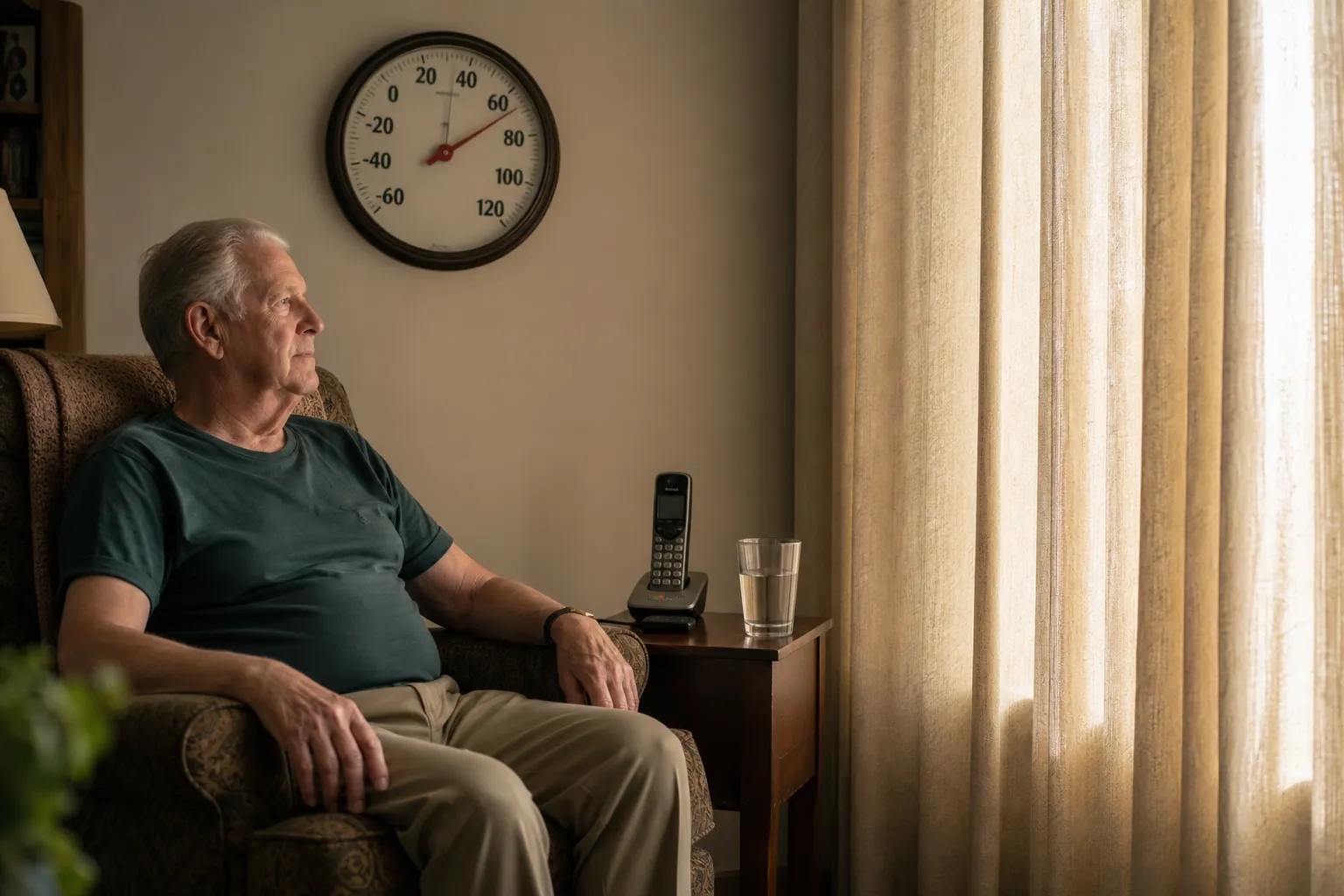
The one-page heat wave plan
Print this, copy it onto a notepad, or write it in large letters and keep it near the phone, refrigerator, or medication area. The point is not to make a perfect emergency binder. The point is to remove decision-making from the hottest part of the day.
| When | What to decide or do | Write this down |
|---|---|---|
| Before heat is forecast | Place a room thermometer where you spend the afternoon and evening. Choose your coolest room. Identify a public cooling place. Pick one primary buddy and one backup. Ask your doctor or pharmacist about fluids, diuretics, fluid restriction, and heat-sensitive conditions. | Thermometer location; cooling-room location; cooling destination; ride plan; buddy names and phone numbers; medical instructions. |
| When the forecast shows several hot days | Start the plan before you feel bad. Check transportation. Charge the phone. Put water where you sit. Close curtains on the sunny side. Confirm buddy calls. | First day to start the plan; time of morning and evening check-ins; cooling-center hours. |
| Morning | Check the indoor temperature. Drink on schedule unless you have a medical fluid limit. Eat something light. Close sunny curtains early. Decide whether you will need to leave for a cooler place later. | Morning room temperature; drinks taken; plan for transportation if the room warms. |
| Midday and afternoon | Avoid cooking that heats the home. Use cool showers, damp cloths, and the coolest room. Do not rely on a fan as your main cooling plan in extreme heat. Leave for a cooling location if your home crosses your action threshold. | Temperature at midday and late afternoon; time to leave if needed; ride contact. |
| Evening | Take the second buddy call. Keep drinking on schedule. If it is cooler outside, open shaded windows only if safe to do so. Recheck the indoor temperature before bed. | Evening temperature; symptoms; overnight plan. |
| Overnight | Pay attention if the night stays hot. Keep water and a phone at the bedside. If the home does not cool down, plan to spend the next day somewhere air-conditioned. | Bedside water and phone; next-day cooling destination. |
| Any time | Call for help if you have warning signs such as confusion, fainting, severe weakness, vomiting, chest pain, trouble breathing, or symptoms that do not improve after cooling. | 911 or local emergency number; nearby contact; medication list location. |
Why feelings are not a safe heat alarm
Heat plans for older adults living alone have to respect a basic mismatch: the body may be heating up while the person does not feel urgent. Aging can reduce thirst sensation, sweat output, and the ability to sense heat stress.[2][3] Some medicines and chronic conditions can add to that problem, especially when they affect fluid balance, sweating, heart strain, kidney function, or alertness.
That is why “drink when thirsty” and “call someone if you feel bad” are weak instructions for a person who lives alone. They put the most important decision at the moment when judgment may be starting to slip. A safer plan says: when the forecast reaches a certain point, when the room reaches a certain temperature, and when the clock reaches the check-in time, do the next step.
Set the plan up before the heat arrives
Do this setup on an ordinary day. If possible, do it with the person who is most likely to call you during hot weather. Think of it like a fire drill: nobody wants to practice, but practice is what keeps the real event from becoming a scramble.
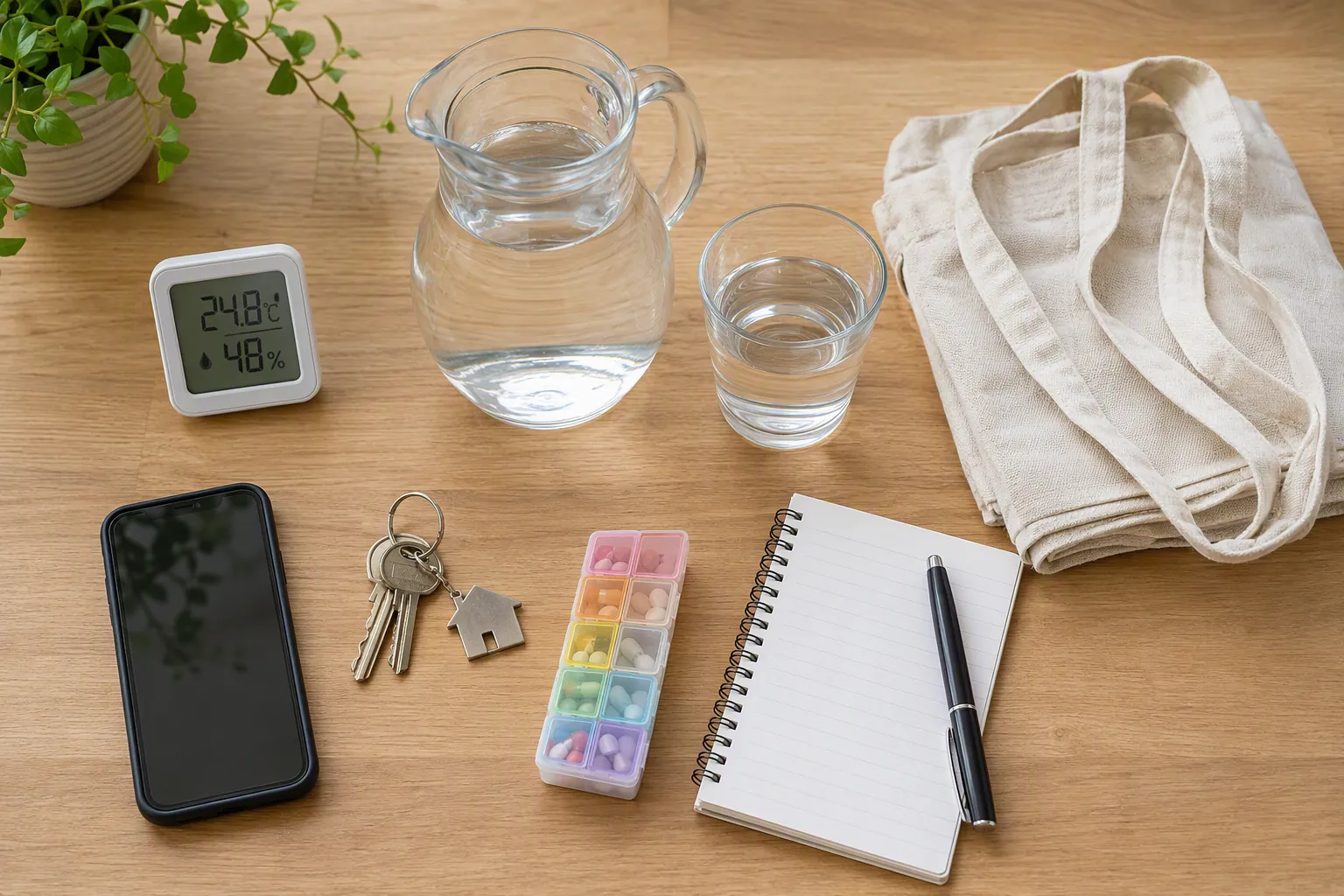
Put the thermometer where the risk is
Use a room thermometer you can read easily. Put it in the room where you spend the afternoon or evening, not in a hallway that stays cooler than your chair or bed area. If you have two thermometers, put one in the main sitting area and one near the bed.
Write your action numbers beside it. AARP’s heat-safety guidance, citing clinicians, notes that older adults with chronic medical conditions may need to take action when the home is above 80°F; the same article quotes a geriatrician describing 85°F with humidity as a point where preventive counseling begins.[4] Duke Heat Policy Innovation Hub guidance reported by PBS also flags overnight lows above 75°F as linked with worse outcomes, because the body gets less chance to recover.[5]
- Above 80°F indoors: take this seriously if you have chronic conditions, take heat-sensitive medicines, or have felt weak or lightheaded in prior hot weather.[4]
- 85°F and humid indoors: treat this as a warning point, not a comfort preference.[4]
- Nighttime staying above 75°F: plan for more cooling the next day, because poor overnight cooling removes a recovery period.[5]
Choose the cooling destination before you need it
If you have reliable air conditioning, your cooling destination may be your own home, with a backup in case power fails or the unit cannot keep up. If you do not have air conditioning, or you avoid using it because of cost, name a public place now: a cooling center, library, senior center, mall, theater, community building, or a friend’s air-conditioned home. Public-health and aging agencies commonly recommend using air-conditioned public spaces during dangerous heat, and New York State’s aging office also points older adults toward programs such as LIHEAP for help with cooling costs where eligible.[6][7]
Write the address, hours, phone number, and transportation plan. “I’ll figure it out if I need to” is not a transportation plan. A useful line on the paper looks like this: “If my living room is 85°F and humid by noon, I call Gloria for a ride to the library. If Gloria does not answer in 10 minutes, I call the senior center ride line.”
Make the buddy plan specific enough to preserve dignity
A buddy plan is not babysitting. It is a scheduled safety handoff for a known hazard, the same way someone might check whether a neighbor’s power came back after a storm. The CDC advises older adults to have someone check on them and advises caretakers to visit at least twice a day during extreme heat, asking about water intake, access to air conditioning, how the person is keeping cool, and signs of heat stress.[6]
Pick one primary buddy and one backup. The primary buddy can be a neighbor, friend, relative, faith-community contact, building staff member, or paid caregiver. The backup matters because heat waves are community events; the first person may lose power, get called into work, or be caring for someone else.
Agree on two daily check-in times, such as 9 a.m. and 7 p.m. The evening call is especially important because a person who seemed fine in the morning may have spent hours in a warming room. Decide what the buddy should do if you do not answer: call again in 10 minutes, call the backup, call building staff, or request a wellness check according to your local options.
Use a short check-in script
The call should not depend on “Are you okay?” Most people say yes out of habit. Use questions that require facts.
- What does your room thermometer say right now?
- How many glasses of water or approved fluids have you had since breakfast or since lunch?
- Are your curtains closed on the sunny side?
- Are you using air conditioning or sitting in the coolest room?
- Do you feel dizzy, weak, confused, nauseated, short of breath, or unusually tired?
- If the room is too warm, what is your cooling destination and how are you getting there?
For adult children or neighbors, this script is a kindness. It lets you be useful without fussing. For the older adult, it keeps the call practical instead of making it feel like a test of competence.
Ask the medication and fluid questions before the first hot spell
Hydration advice has one important exception: some people have been told to limit fluids because of heart, kidney, liver, or other medical conditions. Some medicines, including diuretics, can also change heat and fluid risk. The New York State Office for the Aging advises older adults to drink on a schedule in extreme heat, while also telling those on fluid restriction or diuretics to ask a doctor first.[7] The CDC likewise advises asking a health care provider how much to drink if a doctor has limited fluid intake or prescribed water pills.[8]
Call your doctor’s office or pharmacist before the season gets hot and ask three plain questions: “How much should I drink on very hot days?” “Do any of my medicines raise heat risk or dehydration risk?” “If I feel lightheaded, weak, or unusually tired during heat, which symptoms mean I should call you, urgent care, or 911?” Write the answers on the plan. Do not change or skip prescribed medicines on your own.
During the heat wave: follow the clock
On heat-wave days, the schedule matters more than motivation. The goal is to stay ahead of thirst, ahead of indoor heat buildup, and ahead of the point where a person living alone has to solve too many problems while already overheated.
Morning: start before the apartment heats up
Check the room thermometer when you get up. Drink your first glass of water or the fluid your clinician has approved. Put several glasses, a filled bottle, or a pitcher where you will actually see them. The New York State Office for the Aging recommends drinking about 2–4 glasses of water per hour during extreme heat, while making the medical exceptions noted above.[7] If that amount conflicts with your own medical instructions, follow your clinician’s limit and ask what to do on extreme-heat days.
Close curtains or blinds on the sunny side early, before the room turns into a heat trap. If it is cooler outside in the morning and safe to do so, use that cooler air briefly; then close up the sunny side as the day warms. Eat something light if you can. Skipping food and fluids together is a good way to become weak on your feet.
Midday: decide by temperature, not pride
Check the thermometer again before the hottest part of the day. If the room is approaching your written action point, start the cooling-location plan while you still feel steady. Call the ride, call the buddy, pack keys, phone, charger, medication list, water, and a light sweater or shawl for an air-conditioned building.
Do not cook a hot meal if it will warm the apartment. Use food that does not require the oven or long stove time. If you need to bathe, choose a cool or lukewarm shower, not a hot one. Use damp cloths on the neck, wrists, ankles, armpits, or groin area to help cool the body; no-air-conditioning guidance from aging and public-health sources commonly recommends cool showers, wet cloths, shaded rooms, and public cool spaces as practical cooling methods.[5][7][9]
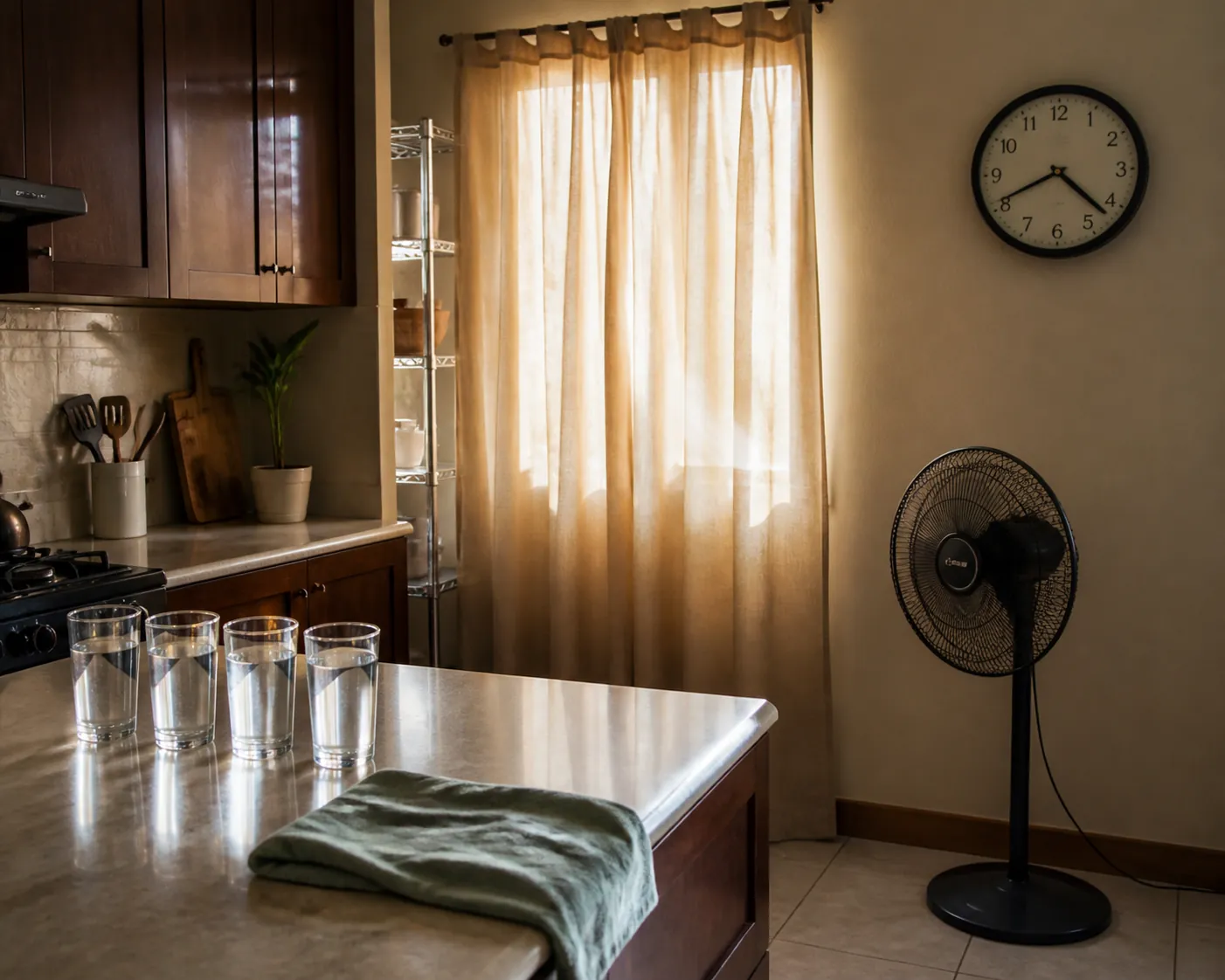
Afternoon: know when a fan is not enough
A fan can make a mildly warm room feel better, especially if it helps move cooler air at night or across a damp cloth. It should not be the main cooling plan in extreme heat. The CDC cautions older adults not to rely on a fan as the primary cooling source during extreme heat.[6] A Cornell Climate and Aging summary of a 2020 study also notes that fans become ineffective above roughly 95°F, but that is a secondhand research summary rather than a direct clinical rule for every apartment.[10]
The practical rule is simpler: if the room is hot and humid, if the thermometer keeps climbing, or if you are sitting in front of a fan but still feel weak, flushed, dizzy, or unusually tired, move to a cooler place. A fan that lets someone stay too long in a dangerously hot room has stopped being helpful.
Evening: make the second check-in count
The evening check-in should happen even if the morning went well. Give the buddy the thermometer reading. Say what you drank. Say whether you used air conditioning, went to a cooling place, showered, or used damp cloths. If the apartment did not cool down, make the next day’s plan before bed.
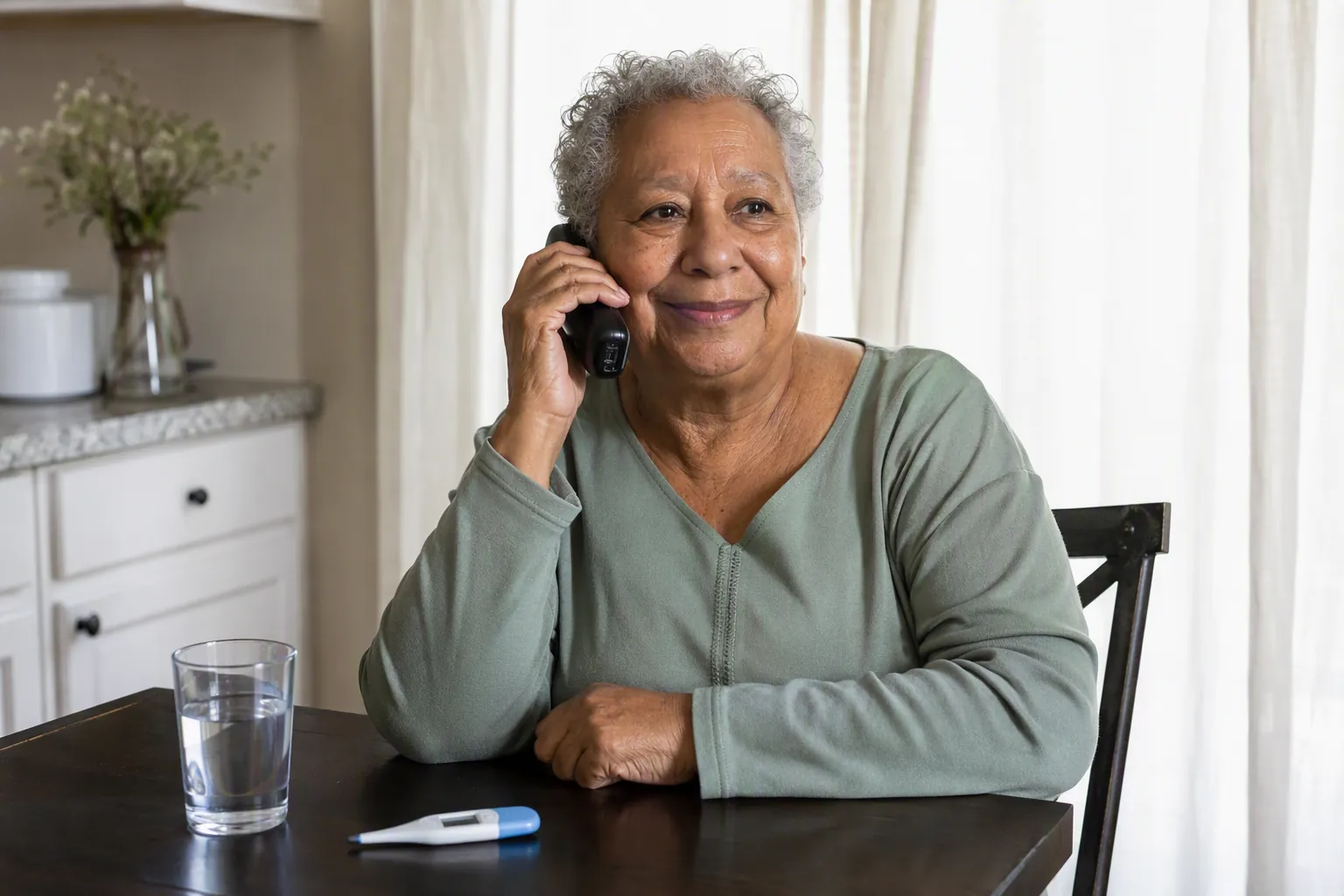
If outdoor air is cooler after sunset and it is safe in your building and neighborhood, open shaded windows for some relief. If the night stays hot, do not treat bedtime as the end of the problem. Keep water, phone, glasses, and a flashlight within reach. A hot night after a hot day is a reason to spend the next day in air conditioning if you can.
When self-management ends and help begins
This plan is not a substitute for medical care. If you have a medical condition, take diuretics, have been told to limit fluids, or have had heat illness before, ask your clinician how to adapt it. Do not wait for a scheduled buddy call if something feels wrong.
Call 911 or your local emergency number now if you have confusion, fainting, seizure, chest pain, trouble breathing, severe weakness, repeated vomiting, or symptoms that do not improve quickly after moving to a cooler place and using cooling measures. Heat illness can also show up as heavy sweating or no sweating, fast pulse, headache, nausea, cramps, dizziness, or unusual fatigue; public-health and geriatric sources treat these as warning signs that should not be ignored in older adults.[6][9]
Also call for help if your room crosses your action threshold and you cannot get to a cooler place. That is not a failure. That is the plan doing its job. The dangerous choice is staying alone in a hot room because you do not want to bother anyone.
Why the living-alone detail matters
Isolation does not cause every heat death, and event-specific data should not be stretched into a universal claim. Still, the pattern is serious enough to plan around. Reporting on the 2021 Pacific Northwest heat disaster cited Oregon emergency-management data that about three-quarters of fatalities lived alone, and the same reporting described Maricopa County data showing 122 indoor heat deaths among people 50 and older living alone in one year.[11] Those examples do not prove that most heat deaths everywhere involve people living alone. They do show why heat advice that quietly assumes someone else will notice trouble is not good enough.
Heat also belongs in the home-safety conversation. Dehydration, dizziness, weakness, confusion, and fainting can turn a hallway, bathroom, or kitchen into a fall zone. A person living alone needs a plan that prevents the collapse, not just a pendant or phone call after it happens.
Caregiver-shareable summary
If you are helping an older parent, neighbor, friend, or client who lives alone, set up the plan with them, not around them. The goal is to make the safest choice the easiest choice on a hot day.
- Put a readable room thermometer where the person spends hot afternoons and evenings.
- Write the heat action thresholds beside the thermometer, including any clinician-specific instructions.
- Identify the coolest room and the backup air-conditioned destination.
- Confirm transportation before a heat warning, including a backup ride.
- Ask the doctor or pharmacist about fluids, diuretics, fluid restriction, and heat-sensitive conditions.
- Schedule two daily check-ins during heat waves and use factual questions, not just “Are you okay?”
- Agree in advance what happens if the person does not answer the phone.
Before the forecast turns dangerous, rehearse the plan once: read the thermometer, make the buddy call, check the cooling-center hours, test the ride plan, and put the written sheet where it will be seen. Living alone can still be compatible with heat-wave safety, but not if the plan depends on feeling bad first. Let the thermometer, the clock, and the check-in do the work.
References
- Heat-Related Deaths — United States, 2004–2018, CDC MMWR, 2020.
- The Effects of Heat on Older Adults, Harvard Medicine Magazine.
- How Seniors Can Stay Safe in the Summer, Brown University Health.
- Heat Wave Dangers, AARP.
- How to stay cool and safe in a heat wave, even without air conditioning, PBS NewsHour.
- Heat and Older Adults Aged 65+, CDC Heat Health.
- Extreme Heat Resources, New York State Office for the Aging.
- Protect Yourself From the Dangers of Extreme Heat, CDC.
- Tip Sheet: Hot Weather Safety Tips for Older Adults, HealthInAging.
- How well do older adults cope with heat waves?, Cornell Climate & Aging.
- Social isolation and older men dying in extreme heat, The 19th, 2024.
Related reading
Noticed something outdated or inaccurate on this page? Flag a correction. We review every report against CDC, NIA, and AARP HomeFit guidance before updating a page.
Part of the Fall Prevention section.