
STEADI: Intervene
Hurricane vs Typhoon Safety Tips for Older Adults
Hurricanes and typhoons are the same storm under different basin names, so older adults need one senior-specific safety plan rather than two. This before-during-after guide covers what generic checklists miss: medication supplies, medical power, mobility help, evacuation decisions, and post-storm fall, carbon monoxide, and isolation risks.
The storm has one science name and several local names
For practical purposes, a hurricane and a typhoon are the same kind of storm: a tropical cyclone. The name changes because of where the storm forms. NOAA uses “hurricane” for storms in the North Atlantic and the central or eastern North Pacific, “typhoon” for storms in the Northwest Pacific, and “tropical cyclone” as the broader term elsewhere. The wind thresholds are the same: a tropical depression has sustained winds below tropical-storm strength, a tropical storm begins at 39 mph sustained winds, and the system becomes a hurricane or typhoon at 74 mph sustained winds. In the Atlantic, hurricane season runs from June 1 through November 30, and NOAA says about 97% of tropical cyclone activity occurs in that window.[1]
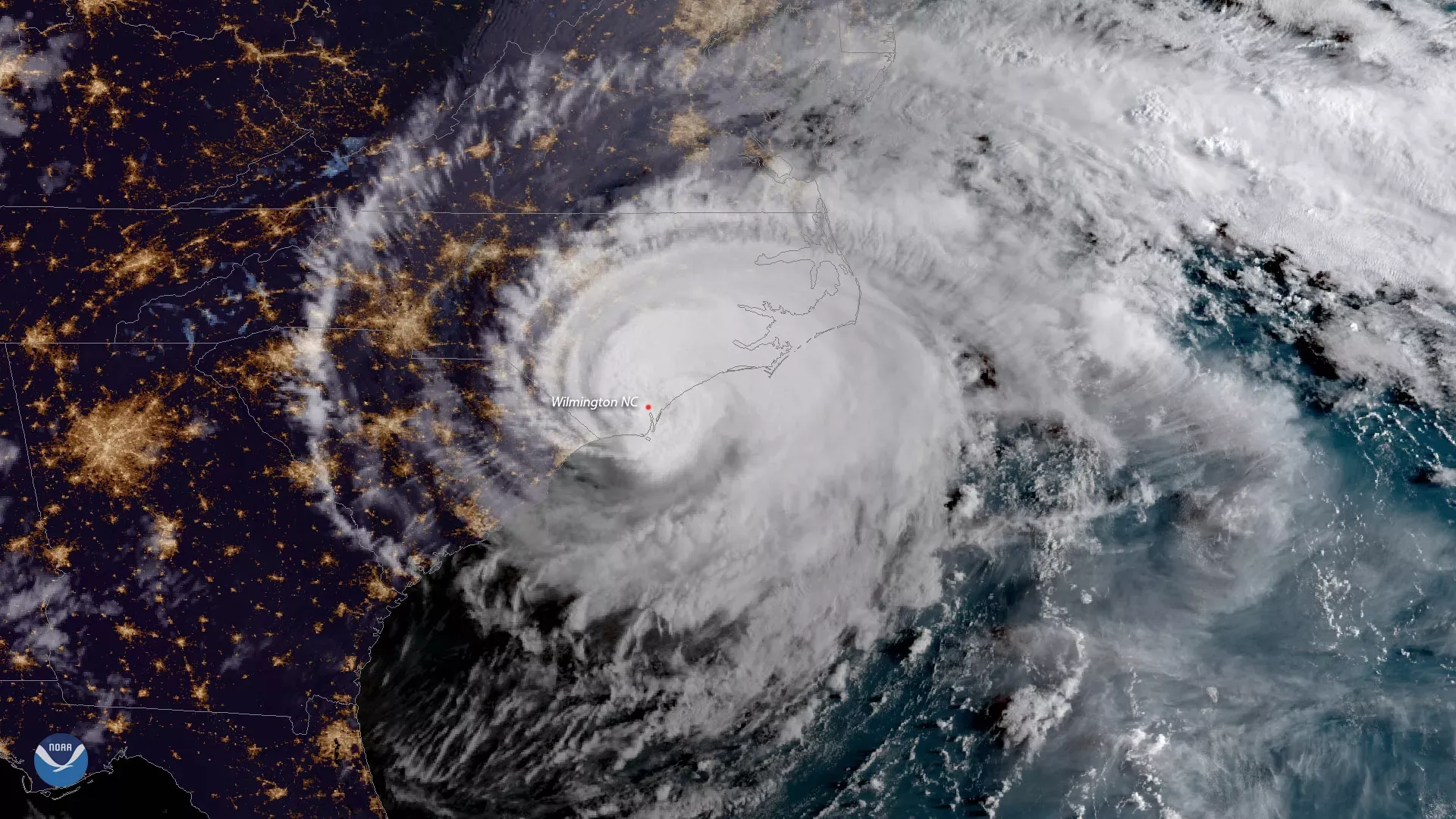
That vocabulary point matters, but only briefly. If you are looking for hurricane vs typhoon safety tips for elderly parents or neighbors, the useful answer is not two separate binders. It is one tropical-cyclone plan that works whether the local forecast uses hurricane, typhoon, or tropical storm. The American Red Cross also notes why “typhoon” is not only a faraway word for a U.S. audience: U.S. territories including Guam and the Northern Mariana Islands can be affected by typhoons.[2]
The plan has to be more specific for an older adult than the usual “stock food, water, and batteries” list. A person who uses a walker, refrigerated insulin, oxygen, dialysis transportation, a stair lift, a powered bed, or a neighbor-held spare key is not protected by a generic three-day kit alone. Local evacuation orders, emergency alerts, and medical advice always outrank an article, but the work that can be done before the alert is what makes those official instructions possible to follow.
The older-adult focus is not sentimental; it is where the death toll has repeatedly concentrated. AARP’s disaster resilience materials cite Hurricane Katrina as an example in which people age 75 and older were about 6% of New Orleans’ population but about half of the deaths. The same source notes that after Hurricane Ian, 61 of 87 identified fatalities were age 60 or older, and that after Sandy, nearly half of fatalities for whom an age was released were age 65 or older.[3]
Before the storm, plan for what cannot be improvised
The most important senior storm-prep work usually looks boring while the sky is still clear: calling the pharmacy, labeling the walker, writing down the oxygen supplier’s after-hours number, checking whether the neighbor still has a key, and deciding who is allowed to insist on evacuation when the older adult is tired, frightened, or determined not to leave. That is the work that prevents the emergency from becoming a medical scavenger hunt.
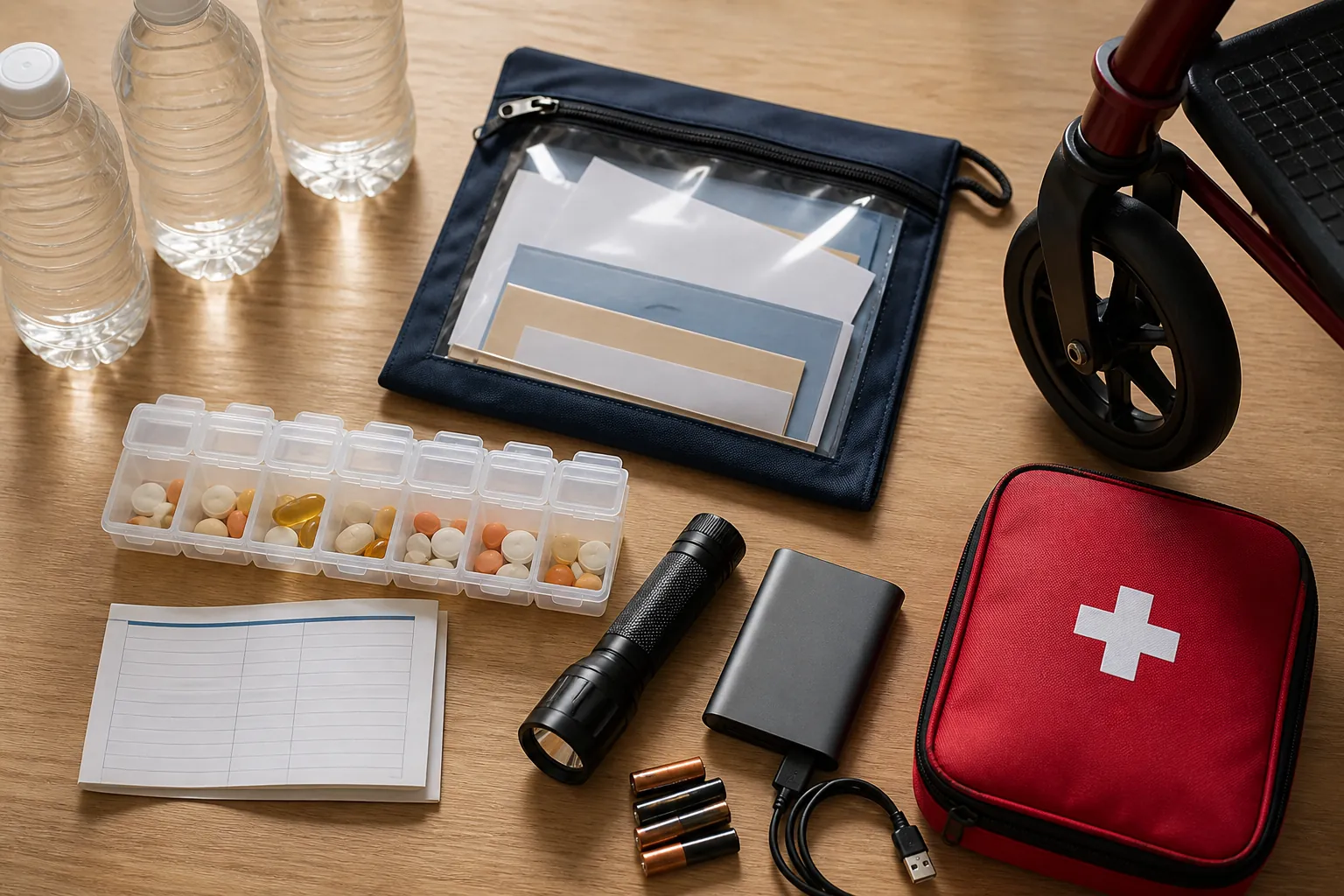
Medication planning is the first place where generic advice often breaks down. The Red Cross tells older adults to prepare at least a 30-day supply of medications and medical supplies, while the American Association for Geriatric Psychiatry advises having a two-week supply, along with written lists of prescriptions, allergies, and medical conditions.[4][5] Those two numbers are not the same, and real refill rules can be stubborn. Treat the higher number as the planning target when it is feasible, but do the practical calls early: pharmacy, prescriber, insurer, mail-order service, and any specialty supplier.
- Keep a current medication list in the go-bag, wallet, and caregiver’s phone. Include dose, schedule, prescribing clinician, pharmacy, allergies, and what happens if a dose is missed.
- Ask the pharmacist which medicines are unsafe after heat exposure, flood exposure, or loss of refrigeration. Do not guess with insulin, injectables, or liquid medications.
- If controlled substances, infusion supplies, dialysis supplies, oxygen, or refrigerated medication are involved, make the refill and backup plan before watches are posted.
- Pack assistive medical items with the same seriousness as prescriptions: hearing-aid batteries, glasses, dentures, incontinence supplies, wound-care supplies, glucose-monitoring supplies, chargers, and device manuals.
A deeper household checklist can live elsewhere; it does not need to be rebuilt from scratch during every forecast cone update. Use a dedicated storm preparedness checklist for elderly parents for food, water, documents, battery rotation, and room-by-room supplies. The senior-specific correction is making sure the kit follows the person’s body and care routine, not just the household.
Write the power plan as if the outage starts before anyone is ready
If an older adult relies on powered medical equipment, the plan needs names and numbers, not a hopeful note that “we have batteries.” List every device that needs electricity: oxygen concentrator, CPAP or BiPAP, nebulizer, hospital bed, lift chair, stair lift, wheelchair, scooter, communication device, medication refrigerator, or home dialysis-related equipment. For each one, write down the battery runtime, the charging method, the supplier, the clinician’s office, and the place the person can go if home power fails.
Ready.gov tells older adults to plan how they will evacuate with assistive devices and medical equipment, and to keep copies of Medicare, Medicaid, and other insurance cards. It also recommends using electronic payments such as direct deposit, with Direct Express available at 800-333-1795 for people who receive federal benefits and do not have a bank account.[6] Those details sound administrative until the ATM is down, the local office is closed, and a replacement card is sitting in a flooded kitchen drawer.
Name the helpers before anyone needs rescuing
A support network is not “someone will check on Mom.” AAGP recommends a support network of at least three people who hold keys and know what help is needed.[5] Put those people in writing. One may be the adult child who makes medical calls. One may be the neighbor who can unlock the door. One may be the nearby church friend, building manager, or home health aide who knows whether the walker fits in the car.
| Question | What the answer should include |
|---|---|
| Who has a key? | Names, phone numbers, and where the spare key is kept if the keyholder is unreachable. |
| Who can lift or move equipment? | A realistic helper, not someone who cannot safely handle a wheelchair, oxygen tank, or packed go-bag. |
| Who calls the pharmacy or supplier? | One named person with the medication list, insurance information, and prescriber contacts. |
| Who checks after the storm? | A first-choice and backup visitor or caller, because cell service, roads, and caregiving routines may fail at the same time. |
Long-distance caregivers need this on paper even more than local families do. A parent may sound calm on the phone while the hallway is dark, the fridge is warm, and the walker is trapped behind a fallen closet door. The person with keys and eyes on the home is not a courtesy contact; that person is part of the safety equipment.
Use watches and warnings for action, not background noise
The CDC explains that a hurricane watch means hurricane conditions are possible, with notice issued 48 hours before expected tropical-storm-force winds, while a warning means hurricane conditions are expected, with notice issued 36 hours before expected tropical-storm-force winds. That timing is tied to the arrival of 39–73 mph winds, not to the dramatic landfall moment on television.[7] For an older adult, that difference matters. Waiting until landfall can mean trying to load a walker, medication cooler, oxygen supplies, and documents when bridges are closing and the helper is no longer safe to drive.
| When | Senior-specific action |
|---|---|
| Before the season | Update medication lists, support-network names, keys, evacuation destinations, device batteries, transportation options, and insurance-card copies. |
| When a watch is issued | Refill what can be refilled, charge equipment, fill water containers, confirm the ride plan, and move documents and medications into the go-bag. CDC specifically advises filling water containers and checking carbon monoxide detector batteries during hurricane preparation.[7] |
| When a warning is issued | Follow local instructions, finish evacuation if ordered, or move to the safest interior space if staying. Do not wait for landfall to decide how a mobility device, oxygen tank, or medication cooler will travel. |
Evacuation is not a character test, and it is not optional when local officials order it. Ready.gov identifies storm surge as the leading cause of hurricane-related deaths, which is why families do not get to substitute a preference for staying home when a surge or evacuation order applies.[8] The hard part for frail adults is that leaving can also be dangerous if it is improvised: a shelter may not have the right medical setup, a sedan may not fit the wheelchair, or the receiving relative may have stairs and no backup power.
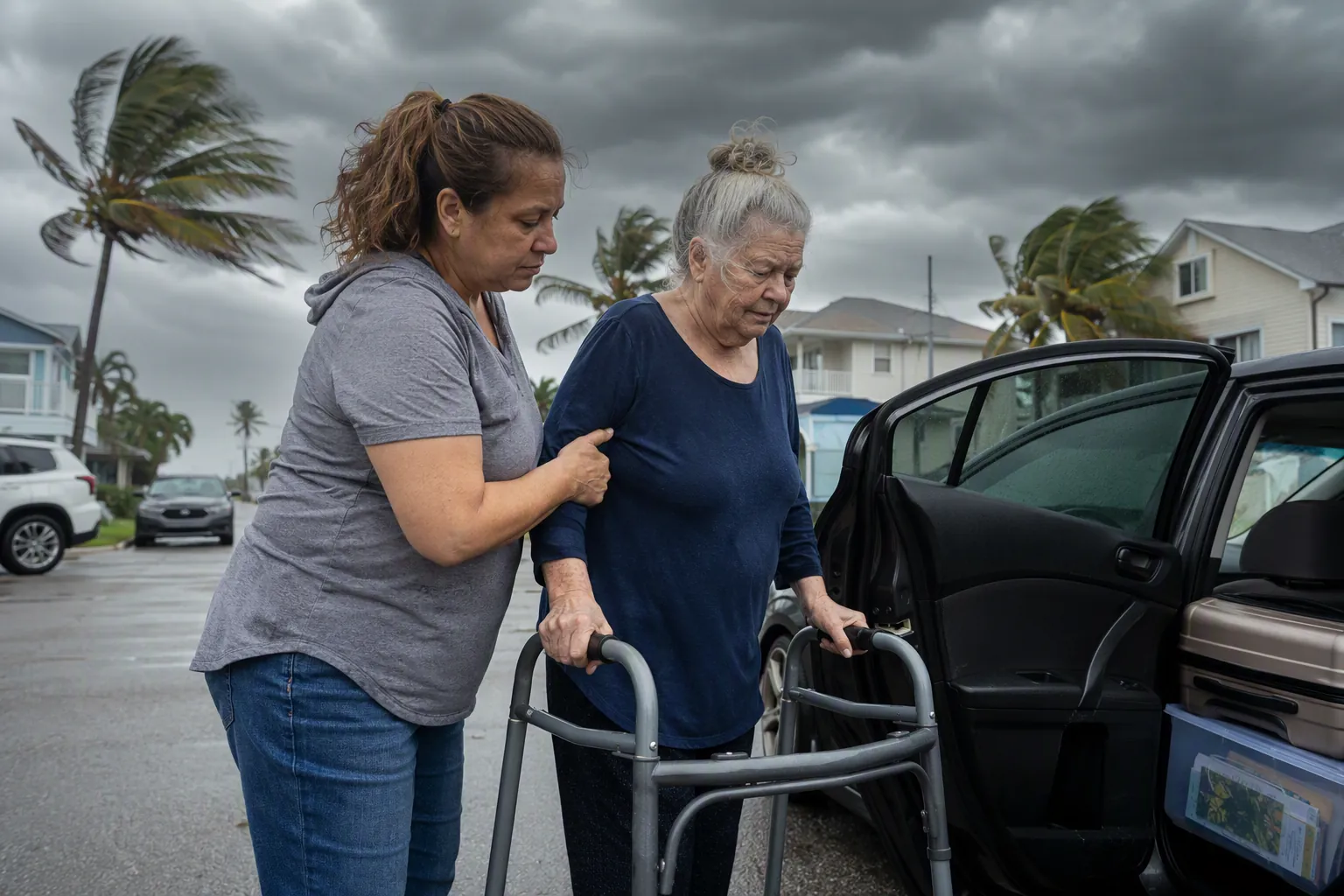
The better evacuation plan has a destination before the order: a relative’s accessible home, a hotel outside the risk area, a medical facility if arranged by the care team, or a local shelter option if no better choice exists. NOLA Ready, for example, describes shelters as a last resort for seniors and people with medical needs and points residents toward pre-registration systems such as Smart911-type profiles.[9] That local detail will vary by county or parish, so the family job is to learn the local process early, not to discover it while the power is flickering.
If the older adult resists planning because it feels like losing control, make the plan with them, not around them. A collaborative storm checklist with an aging parent can keep choices visible: which neighbor is trusted, which family member is the first call, which documents matter, what destination is acceptable, and what condition would make staying home unsafe.
During the storm, make the safe choice easy to repeat
Once tropical-storm-force winds arrive, the plan should be simple enough to follow under stress. If the older adult is sheltering at home, the CDC advises staying in a small interior room, closet, or hallway on the lowest level, away from windows.[7] That room needs the walker or cane within reach, shoes on or beside the feet, medications nearby, a flashlight that can be found by touch, and a phone or medical alert device kept charged as long as possible.
Do not put an older adult in a room that is technically “interior” but functionally dangerous. A narrow closet with loose storage underfoot, a bathroom with no grab bar, or a hallway blocked by a rollator and oxygen tubing can turn the safer wind location into a fall trap. If there is time before the weather deteriorates, clear the path from bed to bathroom and from the safe room to the exit. The same fall-prevention habits used for everyday aging in place—lighting, rug control, clutter removal, and reachable supports—matter more when the house is dark and noisy.
Floodwater rules should be blunt. The CDC and Ready.gov warn that 6 inches of moving water can knock a person down, and 1 foot of moving water can sweep away a vehicle.[7][8] For an older adult using a cane, walker, wheelchair, or weak legs, the margin is even worse. No one should walk through floodwater to check a mailbox, move a trash can, reach a car, or look at damage.
If evacuation has already happened, the same medical-control rule applies: medications, device chargers, insurance cards, hearing aids, glasses, and the written care list stay with the person, not in a separate car or a suitcase buried under bedding. If a shelter is involved, tell staff early about mobility limits, dementia, oxygen, dialysis, refrigeration needs, fall risk, or communication problems. Quiet needs become urgent needs when hundreds of people are waiting.
After the storm, do not treat survival as the finish line
The dangerous period does not end when the wind headline expires. Some of the clearest older-adult risks appear after the storm: dark homes, wet floors, broken routines, closed clinics, spoiled medication, generators, blocked roads, isolation, and grief. These studies should be read carefully, not inflated. A 2025 Frontiers Science News report described a population-level study of Medicare beneficiaries age 65 and older in Hurricane Sandy-flooded ZIP codes, finding about 9% higher all-cause mortality over five years, including about 19% in Connecticut and 8% in New York City, across roughly 300,000 people. That is a ZIP-code population estimate, not a prediction for any one person.[10]
A separate 2026 University of Michigan summary reported that older adults exposed to Hurricane Harvey had about 3% higher mortality within a year and described an estimated, unadjusted 3,738 additional deaths compared with the official direct death count of 103.[11] The exact numbers come with study limits, but the practical lesson is sturdy enough: the caregiver plan cannot stop at “made it through the night.”
First, make the house walkable in the dark
The first trip to the bathroom after an outage can be the injury point. Keystone Health’s senior emergency-preparedness guidance emphasizes blackout fall-proofing: flashlights within reach, taped rugs, nightlights, and mobility aids kept clear of clutter.[12] Add shoes with firm soles, a clear bedside path, a charged lantern placed low enough to reach from a chair, and a rule that the older adult does not inspect damage alone.
This is where storm preparation overlaps directly with home modification. Loose rugs, poor lighting, overloaded hallways, and awkward bathroom routes are routine fall hazards before a storm and amplified hazards after one. If the home already needs work, use the calmer part of the year to prioritize aging-in-place modifications that also make blackout movement safer.
Keep generators outside, far from openings
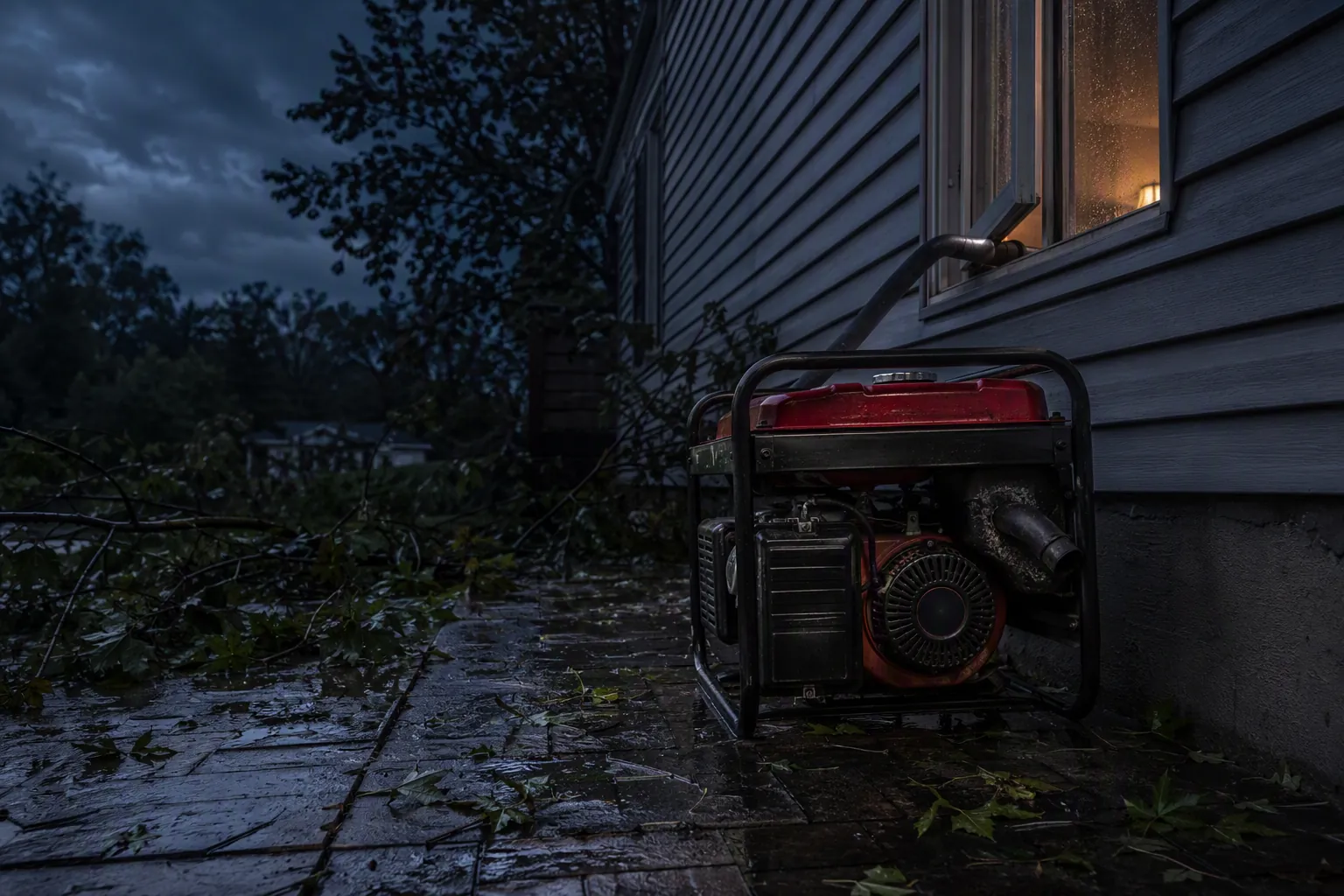
A generator can keep a refrigerator or medical device running, and it can also kill a household quietly. AAGP cites about 500 carbon monoxide deaths and 15,000 emergency room visits each year, with adults age 65 and older especially vulnerable, and warns never to use generators indoors.[5] “Indoors” includes garages, porches, crawl spaces, and any spot where exhaust can drift toward an open window, door, or vent. CDC preparation guidance also includes checking carbon monoxide detector batteries before the storm.[7]
If the older adult cannot safely refuel or move a generator, that is not a small chore left for later. It is a named-helper task. The person assigned to it should know where the generator can run safely, how cords will be routed without creating trip hazards, and what equipment truly needs power first.
Restart medical care before the routine looks normal
After a storm, the question is not only whether the older adult has food and a roof. Ask whether the next dialysis appointment is confirmed, whether oxygen delivery has resumed, whether the insulin stayed in the safe temperature range, whether the wound-care nurse can reach the home, and whether the pharmacy is open or transferring prescriptions. If the answer is uncertain, the support-network list should already say who calls which office.
Mental health belongs in the same recovery check. In a study of older adults living in Hurricane Sandy-affected areas, 14.1% screened positive for depression compared with a 9.8% baseline, 37% found the storm moderately to extremely stressful, and 1 in 10 lost access to medical care. Among adults 75 and older, loss of medical care access was the only storm variable that significantly predicted later depression in that study.[13]
That does not mean every older adult will become depressed after a storm. It means isolation, missed care, and disrupted routines deserve the same follow-up as a leaking roof. A daily call may not be enough if hearing is poor, memory is changing, or the person is minimizing distress. When possible, pair calls with in-person checks by someone who can see the refrigerator, medication supply, bathroom path, and mood.
One plan, reviewed locally, is safer than two name-based plans
A hurricane plan and a typhoon plan do not need to be separate. The safer family document is a tropical-cyclone plan that uses local emergency instructions and keeps the older adult’s real dependencies visible: medication, power, mobility, communication, transportation, evacuation destination, helpers with keys, and post-storm recovery checks.
The name on the forecast tells you the basin. The care plan has to tell you who gets the medication, who charges the battery, who drives before the winds arrive, who unlocks the door, who checks for carbon monoxide and fall hazards, and who keeps calling after the lights come back on.
References
- What is the difference between a hurricane and a typhoon? — NOAA Ocean Service
- Typhoon vs Hurricane — American Red Cross
- Disaster Resilience Tool Kit — AARP
- Older Adults Emergency Preparedness — American Red Cross
- Older Adults and Disaster: Preparedness and Response — American Association for Geriatric Psychiatry
- Older Adults — Ready.gov
- Preparing for Hurricanes or Other Tropical Storms — Centers for Disease Control and Prevention
- Hurricanes — Ready.gov
- Seniors & People with Medical Needs — NOLA Ready
- Living in hurricane-affected areas could increase mortality — Frontiers Science News, 2025-08-06
- Severe weather is deadly for vulnerable older adults long after storm ends, study finds — PreventionWeb / University of Michigan, 2026
- Emergency Preparedness for Seniors — Keystone Health
- Storm Impact and Depression among Older Adults Living in Hurricane Sandy-Affected Areas — Cambridge Core, 2017
Related reading
Noticed something outdated or inaccurate on this page? Flag a correction. We review every report against CDC, NIA, and AARP HomeFit guidance before updating a page.
Part of the Fall Prevention section.