
STEADI: Intervene
Wildfire Safety Checklist for Seniors Living Alone
Step-by-step wildfire preparedness for an older adult who lives alone: what to do before fire season, when a fire is near, and after returning home, including the essentials generic checklists omit — a 30-day medication supply, a named person to help evacuate, and backup power for medical devices.
A wildfire safety checklist for seniors living alone has to answer a harder question than “what should be in the kit?” It has to answer who notices the alert, who unlocks the door, who carries the medications, who moves the walker, who drives, and what keeps a medical device running after the lights go out.
This is planning guidance, not medical or emergency advice. In immediate danger, call 911. Follow local evacuation orders and instructions from fire, law enforcement, public health, and emergency management officials. The point of the plan below is to reduce the number of decisions an older adult has to make alone while smoke, power loss, traffic, and fear are already narrowing the options.
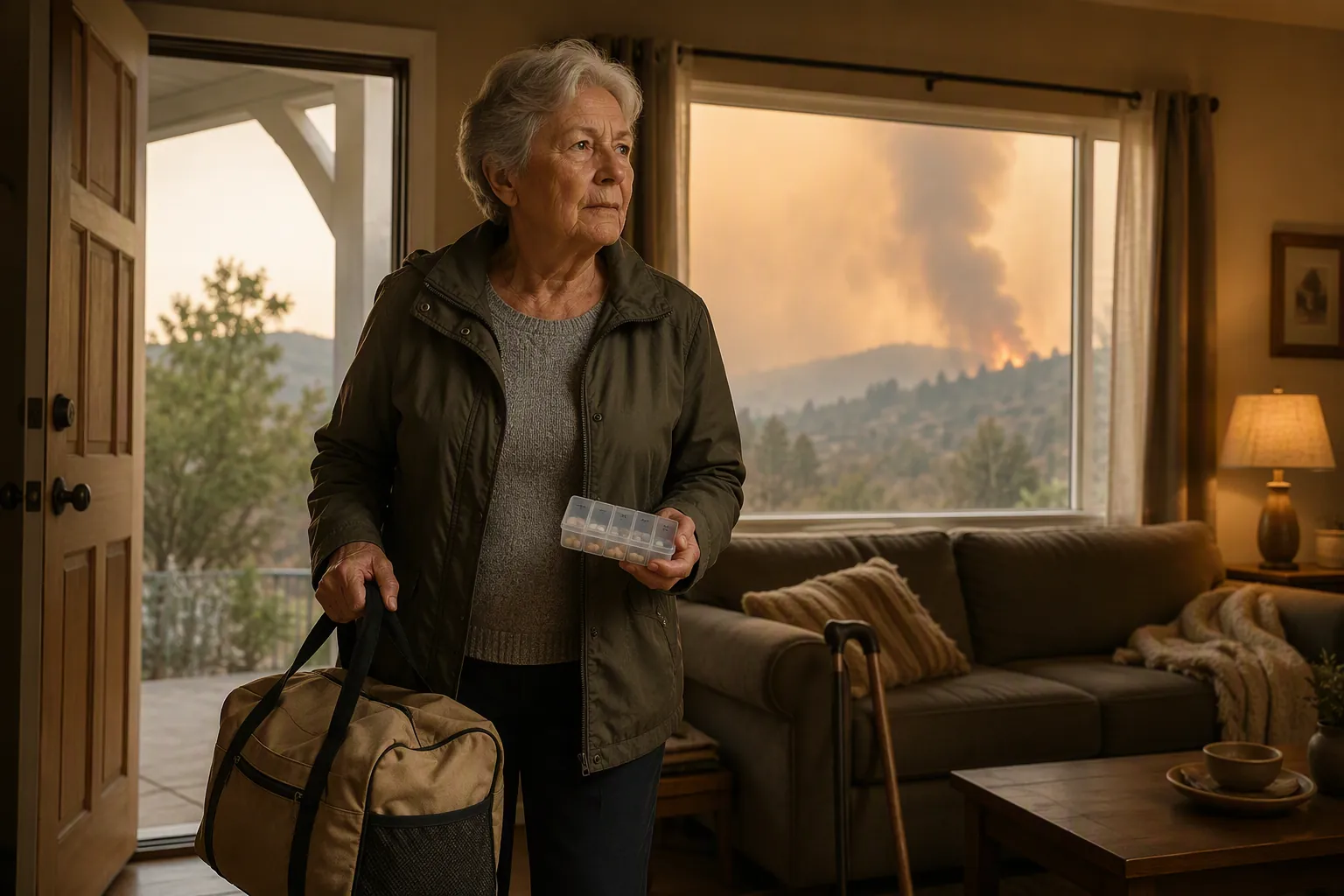
The most important senior-specific items are not exotic. The American Red Cross tells older adults to keep at least 30 days of medications and extra assistive items such as a cane or eyeglasses, and its wildfire guidance calls for a 1-month medication supply in a labeled container, a Go-Kit with 3 days of supplies, a Stay-at-Home Kit with 2 weeks of supplies, and the reminder that “you might not get an official notice to evacuate.” [1][2]
The wildfire plan at a glance
| Phase | What has to be ready | Single-occupant test |
|---|---|---|
| Before fire season | Medication supply, assistive items, documents, go-bag, support network, accessible exit, car plan, backup power | Can one person use this without searching, lifting too much, or calling someone who has no key? |
| When fire is near | Early evacuation trigger, local alerts, helper call, go-bag, medications, devices, route, car, pet or mobility plan | If no one else is home, what action happens before a mandatory order or power outage? |
| After returning | Official re-entry clearance, smoke and ash precautions, food and water check, medication and device check, power safety | Can the person confirm the home is safe before unpacking and resuming routines? |
Ready.gov’s older-adult guidance is unusually practical on the support-network piece: at least one person should have an extra key, know where emergency supplies are kept, and know how to use lifesaving equipment or administer medicine. [3]
There is enough evidence to treat this as more than a paperwork exercise. LA County Aging & Disabilities reported that fewer than one in three adults ages 50 to 80 had an emergency kit, and that in the January 2025 fires, 31 people died, 26 of them over 65 or living with a disability. [4] Separately, a CalMatters analysis of the 2018 Camp Fire found that the average age of those who died was 72. [5] Those are different fires and different findings, but they point toward the same practical concern: older adults need plans that work under pressure, not just lists that look complete on a refrigerator.
Before fire season: make the plan work with one person in the house
Start with the items that cannot be improvised at the curb: medications, glasses, hearing aids, dentures, mobility aids, medical-device instructions, insurance cards, identification, keys, phone charger, and a written contact list. A flashlight is useful. A flashlight stored in a hall closet behind a vacuum is less useful to someone using a walker in the dark.
Ready.gov’s general emergency kit list includes water at 1 gallon per person per day, a battery-powered or hand-crank radio, flashlight, extra batteries, whistle, documents, and cash. [6] For an older adult living alone, those basics should be divided by use: what goes in the car, what stays by the bed, what stays near the exit, and what a helper can find in under a minute.
Medication and assistive items belong in a labeled, reachable system
The 30-day medication supply deserves more attention than the bottled water because it is harder to replace during an evacuation. Keep the medication list printed, current, and stored with the go-bag. Include pharmacy phone numbers, prescribing clinicians, dosage instructions, allergies, and whether any medicine must be refrigerated. If a weekly pill organizer is used, it should not be the only record of what the person takes.
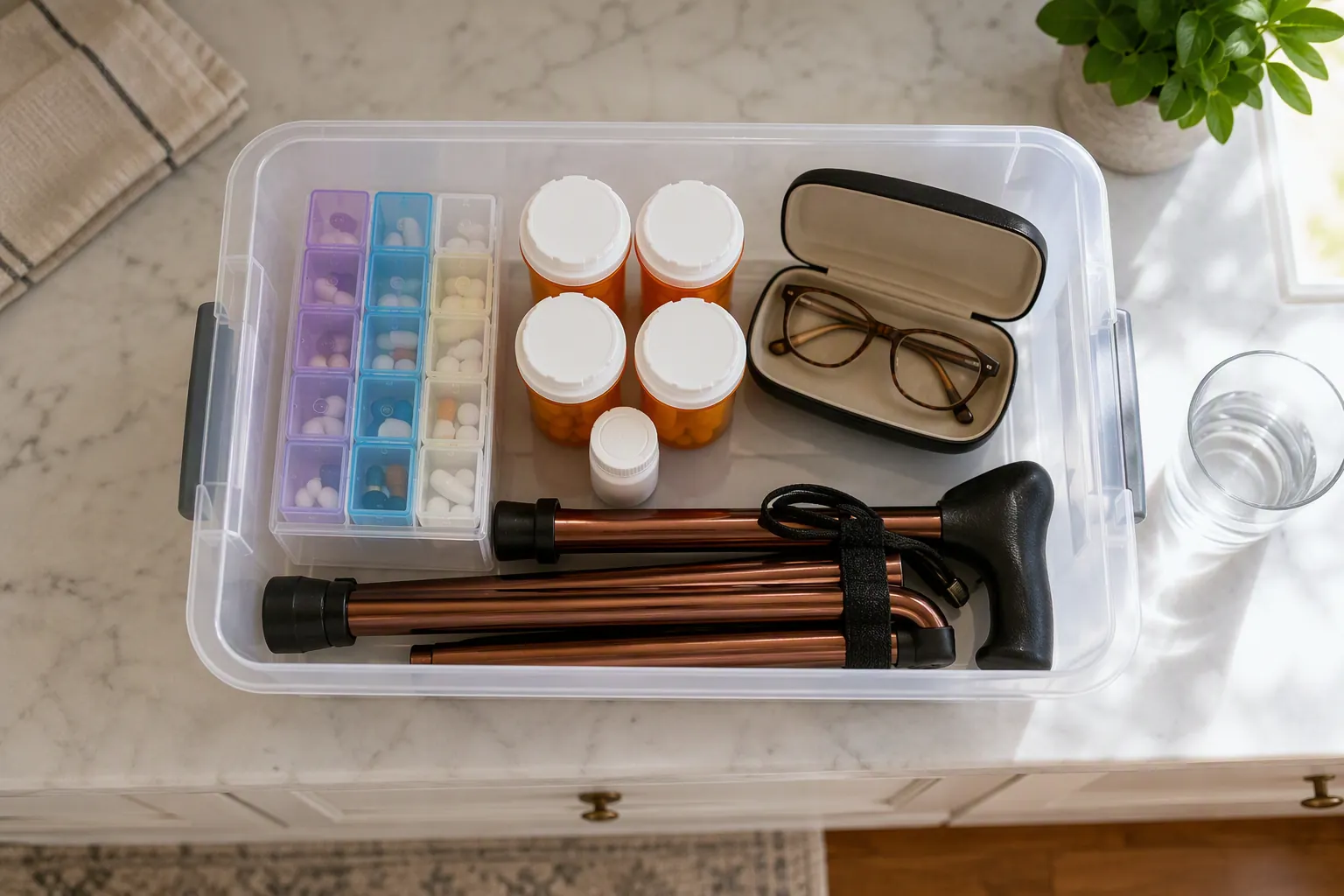
- Keep at least 30 days of necessary medications when possible, and review refill timing before fire season rather than when evacuation warnings begin. [1]
- Add a spare pair of eyeglasses, hearing-aid batteries or charger, denture supplies, cane tips, walker accessories, incontinence supplies, and any small item that would make a shelter or hotel stay unsafe without it.
- Label the medication kit clearly. A helper should not have to open three kitchen drawers to guess what matters.
- Put a copy of the medication list in the go-bag, another near the refrigerator or medical-device area, and a digital copy with the older adult and the named helper.
When the older adult lives alone, the medication plan has to assume that no one else will remember the insulin cooler, the rescue inhaler, the spare glasses, or the cane leaning beside the bed. The kit should be stored where the person can reach it without bending low, climbing, or crossing a smoke-filled room.
Give a real person a real job, a key, and permission to act
The support network should not be a family text thread that says “let us know if you need anything.” Pick a primary helper and a backup. The primary helper needs an extra key or lockbox code, the evacuation address, the location of the go-bag, the medication kit, the medical-device instructions, and the route the older adult normally uses to get out of the house.
For an adult child preparing from a distance, write the plan as if a neighbor, building manager, church member, or paid caregiver may have to follow it. The helper should know whether the older adult can transfer into a car without help, whether a wheelchair fits through the exit, whether pets are part of the evacuation, and whether the garage door can be opened manually.
- Primary helper: name, phone, address, key location, and “come now” trigger.
- Backup helper: same information, with a clear handoff if the primary helper is unreachable.
- Out-of-area contact: one person who can receive updates if local calls are unreliable.
- Medical-device contact: supplier, utility medical-baseline program if applicable, and written instructions.
- Transportation contact: who drives if the older adult cannot, and what happens if that driver is not available.
A broader evacuation template can help with rehearsals and backup roles; use an emergency evacuation plan checklist for elderly parents as the general framework, then add the wildfire-specific triggers, smoke, ash, and power details here.
Living alone changes the timing. A helper who plans to “check later” may arrive after roads are crowded, power is out, or smoke makes a hallway difficult. The plan should state the exact point at which the helper calls, comes over, or arranges transportation.
Check the exit before the fire does
An accessible exit is not a decoration on the plan. Walk the route from bed to bathroom to front door to car. Look for throw rugs, narrow turns, heavy doors, cluttered porches, stairs without rails, gates that stick, and outdoor paths that become difficult in the dark. If the normal exit depends on electricity, such as a garage door opener or powered gate, the manual release has to be known and usable.
CAL FIRE’s evacuation guidance includes practical pre-evacuation steps such as moving flammable items away from windows, preparing the car so it faces out with fuel in the tank, knowing the manual garage-door release, and taking listed actions around utilities and the home when safe and appropriate. [7] For someone living alone, those steps should be simplified before fire season: the car should not be trapped behind boxes, the driveway gate should not require a second person, and the go-bag should not weigh more than the person can manage.
- Keep the main evacuation path clear enough for the actual mobility aid: cane, walker, wheelchair, scooter, or oxygen tubing.
- Store shoes, glasses, phone, charger, keys, and flashlight where they can be reached from the bed.
- Back the car in or park it facing out if that is safe and allowed.
- Keep the gas tank at least half full during high-risk periods if possible.
- Make sure the helper knows how to enter the home and where to park without blocking emergency access.
The single-occupant test is simple: if the older adult fell, lost power, or had smoke at the door, could they still get from the usual chair or bed to a safe pickup point without moving furniture, lifting a heavy bag, or waiting for someone to find the key?
Plan for medical-device power before the first outage
CPAP machines, oxygen concentrators, power wheelchairs, stair lifts, refrigerated medications, nebulizers, and communication devices all create a second evacuation clock. The first clock is the fire. The second is battery life.
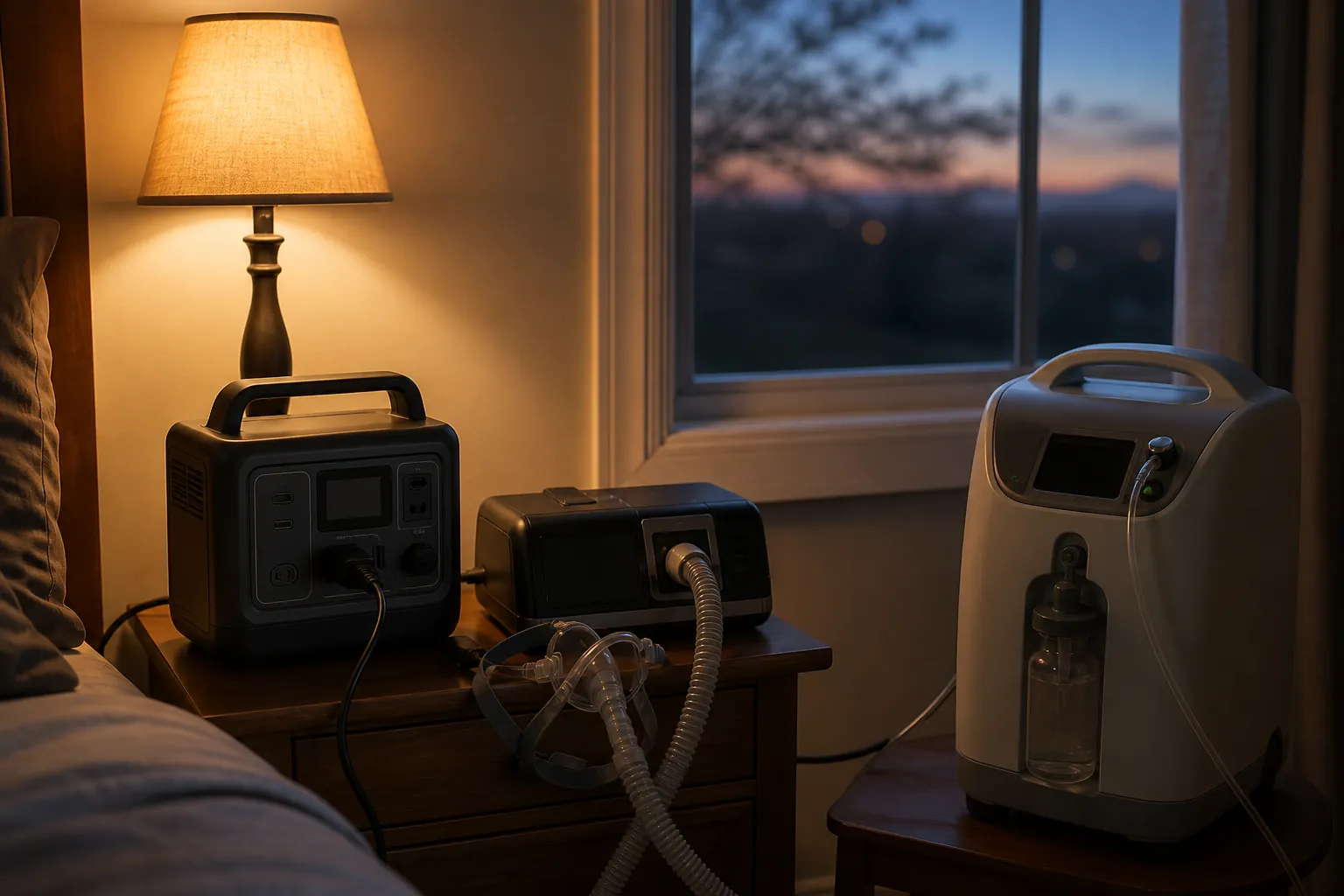
Write down what each device needs: outlet, battery type, charging time, runtime, whether it can be used in a car, and whether the supplier has emergency guidance. Store the instructions with the device and in the go-bag. If a device is essential to life or breathing, the plan should not depend on “we will figure it out if the power goes out.”
For a fuller power-loss worksheet, including refrigerated medications and device battery limits, use what seniors should do while waiting for power restoration. The wildfire version adds one stricter rule: if power loss would make the home medically unsafe, evacuation may need to happen before smoke or flames are close.
Living alone makes backup power a decision point, not a comfort item. No co-occupant is there to notice the concentrator alarm, rotate batteries, carry the device to the car, or explain the equipment to responders.
Prepare for smoke without delaying evacuation
The CDC recommends knowing community evacuation routes, using NIOSH-approved respirators when appropriate, and identifying a clean room with a portable air cleaner for wildfire smoke. [8] That belongs in the plan, but it should not become an excuse to stay too long when evacuation is the safer instruction.
For indoor smoke setup, filtration, AQI alerts, and a clean-air room, use how to protect older parents from poor air quality. In this checklist, the key wildfire question is whether smoke will make the exit, the car, or the medical condition unsafe before an evacuation order arrives.
When fire is near: reduce the time needed to leave
The older adult living alone should not wait for the plan to become dramatic. If a wildfire is close enough that alerts, smoke, power shutoffs, road closures, or evacuation warnings are possible, the work is no longer “prepare.” It is “reduce the number of things that still have to happen.”
CAL FIRE says it is safer to leave before a mandatory evacuation order, and that in severe wildfires there may be no time for door-to-door warnings. [7] Alameda County’s older-adult preparedness guidance similarly tells older adults to consider evacuating during warnings, or any time they feel unsafe, and not to wait to be told to leave. [9]
Set an early trigger in writing
A written trigger prevents the most dangerous conversation from happening too late. It can be plain: “If our zone is under an evacuation warning, if smoke makes breathing difficult, if power is out and the medical device cannot run safely, or if the named helper says roads are getting unsafe, we leave.”
The exact trigger should match the person’s health, mobility, transportation, and local fire conditions. Someone who drives, walks quickly, and has no powered medical equipment may have more margin than someone who needs oxygen, help transferring, or a wheelchair-accessible vehicle. The plan should not pretend those are the same household.
- If there is an evacuation order: leave, following local instructions.
- If there is an evacuation warning and the older adult needs help leaving: call the named helper and begin leaving preparations immediately.
- If smoke, heat, anxiety, confusion, or power loss makes the home feel unsafe: call for help and leave earlier if it is safe to do so.
- If the helper cannot arrive quickly: use the backup plan rather than waiting for the original plan to recover.
Living alone removes the informal safety net. There is no second adult to keep checking the map, load the trunk, talk through panic, or notice that the phone battery is low. The evacuation trigger has to be earlier because the household has fewer hands.
Load what cannot be replaced first
When a fire is near, do not spend the first minutes improving the house if the person is not already ready to leave. The go-bag, medications, assistive devices, phone, charger, keys, wallet, documents, medical equipment, and pets come before sentimental sorting.
| Take first | Why it matters when living alone |
|---|---|
| Medication kit and medication list | A shelter, hotel, or relative may not know what the person takes or where to refill it. |
| Glasses, hearing aids, dentures, cane, walker, wheelchair parts | Evacuation becomes more dangerous if communication, vision, eating, or mobility fails. |
| Phone, charger, backup battery, written contacts | The phone may be the only link to helpers, alerts, transportation, and clinicians. |
| Medical-device instructions and backup power | A helper or shelter staff may need written directions, not a verbal explanation under stress. |
| Identification, insurance, cash, keys, documents | Replacement is harder when the person cannot easily travel, print forms, or prove access. |
If the bag is too heavy, split it. One smaller bag can hold medication, documents, phone power, glasses, and keys. A second bag can hold clothing, hygiene supplies, and comfort items. The first bag is the one that must leave.
The helper’s job is not vague reassurance
When the helper is called, the script should be short enough to use while anxious: “I am under a warning. I have my medication bag. I need help getting to the car. Come now or call the backup.” The helper should already know where to park, which door to use, whether to bring a vehicle with room for a walker or wheelchair, and what to do if the older adult does not answer.
For a person with memory loss, hearing loss, limited English, low vision, or anxiety during emergencies, the plan should include a visible note near the door: destination, helper names, medications, pets, mobility equipment, and emergency contacts. It is not elegant. It is usable.
If the older adult is already in immediate danger, call 911. But the household plan should not assume emergency responders can instantly provide transportation, enter a locked home, identify the medications, and solve a power-dependent medical need. That is why the named support network is part of the safety checklist, not an optional courtesy.
Routes need a backup, and the backup needs to be known
Know the community evacuation routes before fire season, then check official local information when a fire is active. Do not rely on the route that is usually fastest for errands. Wildfire traffic, smoke, road closures, emergency vehicles, and downed power lines can make the familiar route unusable.
The destination should also be written down: a relative, hotel area, shelter, cooling or clean-air site if designated locally, or another agreed safe place. For families that already keep cross-disaster binders, the same waterproof documents folder and written stay-or-go trigger used in a hurricane season plan for elderly parents can carry over, as long as the wildfire plan accounts for smoke, faster movement, and road closures.
For a solo occupant, “I know the way” is not enough. The helper and backup helper need the same destination and the same route assumptions, or everyone may spend the first hour calling instead of moving.
After returning: check the house before settling back in
Return only when local officials say it is safe. Once home, the first task is not unpacking. It is checking whether the house can safely support the older adult’s breathing, mobility, medication, food, water, and medical-device needs.
- Confirm official re-entry permission and follow local instructions about roads, utilities, unsafe structures, and hazards.
- Avoid tracking ash through the house. Wear appropriate protection if cleanup is necessary, and get help for tasks that require climbing, lifting, sweeping large areas, or prolonged smoke exposure.
- Check whether refrigerated medications, oxygen supplies, batteries, and medical devices stayed within safe operating conditions.
- Treat food, water, and medication storage as questionable if power was out, heat was high, or local authorities have issued safety notices.
- If smoke remains indoors, use the clean-air plan and limit exertion until indoor conditions improve.
- Have the named helper or another trusted person do a walk-through before the older adult resumes sleeping there alone.
This is where living alone becomes quiet but serious. A person may be able to unlock the door and feel relieved, yet still be facing spoiled medication, no working phone charger, a tripping hazard left by evacuation, smoke that aggravates breathing, or a device battery that will not last the night.
Use the smoke and power guides for the details they cover more fully: poor-air-quality protection for older parents and power-restoration precautions for seniors. The wildfire return check should stay focused on whether the home is safe enough for one person to manage without guessing.
Build the plan around the older adult’s actual limits. Rehearse the parts that require movement: getting the bag, opening the door, reaching the car, loading the walker, calling the helper, switching to backup power. Follow local evacuation instructions, leave early when the plan calls for it, and use the pre-named support network instead of assuming help will arrive in time to solve every missing step.
References
- Older Adults — American Red Cross
- Wildfire Safety — American Red Cross
- Older Adults — Ready.gov
- Lessons from the January Wildfires: Why Preparedness Matters — LA County Aging & Disabilities
- Older Californians Increased Risk Wildfires — CalMatters
- Build A Kit — Ready.gov
- Go! Evacuation Guide — Ready for Wildfire / CAL FIRE
- Wildfire Safety — CDC
- Older Adults — Alameda County
Related reading
Noticed something outdated or inaccurate on this page? Flag a correction. We review every report against CDC, NIA, and AARP HomeFit guidance before updating a page.
Part of the Fall Prevention section.