
How Humidity in the Boston Forecast Affects Senior Falls
High humidity in the Boston forecast signals more than discomfort — it significantly increases an older adult's risk of falling. This article explains the physiological and environmental pathways through which humidity compounds fall risk and provides actionable steps caregivers can take before and during humid days.
On a Boston summer morning, the useful number in the forecast is not always the high temperature. For an older parent who moves slowly, takes several medications, and says the apartment is “fine,” humidity can be the earlier warning. A forecast that shows humidity above 70% with temperature above 70°F, a dew point above 60°F, or a National Weather Service heat index climbing into local heat-alert territory should change the day before anyone feels sick, thirsty, dizzy, or unsafe on their feet.[1]
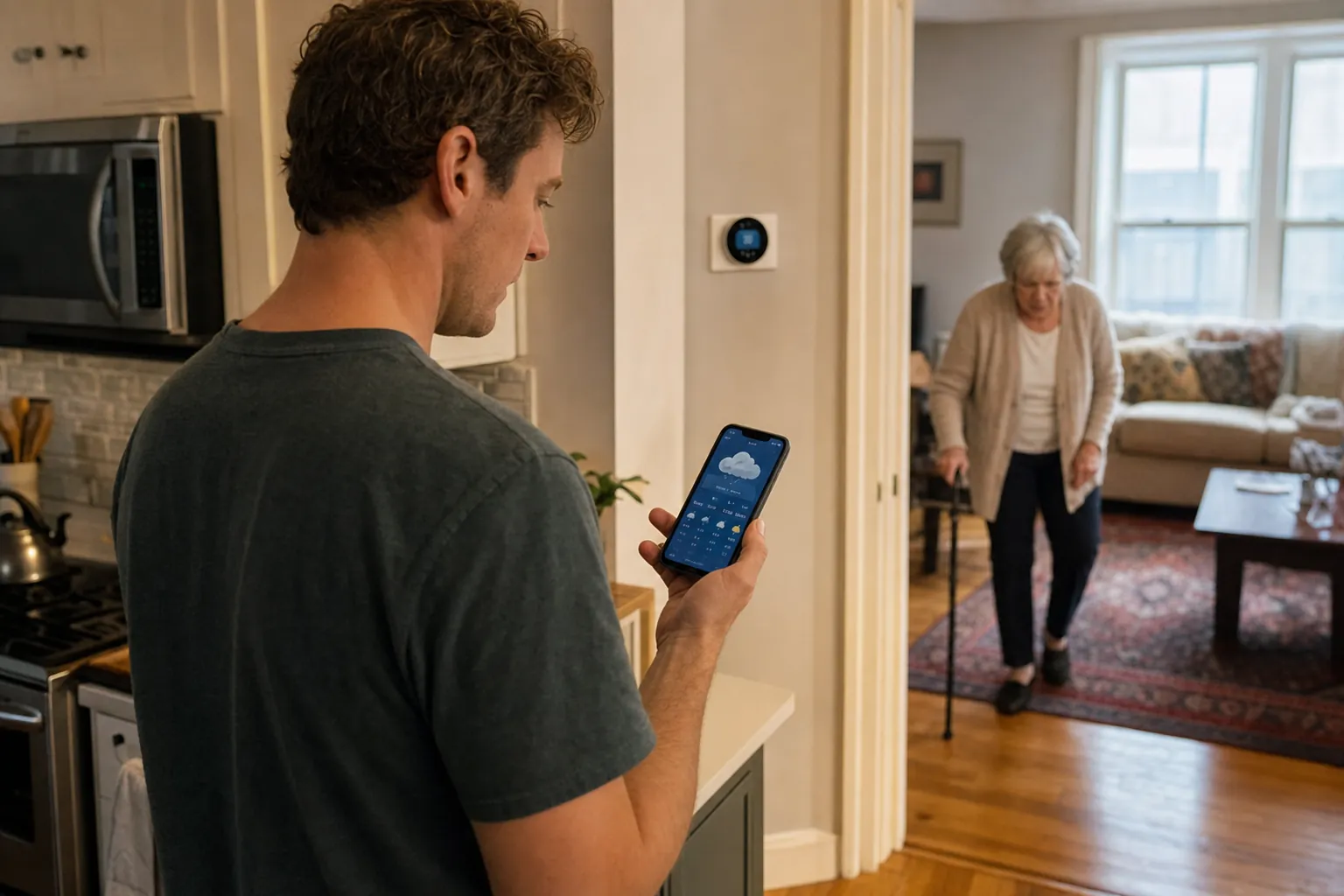
That does not mean humidity by itself has been proven to cause senior falls in Boston. The evidence is more practical than that: humidity makes heat harder to shed, dehydration easier to miss, medication side effects more consequential, joints more difficult for some people, and floors more likely to become slippery. For a caregiver, that is enough to treat a muggy forecast as a fall-prevention prompt.
The Forecast Numbers That Should Change the Day
A plain “humid” label is too vague to act on. The more useful scan is: temperature, relative humidity, dew point, heat index, and any Boston heat advisory or excessive heat warning. The heat index matters because it combines air temperature and humidity into what the body effectively has to manage.
| Forecast signal | Why it matters for an older adult | Caregiver move |
|---|---|---|
| Humidity above 70% and temperature above 70°F | A simple threshold for when heat and moisture start working together instead of separately | Start fluids, cooling, and activity changes early |
| Dew point above 60°F | Air feels more humid, and sweat evaporation becomes less effective | Check whether the apartment actually feels cooler, not just what the thermostat says |
| Heat index rising | The body experiences a higher heat burden than the air temperature alone suggests | Reduce errands, showers, laundry, and other exertion-heavy tasks |
| Local heat advisory or excessive heat warning | The risk is no longer just personal comfort; local agencies may open cooling options | Consider cooling centers, library branches, BCYF locations, or transportation help if staying home is not safe |
The threshold is not a diagnosis. It is a household trigger. If the forecast crosses it, the question becomes concrete: where is the water, how warm is the apartment by late afternoon, who is checking dizziness, what shoes are being worn, and are the bathroom and kitchen floors dry?
Why Humidity Makes Dehydration Easier to Miss
The main fall pathway on a humid day is not dramatic heat collapse. It is quieter: the body fails to cool efficiently, fluid levels drift down, blood pressure regulation gets shakier, and standing up from a chair or toilet becomes more hazardous.
Older adults already have less efficient heat regulation. AARP, citing Boston University research, reported in 2026 that aging can reduce thermoregulatory sweating by up to 25%.[2] Humidity then interferes with the sweat that is still produced because sweat cools the body best when it evaporates. When the air is already heavy with moisture, evaporation slows. The person may look merely sticky or tired while the body is working harder than the room suggests.
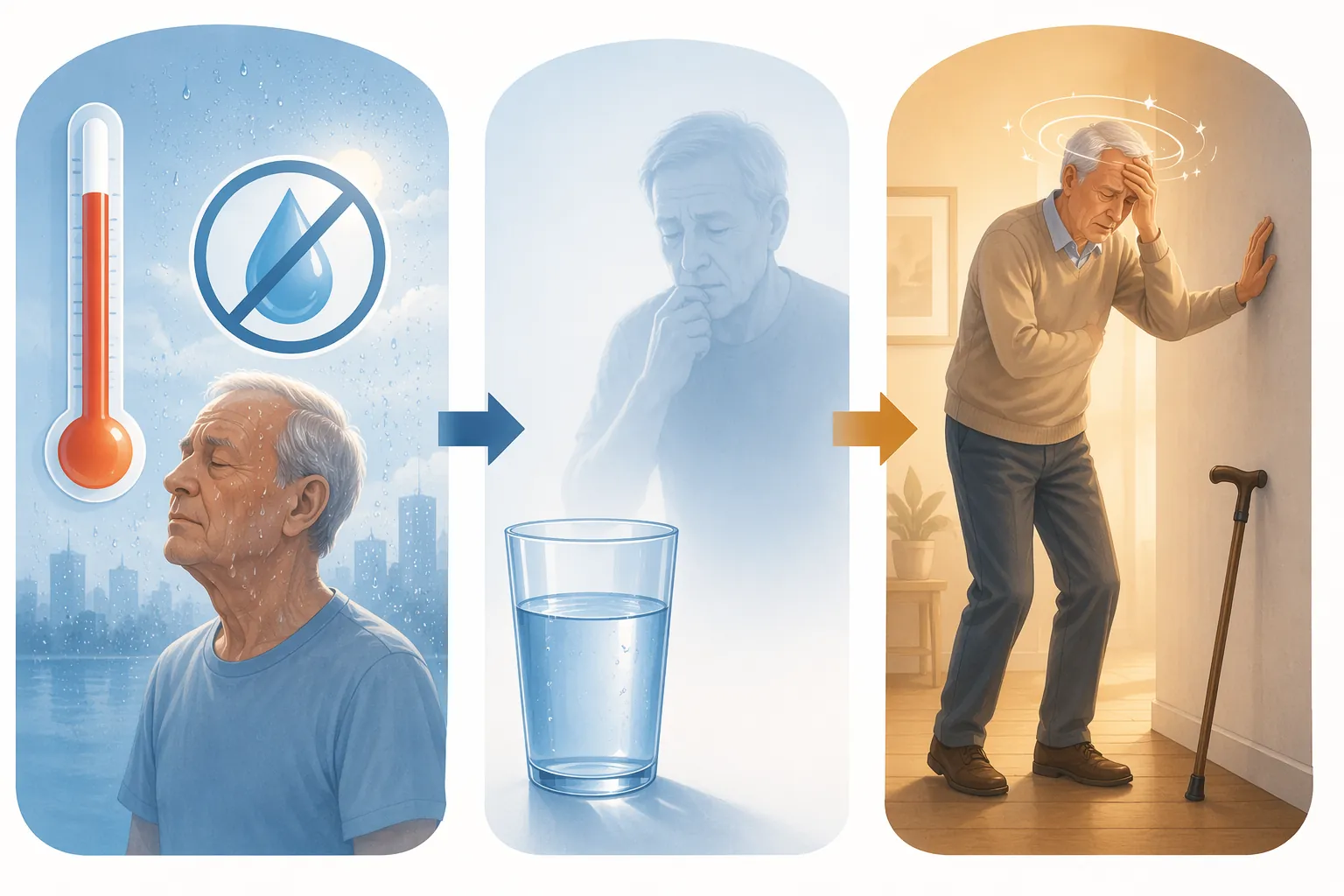
The next problem is thirst. Harvard Medicine has explained that older adults may lose thirst sensitivity, meaning they may not feel thirsty even when their bodies need fluid.[3] That is where “stay hydrated” becomes a weak instruction. It assumes the person will notice the need, want to drink, remember to drink, and tolerate the extra bathroom trips. Many families know exactly how often that chain breaks.
The fall connection is not just theoretical. In a Mayo Clinic study by Hamrick and colleagues, 37.9% of a cohort of 30,634 older adults were dehydrated, and dehydration was associated with 13% higher odds of falling.[4] That finding is useful because it links an ordinary, often invisible condition to the outcome families are trying to prevent.
Dehydration can also feed into orthostatic hypotension, the blood-pressure drop that can happen when someone stands. On a muggy Boston day, the risky moment may be a parent getting up from a recliner after dinner, stepping out of a warm shower, or standing after using the toilet. If they pause, grab the wall, look confused, or say they feel “a little off,” that is not a weather complaint to brush aside.
Medication can make this cascade more serious. In the Hamrick cohort, 33% used anticholinergics and 17.6% used loop diuretics, two categories that can worsen dehydration or heat sensitivity.[4] Beta blockers are also commonly flagged in heat-safety discussions because they can affect cardiovascular response to heat. The point is not to stop or adjust medication at home. It is to know which medicines deserve a clinician’s review when humid days bring dizziness, weakness, confusion, or repeated near falls.
Heat, Humidity, and the Kind of Fall That Injures
The strongest fall data are about heat, not humidity alone. That distinction matters. No single study cited here isolates humidity’s independent effect on falls apart from temperature. What humidity does is increase the body’s effective heat burden, which is why heat index is more useful than the thermometer alone.
In a Sensors study by Vongsachang and colleagues, researchers followed 240 participants and recorded 406 falls over three years. Every 10°C increase in daily temperature corresponded to 24% higher odds that a fall would be injurious rather than non-injurious.[5] That does not tell a Boston family that a humid Tuesday will cause a fall. It does say that hotter conditions are associated with worse fall outcomes, which makes prevention before the day peaks more rational than waiting to see how a parent feels.
A 2025 Nature Climate study of 860,724 fall-related deaths found that high temperatures raised fall mortality risk by 1.48% per 1°C above the minimum mortality temperature, with the oldest-old most vulnerable.[6] The population context was China, so the dose-response should not be casually transferred to Boston. Its value here is narrower: it supports the seriousness of heat exposure around falls, while the more directly usable household guidance still comes from heat-index physiology, dehydration evidence, medication vulnerability, and the forecast in front of you.
The Arthritis and Stiffness Piece Is Real, but It Is Not the Whole Story
Humidity also matters because some older adults with arthritis or chronic joint pain move differently when the air is damp and heavy. The evidence supports a more limited claim: arthritis patients are 2.5 times more likely to fall. It does not prove that humidity causes each painful step, but it does make a humid day a reasonable time to watch gait more closely.
The practical signs are familiar: shorter steps, slower turns, holding furniture, avoiding stairs, skipping the cane because it is in another room, or wearing loose slippers because shoes feel like too much effort. On humid days, footwear and walking surfaces deserve more attention than usual, especially before a parent moves from a cool room into a warmer hallway, bathroom, porch, lobby, or parking area.
Condensation Turns Ordinary Rooms Into Slip Zones
The environmental part is less medical and easier to miss. Humidity can leave tile, bathroom floors, entryways, and poorly ventilated rooms slightly wet. That is enough. A glossy bathroom floor does not need a puddle to become a problem for someone with slow reaction time, numb feet, bifocals, a cane, or blood pressure that drops when they stand.
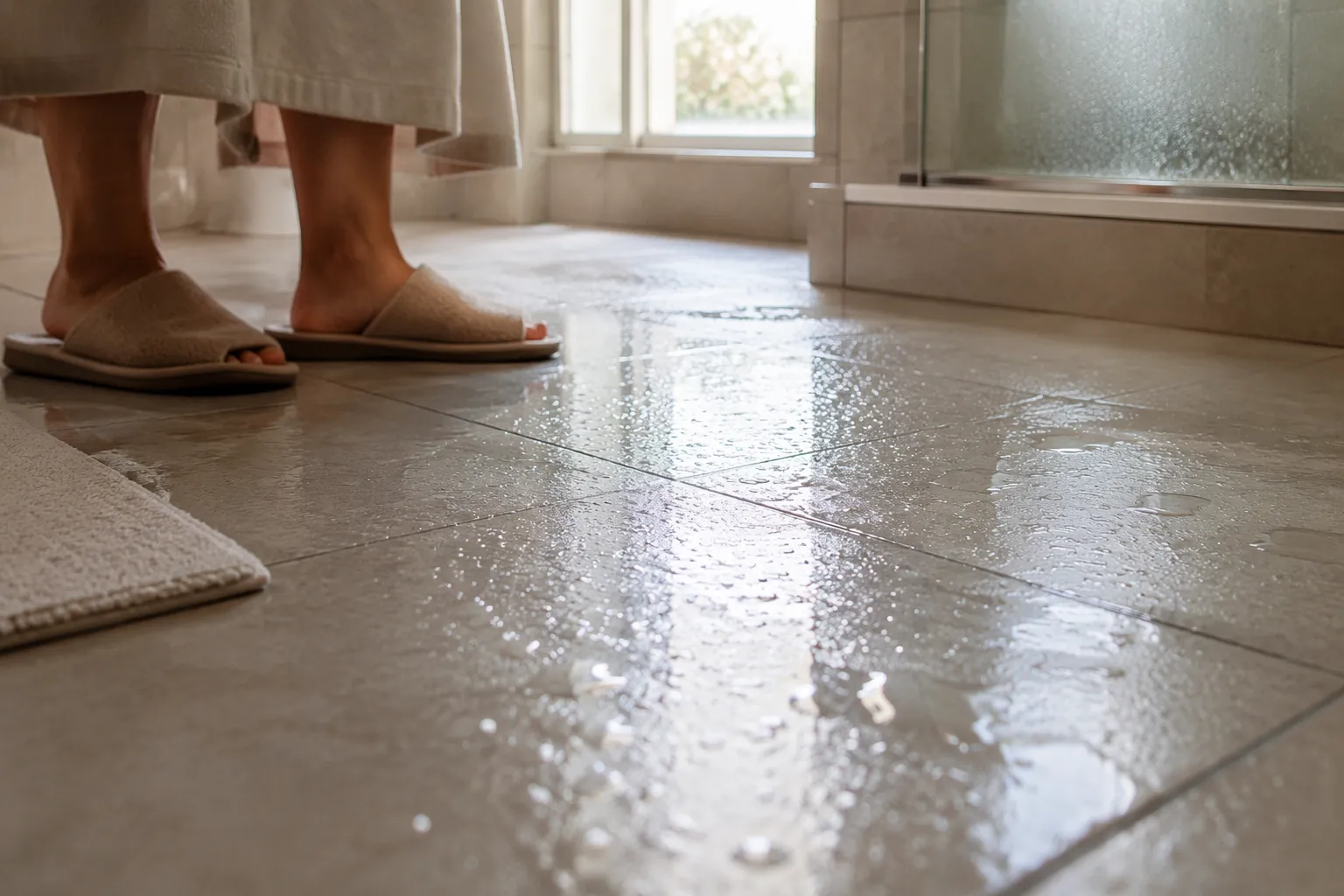
The places to check first are the bathroom, the kitchen sink area, the path from bed to bathroom, the apartment entry, and any spot where an air conditioner cools one surface while humid air enters from another. A bath mat that curls, a towel tossed near the tub, or slippers with worn soles can turn a manageable weather day into a fall-risk day.
A Boston High-Humidity Day Routine
Boston weather can move from tolerable to oppressive quickly, especially when the heat index climbs. During a July 2026 heat event, Boston.com reported an excessive heat warning with heat index values pushed to 112°F and described local warning tiers and cooling-center information.[7] Those are the days when a family plan should already be in motion by late morning, not negotiated at 5 p.m.
- Before work or the first call: check temperature, humidity, dew point, heat index, and any local alert instead of relying on the high temperature alone.
- Before thirst: place water within reach, pair fluids with routine moments, and watch whether the glass is actually being used.
- Before exertion: move laundry, grocery trips, showers, walks, and trash runs away from the hottest part of the day when possible.
- Before standing: remind the parent to sit at the edge of the bed or chair, stand slowly, and pause before walking.
- Before assuming stubbornness: treat dizziness, unusual fatigue, confusion, nausea, or repeated near falls as reasons to contact a clinician.
Cooling is not always as simple as “turn on the AC.” Some older adults avoid using it because of cost, noise, habit, or the belief that a room feels good enough. Others have one cooled room and a much warmer bathroom or hallway. The useful check is not whether the apartment has a cooling device; it is whether the rooms used for walking, toileting, bathing, cooking, and sleeping are safe during the hours the heat index is highest.
Boston.gov directs residents to cooling centers, Boston Centers for Youth & Families locations, Boston Public Library branches, and Age Strong shuttle support when appropriate during heat emergencies.[8] That resource matters, but it should be used realistically. Some parents will not agree to leave home quickly. Some caregivers cannot appear in the middle of a workday. If relocation is unlikely, the backup plan has to be smaller and earlier: cooling one room well, reducing walking, checking floors, arranging a neighbor call, or getting someone eyes-on before evening.
Medication Questions Belong With Clinicians
High-humidity days are a good reason to know whether a parent takes a diuretic, anticholinergic, beta blocker, sedating medication, or any drug that has previously been linked with dizziness. They are not a reason to improvise medication changes. A clinician or pharmacist can explain whether timing, hydration guidance, blood-pressure monitoring, or a medication review is appropriate.
One warning from local senior-care guidance is especially easy to recognize at home: heat-related symptoms can be mistaken for ordinary aging, tiredness, or irritability.[9] On a humid day, “she’s just wiped out” deserves a second look if it comes with unsteadiness, new confusion, poor intake, or a near fall.
The Threshold Mindset
The point of checking humidity in the Boston forecast is not to become a weather expert. It is to make one day safer. When humidity is above 70% with temperature above 70°F, when the dew point is above 60°F, or when the heat index or local alert rises, act before the parent reports thirst, dizziness, stiffness, overheating, or a slippery floor.
- Put fluids within reach and prompt them before thirst appears.
- Cool the rooms where walking and toileting actually happen.
- Reduce exertion and slow position changes.
- Check bathrooms, entryways, kitchens, and tile for condensation.
- Watch for dizziness, confusion, weakness, or near falls, and bring repeated symptoms to a clinician.
- Use Boston cooling resources early if the apartment cannot stay safely cool.
References
- Bethesda Health 70°F/70% humidity threshold, Bethesda Health
- AARP/Boston University thermoregulatory sweating report, AARP, 2026
- Harvard Medicine physiological mechanisms and thirst sensitivity discussion, Harvard Medicine, 2021
- Hamrick et al. dehydration and fall odds study, Mayo Clinic, 2020
- Temperature and injurious falls study, Sensors, 2021
- Nature Climate fall-related mortality and high temperature study, Nature Climate, 2025
- Boston excessive heat warning and cooling center report, Boston.com, July 2026
- Emergency Management heat and cooling resources, Boston.gov
- Senior heat symptom misattribution guidance, Always Best Care Boston
Related reading
Noticed something outdated or inaccurate on this page? Flag a correction. We review every report against CDC, NIA, and AARP HomeFit guidance before updating a page.
Part of the Fall Prevention section.