
Fall Prevention for Older Adults: The Four Pillars of an Evidence-Based Home Safety Plan
Falls in older adults are rarely caused by a single issue. This article explains the four evidence-based domains—medical review, targeted exercise, home modification, and assistive devices—that together significantly reduce fall risk, and provides a coordinated action plan for family caregivers.
A bathroom grab bar can be a very good purchase. It can also give a family the false relief of feeling finished.
That is the hard part about fall prevention in older adults: the thing you can see is rarely the whole problem. A parent may need support getting out of the shower, but the same parent may also be taking several medications, walking less because their legs have weakened, missing parts of conversations because of hearing loss, using a cane that was never fitted, and crossing a dark hallway at night because the light switch is in the wrong place. Each issue may look small when handled alone. Together, they change the odds.
That is why a single fix usually disappoints. StatPearls summarizes fall risk as multifactorial and reports a steep rise as risk factors accumulate: one-year fall risk increases from 8% with no risk factors to 78% with four or more risk factors.[1] The practical lesson is not that families must make the house perfect. It is that prevention has to reach across the places where risk is actually building.
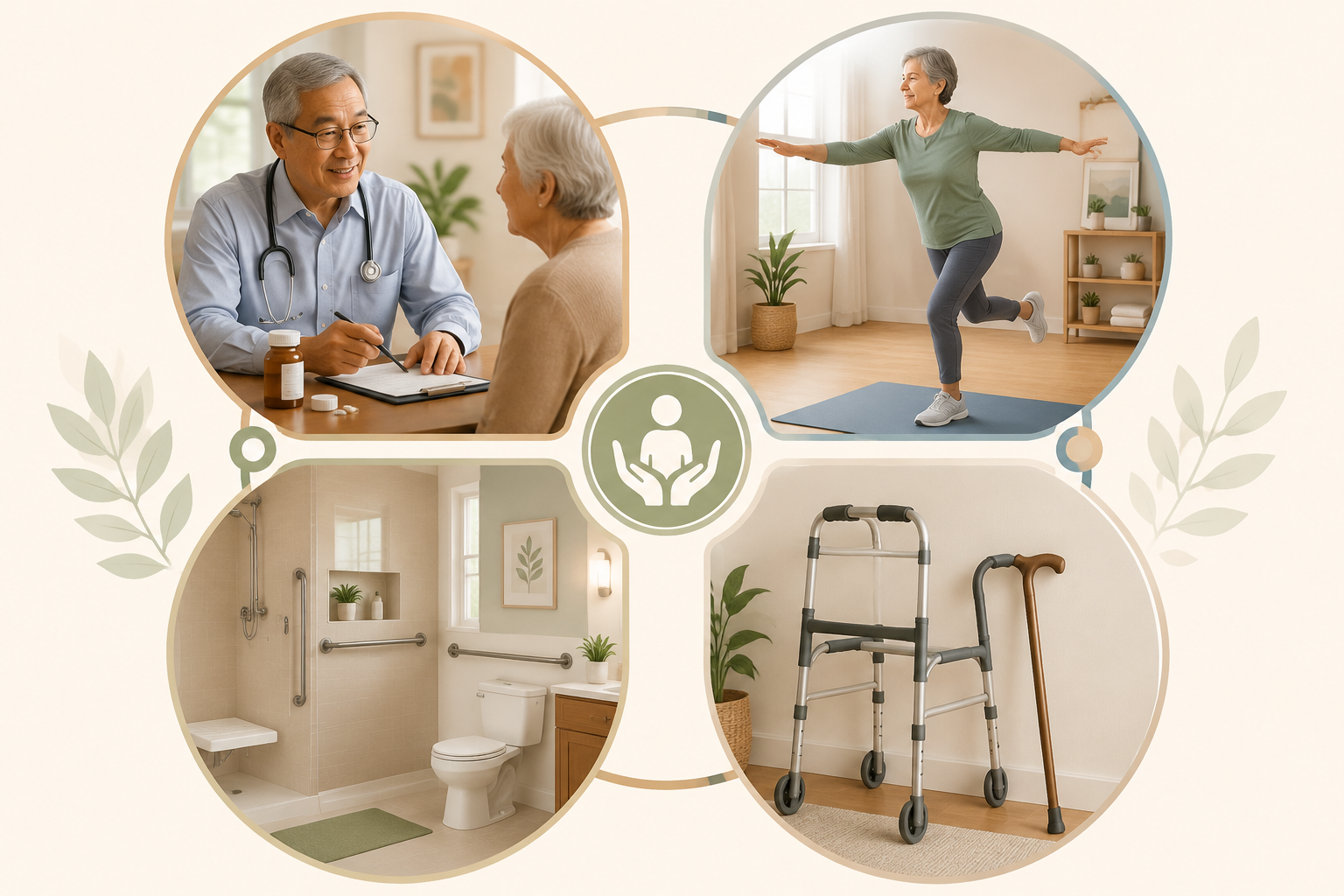
For most families, the plan belongs in four domains: medical review, targeted exercise, home modification, and appropriate assistive devices. They do not have to be completed in one frantic weekend. But they do need to be seen together, because a safer bathroom does not correct dizziness from medication, and stronger legs do not remove a loose rug at the bedroom door.
Start With the Risks You Cannot See
The least visible part of a fall prevention plan is often the most delayed: a medical review. Families tend to notice the stair rail before they notice the medication list. That is understandable. A missing handrail looks like a problem. A prescription bottle looks like treatment.
But some treatments can change balance, alertness, blood pressure, reaction time, sleepiness, or the ability to recover from a stumble. Mayo Clinic specifically flags medicines that increase fall risk in older adults and recommends that adults 65 and older have their medicines reviewed at least once a year.[2] That review is not a family member sitting at the kitchen table deciding what to stop. It is a reason to gather the actual medication list, including over-the-counter products, and ask the primary care clinician, pharmacist, or relevant specialist to look at fall risk as part of the review.
Medication burden matters because the question is not only whether one drug is risky. It is how several drugs behave in the same body. Polypharmacy is commonly defined as taking four or more medications, and one BMJ Open study found it was associated with a 21% increase in fall rate. That kind of number should not lead a caregiver to panic about every prescription. It should make the medication list part of fall prevention instead of treating it as a separate medical chore.
Benzodiazepines deserve particular attention because they can affect sedation and coordination. Mayo Clinic reports that benzodiazepines increase hip fracture risk by 44%.[2] A caregiver does not need to know the replacement plan before making the call. The useful action is simpler: ask whether any current medicines, especially sleep, anxiety, pain, blood pressure, or sedating medicines, could be increasing fall risk and whether safer adjustments are appropriate.
Vision and hearing belong in the same conversation. Poor vision is an obvious fall risk because it changes how a person reads steps, curbs, rugs, and bathtub edges. Hearing is easier to miss, but it affects environmental awareness, divided attention, and how quickly someone responds to what is happening around them. StatPearls reports that hearing loss triples fall risk and that hearing aids reduce that risk by 50%.[1] That does not mean hearing aids are a fall prevention cure. It means untreated sensory loss should not be left outside the plan.
A useful medical review asks about dizziness, faintness, blood pressure changes, sleepiness, neuropathy, foot pain, vision, hearing, osteoporosis risk, and recent changes in walking or confidence. If there has already been a fall, the review should also cover what happened immediately before it: standing up, turning, rushing to the bathroom, missing a step, getting out of bed, or reaching for furniture instead of using a device.
Exercise Has to Be More Specific Than “Be More Active”
General activity is good for many reasons, but fall prevention asks for something more targeted. The parent who walks to the mailbox every day may still struggle with turning, stepping sideways, rising from a chair, recovering from a trip, or standing long enough to shower. Those are strength, balance, gait, and transfer problems. Telling someone to “move more” does not name the skill that needs rebuilding.
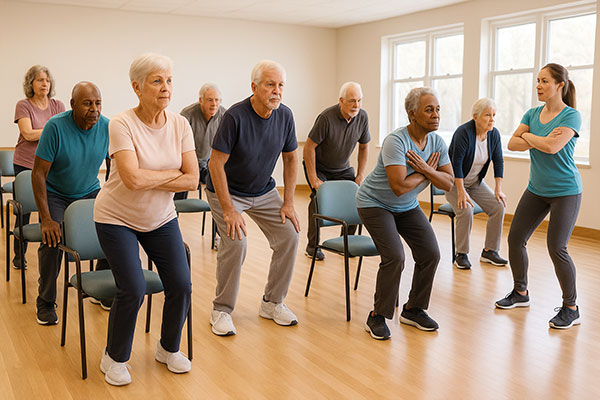
The evidence supports exercise, but it is worth keeping the numbers honest. In June 2024, the U.S. Preventive Services Task Force gave a Grade B recommendation for exercise interventions to prevent falls in community-dwelling adults 65 or older who are at increased risk. In its pooled analysis of 29 trials, exercise interventions alone were associated with about a 15% reduction in fall rate, with an incidence rate ratio of 0.85.[3] That applies to community-dwelling older adults at increased risk, not to every setting and not to every possible exercise class.
That 15% figure is broad evidence. Specific programs may show larger effects in specific groups. The National Council on Aging describes the Otago Exercise Program as reducing falls by 35% to 40% in frail older adults when delivered by a physical therapist.[4] That number is useful precisely because it is not a generic claim that any exercise will do the same. It points families toward the right question: what program matches this parent’s risk level, mobility, and ability to participate safely?
A physical therapist can evaluate gait, leg strength, balance reactions, transfers, and device use. Evidence-based programs may include balance practice, progressive strength work, walking and gait training, chair rises, stepping drills, and exercises that are advanced gradually instead of performed once and forgotten. Some community programs, including Tai Chi and SAIL, are also included in fall prevention resources, but the fit depends on the person’s current stability, cognition, transportation, confidence, and medical limitations.[5]
The family job is not to become the trainer. It is to ask for the referral, make attendance realistic, remove obstacles, and watch for the quiet drop-off that happens when a proud parent says the class is “probably not necessary.” Resistance is common when prevention feels like an announcement that someone is getting old. The better framing is often practical: this is training for stairs, showers, curbs, nighttime bathroom trips, and getting up from low chairs without grabbing unstable furniture.
Walk the Home by Task, Not by Room Alone
Home modification still matters. StatPearls reports that home hazards such as poor lighting, loose rugs, and missing grab bars account for 30% to 50% of falls.[1] But the best home walkthrough is not a decorator’s tour. It follows the movements that create trouble: getting out of bed, reaching the bathroom at night, stepping into the shower, using the toilet, carrying laundry, answering the door, going down stairs, and moving through the kitchen with full hands.
The National Institute on Aging’s room-by-room fall prevention guidance puts the usual suspects in the right order: bathrooms need grab bars, non-slip surfaces, and safer toilet transfers; stairways need adequate lighting and handrails; bedrooms need night lights and clear pathways.[6] CDC STEADI also gives caregivers and clinicians structured home assessment tools rather than asking families to rely on memory during a rushed visit.[5]
| Where to Look | What to Check First |
|---|---|
| Bathroom | Grab bars, non-slip bathing surfaces, shower chair fit, raised toilet seat need, clutter around the toilet and tub |
| Stairs | Handrails, lighting, contrast at step edges, loose carpet, items left on steps |
| Bedroom | Path from bed to bathroom, night lighting, bed height, rugs, reachable glasses, phone, and lamp |
| Hallways and pathways | Loose rugs, cords, narrow furniture spacing, uneven thresholds, dark corners |
| Transfer points | Chairs, toilet, bed, shower, car entry area, and any place the person pushes, pulls, or twists to stand |
Bathrooms are often the first place families spend money, and that is reasonable. Wet surfaces, turning, stepping over tub walls, and getting on and off the toilet combine several risks at once. For installation details and pricing decisions, a dedicated Grab Bars Installation Guide is the right place to go deeper. The prevention question here is more basic: can the person enter, bathe, use the toilet, and leave without reaching for towel bars, sliding doors, or the sink for balance?
The same thinking applies to a quick family walkthrough. A 30-Minute Family Safety Walkthrough can help divide the job so one person watches lighting, another watches trip hazards, and another watches transfers. The point is not to create a renovation list so long that nobody starts. It is to remove the hazards that repeatedly appear in the parent’s real routines.
Devices Help Only When They Fit the Person
Assistive devices are where families can spend quickly and still miss the problem. A cane bought after a scare may be too tall, too short, used on the wrong side, or left by the door because it makes the parent feel conspicuous. A walker may be safer than furniture-walking, but only if it fits the home layout and the person is trained to use it. A shower chair may reduce risk, but not if the person refuses it or if the bathroom setup makes transfers awkward.
CDC STEADI and Mayo Clinic fall prevention guidance both include practical measures such as proper footwear, assistive devices, bathroom safety equipment, and home safety changes.[5][7] The important judgment is matching. A cane, walker, raised toilet seat, shower chair, footwear change, or medical alert system should answer a real problem observed in the person’s movement, balance, habits, and willingness to use the tool.
A physical therapist or clinician can help fit and train cane or walker use. That matters because the device changes the mechanics of walking. Families can then watch the daily reality: whether the device is where the person needs it, whether pathways are wide enough, whether the parent abandons it for short trips, and whether it creates new hazards at thresholds, stairs, rugs, or bathroom doors.
Medical alert systems and fall detection devices belong in this domain too, but they are not prevention in the same way as strength training or removing hazards. They help with response if a fall happens, especially for someone who lives alone or spends long stretches without another adult nearby. They should be considered after asking a blunt question: if my parent fell in the bathroom, basement, yard, or bedroom, how long might they wait before help knew?
A Caregiver Sequence That Does Not Require Doing Everything at Once
The coordinated approach used in CDC STEADI is built around screening, assessing, and intervening across domains.[5] Families can borrow that logic without turning the house into a clinic. The work becomes easier when it is sequenced instead of carried around as one vague command to “make things safer.”
- Schedule a medical review. Bring the current medication list, recent symptoms, vision or hearing concerns, and any details from prior falls or near-misses.
- Ask about physical therapy or an evidence-based fall prevention program. The goal is targeted balance, strength, gait, and transfer work, not just general encouragement to be active.
- Do a room-by-room and task-by-task home walkthrough. Start with bathrooms, stairs, bedrooms, lighting, pathways, rugs, cords, and transfer points.
- Reassess devices and monitoring. Check footwear, cane or walker fit, bathroom equipment, toilet height, shower seating, and whether a medical alert system is appropriate.
Some families can move through that list in a week. Many cannot. If there is only capacity for one call today, make the medical review or physical therapy referral call first, because those often have waiting time. If there is one free evening, walk the path from bed to bathroom and fix lighting, rugs, cords, and anything used for balance that was never meant to hold body weight.
Vitamin D often comes up in fall prevention conversations, but it should not distract from the main plan. The USPSTF treats vitamin D supplementation as a separate review topic, and the evidence for fall prevention is contested.[3] A clinician can advise based on bone health, deficiency risk, diet, lab results, and other medical factors. It does not replace medication review, exercise, home safety, or properly matched devices.
If a fall has already happened, prevention still matters, but the first hours and days have their own decisions: injury checks, when to seek urgent care, what to report, and how to activate services. A First 24 Hours After Your Elderly Parent Falls guide or Your Parent’s First Fall: A 72-Hour Prevention Plan is better suited for that immediate response. This article is about the longer plan that should still be there after the crisis energy fades.
Good fall prevention is maintained, not purchased. It is the medication list reviewed again when prescriptions change, the exercise plan adjusted when walking changes, the hallway light replaced before winter evenings get dark, the cane refitted when posture shifts, and the family willing to revisit the plan without acting as if every review is a loss of independence. The goal is not perfect safety. The goal is fewer stacked risks, handled before they become the reason everyone says they should have done more.
References
- Falls and Fall Prevention in Older Adults, NCBI Bookshelf,
- Medicines that increase fall risk in older adults, Mayo Clinic,
- Falls Prevention in Community-Dwelling Older Adults: Interventions, U.S. Preventive Services Task Force,
- Evidence-Based Falls Prevention Programs, National Council on Aging,
- STEADI - Older Adult Fall Prevention, Centers for Disease Control and Prevention,
- Preventing Falls at Home: Room by Room, National Institute on Aging,
- Fall prevention: Simple tips to prevent falls, Mayo Clinic,
Related reading
Noticed something outdated or inaccurate on this page? Flag a correction. We review every report against CDC, NIA, and AARP HomeFit guidance before updating a page.
Part of the Fall Prevention section.