
Three Ways Heat Waves Increase Fall Risk in Seniors
Extreme heat creates three hidden pathways that raise fall risk in older adults — through dehydration, medication interactions, and blood pressure instability. This guide helps caregivers recognize warning signs and take targeted action during heat waves.
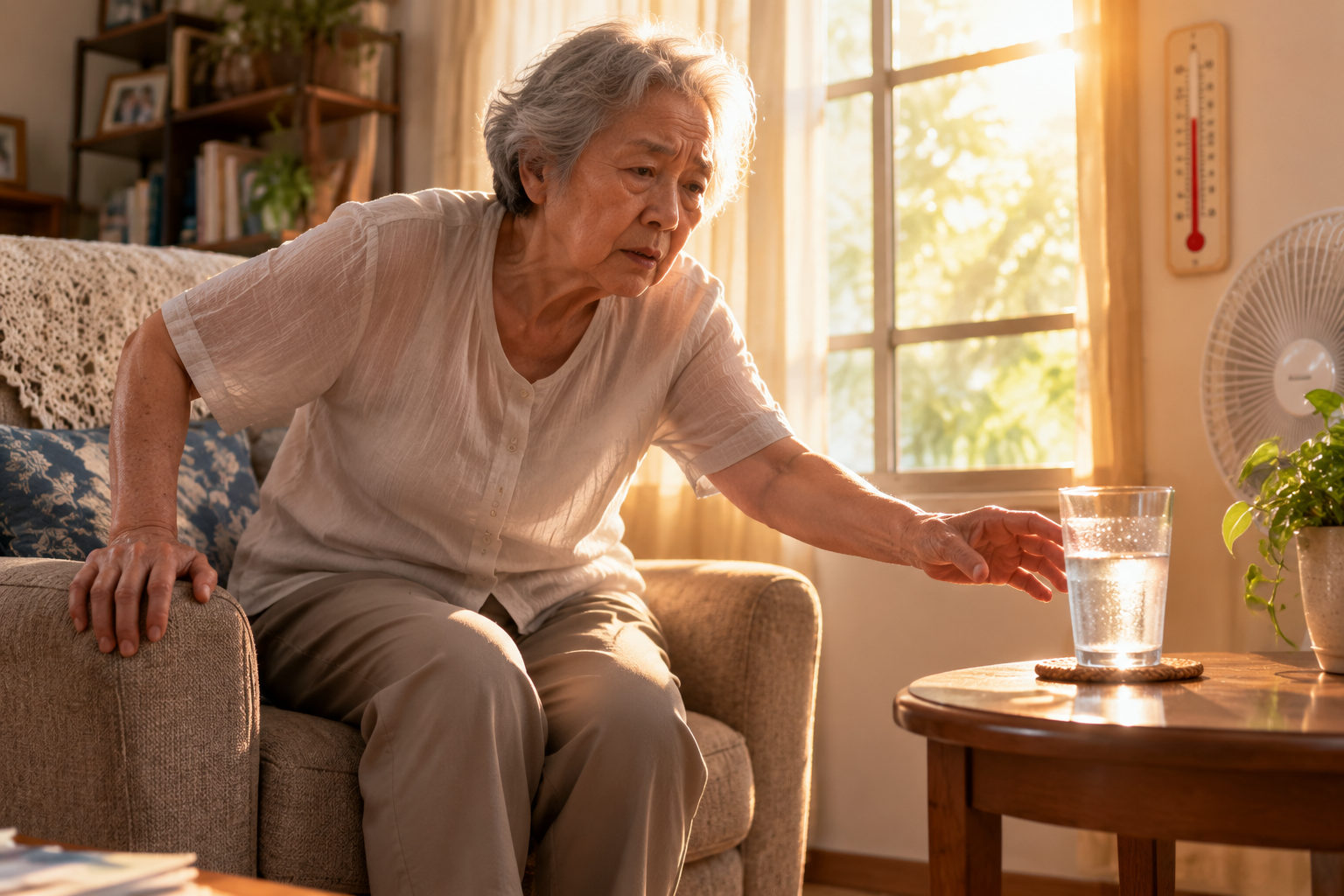
A heat wave can make an already-unsteady parent more likely to fall even if they never step outside. The dangerous moment may be ordinary: standing up from a recliner, walking down a warm hallway, getting to the bathroom after lunch, or insisting they feel fine because they are not thirsty.
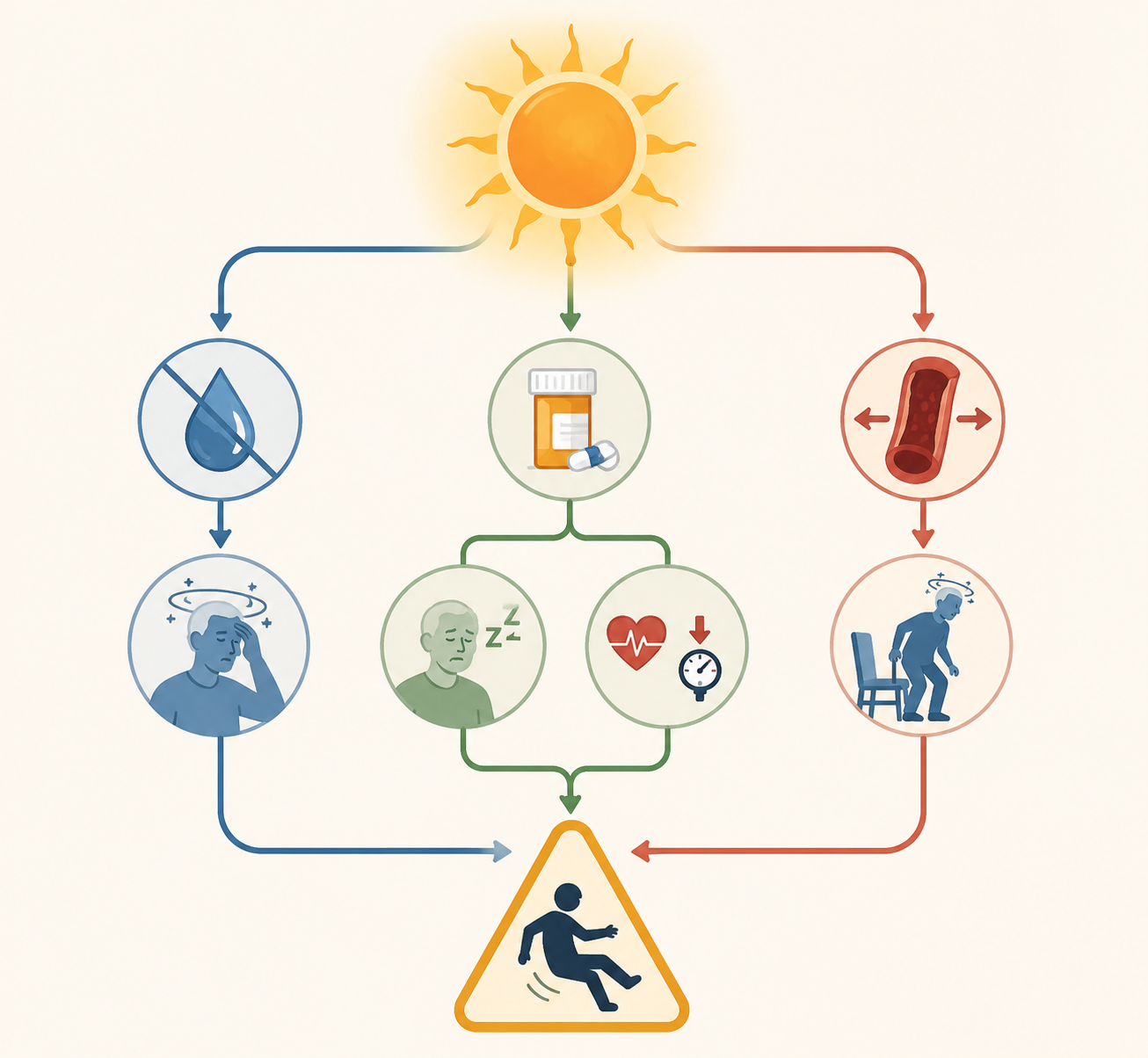
That is why practical heat-wave safety guidance for older parents needs to go beyond “drink water and stay cool.” Extreme heat raises fall risk through three pathways caregivers can actually watch: dehydration from blunted thirst, medication-amplified side effects, and blood-pressure drops during position changes.
The stakes are not theoretical. The CDC says most heat-related deaths occur among people age 65 and older, and Climate Central reports that more than 80% of heat-related deaths occur in people over 60; heat-related mortality among adults 65 and older increased 85% between 2004 and 2021.[1][2] Those numbers matter because they explain why a parent’s “normal” routine can become unsafe when the home is hot, the medications are unchanged, and the body is working harder to keep itself cool.
The three heat-to-fall pathways to watch
| Pathway | What heat changes | Fall-risk moment | Caregiver action |
|---|---|---|---|
| Dehydration | Thirst may not show up early enough; fluid loss affects alertness and coordination | Dizziness, confusion, or a wobbly walk before the person asks for water | Offer fluids on a schedule and watch behavior, not just thirst |
| Medication interactions | Some drugs make heat harder to tolerate while also raising fall risk | Light-headedness, sedation, faintness, or weakness after taking usual doses | Know the high-risk medication classes and call the prescriber before changing anything |
| Blood-pressure instability | Heat dilates blood vessels and can lower blood pressure | Standing up from bed, a chair, the toilet, or the couch | Slow transitions and monitor symptoms during the first steps |
These pathways often overlap. A parent can be mildly dehydrated, taking a blood pressure medication and a diuretic, and then stand too quickly in a room that has been heating up all morning. No single factor has to look dramatic for the fall risk to rise.
Pathway 1: Dehydration can arrive before thirst
Older adults do not always feel thirsty when their bodies need fluid. The CDC notes that aging can reduce the body’s ability to regulate temperature and can weaken the thirst response, which means dehydration may begin before an older person recognizes a need to drink.[1]
For fall prevention, the important point is not hydration as a virtue. It is what dehydration does to movement. It can make a person dizzy, slower to react, less coordinated, or more confused. A parent who usually walks steadily to the kitchen may start reaching for furniture, misjudge a turn, or forget to use the walker sitting beside the chair.
Warning signs that matter for falls
- New dizziness, especially when standing or walking
- Unusual sleepiness, confusion, irritability, or “not acting right”
- Dry mouth, less frequent urination, or very dark urine
- A slower, wider, or more hesitant gait than usual
- Grabbing walls, counters, or furniture during routine trips
A caregiver does not need to wait for a parent to say, “I’m thirsty.” On hot days, fluids should become part of the routine: with morning medications if allowed, between meals, after a bathroom trip, and before a longer walk inside the home. If a clinician has restricted fluids because of heart, kidney, or other medical conditions, follow that plan and ask for heat-wave instructions rather than guessing.
The more useful question is: “What changed from yesterday?” A parent who suddenly needs both hands to rise from a chair, pauses after standing, or seems mentally foggy in a warm room may be showing a heat-related fall warning before they show a classic heat emergency.
Pathway 2: Some medications create a double risk in heat
“Review medications” is too vague to help during a heat wave. The practical issue is that several common drug classes can affect heat tolerance and fall risk at the same time. CDC clinical guidance identifies medications that may interfere with sweating, thirst, fluid balance, electrolytes, kidney function, cognition, or cardiovascular responses during heat exposure.[3] AARP’s July 2026 medication list similarly highlights drug types that can be risky in extreme heat.[4]
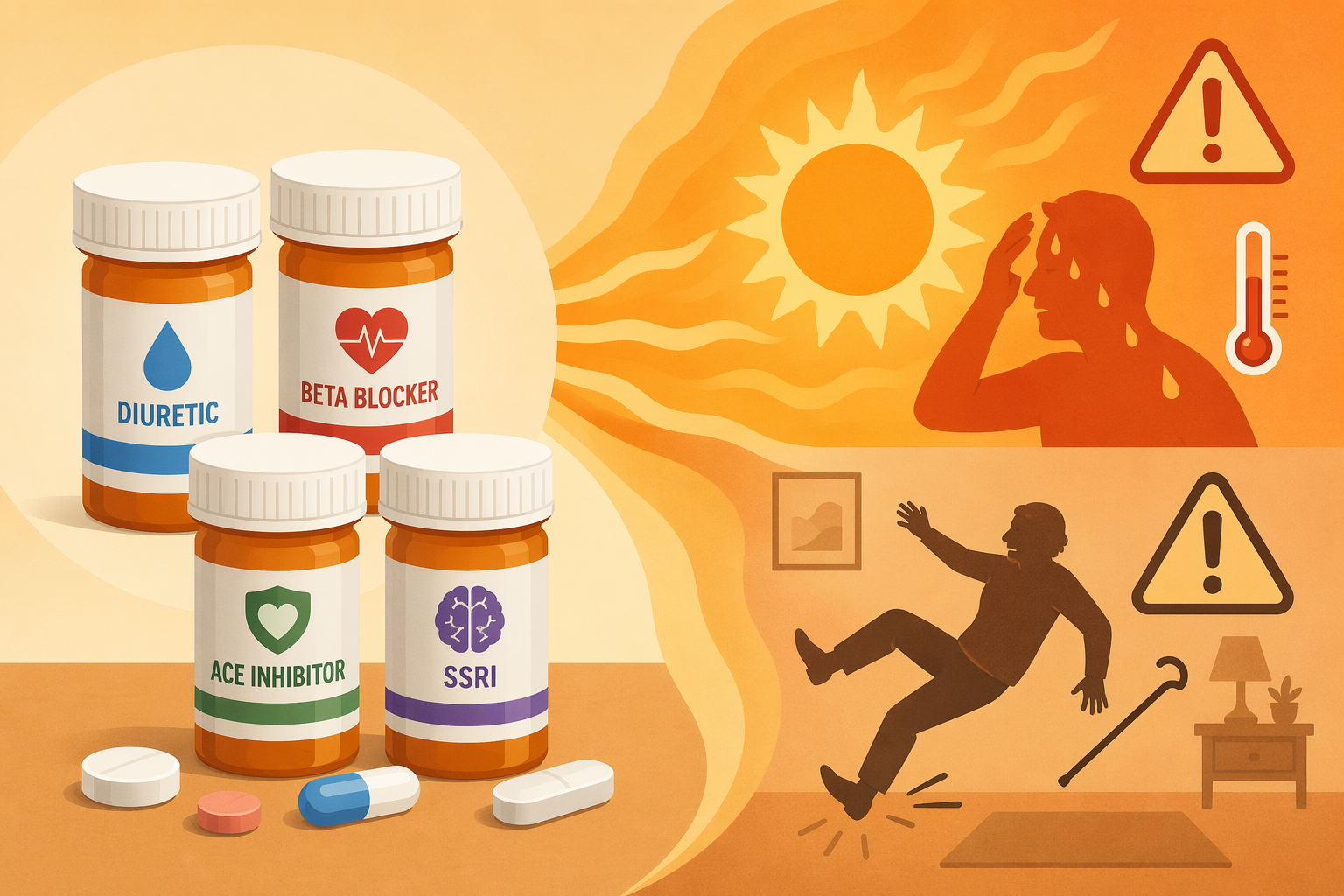
The classes caregivers should recognize include diuretics, beta blockers, ACE inhibitors, SSRIs, antipsychotics, and anticholinergic drugs.[3][4] These are not “bad” medications. Many are necessary. The heat-wave problem is that their usual side effects can become more consequential when an older body is already trying to cool itself.
| Medication class | Why heat can matter | Fall-related concern to watch |
|---|---|---|
| Diuretics | Can increase fluid and electrolyte loss | Dehydration, weakness, dizziness, faintness |
| Beta blockers | Can affect heart-rate response and heat regulation | Fatigue, reduced exercise tolerance, light-headedness |
| ACE inhibitors | Can affect blood pressure and kidney response, especially with fluid loss | Low blood pressure symptoms, faintness when standing |
| SSRIs | Can be associated with sweating, sodium changes, or dizziness in some patients | Unsteadiness, confusion, fall-risk medication burden |
| Antipsychotics | Can impair temperature regulation and cause sedation | Sleepiness, slowed reactions, orthostatic hypotension |
| Anticholinergics | Can reduce sweating and worsen confusion | Overheating, delirium-like symptoms, poor coordination |
One common combination deserves special attention: an ACE inhibitor such as lisinopril plus a diuretic such as furosemide. The CDC’s clinician guidance warns that medication combinations can increase heat risk through effects on hydration, kidney function, electrolytes, and blood pressure.[3] In practical terms, a parent who takes this kind of combination exactly as prescribed may still become more vulnerable on a hot day if they are drinking less, sweating more, eating poorly, or sitting in an overheated room.
The caregiver action is not to skip pills, split doses, or move medication times independently. It is to know which prescriptions are in the heat-risk group and call the prescribing clinician or pharmacist with a specific question: “During heat waves, what symptoms should make us call, and should any timing, monitoring, or fluid instructions change?”
What to have ready before calling
- A current medication list, including over-the-counter sleep aids, allergy medicine, bladder medicine, and supplements
- The parent’s usual blood pressure range, if you track it at home
- Recent symptoms: dizziness, fainting, confusion, weakness, unusual sleepiness, poor intake, or reduced urination
- The home temperature pattern: which rooms become hottest and when
- Any recent falls, near-falls, or new need to hold furniture while walking
This is also where a baseline fall-risk medication review helps. The CDC STEADI approach includes medication review as part of fall prevention; during heat waves, that same medication burden can become more urgent because the environment is adding stress to the body’s balance and blood-pressure systems.[3] If you are also checking the home for trip hazards, lighting, grab bars, and walking paths, the CDC STEADI home fall prevention checklist is a useful continuation.
Pathway 3: Heat can drop blood pressure at the exact moment a fall happens
Heat makes blood vessels dilate as the body tries to release warmth. That can lower blood pressure and contribute to light-headedness, especially when an older adult changes position.[5] Injury Matters Australia describes the same heat-to-fall connection through dehydration, dizziness, faintness, and heat-related drops in blood pressure; its local injury statistics are Australian, but the basic physiology is not country-specific.[6]
The high-risk moment is often the first 10 to 30 seconds after movement begins. A parent goes from lying to sitting, sitting to standing, or standing to walking. Blood pressure has to adjust quickly. In a hot room, with possible dehydration and medications on board, that adjustment may lag.
This is why a fall-prevention plan during a heat wave should slow down transitions, not just cool the room. The bathroom trip, the walk from the couch to the kitchen, and the rise from a dining chair are the places to build in pauses.
A safer sit-to-stand routine
- Sit upright first. If the parent has been lying down or reclining, have them sit at the edge of the bed or chair before standing.
- Pause and check. Ask about dizziness, blurry vision, nausea, weakness, or feeling “off.” Watch the face and posture, not just the answer.
- Stand with support. Use armrests, a walker, a grab bar, or a stable surface already positioned within reach.
- Pause again before walking. The first steps should not begin while the parent is still testing their balance.
- Turn slowly. Quick pivots are a common way dizziness turns into a fall.
If your parent uses a walker, cane, or rollator, hot days are not the time to negotiate whether they “really need it” for a short indoor walk. The body is less forgiving, and the fall is more likely to happen during a routine transfer than during a dramatic emergency.
Indoor heat changes the home plan
Staying indoors helps only if indoors is actually safe. Nearly 1 in 3 older adults, about 14.8 million people, were energy insecure in a Center for American Progress analysis using 2023 Household Pulse Survey data, meaning they had difficulty affording or maintaining safe home energy.[7] That matters for fall risk because caregivers may be managing heat in apartments, older homes, mobile homes, or rooms where air conditioning is limited, unaffordable, or unreliable.
The CDC also warns that electric fans can be dangerous when indoor temperatures are above 90°F because they can increase body temperature rather than cool the person safely.[8] A fan blowing hot air across a dehydrated older adult taking blood pressure medication is not a fall-prevention plan.
If the home cannot be kept safely cool, the plan may need to shift from “stay inside” to “spend the hottest hours somewhere cooler.” That could mean a cooling center, a relative’s home, a library, a senior center, or another air-conditioned place the parent can reach safely. The move itself needs fall planning: shoes on, mobility aid ready, medications packed, water available, and no rushing through hot parking lots or stairs.
Heat waves also raise the risk of power interruptions. If your area is under grid strain or storm risk, use a room-by-room plan like the power outage fall prevention checklist for seniors before the lights go out. Flashlights, clear walking paths, charged phones, backup cooling options, and a plan for medication refrigeration can prevent a heat problem from becoming a fall problem.
Some heat waves arrive with poor air quality, wildfire smoke, or ozone alerts. If breathing symptoms or air-quality restrictions are part of the same week, the fall plan should account for both environmental triggers; protecting seniors from falls when air quality alerts arrive covers that overlap in more detail.
A caregiver-ready monitoring routine for hot days
The routine below is meant for heat-wave days when an older parent is already at risk of falling. It does not replace medical advice, and it should be tightened if the parent has dementia, heart disease, kidney disease, diabetes, Parkinson’s disease, a recent fall, or medication changes.
Morning
- Check the day’s heat forecast and which rooms usually become hottest.
- Review the medication schedule for diuretics, blood pressure drugs, sedating medicines, anticholinergics, and psychiatric medications.
- Offer fluids early, unless the care plan limits fluid intake.
- Confirm that the walker, cane, glasses, hearing aids, and supportive shoes are within reach before the parent starts moving around.
- Move common items closer so the parent does not make extra trips through warm rooms.
Midday and afternoon
- Watch transitions: bed to chair, chair to standing, toilet to standing, and standing to walking.
- Look for new dizziness, confusion, sleepiness, weakness, headache, nausea, poor coordination, or furniture-walking.
- Keep fluids visible and offer small amounts regularly instead of waiting for thirst.
- Check whether fans are moving cool air or only blowing hot air; do not rely on a fan alone above 90°F indoors.
- Reduce unnecessary walking during the hottest hours and use delivery, meal prep, or caregiver help when available.
Evening
- Ask whether the parent felt dizzy, weak, faint, or unusually tired during the day.
- Note near-falls, missed meals, low fluid intake, or bathroom changes.
- Prepare the path to the bathroom before nighttime: lights, mobility aid, clear floor, stable footwear.
- If concerning symptoms appeared, contact the clinician or pharmacist with the symptom pattern and medication list.
For product decisions, the safest starting point is function: Does the item reduce a real fall-risk step, remind without confusing, fit the parent’s routine, and stay usable during heat or a power outage? The home safety products guide for seniors can help sort practical supports from clutter.
Call the prescribing clinician or pharmacist promptly for new fainting, repeated dizziness, confusion, very low intake, signs of dehydration, or a fall or near-fall after medication. Seek urgent medical help for severe confusion, loss of consciousness, chest pain, trouble breathing, inability to keep fluids down, or symptoms that suggest heat stroke. During a heat wave, fall prevention is not just more water; it is watching the thirst failure, the medication burden, the sit-to-stand moment, and the actual temperature inside the rooms where your parent is trying to live safely.
References
- Heat and Older Adults (Aged 65+) — CDC
- Seniors at Risk: Heat and Climate Change — Climate Central
- Heat and Medications – Guidance for Clinicians — CDC
- 8 Types of Medications That Don't Mix With Heat — AARP, July 2026
- The Effects of Heat on Older Adults — Harvard Medicine Magazine
- Supporting older adults to beat the heat — Injury Matters Australia
- Protecting Older Adults From the Growing Threats of Extreme Heat — Center for American Progress
- About Heat and Your Health — CDC
Related reading
Noticed something outdated or inaccurate on this page? Flag a correction. We review every report against CDC, NIA, and AARP HomeFit guidance before updating a page.
Part of the Fall Prevention section.