
Could Indoor CO2 Be Raising Alzheimer's Risk for Seniors?
This article explains how chronic exposure to elevated indoor CO₂ — common in energy-efficient homes — can impair cognitive function and may accelerate Alzheimer's pathology, and offers a practical threshold of keeping bedroom CO₂ below 800 ppm to reduce risk.
At night, a parent’s bedroom can look peaceful and still be doing more than holding sleep. The door is mostly closed. The windows are shut because it is cold, noisy, smoky, humid, or simply because drafts bother the person in the bed. The air does not smell bad. Nothing looks wrong. But if an older adult with mild cognitive impairment or early Alzheimer’s is sleeping in a tight room, indoor CO2 is one of the few invisible conditions a caregiver can actually measure.
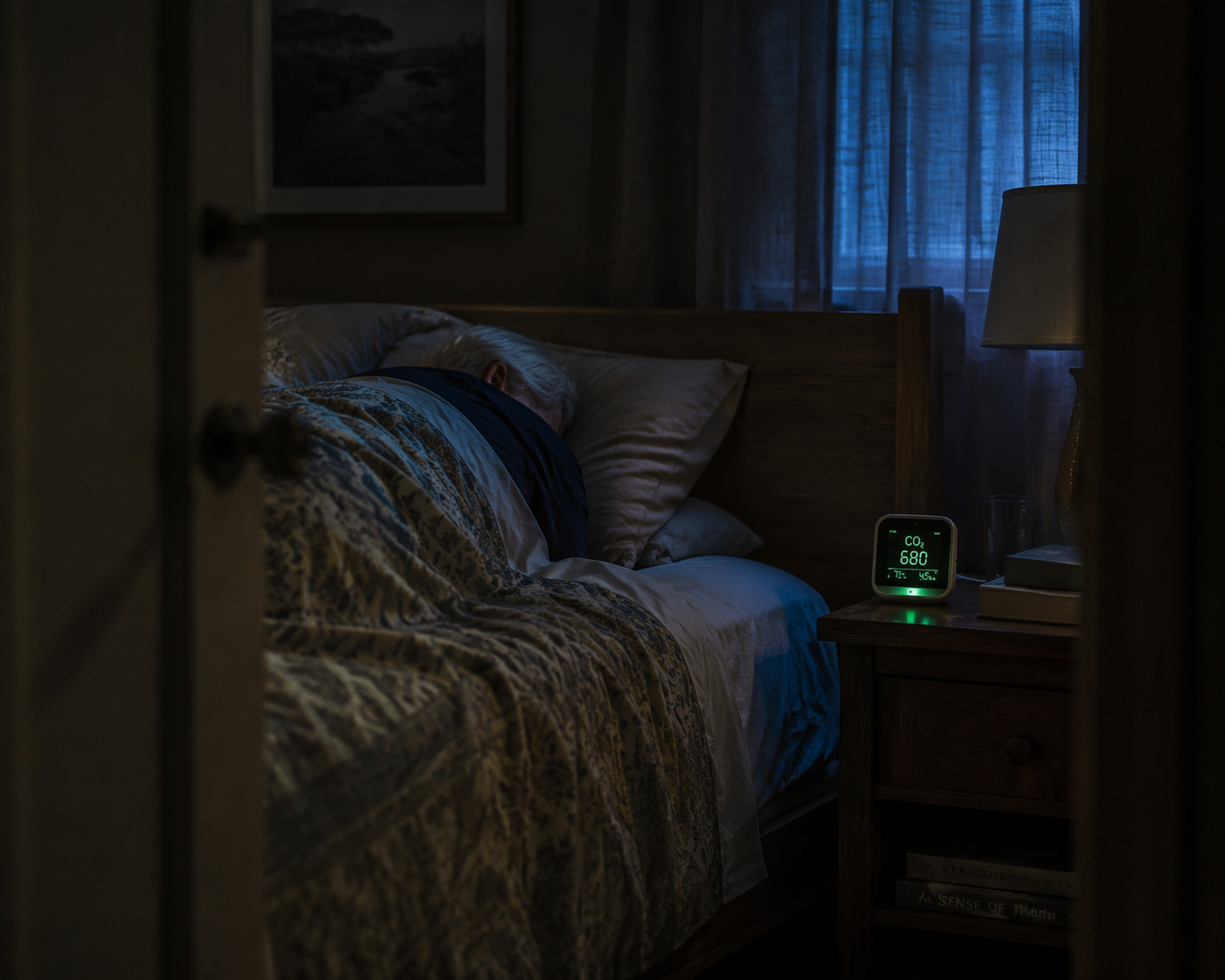
The careful answer is yes, indoor CO2 is worth checking — but no, it is not proven to be a stand-alone cause of Alzheimer’s or a proven treatment target. Elevated indoor CO2 is plausible enough to take seriously because it has been linked with short-term cognitive performance, slower response time, sleep disruption, and impaired vascular response in Alzheimer’s disease. It is not strong enough to justify fear, miracle claims, or blaming one room for a neurodegenerative disease.
That distinction matters. A caregiver does not need proof that CO2 causes Alzheimer’s in order to ask whether a bedroom is adding avoidable strain to a vulnerable brain.
What Elevated CO2 Can Do to Thinking
Indoor CO2 is usually a marker of how much exhaled air is accumulating in a room. In a well-sealed bedroom, especially with the door closed, levels can rise overnight because the person sleeping there is continuously breathing out CO2 while the room exchanges too little air with outdoors or the rest of the home.
The reason CO2 keeps coming up in indoor-air research is not that every study agrees. They do not. Some experiments have found little or no cognitive effect even at high concentrations. But the better-known findings are hard to ignore when the person in the room already has fragile memory, attention, and sleep.
In the Harvard COGfx study, researchers reported that a 400 ppm increase in CO2 was associated with a 21% decrease in cognitive scores across tested conditions.[1] The Global CogFx work later found that response times slowed by 1.4% to 1.8% for each 500 ppm increase in CO2.[2] Those studies were not Alzheimer’s trials, and they do not prove dementia progression. They do show something more immediate: air that feels normal can still be associated with measurable changes in how quickly and effectively people think.
For a healthy adult, a small response-time change may sound academic. In a parent who already loses the thread of a conversation, misreads a medication label, or wakes confused in the dark, small burdens can pile up. The practical question becomes less dramatic and more useful: is this one burden removable?
The Bedroom Case That Makes the Question Hard to Dismiss
The most vivid Alzheimer’s-specific report is also the one that must be handled most carefully. In a 2015 single-patient case study, Cremers described an Alzheimer’s patient whose nocturnal restlessness included humming, teeth-grinding, apnea, and panic. The symptoms disappeared when bedroom CO2 stayed below roughly 750–800 ppm, returned above that level, and resolved within 30–45 minutes after a window was opened.[3]
Anyone who has sat awake listening outside a parent’s room understands why that detail has force. It is not an abstract “healthy building” outcome. It is the difference between a quiet night and a night of distress, between wondering whether agitation is psychiatric, neurological, respiratory, environmental, or all of the above.
But one patient is one patient. The 750–800 ppm threshold from that report has not been validated as a universal Alzheimer’s cutoff in larger controlled trials. It should not be treated as a diagnostic rule, and it cannot tell a family that CO2 is the cause of every bad night. What it can do is justify a modest experiment: measure the bedroom, improve ventilation, and see whether nights become calmer while continuing appropriate medical care.
Why Alzheimer’s May Make CO2 More Consequential
The concern is not simply that older brains are delicate. Alzheimer’s disease affects systems that help the brain respond to changing blood gases, blood flow, and sleep. That makes CO2 exposure different in this context than it would be in a generic office-productivity article.
The vascular response may already be impaired
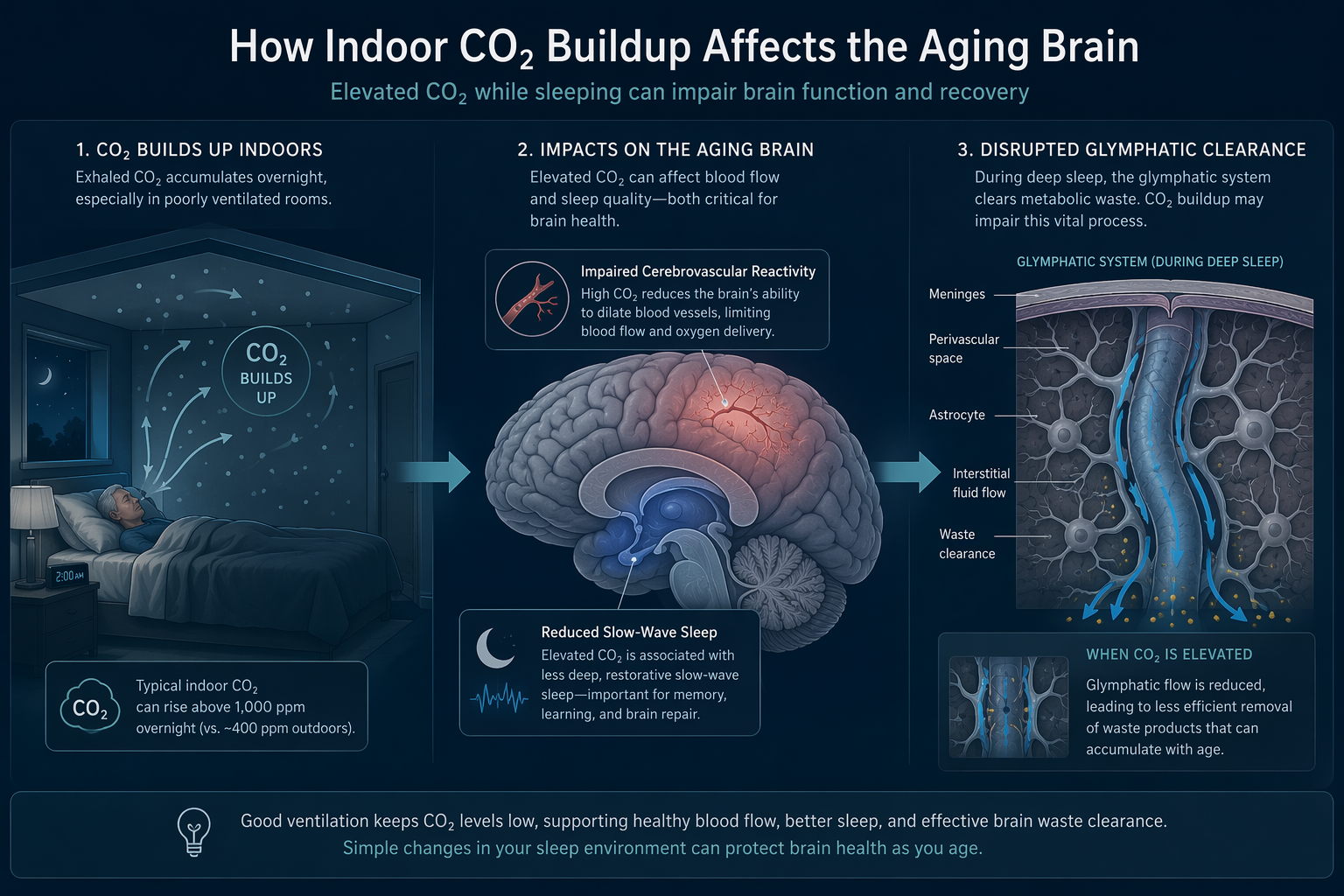
Normally, CO2 is one of the signals that helps regulate blood vessel dilation in the brain. When CO2 rises, cerebral blood vessels should respond. In Alzheimer’s disease, that cerebrovascular reactivity to CO2 has been documented as impaired.[4] That does not mean household CO2 automatically damages the brain. It means the system that should help compensate for CO2 changes may not be working normally.
That is the kind of finding that changes how a caregiver reads a number on a monitor. A bedroom level that might be only mildly concerning for a younger adult may deserve more attention when the sleeper has a disease associated with poorer vascular responsiveness.
Sleep is when the brain is supposed to do maintenance
The second pathway runs through sleep. A 2024 meta-analysis reported that elevated CO2 during sleep reduced slow-wave sleep duration, with a standardized mean difference of -1.57.[5] Slow-wave sleep matters in Alzheimer’s conversations because it is closely tied to the brain’s overnight clearance processes, including glymphatic clearance of amyloid-beta and tau.
This is where the bedroom becomes the right place to focus. A living room CO2 reading may matter for daytime alertness. A bedroom reading matters because it covers the hours when a parent is not just resting but cycling through sleep stages that support repair, memory processing, and waste clearance. If elevated CO2 shortens or fragments deeper sleep, it may be adding pressure at the worst time of day.
The word “may” is doing real work here. The evidence supports concern about sleep quality and plausible Alzheimer’s relevance. It does not prove that lowering bedroom CO2 slows Alzheimer’s progression.
Air Pollution Evidence Is Stronger Than CO2-Specific Dementia Evidence
Dementia researchers already take air quality seriously, but the strongest population-level evidence is broader than indoor CO2. The Lancet Commission included air pollution as a modifiable dementia risk factor in 2020 and reaffirmed that concern in 2024.[6] Much of the stronger dementia-risk evidence centers on particulate pollution, especially PM2.5, rather than CO2 itself.
That matters because CO2 should not crowd out better-established environmental protections. If outdoor smoke, indoor combustion, poor filtration, or high PM2.5 is present, those deserve attention too. CO2 is useful partly because it is easy to measure and often reveals poor ventilation, but it is not the whole indoor-air story.
The older-adult literature also points toward ventilation as a practical concern. Chen and colleagues linked poor ventilation with amplified cognitive decline in older adults, widening the question beyond younger office workers and toward the age group families are actually caring for.[7] Roque and colleagues later emphasized the importance of accurate indoor air quality assessment in aging and dementia populations, which is a quiet but important point: if nobody measures the room, nobody knows whether the room is part of the problem.[8]
A Practical Bedroom Target: Stay Below 800 ppm When You Can
For a family caregiver, the most useful number is not a grand theory of Alzheimer’s prevention. It is a nighttime target. Based on the Cremers case, keeping a vulnerable parent’s bedroom below 800 ppm is a reasonable, cautious goal, as long as it is understood as a practical safeguard rather than a validated medical threshold.[3]
A simple monitoring routine is enough for most homes:
- Use a reliable CO2 monitor that shows ppm and can log overnight readings if possible.
- Place it near the bed but not directly in the sleeper’s breath stream, because exhaled air can distort the reading.
- Check the pattern across the whole night, not just the bedtime number.
- If levels climb above 800 ppm, try a small ventilation change and watch whether the curve changes.
- Keep notes on sleep, restlessness, morning confusion, and ventilation changes, without assuming CO2 explains everything.
The fixes do not have to be dramatic. Cracking a window, opening the bedroom door, using a quiet fan to move air toward a hallway, adjusting mechanical ventilation, or improving fresh-air exchange may lower CO2. The right choice depends on climate, safety, outdoor pollution, noise, fall risk, and whether the person with dementia will tolerate the change.
That last part is not minor. A parent who hates drafts may close the window at 1 a.m. A fan may create noise that worsens agitation. A door left open may increase wandering risk. A caregiver may have to test small changes one at a time, because the best ventilation plan is the one that lowers the number without making the night harder.
| Overnight CO2 Pattern | Caregiver Response |
|---|---|
| Mostly below 800 ppm | Keep the current setup and recheck during seasonal changes or after home improvements. |
| Gradually rises above 800 ppm after the door closes | Increase gentle air exchange with a cracked window, open door, fan-assisted airflow, or mechanical ventilation adjustment. |
| Spikes only when someone else is in the room | Retest with normal sleeping conditions and avoid overinterpreting a reading caused by brief crowding. |
| Stays high despite window or door changes | Look at whole-home ventilation and consider help from an HVAC or indoor-air professional. |
| CO2 is controlled but restlessness, apnea, panic, or severe confusion continues | Discuss symptoms with a clinician; sleep apnea, medication effects, pain, infection, anxiety, and dementia progression may be involved. |
Do Not Confuse Household CO2 With Experimental CO2 Therapy
One confusing development deserves a clear warning. A 2026 New Scientist report described research on high-dose CO2 inhalation at 5% as a possible therapeutic approach related to clearing Alzheimer’s proteins from the brain.[9] That is controlled medical research. It is not a reason to allow chronic CO2 buildup in a bedroom, and it is not something families should try to imitate at home.
Dose, duration, medical supervision, and patient selection change the meaning of an exposure. A carefully studied short medical intervention is categorically different from sleeping night after night in a poorly ventilated room. For caregivers, the safe household lesson remains the opposite: measure ordinary indoor CO2 and reduce avoidable buildup.
What This Can and Cannot Do
Keeping a parent’s bedroom below 800 ppm is not a cure for Alzheimer’s. It is not a substitute for diagnosis, medication review, sleep evaluation, fall prevention, hearing support, social connection, exercise, or management of vascular risk. It is also not proof that a bad night was caused by the air.
It is still a reasonable low-cost environmental safeguard. The case for doing it does not rest on panic. It rests on a narrower and more practical chain: elevated CO2 has been associated with worse cognitive performance and slower response time; Alzheimer’s disease can involve impaired cerebrovascular response to CO2; elevated CO2 during sleep may reduce slow-wave sleep; and one Alzheimer’s case report found nighttime restlessness tracked closely with bedroom CO2 above roughly 750–800 ppm.[1][2][3][4][5]
A caregiver cannot control the disease. But sometimes the room offers one measurable thing to remove from the night: stale air accumulating around a sleeping brain that is already working harder than it should have to.
References
- Associations of Cognitive Function Scores with Carbon Dioxide, Ventilation, and Volatile Organic Compound Exposures in Office Workers: A Controlled Exposure Study of Green and Conventional Office Environments, PMC, 2016, link
- Impacts of Indoor Air Quality on Cognitive Function, Harvard T.H. Chan School of Public Health Healthy Buildings, 2021, link
- Effect of CO2 on Restlessness of an Alzheimer Patient, AIVC, 2015, link
- Cerebrovascular Reactivity to Carbon Dioxide in Alzheimer’s Disease, PMC, 2013, link
- Effects of carbon dioxide concentration on sleep quality: A systematic review and meta-analysis, ScienceDirect, 2024, link
- Dementia prevention, intervention, and care: 2020 report of the Lancet Commission, The Lancet, 2020, link
- Poor ventilation amplifies cognitive decline among older adults, ScienceDirect, 2023, link
- Indoor air quality assessment in aging and dementia populations, PubMed, 2025, link
- Inhaling high-dose CO2 clears Alzheimer’s proteins from the brain, New Scientist, 2026, link
Related reading
Noticed something outdated or inaccurate on this page? Flag a correction. We review every report against CDC, NIA, and AARP HomeFit guidance before updating a page.
Part of the Fall Prevention section.