
STEADI: Intervene
How to Keep Older Adults Safe During Record Heat
Record heat endangers older adults most inside the home, where illness builds over days through dehydration, medication effects, and chronic conditions. This guide gives caregivers a pre-heat cooling and medication plan, twice-daily check-ins for during the event, and the symptom thresholds that mean it's time to call 911.
To keep elderly people safe during record heat, start indoors. The dangerous scene is often not an older adult collapsing outside; it is a parent sitting in a hot living room for a second or third day, sleeping poorly, drinking less than they think, taking a diuretic or another heat-sensitive medication, and becoming weak or confused before anyone nearby calls it heat illness.
That matters for fall prevention as much as for heat safety. Dehydration, dizziness, low blood pressure, weakness, medication side effects, and confusion can turn a short walk to the bathroom or an unsafe transfer from a chair into the first visible crisis. By then, the record-heat event has already been working on the body for hours or days.
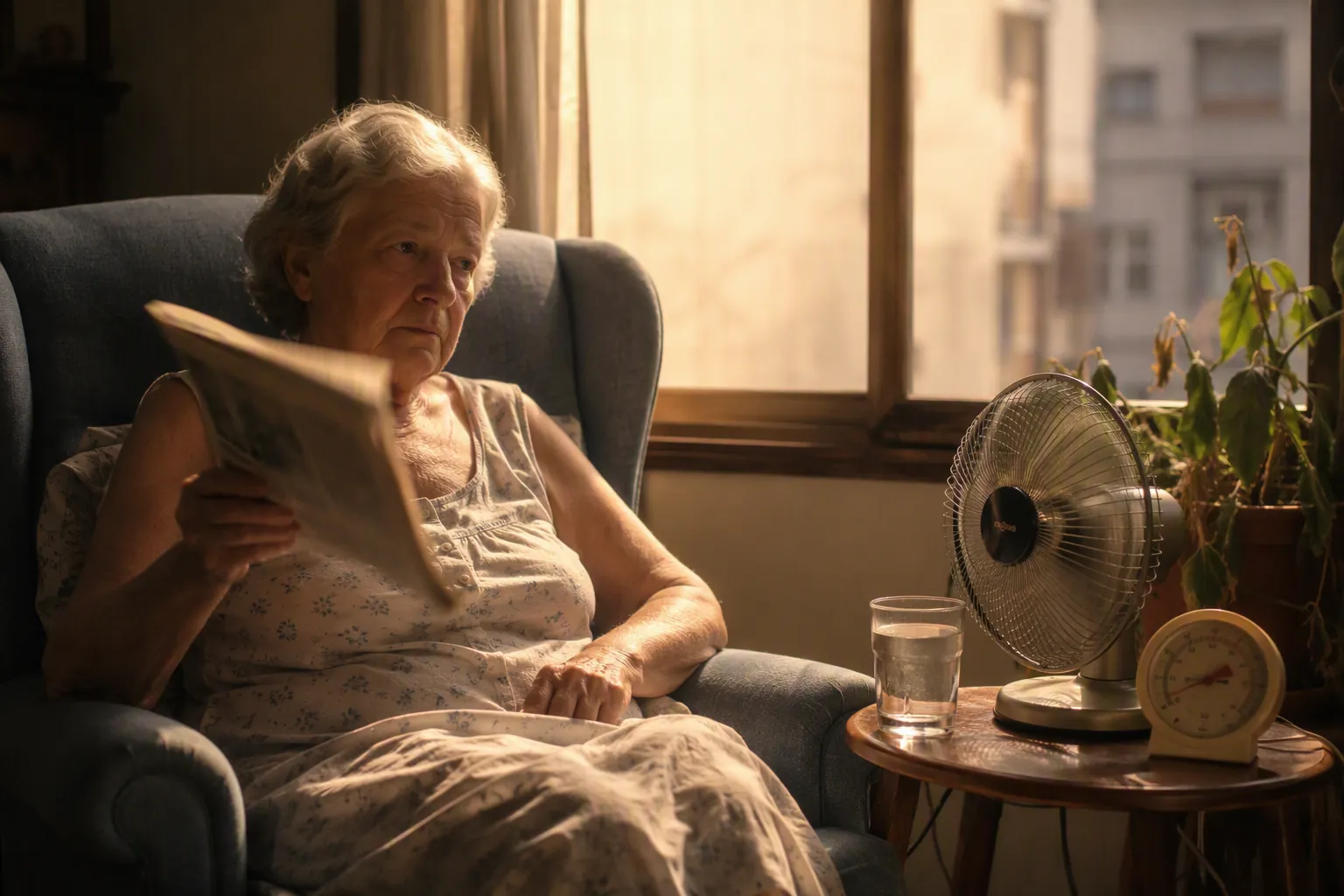
Older adults are at higher risk because they do not adjust as well to sudden temperature changes, are more likely to have chronic medical conditions, and are more likely to take medicines that affect sweating, hydration, circulation, or temperature control, according to the CDC and the National Institute on Aging.[1][2] A useful caregiver plan therefore has two parts: set the cooling, medication, and backup plan before the heat arrives; then use a short, twice-daily check-in routine while it is happening.
Use HeatRisk as the trigger, not the afternoon headline
Before a record-heat stretch, check the CDC/National Weather Service HeatRisk tool by ZIP code. HeatRisk uses a color scale from green to magenta to show how unusual the heat is for that location, how long it is expected to last, and whether it reaches levels linked with health risk.[3] For caregivers, the practical move is to treat orange, red, and magenta days as action days, especially for an older adult who lives alone, has heart or kidney disease, takes heat-sensitive medications, or has limited air conditioning.

The point of checking early is not to admire the map. It is to decide, before Tuesday morning, who will call, where the older adult can cool down, what happens if the power fails, and which symptoms mean the call stops being a check-in and becomes emergency care.
| HeatRisk or forecast signal | Caregiver action |
|---|---|
| Orange, red, or magenta HeatRisk for the older adult’s ZIP code | Confirm working air conditioning or a cooled room; start twice-daily check-ins; review medication and fluid instructions already approved by a clinician. |
| No reliable AC, one-room cooling only, or repeated indoor temperatures in the high 90s | Move the person to a cooler location during the hottest hours or arrange a ride to a cooling center, library, mall, senior center, or another cooled home. |
| Power outage, broken AC, or the older adult sounds weak, confused, faint, or unable to cool down | Escalate the plan immediately: in-person check, cooling location, clinician call, or 911 depending on symptoms. |
Build the pre-heat plan while everyone is still thinking clearly
The days before a heat wave are when a caregiver can remove the most uncertainty. Once the house is hot and the older adult is tired, small decisions become slower: whether to leave home, whether the AC is really working, whether it is safe to drink more water, whether a medication could be contributing to dizziness. Those questions should not wait until the person already sounds “off.”
Confirm the actual cooling setup
Ask for specifics, not reassurance. “Is the AC on?” is less useful than “Which room is coolest right now, and will you sleep there tonight?” If the home has central air, confirm that it is working before the high-risk day. If there is only a window unit, identify the room it cools best and move the essentials there: phone charger, medications, water, walker or cane, glasses, hearing aids, and a clear path to the bathroom.
If the whole home cannot be cooled, make a “cool corner” for resting and sleeping. This is not decorative advice; hot nights reduce the body’s chance to recover, and high overnight temperatures have been linked with serious heat illness and mortality risk in reporting on heat-health policy and older adults.[4]
Fans need a boundary. The CDC warns that electric fans will not prevent heat-related illness when temperatures are in the high 90s; CDC HeatRisk guidance describes fans as helpful only when indoor temperatures are below 90°F.[3] A fan can move cooler air around an air-conditioned room or help during active cooling with misting, but it should not be the entire plan for a hot apartment.
Name the backup place before the first bad day
If the AC fails or the home stays hot, the older adult needs a destination that is already acceptable to them. That may be a relative’s house, a neighbor’s cooled apartment, a library, mall, senior center, or local cooling center. Local health departments, state aging offices, and 211 services are common starting points for finding cooling centers and transportation options during extreme heat.[5]
Long-distance caregivers should write the backup plan in plain language and share it with the person who can act locally. The plan should say who has a key, who can drive, which cooling location is preferred, what medical equipment or mobility aid must go along, and who gets called after the move.
Ask the medication and fluid question before the forecast turns red
Medication planning is where caregivers need to be careful. Do not stop, skip, or adjust a parent’s medicines on your own. The useful pre-heat question is for the prescribing clinician or pharmacist: “On orange, red, or magenta HeatRisk days, what should we watch for, and does this person need a specific fluid or medication plan?”
CDC clinical guidance names several medication categories that can increase heat risk, including diuretics, anticholinergics, and some psychotropic medicines. It also warns that ACE inhibitor or ARB combinations with diuretics can add risk because of effects such as reduced thirst, impaired sweating, volume depletion, fall risk, and reduced ability to dilate blood vessels.[6] AARP likewise advises that older adults should not abruptly stop medications and should ask a clinician about heat-related risks.[7]
This conversation is especially important for people with heart failure, kidney disease, diabetes, high blood pressure, cognitive impairment, Parkinson’s disease, or any fluid restriction. General heat advice often says to drink more water, but some patients need a doctor-approved fluid target rather than a slogan.
Heat can also damage supplies. CDC clinical guidance notes that high temperatures can degrade insulin, inhalers can burst, and epinephrine auto-injectors can malfunction.[6] Before a heat event, check storage instructions and make sure medications are not left in a hot car, sunny windowsill, or uncooled room.
Stock for a power outage, not just a warm afternoon
The Red Cross recommends storing at least one gallon of water per person per day and keeping a one-month supply of medications as part of emergency preparedness.[8] For an older adult living alone, that supply should be reachable without climbing, bending into a deep cabinet, or crossing a cluttered room in the dark.
If cost is the barrier to cooling, do not wait until the hottest week to investigate help. State aging offices and programs such as LIHEAP may be able to help eligible households with cooling costs or equipment, including window air conditioners in some places.[5]
During the heat event, make the check-in boring and specific
During extreme heat, the CDC’s caretaker checklist says to check on older adults at least twice a day and ask direct questions about water intake, access to air conditioning, how they are staying cool, and signs of heat stress.[1] Twice daily is a minimum rhythm, not a courtesy call: morning catches overnight trouble; late afternoon or evening catches the heat that built up through the day.
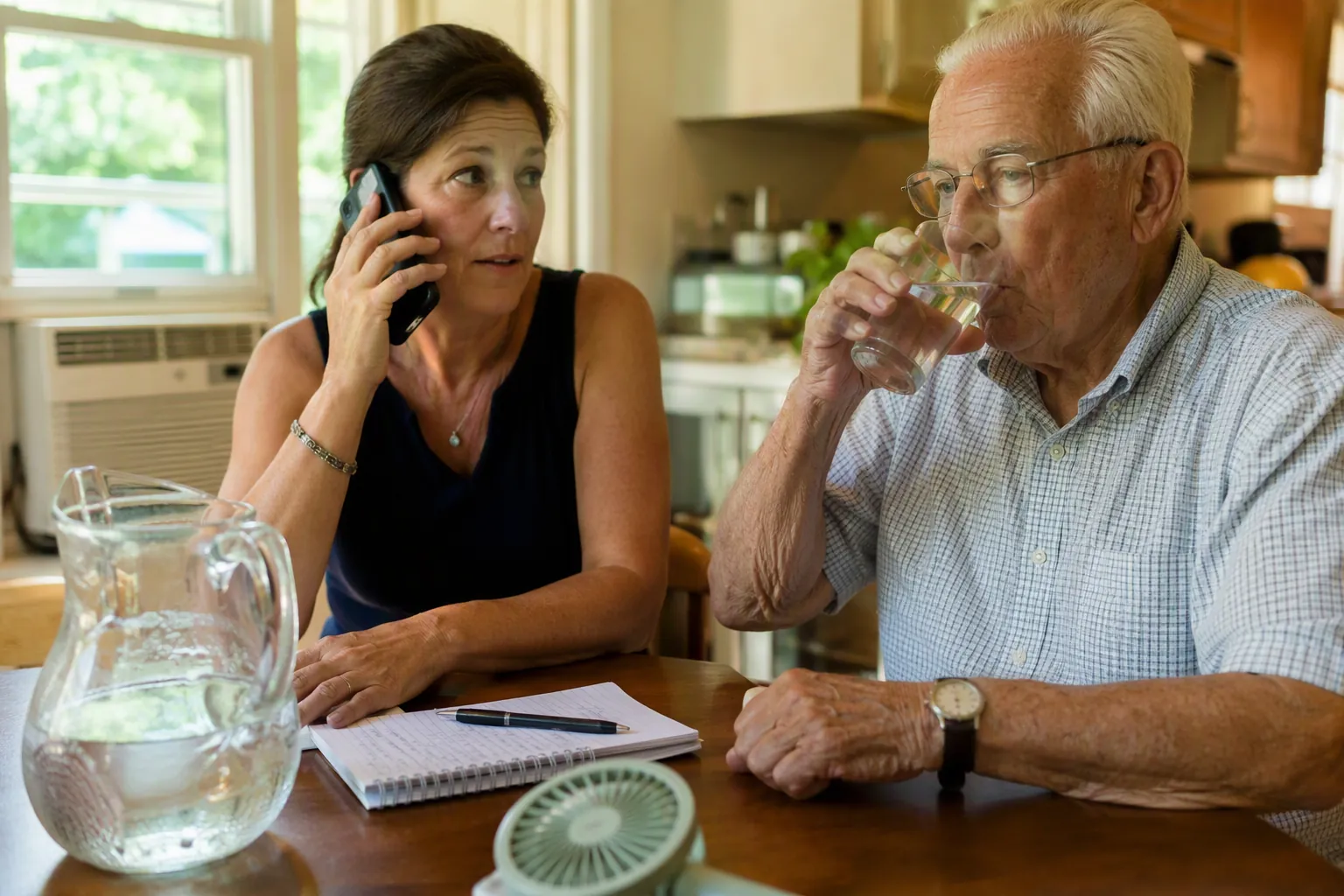
A useful call is short enough to repeat and concrete enough to reveal trouble. If the older adult tends to minimize problems, ask for observable facts.
- “What room are you in right now, and is that the coolest room?”
- “Is the air conditioner running? If not, why not?”
- “How many glasses of water or other nonalcoholic drinks have you had since breakfast?”
- “Have you urinated normally today?”
- “Are you dizzy when you stand up?”
- “Any headache, nausea, cramps, heavy sweating, weakness, or new confusion?”
- “Did you sleep in the cooled room last night?”
- “Can you put the phone on speaker and walk me through what you’re doing to cool the room?”
For a local helper, the in-person version adds what a phone call may miss: flushed or pale skin, unusual sleepiness, unsteady walking, a full glass that has not been touched, a thermostat that does not match what the older adult reported, closed windows with no AC, or a fan blowing hot air around a room.
Hydration: use numbers, then check whether they apply
Some state and local emergency guidance advises drinking 2 to 4 glasses of water per hour during extreme heat and avoiding alcohol and caffeine.[5][9] That number is useful because “drink more” is too vague, but it is not safe as a blanket order for everyone. People with heart failure, kidney disease, or a prescribed fluid restriction need a clinician-approved plan.
During the call, listen for barriers rather than arguing about ounces. Some older adults drink less because the bathroom is far away, they fear incontinence, water tastes bad, they are nauseated, or they do not want to get up. Each of those changes the fix: place drinks within reach, schedule toileting before dizziness sets in, offer preferred nonalcoholic drinks, or get medical advice if nausea or weakness is appearing.
Cooling actions that actually change the room or the body
Close curtains or shades against direct sun. Move to the lowest, coolest room. Use air conditioning if available. Take a cool shower or bath if the person can do so safely, or use cool wet cloths on the neck, wrists, armpits, and groin. Keep pathways clear, because a heat-weakened person carrying a wet towel or rushing to the bathroom is also a fall risk.
If the home is still hot, the plan should move from “try another tip” to “go somewhere cooler.” A library, senior center, mall, neighbor’s home, or official cooling center is not a last resort only after someone is sick. It is the safer location when the house cannot cool down.
The symptom ladder: when a check-in becomes urgent
Temperature numbers are helpful, but caregivers should not wait for a perfect reading. Different medical and public-health sources use slightly different thresholds: Cleveland Clinic describes heat exhaustion as often involving a body temperature from 101°F to 104°F with heavy sweating; CDC, Red Cross, Cleveland Clinic, and the American Geriatrics Society describe heat stroke around 104°F or higher; other clinical guidance cited in consumer health reporting uses 103°F as an emergency threshold.[10][11][12][13] CDC NIOSH warns that body temperature can rise to 106°F within 10 to 15 minutes during heat stroke.[14]
For an older adult at home, the response should be driven by function and mental status as much as the thermometer. Confusion, lethargy, fainting, inability to drink safely, or worsening symptoms are not “just aging” during record heat.
| Level | What you may notice | What to do |
|---|---|---|
| 1. Early heat stress | Thirst, fatigue, mild headache, muscle cramps, darker urine, sleeping poorly, less interest in food, or mild dizziness when standing. | Move to the coolest room, start active cooling, encourage appropriate fluids if the person is awake and allowed to drink, and increase check-ins. If symptoms do not improve, call a clinician or local nurse line. |
| 2. Possible heat exhaustion | Heavy sweating, weakness, nausea, headache, cramps, cool or clammy skin, dizziness, or a body temperature in the range some sources describe around 101°F to 104°F. | Stop activity, move to a cool place, cool the body, and arrange an in-person check if you are not there. Call a clinician promptly, especially for chronic illness, fluid restriction, medication risk, or symptoms that persist or worsen. |
| 3. Emergency signs | Confusion, lethargy, fainting, seizure, very high body temperature, hot skin, worsening symptoms, inability to swallow safely, or suspected heat stroke. | Call 911. Move the person to a cool place and start active cooling while waiting for help. Do not give anything to drink if heat stroke is suspected. |
Red Cross first aid for suspected heat stroke is direct: call 911, move the person to a cool place, and cool the body using wet cloths, misting, fanning, or a cool bath if it can be done safely. The Red Cross also says not to give anything to drink when heat stroke is suspected.[11] Small sips belong only in the narrower situation where the person is awake, not confused, able to swallow safely, and not under a fluid restriction.
In older adults, heat stroke may build gradually over days of heat exposure, and confusion or lethargy can be mistaken for dementia or ordinary decline, according to Health in Aging from the American Geriatrics Society.[13] During record heat, a sudden change in behavior deserves a heat-safety response until another cause is found.
Why this cannot be treated as ordinary summer discomfort
The broad mortality numbers are serious, but they are most useful when they keep attention on planning instead of panic. The CDC’s climate and health materials say more than 700 people die from extreme heat in the United States each year.[15] A Harvard T.H. Chan School of Public Health study of 73.7 million Medicare beneficiaries from 2000 to 2018 estimated about 9 extra deaths per heat wave per 10,000 older adults per year, or about 17,600 extra deaths over the study period.[16]
That Harvard study also found unequal risk: estimated heat-wave mortality was nearly three times higher for Black older adults than for white older adults, 16.50 versus 5.85 additional deaths per 10,000 people per year, and higher in high-poverty ZIP codes; areas with more green space had fewer heat-wave deaths, an observational association rather than proof that any one household factor caused the difference.[16]
The practical lesson is not that one caregiver can fix climate exposure or neighborhood inequality during a heat wave. It is that the person making Tuesday’s phone call should not wait for visible collapse. HeatRisk, a cooled room, a medication and fluid plan, and a twice-daily script are the tools that turn a vague worry into a decision.
A simple call plan for the next orange, red, or magenta day
- Check HeatRisk by ZIP code before the event. If the forecast is orange, red, or magenta, activate the plan.
- Confirm the coolest room, working AC, safe walking paths, reachable water, phone charger, medications, mobility aids, and sleeping location.
- Confirm the backup cooling place and transportation: who drives, who has the key, and where the older adult will go if the home cannot cool down.
- Ask the clinician or pharmacist about medication and fluid instructions before the heat event, especially for diuretics, anticholinergics, psychotropics, ACEi/ARB-plus-diuretic combinations, heart failure, kidney disease, diabetes, or fluid restriction.
- Call at least twice daily during the event. Ask what room they are in, how they are cooling it, what they have had to drink, whether they are dizzy or weak, and whether there is any headache, nausea, cramps, heavy sweating, confusion, fainting, or unusual sleepiness.
- Escalate quickly. New confusion, lethargy, fainting, inability to drink safely, very high temperature, worsening symptoms, or suspected heat stroke means call 911, move the person to a cool place, start active cooling, and do not give anything to drink if heat stroke is suspected.
References
- Heat and Older Adults, CDC,
- Hot Weather Safety for Older Adults, National Institute on Aging,
- HeatRisk, CDC,
- As climate change intensifies, older adults face higher indoor heat risks, Al Jazeera, August 2026,
- Extreme Heat and Older Adults, New York State Office for the Aging,
- Heat and Medications – Guidance for Clinicians, CDC,
- Medications That Can Make Heat Waves More Dangerous, AARP,
- Heat Wave Safety, American Red Cross,
- Extreme Heat, Ready LA County,
- Heat Exhaustion, Cleveland Clinic,
- Heat Stroke First Aid, American Red Cross,
- Heatstroke, Cleveland Clinic,
- Heat-Related Illness, Health in Aging Foundation,
- Heat Stress – Heat Related Illness, CDC NIOSH,
- Climate Change and Extreme Heat, CDC,
- Heat waves linked with increased mortality among older adults, Harvard T.H. Chan School of Public Health,
Related reading
Noticed something outdated or inaccurate on this page? Flag a correction. We review every report against CDC, NIA, and AARP HomeFit guidance before updating a page.
Part of the Fall Prevention section.