
STEADI: intervene
How to Spot Heat Stroke in Older Adults and Act Fast
Older adults can develop heat stroke without dramatic symptoms — sudden confusion may be the first sign. Knowing when to call 911, how to cool the person safely before help arrives, what not to do, and what to watch for in the days after can make the difference in a fast-moving emergency.
If an older adult is suddenly confused, unusually irritable, faint, very weak, hard to wake, or simply “not acting like themselves” during hot weather, treat it as possible heat stroke. Call 911 and start cooling the person while help is on the way. Do not wait for the skin to feel dry, for the person to say they are thirsty, or for a thermometer to prove the emergency.
This is general safety guidance, not a diagnosis and not a substitute for emergency care. In a possible heat-stroke situation, the safest first move is to involve 911 early and follow dispatcher instructions.
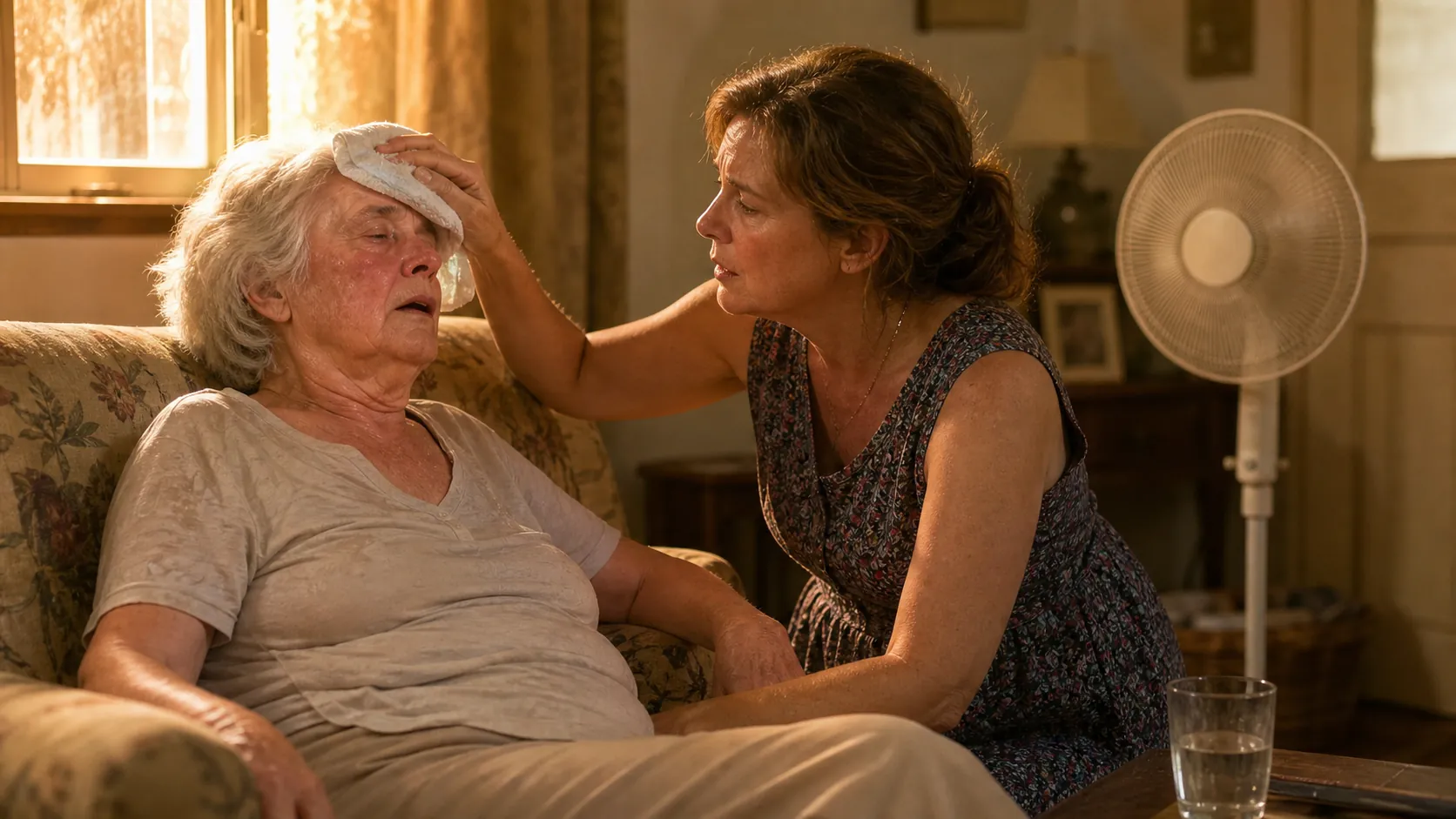
The first decision: heat exhaustion or heat stroke?
Heat exhaustion can be serious, but heat stroke is the emergency that threatens the brain and organs. The practical dividing line is not whether the person is sweating. It is whether their brain is working normally.
The CDC’s heat-stress guidance warns that heat stroke can push body temperature to 106°F or higher within 10 to 15 minutes and can cause permanent disability or death without emergency treatment.[1] Cleveland Clinic describes brain dysfunction — confusion, agitation, aggression, or passing out — as the key difference between heat stroke and heat exhaustion, and notes that classic heat stroke typically affects adults over 65 and can happen indoors in a home without air conditioning.[2]
That indoor detail matters. A parent sitting in a stuffy apartment can be in danger even if they never went outside. Adults 65 and older are at higher risk during heat because aging can make it harder for the body to cool itself, and chronic conditions or medications can add to that risk.[3]
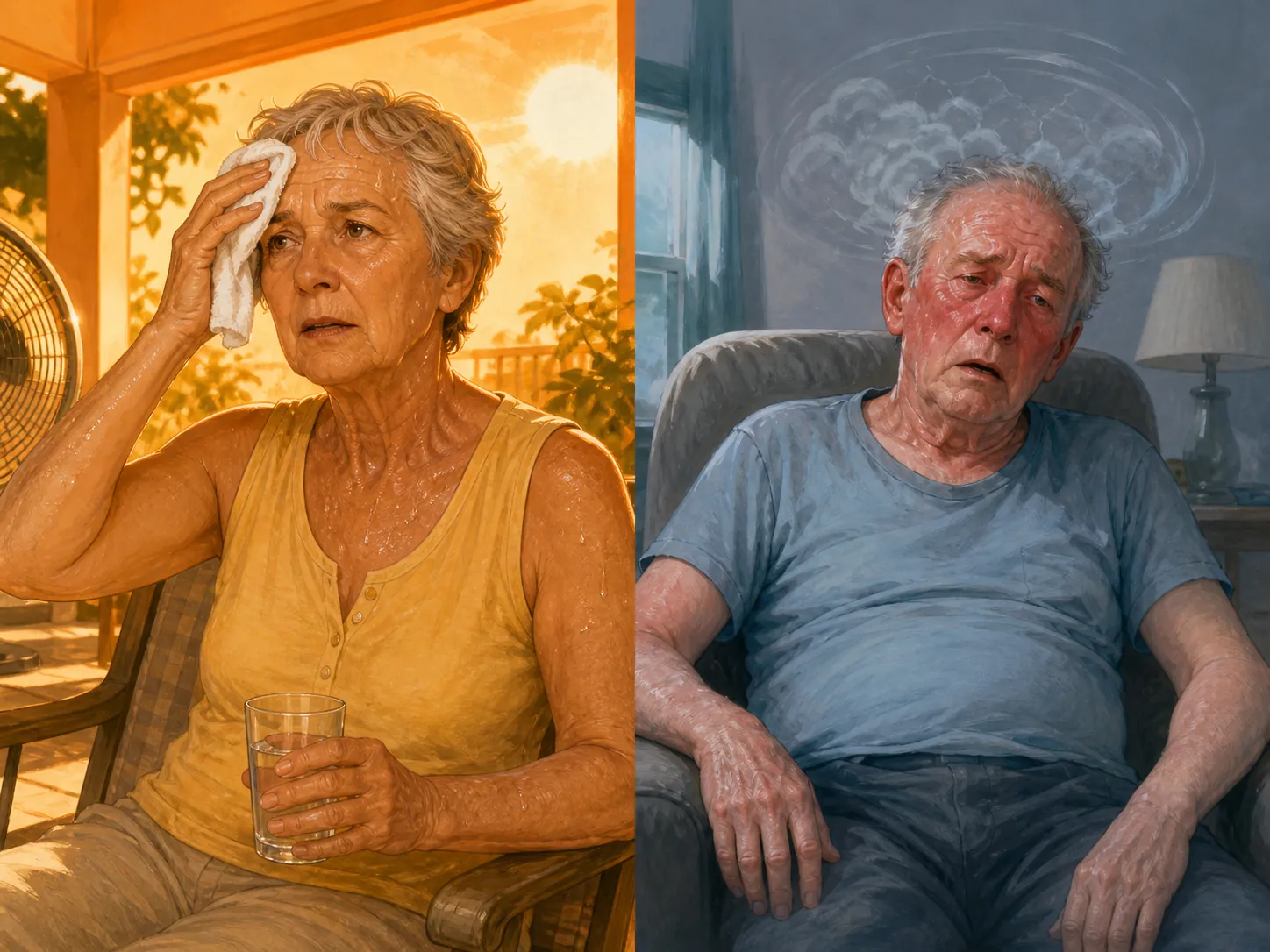
| What you see | What it suggests | What to do |
|---|---|---|
| Tired, weak, dizzy, nauseated, sweating, but awake, coherent, and answering normally | Possible heat exhaustion | Move to a cooler place, cool the body, give small sips if fully alert and able to swallow, and monitor closely |
| Confusion, agitation, aggression, fainting, hard to wake, seizure, or not acting like themselves | Possible heat stroke | Call 911 now and start cooling; do not wait for a temperature reading |
| Very high temperature, hot skin that may be dry or sweaty, rapid worsening, collapse | Possible heat stroke | Call 911 now and cool aggressively while waiting |
Call 911 now if behavior changes in the heat
The moment to stop debating is the moment an older adult’s thinking changes. Confusion may look like repeating the same answer, arguing strangely, refusing help in a way that is out of character, not recognizing what is happening, or becoming suddenly combative. It may also look quieter: staring, slumping, not following simple directions, or answering with words that do not match the question.
Call 911 immediately if any of these happen during or after heat exposure:
- New confusion, agitation, aggression, disorientation, or behavior that is clearly not normal for the person.[2]
- Fainting, collapse, seizure, or being hard to wake.[2]
- A very high temperature, especially around 104°F or higher, if you can check it quickly without delaying action.[2]
- Hot skin with either dryness or sweating. Mayo Clinic notes that while classic heat stroke often involves hot, dry skin, profuse sweating can still occur.[6]
- Symptoms that are getting worse quickly, especially weakness, vomiting, stumbling, or inability to sit upright safely.
Temperature cutoffs can be confusing because guidance is not identical. The National Weather Service lists a body temperature above 103°F as a heat-stroke warning sign.[4] Cleveland Clinic, Mayo Clinic, and the American Red Cross commonly use 104°F as the clinical threshold.[2][5][6] Harvard Health describes heat stroke as a life-threatening emergency generally involving body temperature of 105°F or higher.[8] In a kitchen, bedroom, parked car, porch, or sidewalk, the useful rule is simpler: a high reading strengthens the case for 911, but a normal-looking or missing reading does not rule heat stroke out.
What to do before EMS arrives
Once 911 is called, the waiting time is not empty. Cleveland Clinic says cooling should ideally begin within 30 minutes of symptom onset.[2] Put the phone on speaker if you can, keep the dispatcher on the line, and start lowering body heat.
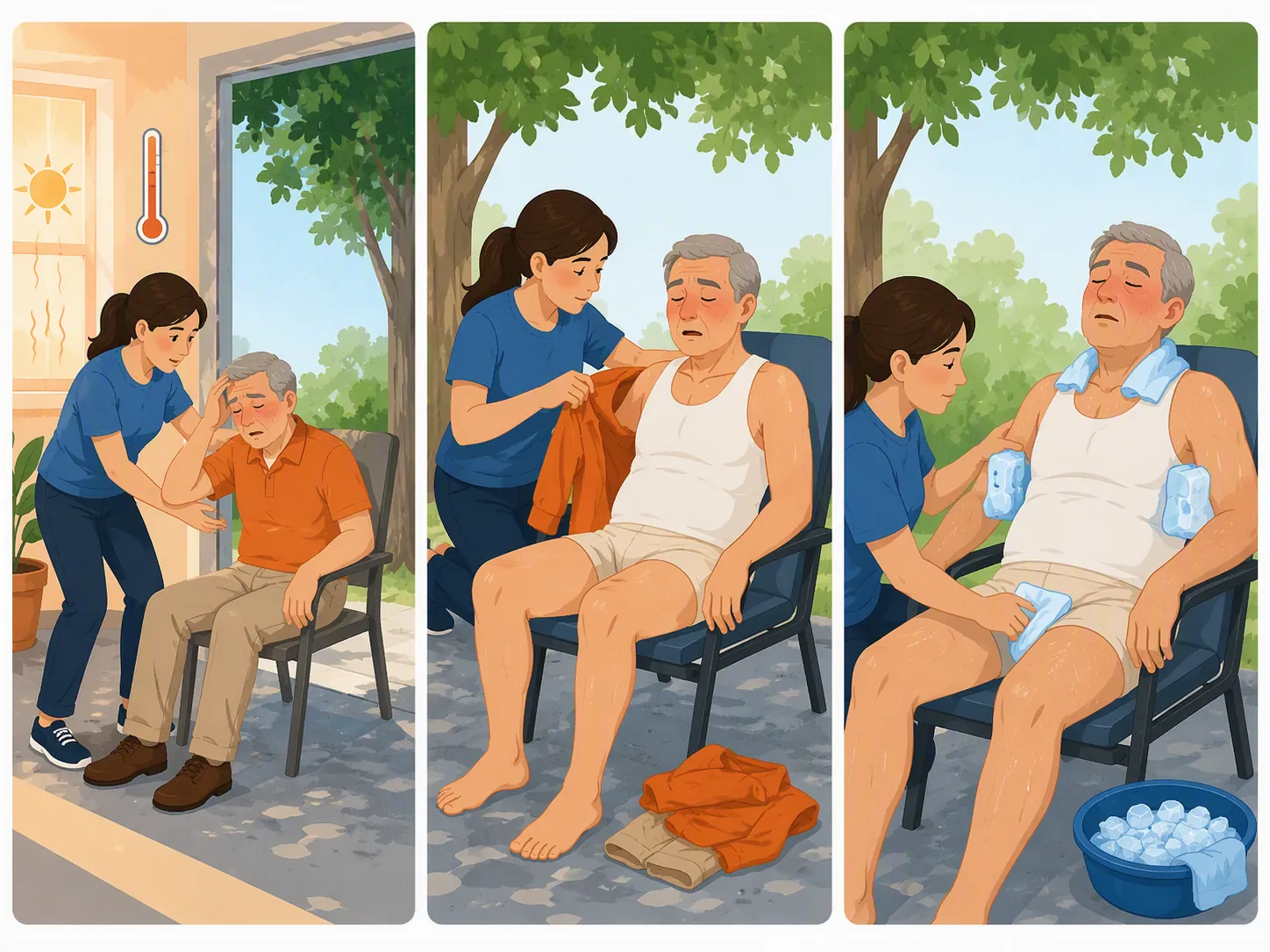
- Move the person out of the heat. Get them into air conditioning if available. If not, move them to shade, a cooler room, a hallway, or the coolest safe place nearby. Do not make them walk if they are faint, confused, or unsteady.
- Lay them down or keep them safely seated. If they are weak or dizzy, protect them from falling. If they vomit or are very drowsy, follow dispatcher guidance and keep the airway clear.
- Remove excess clothing. Take off outer layers, heavy shoes, hats, blankets, compression garments that are not medically urgent, or anything trapping heat.
- Cool the skin with water. Use cool wet cloths, towels, a spray bottle, a sponge, or a shower if it can be done safely. The National Weather Service and Mayo Clinic both include cooling the person with water, wet cloths, or similar methods while waiting for emergency help.[4][7]
- Place cold packs where large blood vessels are close to the surface. Use wrapped ice packs or cold wet towels on the neck, armpits, and groin. Do not put bare ice directly on fragile skin.
- Use a fan only if it is helping evaporation and the surrounding air is not dangerously hot. The National Weather Service warns that when the heat index is above the high 90s, a fan can make a person hotter instead of cooler.[4]
- Keep cooling until EMS takes over or the dispatcher tells you to change course. If the person seems more alert, do not cancel the call on your own; heat stroke can injure organs even after the person looks somewhat better.
If there are two helpers, split the work. One person stays with the older adult and cools them. The other unlocks the door, gathers the medication list, moves pets, and watches for the ambulance. If there is only one helper, stay close to the person unless the dispatcher tells you otherwise.
What not to do during suspected heat stroke
Bad first aid often comes from treating heat stroke like a fever, dehydration, or ordinary summer fatigue. In the first few minutes, treating it that way can waste time.
- Do not wait for a perfect thermometer reading. If the person is confused, fainting, or rapidly worsening in heat, call 911 and cool them.
- Do not rely on thirst. Older adults may not feel or report thirst reliably, and a person with heat stroke may be too confused to drink safely.
- Do not assume sweating rules out heat stroke. Mayo Clinic specifically notes that profuse sweating can happen in heat stroke.[6]
- Do not give acetaminophen or other fever reducers as if this were an infection. Cleveland Clinic warns that medications used to lower fever, including acetaminophen and aspirin, do not help heat stroke and may worsen organ damage.[2]
- Do not put the person in an unsafe shower, tub, or stairway situation if they are confused, faint, or too weak to support themselves.
The fluids question: why this guide takes the conservative path
You will see different advice about fluids. The National Weather Service says to call 911 and not give anything to drink during suspected heat stroke.[4] The American Red Cross also says not to give fluids when calling 911 for heat stroke.[5] Mayo Clinic’s first-aid page says to offer chilled water if the person is conscious and able to swallow.[7]
For an older adult with confusion, fainting, severe weakness, vomiting, or reduced alertness, use the conservative emergency rule: do not routinely give anything by mouth unless the 911 dispatcher or a clinician tells you to. Cooling the body and getting emergency care are the priority.
If they are alert and coherent, treat heat exhaustion seriously
Not every overheated older adult has heat stroke. A person who is tired, dizzy, nauseated, cramping, sweaty, or weak but still fully alert and answering normally may have heat exhaustion. That still deserves quick action: move them to a cooler place, loosen clothing, apply cool cloths, and give small sips of cool water if they can swallow safely. The National Weather Service advises getting medical help if heat-exhaustion symptoms worsen, vomiting occurs, or symptoms last longer than one hour.[4]
With an older adult, it is reasonable to set a lower bar for calling a clinician, urgent care, or 911. Heat exhaustion can slide into heat stroke, and the person watching from the doorway may see the change before anyone else does.
After the emergency: what recovery can look like
Heat exhaustion and heat stroke do not have the same recovery path. UCLA Health describes heat-exhaustion recovery as often taking 24 to 48 hours, with longer recovery possible for older adults and people with other health conditions.[10] True heat stroke is different. In an AMA interview, emergency physician Dr. Frederick Davis described heat-stroke care as often involving days in the hospital for cooling, IV fluids, and monitoring for organ damage, followed by weeks of rest and 7 to 21 days avoiding heat and exertion.[9]
A person may look better before their kidneys, liver, heart, or brain are fully out of danger. Harvard Health notes that complete recovery after heat stroke may take months.[8] That does not mean every case follows that course, but it is a reason not to wave off emergency evaluation once brain symptoms have appeared.
In the days after a heat emergency, watch for new confusion, unusual sleepiness, weakness that is not improving, reduced urination, dizziness when standing, shortness of breath, chest pain, or another episode of overheating. Follow the discharge plan closely, especially instructions about fluids, medications, activity, and when it is safe to return to normal routines.
Prevent the next crisis without turning this into a weather project
Heat-stroke prevention for older family members starts with the same practical question as the emergency itself: who will notice when the room is too hot and the person is not acting right? After a close call, set up a short heat plan rather than a binder nobody opens.
- Know which room stays coolest and whether the air conditioner actually works during afternoon heat.
- Set check-in times during heat waves, especially for someone who lives alone or tends to say they are “fine.”
- Ask a clinician or pharmacist whether any medications or health conditions increase heat risk.
- Keep emergency contacts, medication lists, and building access instructions easy to find.
- Plan outings around shade, restrooms, transportation, and a clear exit if the person starts to fade.
For broader planning, CareWise Guide’s severe-weather checklist for seniors covers heat sensitivity and preparation across hazards. For trips and crowded events, the guides to a senior-friendly Labor Day weekend in Philadelphia and state fair safety for seniors can help you think through shade, cooling breaks, and when to leave. If heat risk is part of a larger emergency-prep gap, use the hurricane preparedness checklist for seniors to organize medications, support people, and backup plans.
In an older adult, sudden behavior change in heat is enough to act. Call 911, start cooling, avoid the common mistakes, and let EMS decide how serious it is after the body is already being cooled.
References
- Heat-related Illnesses, CDC NIOSH
- Heatstroke, Cleveland Clinic
- Heat and Older Adults Aged 65+, CDC
- Heat Illness, National Weather Service
- Extreme Heat Safety, American Red Cross
- Heatstroke - Symptoms and causes, Mayo Clinic
- First aid: Heatstroke, Mayo Clinic
- Heat stroke (Hyperthermia) A to Z, Harvard Health
- What doctors want patients to know about heat stroke, American Medical Association
- Heat exhaustion recovery time is impacted by many factors, UCLA Health
Related reading
Noticed something outdated or inaccurate on this page? Flag a correction. We review every report against CDC, NIA, and AARP HomeFit guidance before updating a page.
Part of the Fall Prevention section.