
Protect Your Aging Parent From Wildfire Smoke Step by Step
This guide explains why wildfire smoke is more dangerous for older adults and provides a phased, step-by-step plan covering indoor air management, proper masks, medication prep, and evacuation readiness to keep your aging parent safe before, during, and after a smoke event.
When the forecast says wildfire smoke is coming, or the AQI app has already turned orange, protecting an older parent from wildfire smoke should start before the air looks frightening. For an older parent, treat AQI Orange — 101 and above — as the point to act, not the point to “keep an eye on it.” That is the level the CDC places in the unhealthy-for-sensitive-groups range, and older adults, especially those with heart disease, lung disease, diabetes, frailty, or limited mobility, belong in that group.
The first hour is not the time to debate every possible health effect. It is the time to assign jobs: who is checking the AQI, who is closing the house, who is setting up the clean room, who is looking at medications, and who knows what happens if the power goes out.
| Phase | What to do first | Why it matters for an older adult |
|---|---|---|
| AQI rising or smoke forecast | Start protective action at AQI 101; check local alerts and the hourly forecast. | Waiting until smoke is visible can leave a parent exposed during the early part of the event. |
| Before smoke arrives | Choose a clean room, prepare filtration, refill key medications, and confirm backup power needs. | The home has to be ready before windows need to stay closed and errands become harder. |
| During smoke | Keep outdoor air out, filter indoor air, avoid indoor particle sources, and limit outdoor trips. | Most exposure may happen at home if the indoor air is not actively managed. |
| If going outside is unavoidable | Use a well-fitting N95 or better respirator if tolerated. | Loose masks and poorly fitted respirators give a false sense of protection. |
| If symptoms, equipment problems, or evacuation risk appear | Call the clinician, utility, oxygen supplier, or local emergency line before the situation is urgent. | A parent with chronic conditions or power-dependent equipment may have less margin for delay. |
| After smoke clears | Ventilate when outdoor air improves, replace filters as needed, review symptoms, and restock supplies. | Recovery is part of the plan, not an afterthought. |
If you need a faster companion while you are making calls or texting siblings, use a wildfire smoke safety checklist for older adults alongside this more detailed guide. For AQI color bands and family alert thresholds, the separate guide on protecting an aging parent during an air quality alert is the better quick reference.
Why Older Adults Need Earlier Action
Wildfire smoke is not just “bad air.” The fine particles in smoke, PM2.5, can move deep into the lungs and affect the cardiovascular system. AARP, citing research by Aguilera and colleagues, reports that wildfire smoke PM2.5 may be about 10 times more toxic than equal doses of ambient PM2.5 from fossil fuel combustion.[1] That does not mean every smoky hour produces an emergency. It does mean the usual household instinct — wait, see, then react — is a poor fit for a parent whose lungs, heart, medications, mobility, and judgment under stress are already part of the safety picture.
The evidence also does not stay neatly in the lungs. The CDC advises people with chronic conditions, including heart disease, lung disease, and diabetes, to make specific plans for wildfire smoke because smoke can worsen symptoms and make it harder to manage existing illness.[2] A scoping review on wildfires and older adults describes higher risks across respiratory, cardiovascular, mental health, and evacuation-related outcomes, while also noting that only 24% of reviewed studies collected data directly from older adults themselves.[3] That gap matters. A chart can show admissions; it cannot show that Mom’s rescue inhaler is in a purse in the car, or that the window in the back bedroom never quite latches.
Event-specific numbers are useful when they change timing. During the 2023 Canadian wildfire smoke event affecting New York, CDC researchers reported a 17% increase in asthma emergency department visits on days when AQI exceeded 101, with an 82% jump on the worst day.[4] That is not a universal annual rate and should not be treated as one. But for a caregiver deciding whether Orange is “serious enough,” it is a practical signal: sensitive people can be affected before the sky looks apocalyptic.
Start With the AQI, Then Move From Watching to Doing
One person should be responsible for watching the AQI during smoke season. Not because older adults cannot check it themselves, but because a shared plan prevents the family from assuming someone else noticed the alert. Use AirNow, your local air district, emergency alerts, or a reliable weather app, and look at both current AQI and the next several hours.
- At AQI Orange/101: close windows and doors, start the purifier or HVAC filtration plan, move heavy activity indoors, and check medications.
- At AQI Red or worse: keep the parent indoors as much as possible, cancel nonessential errands, and watch symptoms more closely.
- If smoke is worsening and the parent uses oxygen, a nebulizer, CPAP, refrigeration for medication, or powered mobility equipment: start the power and backup-contact plan early.
- If the parent is confused, unusually breathless, having chest pain, or cannot keep essential equipment running: stop improving the room and seek medical or emergency guidance.
The AQI is a trigger, not a diagnosis. A parent with COPD, heart failure, diabetes, recent pneumonia, dementia, or frailty may need action at the same outdoor reading that a healthier adult would simply tolerate. The plan should be written for the parent in front of you, not for an average adult in a public service announcement.
Prepare One Clean Room Before the House Smells Smoky
The clean room is the practical center of the smoke plan. It does not have to be perfect. It should be a room where your parent can sit, sleep if needed, reach water and medications, charge a phone, and run filtration safely. A bedroom or living room often works better than a formal “best” room if that is where your parent will actually stay.
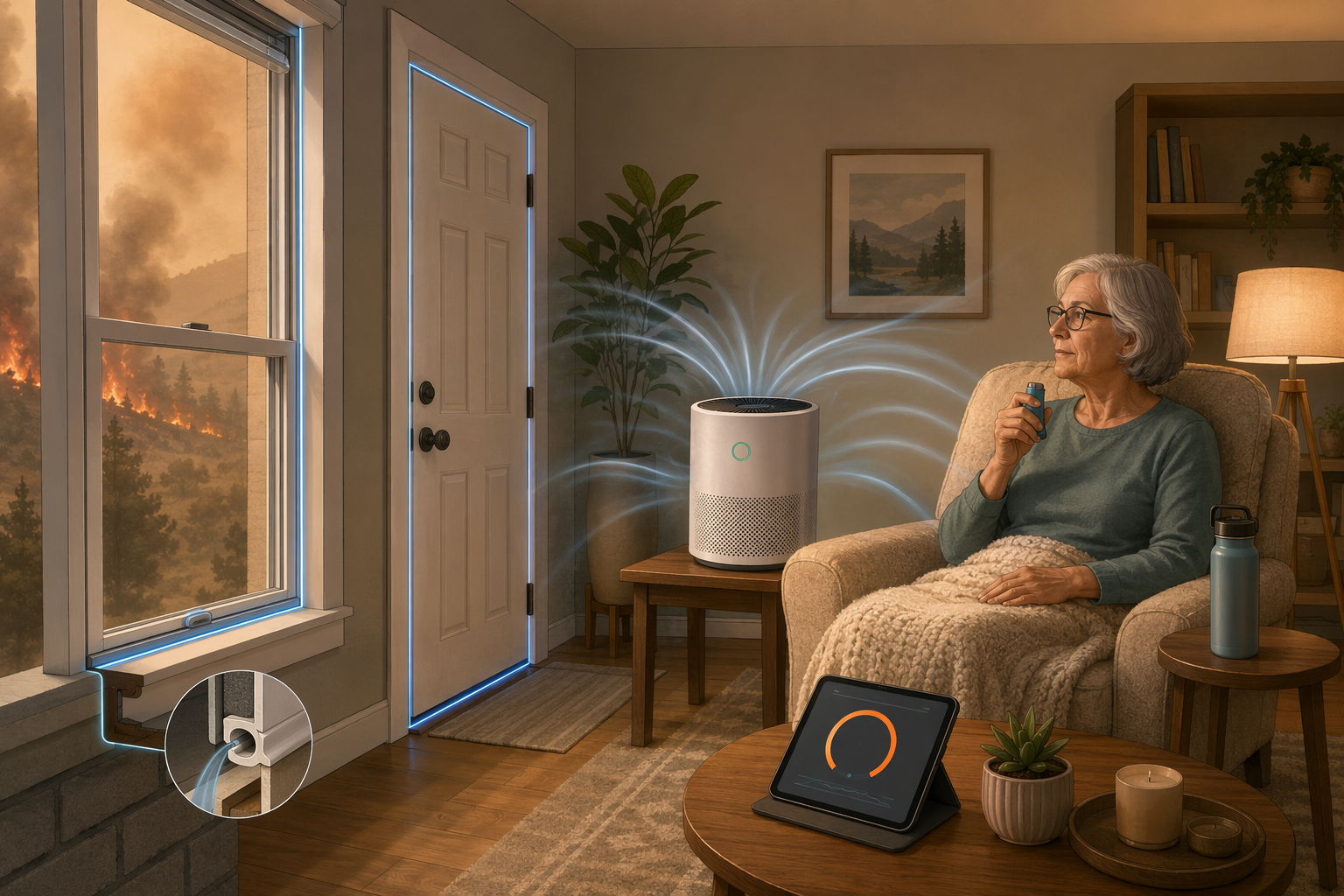
Before smoke arrives, close windows and exterior doors, then look for obvious leaks: a window that does not latch, a door gap, a fireplace damper left open, a bathroom fan that pulls smoky air inside. Oregon State University Extension advises keeping windows and doors closed during smoke events, using portable air cleaners or upgraded HVAC filtration when available, and reducing indoor particle sources.[5] If the home has central air, set it to recirculate if that option exists and use the highest-efficiency filter the system can handle safely.
A true HEPA portable air cleaner can make a meaningful difference in the clean room. EPA and Oregon State University Extension materials note that portable HEPA cleaners can reduce indoor PM2.5 during smoke events, with OSU citing reductions up to 45% in some conditions.[5][6] That number depends on the room, the cleaner, the fan setting, leaks, and how often doors open. It is not a promise that the room becomes safe; it is a reason to set up filtration early enough for it to work.

For a parent with COPD, asthma, or chronic bronchitis, the clean-room setup deserves extra attention. The room-by-room air quality checklist for seniors with COPD can help you walk through bedrooms, kitchens, bathrooms, vents, and filtration without trying to remember everything during an alert.
Do Not Add Smoke Indoors While Trying to Escape Outdoor Smoke
Indoor air can get worse even with the windows closed. During a smoke event, avoid candles, incense, fireplaces, wood stoves, frying, broiling, smoking, vacuuming without a HEPA filter, and anything else that throws particles into the room. If cooking is necessary, choose lower-particle options and use ventilation only when it does not pull smoky air indoors. This is the unglamorous part of the plan, but it matters because your parent may spend many continuous hours in that space.
DIY box fan filters, including Corsi-Rosenthal-style setups, can reduce particles when built and used correctly, but they are not a carefree substitute for a listed portable air cleaner. Oregon State University Extension cautions that box fan filters can create fire risk if operated unattended.[5] If a family uses one because cost or availability leaves no better option, someone should follow reputable instructions, use a newer fan with safety features, keep it away from curtains and clutter, and avoid leaving it running when no one is home or awake.
Permanent fixes may be worth planning after the season: better weatherstripping, window repair, HVAC assessment, or filter upgrades. Those are home-safety improvements, not luxuries, but cost is real. If the issue is bigger than a roll of tape and a portable purifier, look into home modification resources before the next fire season rather than trying to solve building leakage during a smoke alert.
Check Medications, Symptoms, and Conditions Before the Errands Become Hard
A wildfire smoke plan for an older parent should include the medicine cabinet. The CDC recommends that people with chronic conditions have enough medication, follow their health care provider’s plan, and know when to seek medical help during smoke exposure.[2] In a real household, that means checking refill dates before the AQI is Red, confirming where rescue inhalers are, and making sure the parent can actually open, read, and use what is available.
- For lung disease: confirm rescue inhalers, controller inhalers, nebulizer supplies, spacer devices, oxygen contacts, and the clinician’s action plan.
- For heart disease: watch for chest discomfort, unusual fatigue, swelling, palpitations, shortness of breath, or a sudden drop in usual activity tolerance.
- For diabetes: check testing supplies, insulin storage, food access, hydration, and sick-day instructions.
- For cognitive impairment: simplify instructions, label the clean room, and arrange more frequent check-ins because smoke, stress, heat, and isolation can blur routines.
- For dry eyes, skin irritation, or frailty: keep lubricating drops, skin care, water, glasses, hearing aids, and mobility aids within reach in the clean room.
Diabetes deserves a specific mention because the trouble may not look respiratory. Research summarized in Environmental Health Perspectives found increases in diabetes-related complications within 48 hours of wildfire smoke exposure.[7] That does not mean every person with diabetes will have a complication after two smoky days. It does mean blood sugar, hydration, food access, and medication routines belong in the smoke plan, especially if the parent tends to say, “I’m fine,” while eating less or moving less than usual.
Cognition can shift quickly, too. AARP’s 2026 health review quotes Kaiser Permanente physician Dr. Laura Myers describing cognitive effects that can appear within hours or days of smoke exposure.[1] A caregiver does not need to diagnose the cause of confusion to take it seriously. If a parent is suddenly mixing up medications, forgetting oxygen tubing, wandering outside to “check the air,” or sounding unusually disoriented on the phone, that is a safety change.
Eyes and skin are easy to dismiss until they keep someone from sleeping. AARP reports that dry eye syndrome, which smoke can worsen, affects up to 30% of adults over 50.[1] Irritated eyes may also interfere with reading medication labels, using a glucose monitor, or safely walking through the house. Small comfort supplies can prevent larger risks when an older adult is stuck indoors for days.
Use Respirators for Necessary Trips, Not as the Whole Plan
If your parent must go outside during wildfire smoke, a properly fitted N95 or better respirator is the usual starting point. Harvard Healthy Buildings explains that respirator choice after wildfire smoke should focus on filtration and fit; surgical masks, cloth masks, and loose coverings do not provide the same protection from fine smoke particles.[8] The American Lung Association also emphasizes limiting exposure and using appropriate respiratory protection when smoke cannot be avoided.[9]
Fit is the part many families skip. The respirator should seal around the nose and chin, and facial hair, small faces, weak hands, or arthritis can make that harder. Some older adults also cannot tolerate a tight respirator for long, especially if they have lung or heart disease. That is not stubbornness; it is a constraint the plan has to respect. If the respirator causes distress, dizziness, or worsening breathlessness, call the clinician for individualized guidance rather than forcing the issue.
For many parents, the better solution is to reduce the number of trips: refill medications early, postpone nonurgent appointments if the clinician agrees, arrange delivery, move trash bins later, and ask a neighbor or family member to handle outdoor chores. A mask helps during unavoidable exposure. It does not make smoky air harmless.
Plan for Power-Dependent Equipment Before the Utility Warning
Smoke events often overlap with heat, fire danger, and public safety power shutoffs. If your parent uses oxygen, a powered concentrator, CPAP, a nebulizer, refrigerated medication, an electric bed, a stair lift, or a power wheelchair, the smoke plan is also a power plan. The CDC’s wildfire preparedness guidance tells households to prepare emergency supplies, follow evacuation instructions, and plan for medical and access needs before a wildfire emergency.[10]
- Call the utility about medical baseline or medical needs programs before fire season if the parent depends on electricity for health equipment.
- Ask the oxygen or equipment supplier what backup options exist and how long each one lasts.
- Keep chargers, extension cords, batteries, printed instructions, and supplier phone numbers in one labeled place.
- Decide where the parent can go if the house loses power and indoor smoke protection fails.
- Write the plan down, because smoke emergencies are not a good time to rely on memory.
For evacuation bags, power backups, medical documentation, and communication planning, pair this smoke plan with severe weather safety tips for elderly people with medical needs. The same binder that helps during a heat wave or outage can keep a smoky week from turning into a medication or equipment scramble.
Know When Staying Put Is No Longer the Safer Choice
Staying inside with filtration may be reasonable when the parent is stable, the home can stay cool enough, the clean room is working, medications are available, and power-dependent equipment is secure. It becomes less reasonable when any one of those layers fails. Evacuation does not have to mean panic; sometimes it means leaving early enough that a parent with limited mobility is not trying to relocate after symptoms worsen or roads are crowded.
- Call a clinician promptly for worsening shortness of breath, wheezing, chest discomfort, faintness, severe fatigue, persistent high or low blood sugar, or new confusion.
- Call the equipment supplier or utility early if oxygen, CPAP, refrigeration, or mobility equipment may lose power.
- Consider leaving before conditions deteriorate if the home cannot be kept cool and filtered, the parent cannot avoid smoke indoors, or transportation requires extra time.
- Follow local evacuation orders immediately; indoor air improvements do not override fire danger.
Some risks are unevenly distributed. AARP notes that older adults with fewer resources may be less likely to have air conditioning, air purifiers, or access to healthier foods that could help them withstand smoke-related stress.[1] That is not a character flaw in the family or the parent. It is a reason to identify community cooling and clean-air spaces, senior centers, libraries, clinics, transportation programs, and relatives with safer homes before the AQI map turns red.
After the Smoke Clears, Do the Boring Follow-Through
When outdoor air improves, the job is not quite done. Ventilate the home when local guidance and AQI readings say outdoor air is better. Replace or check HVAC filters and portable purifier filters according to the manufacturer’s instructions, especially if they ran for long hours. Wipe surfaces where ash or dust settled, using care not to stir particles back into the air.
Ask your parent how the week actually went, not just whether they are okay. Did the clean room get too hot? Was the purifier too loud to sleep? Did the N95 feel impossible? Did anyone run out of test strips, inhaler doses, eye drops, or easy meals? Did the phone stay charged? Did confusion or breathlessness show up at a certain time of day? Those answers are the next version of the plan.
Wildfire smoke protection for an aging parent works best as layers: earlier AQI thresholds, cleaner indoor air, fewer indoor particle sources, realistic respirator use, medication and condition checks, power planning, and an evacuation decision made before the household is out of options. None of those layers makes a smoke event safe by itself. Together, they give an older adult a better chance to get through the event with dignity, comfort, and less avoidable risk.
References
- 8 Ways Wildfire Smoke Affects Your Health — AARP, July 17, 2026
- Wildfire Smoke and People with Chronic Conditions — CDC
- Wildfires and Older Adults: A Scoping Review of Impacts, Risks, and Interventions — PMC, 2023
- Notes from the Field: Asthma-Associated Emergency Department Visits During a Wildfire Smoke Event — New York, June 2023 — CDC MMWR, 2023
- Protecting Indoor Air from Wildfire Smoke — Oregon State University Extension, April 2023
- Wildfires and Indoor Air Quality — US EPA
- Wildfire Smoke Exposure and Diabetes-Related Complications — Environmental Health Perspectives
- Choosing the Right Respirator After a Wildfire — Harvard Healthy Buildings, Feb 2025
- Wildfire Smoke and Lung Health — American Lung Association
- Preparing for Wildfires — CDC
Related reading
Noticed something outdated or inaccurate on this page? Flag a correction. We review every report against CDC, NIA, and AARP HomeFit guidance before updating a page.
Part of the Fall Prevention section.