
Room-by-Room Air Quality Checklist for Seniors with COPD
This room-by-room checklist helps caregivers of seniors with COPD identify and reduce indoor air quality triggers using low-cost, actionable steps supported by clinical evidence — from bedroom HEPA filtration to kitchen exhaust fan usage.
The fastest way to make air quality tips for seniors with COPD useful is to stop treating the house like one big problem. Walk it room by room. The bedroom needs overnight filtration and fewer irritants. The kitchen needs ventilation every time food is cooked. The living room needs combustion and fragrance sources removed. The bathroom and utility spaces need humidity, mold, and filters kept on a schedule. None of that is glamorous. It is also the kind of work that can change what a parent breathes tonight.
The best clinical evidence here is specific, not magical. In the CLEAN AIR randomized trial, 116 former smokers with moderate-to-severe COPD used portable air cleaners with HEPA and activated carbon filtration. The intervention reduced indoor PM2.5 by 61% and nitrogen dioxide by 24%. The trial did not meet its primary St. George’s Respiratory Questionnaire endpoint in the intention-to-treat analysis, so it should not be sold as a cure. But active use was associated with a 68% lower moderate exacerbation rate, 46% lower rescue medication use, and clinically meaningful quality-of-life improvement in people who used the cleaners more than 80% of the time.[1]
That is the useful lesson: the device mattered, the room mattered, and adherence mattered. A purifier that gets turned off because it is loud, put in the wrong room, or run next to an open window is not the same intervention.
Start With the Bedroom
If you only have energy for one room today, start where the person with COPD sleeps. Overnight breathing is not a side issue. It is hours of repeated exposure in a closed space, often with bedding dust, fragrance, dry air, damp air, or a purifier that someone bought and then left on “auto” in the corner like a decorative appliance.
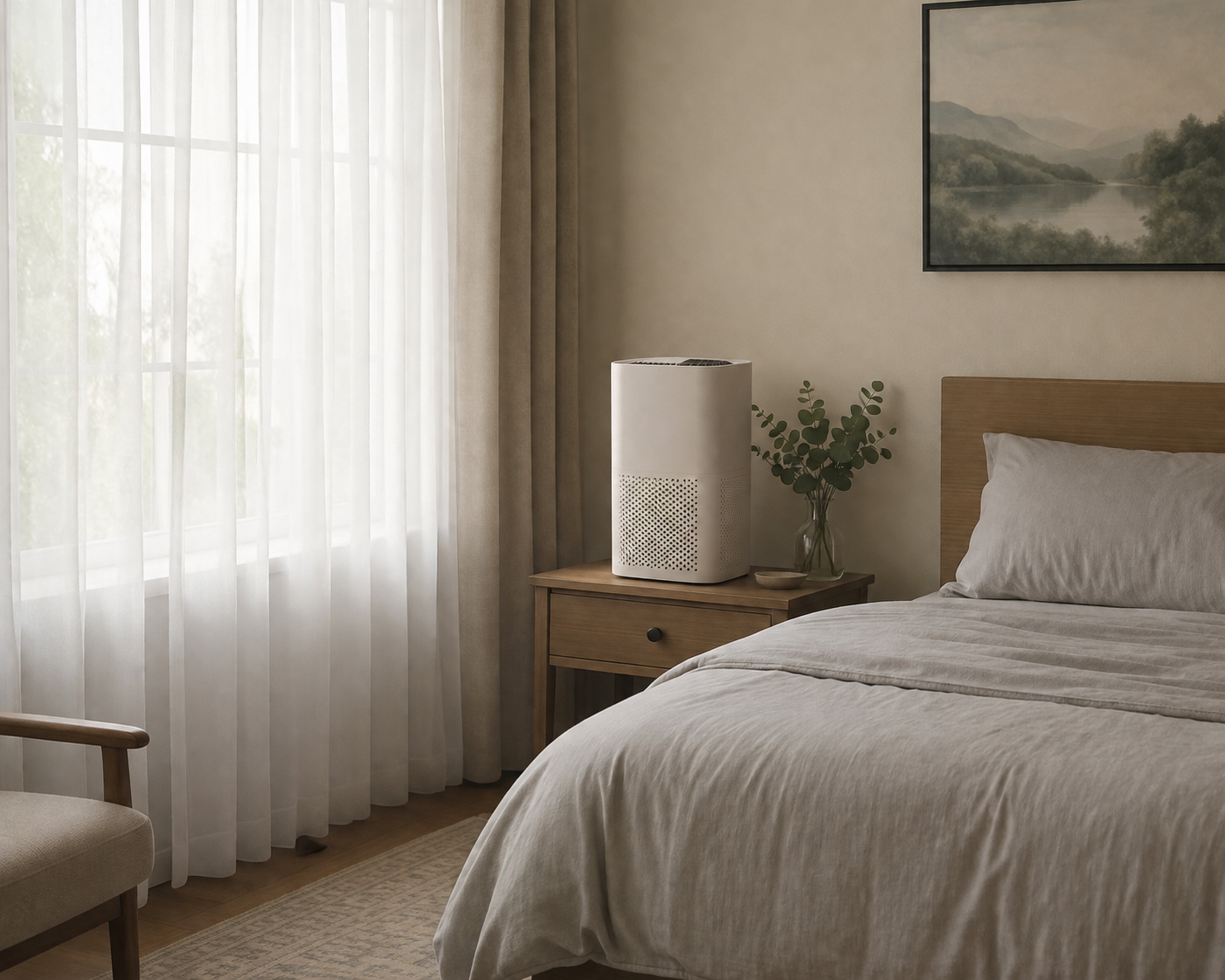
- Run a true HEPA air purifier with activated carbon in the bedroom continuously, especially overnight.
- Keep the bedroom door and windows closed while the purifier is running, unless there is a specific safety reason not to.
- Place the purifier where air can move freely around it, not wedged behind a chair, curtain, laundry basket, or nightstand.
- Choose a unit with no ozone generation, an appropriate clean air delivery rate for the room, and replacement filters the household can actually afford.
- Use the lowest setting that the person can sleep through if the high setting makes them turn it off.
The American Lung Association recommends looking for HEPA filtration, MERV 13 or higher where applicable, high clean air delivery rate, and no ozone generation when choosing air-cleaning products.[2] That last part is not a nice-to-have. Ozone is not something to add to the room of a person whose lungs are already doing overtime.
The bedroom also needs a boring bedding audit. Put allergen-proof covers on the mattress and pillows if dust mites are a likely trigger. Wash sheets and pillowcases regularly. Remove extra pillows, fabric throws, old stuffed animals, and decorative textiles that collect dust but do not help anyone breathe. This is not about making the room look sterile. It is about reducing the soft surfaces that quietly reload the air every time someone sits down, turns over, or makes the bed.
Humidity belongs in the same checklist, because both extremes can punish breathing. Aim for roughly 40% to 50% indoor humidity when possible. Too much humidity encourages mold and dust mites; too little can dry and irritate airways. If the room smells musty, the answer is not a plug-in fragrance. It is finding the moisture source, improving ventilation or dehumidification, and cleaning up mold safely.
- Remove scented candles, incense, plug-in air fresheners, essential oil diffusers, and heavily scented sprays from the bedroom.
- Switch laundry products used on bedding to fragrance-free versions.
- Vacuum with a HEPA-filter vacuum if available, or damp-dust surfaces so dust is captured instead of launched.
- Do not store cleaning chemicals, paint, hobby solvents, or gasoline-powered equipment near sleeping areas.
If the purifier is new, write the filter replacement date on painter’s tape and stick it to the unit. A hidden app reminder is fine until the person who set it up is not there. A visible date works for whoever walks into the room next.
Kitchen: Turn On the Fan Before the Pan Gets Hot
The kitchen is where a visible habit changes an invisible exposure. Cooking can add fine particles and combustion byproducts to indoor air. Gas stoves can emit nitrogen dioxide, the same pollutant that dropped by 24% in the CLEAN AIR intervention using HEPA plus activated carbon filtration.[1] If there is a working range hood that vents outdoors, it should go on before cooking starts and stay on for several minutes after cooking ends.
| Kitchen Trigger | What To Do Today | Why It Matters |
|---|---|---|
| Frying, searing, broiling, or smoky cooking | Use the exhaust fan every time and open ventilation only if outdoor air is safe | These methods can raise fine particle levels quickly |
| Gas stove or oven | Use the hood fan; consider electric or induction when replacing appliances | Gas combustion can add nitrogen dioxide indoors |
| Strong cleaners, degreasers, and sprays | Use fragrance-free, lower-irritant products and avoid aerosolizing cleaners | Volatile chemicals and fragrances can irritate airways |
| Burned food or lingering odors | Ventilate, clean the source, and skip scented cover-ups | Covering odor with fragrance adds another exposure |
This is also where people get sold a renovation when what they need first is a switch. Yes, induction can be a good direction when an appliance is already being replaced. No, a caregiver should not feel that the only serious option is a full kitchen overhaul this week. Use the fan. Cook with less smoke. Keep the person with COPD out of the kitchen during high-smoke cooking. Do not clean the stove with harsh chemicals while they are sitting ten feet away trying to recover from breakfast.
If the range hood only recirculates through a tired filter, replace that filter and consider adding a portable HEPA-plus-carbon purifier nearby, positioned safely away from heat, steam, and grease. It is not a substitute for outdoor-vented exhaust, but it may reduce particles in the room people actually use.
Living Room: Remove the Obvious Irritants First
The living room is usually the social room, the TV room, the nap room, and sometimes the room where everyone pretends one candle will not matter. For a senior with COPD, combustion and fragrance sources do not deserve sentimental protection.
- Make the home completely smoke-free, including visitors, porches near open doors, and attached garages.
- Remove candles, incense, wax melts, and scented plug-ins.
- Upgrade the HVAC filter to MERV 13 if the system can handle it, and replace it on schedule.
- Use a shoe-removal habit at the door to reduce tracked-in dust, pollen, and outdoor particles.
- Dust with a damp cloth and vacuum slowly, preferably when the person with COPD is in another room.
Indoor air is often worse than people assume. The American Lung Association notes that indoor air can have two to five times higher pollutant levels than outdoor air.[2] That does not mean opening windows is always the answer; during wildfire smoke, high ozone days, or heavy traffic pollution, outdoor air can make the house worse. It means the sources already inside the living room deserve attention before anyone buys a complicated system they will not maintain.
For acute outdoor air events, a separate plan helps. The same household that keeps a COPD bedroom purifier running every night may also need a stricter bad-air-day routine, like the steps in How to Protect an Older Adult During an Air Quality Alert. The everyday checklist and the emergency checklist are related, but they are not the same job.
Bathroom: Control Moisture Before It Becomes Mold
The bathroom does not need a speech. It needs the fan to work, the grout to be watched, and the damp towels to stop living in a pile. Run the exhaust fan during showers and leave it on long enough for mirrors and walls to dry. If there is no fan, use the safest available ventilation strategy, and do not leave the door closed on wet air for hours.
- Fix leaks promptly, including slow sink, toilet, and tub leaks.
- Wash or replace moldy shower curtains, bath mats, and caulk.
- Use fragrance-free soaps, shampoos, and cleaning products when possible.
- Avoid aerosol sprays in small bathrooms, especially before the person with COPD uses the room.
Mold cleanup can become unsafe when the area is large, the person cleaning has respiratory disease, or the material is porous and contaminated. Small maintenance is one thing. Pretending a serious moisture problem can be solved with bleach smell and optimism is another.
Utility Areas: Filters, Basements, Garages
Utility areas are where indoor air quality gets quietly neglected. Nobody wants to talk about the furnace closet at 9 p.m. after an ER discharge. Unfortunately, that is where a clogged filter, damp basement, stored solvent, or attached-garage fumes can keep feeding the same breathing problem.
- Replace HVAC filters every 30 to 90 days, or more often if the filter loads quickly, the home has pets, or outdoor smoke has been heavy.
- Use MERV 13 filtration if the HVAC system is rated for it; if not, ask an HVAC professional before forcing a filter the system cannot move air through.
- Keep basement humidity controlled with a dehumidifier when needed, and drain it reliably so it does not become another maintenance failure.
- Do not store gasoline, paint thinner, pesticides, or strong solvents in indoor areas connected to living space.
- Never idle a car, generator, or gas-powered tool in an attached garage.
The EPA has classified indoor air quality among the top five environmental health risks, and it recognizes a DIY box fan with a MERV 13 filter as a low-cost particle-reduction option in situations such as wildfire smoke when used safely.[3] That does not make a homemade cleaner the right choice for every senior household. Cords, fan stability, supervision, and fire safety matter. But it does mean low-cost particle reduction is not fringe advice.
The Printable Pass: What To Change in Each Room
| Room | First Move | Then Check |
|---|---|---|
| Bedroom | Run HEPA plus activated carbon filtration continuously with doors and windows closed | Bedding covers, fragrance removal, humidity around 40% to 50%, visible filter date |
| Kitchen | Use the exhaust fan before, during, and after cooking | Gas stove ventilation, low-smoke cooking, fragrance-free cleaners, no aerosol sprays |
| Living room | Remove smoke, candles, incense, and plug-in fragrances | MERV 13 HVAC filter if compatible, shoe removal, damp dusting, vacuum timing |
| Bathroom | Run the fan during and after showers | Leaks, moldy caulk, damp textiles, fragrance-free products |
| Utility areas | Replace HVAC filters on schedule | Basement humidity, chemical storage, attached garage fumes, dehumidifier drainage |
If you keep caregiver paperwork in one place, add this table to a binder or home notebook. A printable system only helps if someone can find it when the regular caregiver is sick, at work, or finally asleep. For a broader organizing template, use the free printable caregiver checklist binder and keep the filter dates, purifier model, and replacement filter size in the same section.
Where Fall Risk Fits
Cleaner indoor air should not be advertised as a fall-prevention device. That is too neat. The connection is more careful than that.
People with COPD have a substantial fall burden; one review reported an annual fall prevalence of about 40% among COPD patients.[4] Poor air quality can contribute to COPD symptoms and exacerbations, exacerbations can worsen oxygenation and weakness, and weakness and impaired balance can raise fall risk. CLEAN AIR also reported that participants took an average of 8.1 medications, and polypharmacy is its own fall-risk concern.[1] A 2025 pilot study on reducing fall risk in older adults with COPD adds support for treating fall risk as part of COPD care, not as a separate universe.[5]
So the honest version is this: no single trial has proved that room air cleaners prevent falls in COPD. But reducing respiratory stressors, preventing bad spells where possible, and keeping the person steadier during daily routines is a sensible part of fall-risk work. If that is the concern that brought you here, pair this checklist with How Hazardous Air Quality Increases Fall Risk and What to Do.
Buying an Air Purifier Without Getting Played
A purifier for a senior with COPD is not a vibes purchase. Look at the room size, clean air delivery rate, filter type, noise, replacement filter cost, and whether it produces ozone. If it is too loud to run all night or too expensive to maintain, it will become a white plastic guilt object in the corner.
- Prioritize true HEPA filtration for particles and activated carbon for gases and odors.
- Match the purifier to the bedroom first, not the whole house.
- Check the noise level at the setting likely to be used overnight.
- Price the replacement filters before buying the machine.
- Avoid ionizers, ozone generators, or devices that make broad health claims without clear filtration specs.
If you are comparing products for an older adult’s home, use the same sober approach you would use for grab bars, walkers, or medication organizers: who will use it, who will maintain it, what happens when it fails, and whether the claim matches the evidence. This home safety product evaluation guide can help keep the decision practical.
What This Checklist Can and Cannot Promise
About 16 million Americans have diagnosed COPD, and adults 65 and older are considered a sensitive group for air quality.[6] That is enough reason to take the home environment seriously. It is not enough reason to pretend every person with COPD will respond the same way to every indoor air change.
The strongest trial evidence discussed here came from former smokers with moderate-to-severe COPD, not current smokers and not every stage of disease.[1] The most impressive results depended on actual use. The fall-risk connection comes from combining evidence about COPD, exacerbations, weakness, medication burden, and falls; it is not a direct proof that air cleaning prevents falls.
Still, the right first move is clear enough: clean up the air your parent already breathes every day, one room at a time. Run the bedroom purifier all night. Use the kitchen fan every time. Ban the candles and plug-ins. Replace the filters before the next bad spell. Keep the medical care, the inhalers, the oxygen plan, and the clinician’s instructions exactly where they belong. This checklist is not a cure; it is a way to stop making the lungs fight the house too.
References
- Effect of Air Cleaners on Health in Chronic Obstructive Pulmonary Disease: A Randomized Clinical Trial, Johns Hopkins / PMC.
- Indoor Air Pollutants and Health, American Lung Association.
- Indoor Air Quality, U.S. Environmental Protection Agency.
- Falls in people with chronic obstructive pulmonary disease: a systematic review, Oliveira et al., 2015.
- Reducing fall risk in older adults with COPD: A pilot study, PMC, 2025.
- Air Quality, Centers for Disease Control and Prevention.
Related reading
Noticed something outdated or inaccurate on this page? Flag a correction. We review every report against CDC, NIA, and AARP HomeFit guidance before updating a page.
Part of the Fall Prevention section.