
Fall-Proof Your Home with These Hurricane Safety Tips for Elderly
A room-by-room guide to preventing falls when hurricanes cause power outages, flooding, and rushed evacuations — addressing hazards that typical checklists overlook.
The dangerous part of a hurricane is not always the wind at the window. Inside an older adult’s home, the trouble often starts smaller: the power goes out, the hallway becomes a storage lane for bottled water, the bathroom trip happens by flashlight, the entry rug gets damp and curls, and the walker has to squeeze around things that were moved “just for now.”
Most hurricane safety tips for older adults cover the obvious essentials: food, water, medications, documents, radios, chargers, evacuation orders. Those matter. But for an older parent who is trying to stay independent, the missing layer is a storm-specific fall audit. The question is not only, “Do we have supplies?” It is, “Can Dad reach the bathroom, bed, phone, medication, front door, and car when the house is dark, wet, crowded, or rushed?”
That is a practical extension of established preparedness guidance, not a claim that any one checklist has been proven to prevent hurricane-related falls. Keystone Health frames emergency preparedness for older adults around safety, self-sufficiency, and support systems, which is the right way to think about fall risk during a storm: the home has to be safer, the parent has to be able to function for a while, and someone else has to know where the weak points are before the weather arrives.[1] Ready.gov’s older adult guidance uses a similarly useful sequence: assess needs, make a plan, and engage a support network.[2]
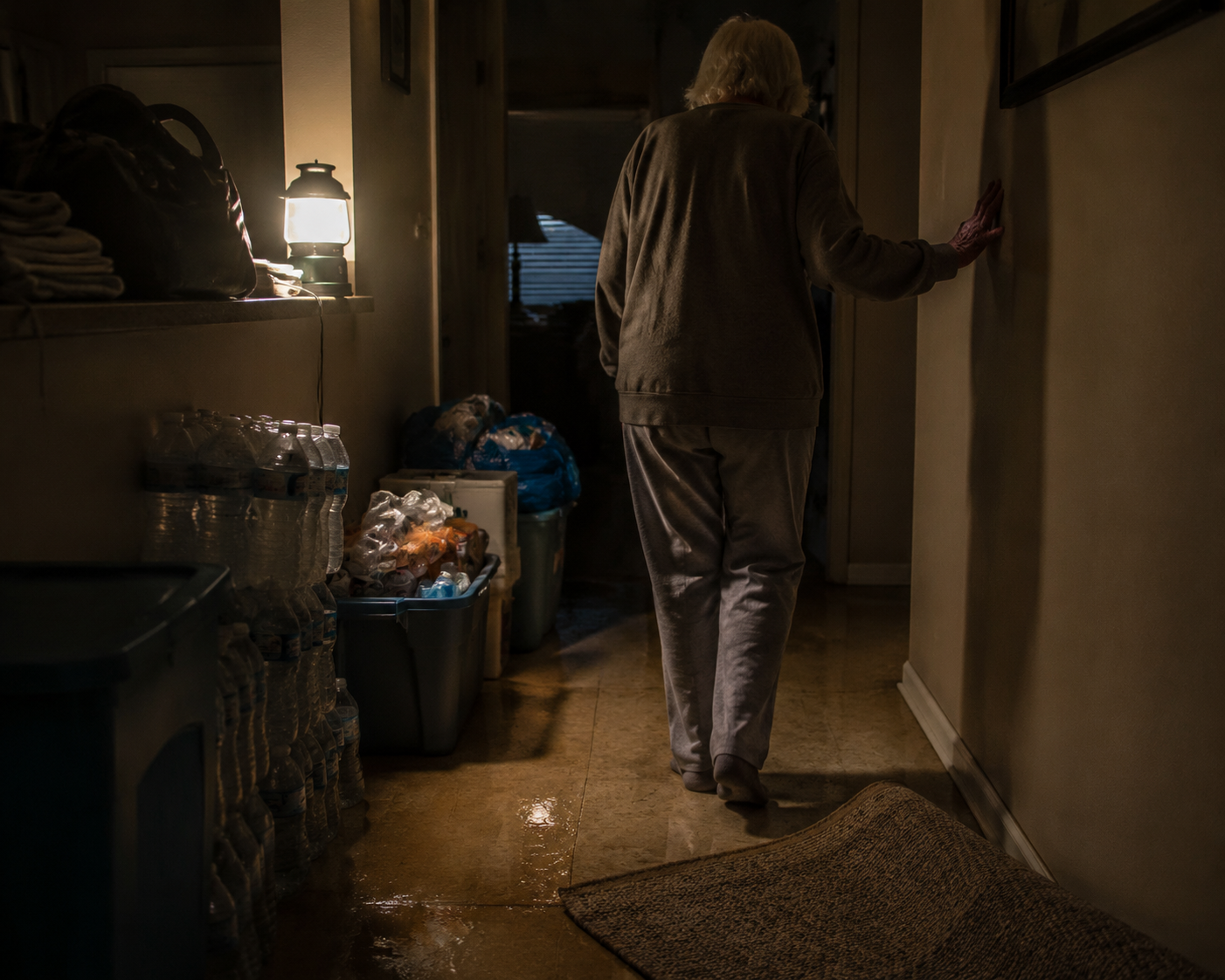
Start with the storm version of the house
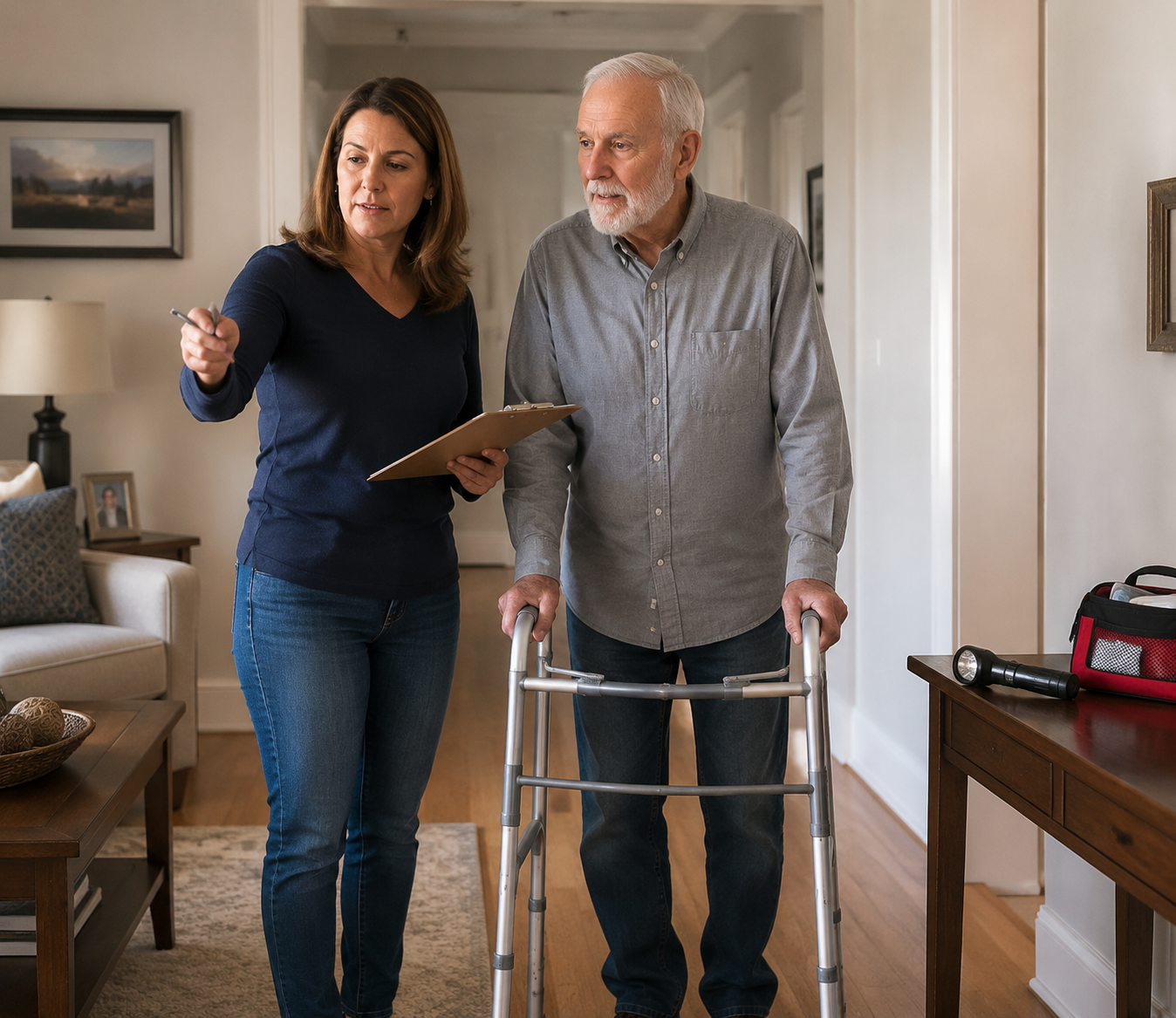
Do the audit before the season gets busy, not when a named storm is already on the map. Walk the home the way your parent would use it during a long outage: from the favorite chair to the bathroom, from the bed to the kitchen, from the kitchen to the medication spot, from the bedroom to the exit, from the exit to the car.
Do not audit the tidy version of the house. Put a case of water where it usually lands. Pull out the emergency bin. Move the cooler into the kitchen. Turn on only the lights that would work if the power failed, or walk the route with a flashlight. If your parent uses a walker, cane, rollator, wheelchair, oxygen tubing, portable concentrator, bedside commode, or scooter, include it in the walkthrough.
The CDC’s hurricane guidance emphasizes avoiding floodwater, using generators safely, and taking care with food, water, cleanup, and power outages.[3] For fall prevention, those same conditions change the inside of the home: floors get wet, lighting fails, routines shift, and people hurry. That is where a room-by-room audit earns its keep.
| Storm change | Fall hazard it creates | What to check before hurricane season |
|---|---|---|
| Power outage | Dark routes to bathroom, bed, phone, and exits | Flashlights, battery lanterns, night lights with backup power, clear bedside path |
| Emergency supplies moved indoors | Cases, bins, coolers, and cords narrowing walkways | A storage zone that does not touch mobility routes |
| Wind-driven rain or flooding | Wet entries, curled rugs, slick tile, hidden thresholds | Rug removal, towels or mats placed safely, dry shoes near entry |
| Evacuation pressure | Rushed walking, forgotten mobility aids, crowded doorways | A practiced exit route and a ready-to-lift go bag |
| Medical device dependence | Trips over cords, panic if batteries fail, unsafe movement to find power | Charging plan, backup power discussion, device list for helpers |
Clear the routes that will matter in the dark
There are usually five storm routes worth protecting first: bed to bathroom, chair to bathroom, chair to kitchen, bedroom to exit, and exit to car. If those routes are safe, the house is not perfect, but the most predictable movements are less likely to turn into an obstacle course.
Walk each route at your parent’s pace. If your parent uses a walker, the route has to fit the walker without angling around boxes. If your parent furniture-walks, the answer is not to scold them into better habits during a storm; it is to make sure the stable touch points are not blocked by a cooler, a laundry basket, or a stack of supplies.
- Move bottled water, pet food, coolers, and emergency bins out of hallways before a storm watch becomes stressful.
- Remove loose throw rugs from the main storm routes, especially near entries and bathrooms.
- Tape down or reroute charging cords so they do not cross walking paths.
- Keep shoes with nonslip soles near the bed and main chair; bare feet and wet tile are a bad storm combination.
- Place one stable chair near the exit if your parent may need to sit while waiting, changing shoes, or being picked up.
If you already use a regular fall checklist, keep it, but run it through storm conditions. A daily-life hazard becomes more serious when the house is dim and everyone is distracted. CareWise’s broader Senior Storm Safety checklist can sit beside this audit, but the storm routes deserve their own pass.
Make lighting reachable, not merely available
A flashlight in the junk drawer is not a lighting plan for an older adult who wakes at 2 a.m. and needs the bathroom. Put light where the hand already goes: bedside table, favorite chair, bathroom counter, kitchen counter, and exit table. Battery lanterns are often easier than narrow flashlight beams because they free both hands and light the floor ahead.
Test the lighting with the actual person who will use it. Can they find the switch by touch? Can they turn on the lantern with stiff fingers? Can they carry it while using a cane? If they use a walker, a clip-on light or a small lantern placed along the route may be safer than asking them to hold a flashlight.
Avoid creating a new hazard with the fix. Extension cords across the floor, rechargeable lights placed far from the walking route, and heavy lanterns stored on high shelves all defeat the point. The best storm light is the one your parent can reach before standing up.
Treat the bathroom as the highest-risk room
The bathroom becomes more dangerous during a hurricane because the usual timing changes. People drink differently, sleep poorly, wait longer, wake in the dark, and may be moving around on wet floors. If only one room gets a serious pre-season fall audit, make it this one.
- Put a battery lantern or motion light where it illuminates the toilet path without shining directly into the eyes.
- Remove small rugs unless they have a firm nonslip backing and stay flat when damp.
- Place towels where they can dry a small spill without being left in a heap on the floor.
- Check that grab bars, toilet frames, shower chairs, and raised toilet seats are stable before storm season, not during it.
- Consider whether a bedside commode is safer for a parent who has urgent nighttime bathroom trips during outages.
This is not about taking away independence. It is about protecting the movements your parent will make whether anyone is awake to help or not.
Keep the bedroom ready for a power-out night
The bedroom should work like a small command post after bedtime. From the bed, your parent should be able to reach light, phone, glasses, water, medication if needed overnight, shoes, and mobility aid without standing first.
Place the walker or cane in the same position every night during hurricane season. Clear the floor around the bed so a blanket, charging cord, oxygen tubing, or laundry pile does not become the first obstacle of the day. If the bed is too high or too low, a rushed storm week is the wrong time to discover it.
If your parent sleeps in a recliner during storms because it feels safer or more comfortable, audit that route too. The recliner-to-bathroom path may matter more than the bedroom on the nights when the wind is loud and no one sleeps normally.
Do not let supplies become the fall hazard
Emergency supplies are necessary. They are also bulky. Cases of water, canned food, battery packs, pet supplies, coolers, and plastic bins tend to migrate into the exact spaces an older adult needs for balance and turning. The fix is not fewer supplies; it is a storage rule.
Pick one supply zone that does not cross a walking route. A dining room corner may be better than a hallway. A low shelf may be better than a deep closet. Heavy items should be stored between knee and waist height when possible, so your parent is not reaching overhead or bending to the floor during an outage.
Keep the most frequently needed items separate from the big kit: flashlight, phone charger, medication list, hearing aid batteries if used, glasses, water, snack, and emergency contacts. If the only way to get a charger is to open a bin on the floor in a dark room, the kit is organized for storage, not use.
Plan for wet entries before the first bands arrive
Rain does not have to flood a home to create fall risk. A damp threshold, slick tile, wet shoes, and a towel dropped in a hurry can be enough. If flooding is possible, the problem grows: water can hide uneven flooring, debris, and thresholds. CDC hurricane guidance warns people to avoid floodwater and take precautions during cleanup because floodwater can contain hazards.[3]
Before the storm, remove decorative entry rugs that slide, curl, or bunch. Set out a stable, low-profile mat only if it stays flat. Place dry shoes with traction near the main interior route, not outside where they may get wet. Keep towels available, but assign a place for used wet towels so they do not end up as floor clutter.
For homes with repeated water problems, pair this audit with a fuller room-by-room flood plan. CareWise’s flood-proofing guide for an older parent’s home can help separate water-control tasks from the immediate fall-prevention tasks.
Check power needs as a mobility issue
Backup power is often discussed as a medical issue, and it is. It is also a fall issue when the device affects movement. A power chair, scooter, lift recliner, adjustable bed, oxygen concentrator, CPAP machine, stair lift, or phone can change whether an older adult can move safely, call for help, or sleep well enough to stay steady the next day.
The affordability gap is real. A survey discussed by The Conversation and PBS reported that only 25% of older adults had backup power for medical devices, and 24% said they could not afford a week away from home.[4] Those numbers do not prove who will fall during a hurricane. They do explain why “just evacuate early” or “just buy backup power” is not a complete plan for many families.
Make a device list that a tired helper can understand. Write down what each device does, how long it can run unplugged if known, where the charger is, whether it can go in the car, and who to call if power is expected to be out. Ready.gov advises older adults to consider medical, transportation, mobility, and support needs when making a disaster plan.[2]
If generators are part of the plan, keep the fall audit separate from the generator setup. The CDC warns that generators should be used safely to avoid carbon monoxide poisoning.[3] From a fall-prevention angle, that also means cords, fuel containers, and equipment should not block the older adult’s walking route.
Put medications where the plan can survive disruption
Medication problems can become fall problems when a missed dose affects blood pressure, balance, pain, sleep, blood sugar, or alertness. The Red Cross recommends that older adults keep at least a 30-day supply of medications and medical supplies when possible.[5] That is the supply side. The access side is just as important.
Keep a current medication list in the go bag and in an easy-to-reach home location. Include prescribing doctors and pharmacy information. If medications require refrigeration, decide ahead of time what happens during an outage. If pills are stored in more than one room, identify which ones must leave with your parent during evacuation.
The medication bag should be light enough to carry or easy to attach to a walker without changing balance. A heavy shoulder bag can pull an unsteady person sideways. A plastic bin may be organized but impossible to manage during a hurried exit.
Rehearse evacuation as movement, not paperwork
An evacuation plan on paper can miss the hardest part: getting an older adult from chair to car with the right shoes, walker, medications, phone, charger, hearing aids, glasses, and dignity intact while everyone is watching the clock.
PBS NewsHour has reported on why evacuation can be more difficult for older adults in disasters, including mobility, health, transportation, and care coordination barriers.[6] That difficulty changes fall risk because rushing compresses decisions. People skip the walker “just this once.” They carry too much. They step over thresholds they would normally approach slowly. They leave behind the device that would have kept them steady at the shelter or family home.
Practice the exit once on a normal day. Not a dramatic drill; a plain walkthrough. Where does the walker turn? Which door is easiest? Does the storm shutter hardware narrow the path? Can your parent sit while the car is being loaded? Who carries the go bag? Where do keys live? If there is a step at the threshold, who knows how your parent manages it?
- Keep the go bag near the exit but out of the walking path.
- Attach a tag to mobility aids with name, phone number, and emergency contact.
- Put a spare phone charger and medication list in the evacuation bag, not only in the kitchen drawer.
- Decide who physically assists at the door and who handles supplies, so your parent is not balancing while others search.
- If evacuation may require public transportation, medical transport, or a shelter that can support medical needs, identify that before storm week.
For parents with more complex equipment or health needs, use a separate medical-needs plan alongside the fall audit. CareWise’s severe weather medical needs guide is a useful companion.
Divide the work before the storm divides your attention
One adult child cannot be the weather service, transportation coordinator, medical assistant, supply manager, and night-shift fall monitor all at once. Ready.gov’s “assess, plan, engage” structure is useful because it forces the support question into the plan instead of leaving it as a vague hope.[2]
Make the contact list specific. One person checks prescriptions. One confirms transportation. One neighbor knows where the spare key is. One relative calls after power outages. One person knows whether your parent uses a walker inside the home, not just outside. Support systems fail when everyone assumes someone else has the detail.
Write the list on paper and put it where your parent can find it. Phones die, passwords get forgotten, and stress makes simple things hard. If your parent resists too much visible planning, keep the list modest and practical: names, numbers, roles, pharmacy, doctor, utility company, transportation option.
When sheltering in place, reduce unnecessary trips
If your parent is staying home during the storm, set up a safe zone before conditions deteriorate. This is not a bunker. It is the room where your parent can sit, charge devices if power is available, reach water, use a light, access the phone, and get to the bathroom by the clearest route.
Bring essentials to that room before the wind rises: glasses, hearing aids and batteries if used, phone, charger, medication schedule, water, snack, flashlight or lantern, sweater, shoes, and mobility aid. The point is to reduce wandering through a dark house to look for ordinary things.
During heavy rain warnings, the same logic applies even without a full hurricane threat. Wet outdoor steps, ponding water near entries, and poor visibility can raise the risk of a bad misstep. CareWise’s heavy rain fall-prevention guide covers that narrower situation.
A pre-season fall-proofing audit you can finish in one afternoon
A perfect plan is not the standard. A usable plan is. If you have one afternoon before hurricane season gets active, spend it on the parts that change how your parent moves through the home.
- Walk the five key routes: bed to bathroom, chair to bathroom, chair to kitchen, bedroom to exit, and exit to car.
- Remove or relocate anything that narrows those routes, including water cases, bins, cords, rugs, coolers, and small furniture.
- Place lights where your parent can reach them before standing, then test them in low light.
- Set up the bathroom for night use: stable support, dry floor plan, reachable light, and no loose rug.
- Create a light, reachable medication and document grab bag that does not change your parent’s balance.
- List every power-dependent device and decide what happens if it cannot be used.
- Practice the exit route once with the actual walker, cane, wheelchair, or other aid.
- Assign support roles so one person is not trying to solve transportation, medications, charging, and check-ins during the same hour.
If a storm is already close, narrow the job. Clear the routes, set the lights, secure the bathroom, move the supplies out of the way, and put the medication bag where it can leave with your parent. The rest can wait.
The goal is not a disaster-proof house. It is a house where an older adult can make the predictable storm movements with fewer preventable hazards: stand up in the dark, reach the bathroom, avoid wet flooring, get to the phone, use the walker, and leave without stepping around the very supplies meant to keep them safe.
References
- Emergency Preparedness for Seniors, Keystone Health.
- Older Adults, Ready.gov, updated March 2026.
- Hurricanes, Centers for Disease Control and Prevention.
- 5 tips for hurricane disaster planning with aging parents – starting now, before the storms, The Conversation.
- Older Adults, American Red Cross.
- Why it can be more difficult to evacuate older adults in a disaster, PBS NewsHour.
Related reading
Noticed something outdated or inaccurate on this page? Flag a correction. We review every report against CDC, NIA, and AARP HomeFit guidance before updating a page.
Part of the Fall Prevention section.