
Senior Care Options After a Fall: Matching Care Levels to Recovery Needs
A fall is often the crisis that triggers the first serious conversation about senior care. This guide maps each level of the care continuum — from aging in place with home modifications through skilled nursing — to the post-fall clinical pathway, giving families a decision framework anchored in their immediate reality.
The Moment After the Fall: Why This Is the Right Time to Evaluate Care Options
The phone call no adult child wants to receive has come. Your parent has fallen. Maybe it was a stumble in the bathroom, a misstep on the stairs, or a dizzy spell in the kitchen. The immediate crisis — the ambulance ride, the emergency room, the X-rays — is stabilizing. But a new, more complex question is already forming: What happens next?
Falls are not just common; they are the leading cause of injury-related hospitalization among older adults. And they are the single most frequent trigger for families to begin evaluating senior care options. The National Institute on Aging notes that many falls happen at home, and the aftermath often reveals what was previously hidden: a parent who has been struggling with mobility, managing medications poorly, or living in a home that is no longer safe for their changing needs.
The challenge is that most guides to senior care present options as a static menu: home care, assisted living, nursing home. But a post-fall recovery is not static. Your parent may need intensive rehabilitation in a skilled nursing facility for two weeks, then step down to assisted living, then return home with home care and home modifications. The care continuum is a dynamic pathway, not a one-way decision.
This guide maps each level of the care continuum — from aging in place with home modifications through skilled nursing — directly to post-fall recovery needs. It gives you a decision framework anchored in your immediate reality: your parent's current functional status, fall risk, and recovery trajectory.
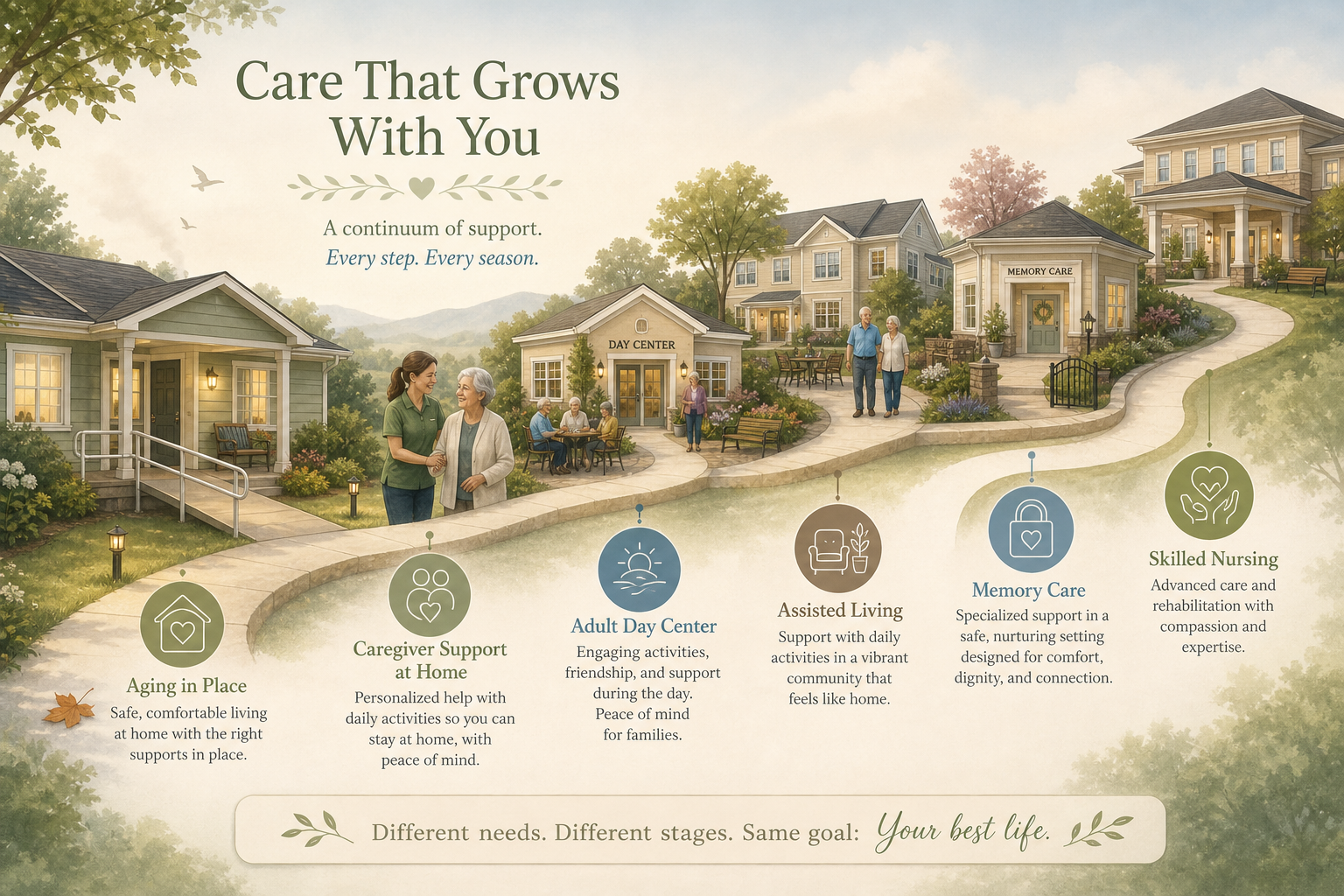
The Senior Care Continuum: A Ladder of Options from Home to Skilled Nursing
The senior care landscape is not a collection of unrelated choices. It is a spectrum of support levels, each designed for a different degree of functional need. Understanding this continuum is the first step to matching your parent's post-fall status to the right setting.
Below is each level of care, ordered from least to most intensive support, with 2026 median monthly costs drawn from multiple authoritative sources. Note that costs vary significantly by state and level of care required.
| Care Level | What It Offers | 2026 Median Monthly Cost | Source |
|---|---|---|---|
| Independent Living | Housing, meals, social activities, minimal personal care | $3,200 | A Place for Mom |
| Home Care (Non-Medical) | Personal care, companionship, light housekeeping, meal prep | $34–$35/hr (~$2,944/mo at 20 hrs/week) | A Place for Mom / CareScout |
| Home Health Care | Skilled nursing, physical therapy, wound care (short-term, Medicare-covered) | Varies by agency; typically $150–$250 per visit | NIA / Medicare |
| Adult Day Services | Supervision, meals, social activities during daytime hours | $95 per day (~$2,090/mo for 22 days) | U.S. News |
| Assisted Living | Housing, meals, personal care, 24/7 supervision, medication management | $5,419–$6,200 | A Place for Mom / CareScout |
| Memory Care | Secured environment, specialized dementia care, structured routines | $6,690–$7,645 | A Place for Mom / U.S. News |
| Skilled Nursing (Semiprivate Room) | 24/7 skilled nursing care, rehabilitation, long-term custodial care | $9,842 | SeniorLiving.org |
| Skilled Nursing (Private Room) | Same as above with private accommodation | $11,294 | SeniorLiving.org |
Related reading
Noticed something outdated or inaccurate on this page? Flag a correction. We review every report against CDC, NIA, and AARP HomeFit guidance before updating a page.
Part of the Fall Prevention section.