
5 Kitchen 'Safety' Products That Can Actually Increase Fall Risk for Seniors — and What to Use Instead
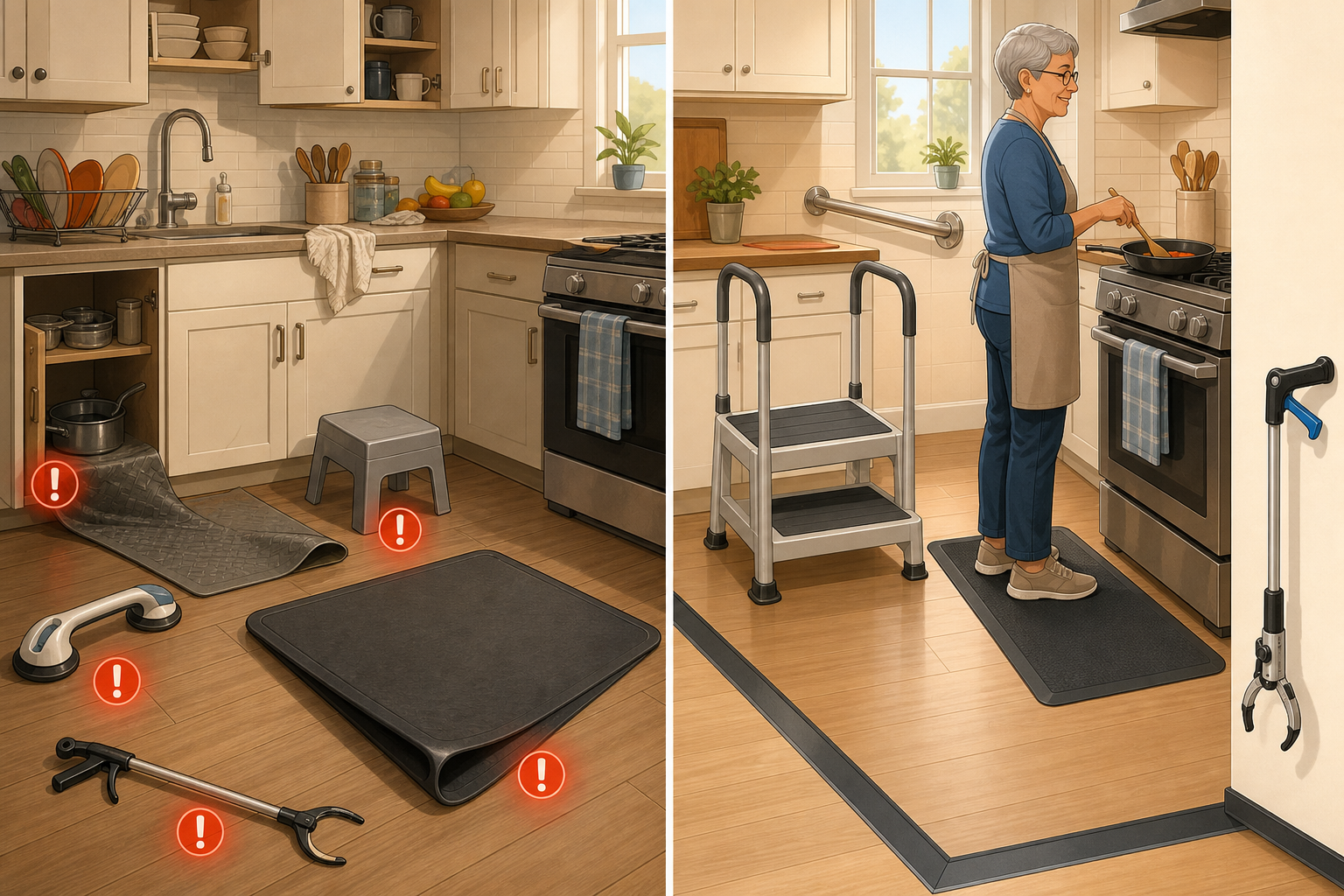
Many products marketed as fall prevention for the kitchen can paradoxically increase fall risk due to design flaws or improper installation. This guide identifies five common culprits — from non-slip mats to suction-cup grab bars — and provides evidence-based alternatives to help adult children make safer choices for their aging parents.
Introduction: When 'Safety' Products Become Hazards
Walk into any home goods store or browse online marketplaces, and you'll find an entire aisle dedicated to 'senior safety' products for the kitchen. Non-slip mats, step stools with grabbers, suction-cup grab bars, anti-fatigue mats, and long-reach tools — all marketed as essential equipment for preventing falls. The message is clear: buy these products, and your parent will be safer.
The reality is more complicated — and more dangerous. Many of these products, through design flaws, improper installation, or simple misuse, can paradoxically increase the very fall risk they claim to reduce. The Centers for Disease Control and Prevention (CDC) reports that more than 1 in 4 older adults falls each year, leading to about 3 million emergency department visits annually. While clutter and throw rugs are well-known hazards, the products designed to fix those problems can introduce new, less obvious risks.
This guide is for the adult child who has already bought these products in good faith. We'll walk through five common kitchen 'safety' items that can work against you, explain the specific mechanisms that make them dangerous, and offer evidence-based alternatives that actually reduce fall risk.
Product 1: Standard Non-Slip Kitchen Mats — The Curled-Edge Trip Hazard
Non-slip mats are one of the most common 'safety' purchases for the kitchen. The logic seems sound: place a mat in front of the sink or stove to provide traction on a floor that might get wet or greasy. But the design of standard non-slip mats introduces a predictable failure mode: curled edges.
Within months of use, the edges of many non-slip mats begin to curl upward. This creates a raised lip — often just a quarter-inch high — that is enough to catch the toe of a shoe or slipper. For an older adult with reduced toe clearance during walking (a common age-related gait change), that quarter-inch edge is a genuine trip hazard.
The data on rug and mat-related falls is sobering. A study published in the Journal of the American Geriatrics Society (PMC) estimated that 37,991 adults aged 65 and older were treated annually in U.S. emergency departments for fall injuries associated with carpets and rugs between 2001 and 2008. Of those, 72.8% occurred at home, and 41.7% resulted in a fracture. Women represented 80.2% of these injuries. The study noted that falls commonly occurred at the transition between the rug or mat and the bare floor — exactly where a curled edge sits.
The National Institute on Aging (NIA) is unequivocal on this point: 'Don't use throw rugs or small area rugs.' The NIA's guidance recommends removing them entirely rather than attempting to secure them. The National Council on Aging (NCOA) similarly advises replacing scatter rugs with rubber-backed rugs and ensuring any mat 'doesn't have turned corners or edges you could trip on.'
What to Use Instead
- Remove the mat entirely. This is the safest option. If the floor is slippery when wet, address the floor surface itself rather than covering it.
- Install beveled rubber flooring strips. These are thin, permanently adhered strips that transition between floor surfaces without a raised edge. They provide traction without creating a trip point.
- If a mat is absolutely necessary, choose one with a heavy rubber backing and a beveled edge that is less than 1/8 inch thick. Inspect it monthly for any signs of curling and replace it immediately if edges lift.
Product 2: Generic Step Stools Without Handrails — Missing Three-Point Contact
A small, lightweight step stool seems like an obvious solution for reaching upper cabinets. But the vast majority of step stools sold in big-box stores are designed for general household use, not for older adults with balance concerns. The critical missing feature: bilateral handrails.
Three-point contact — having two hands and one foot, or two feet and one hand, in contact with a stable surface at all times — is the gold standard for safe stair and step use. A step stool without handrails forces the user to reach upward while balancing on a narrow platform, with nothing to hold onto. This is a recipe for a backward fall.
The NIA recommends: 'If you use a step stool, make sure it's steady and has a handrail on top. Have someone stand next to you.' The American Academy of Orthopaedic Surgeons (AAOS) echoes this, advising to use only a stepstool with an attached handrail for reaching upper cabinets.
Beyond handrails, platform size matters. A step stool platform should be at least 14 by 11 inches to provide a stable base for both feet. Each riser should be 6 inches or less — research cited in product safety evaluations shows that knee joint torque increases by 30–40% when step height jumps from 6 to 10 inches, dramatically increasing the effort and instability of the climb.
What to Use Instead
- A purpose-built senior step stool with bilateral handrails, a platform at least 14x11 inches, and risers of 6 inches or less. Models with all five safety features (wide platform, bilateral handrails, low risers, powder-coated steel frame, weight capacity exceeding user weight by at least 50 pounds) have been associated with a roughly 40% reduction in incident reports in facility pilot evaluations.
- Even better: eliminate the need for a step stool entirely. Reorganize the kitchen so that frequently used items — plates, glasses, pots, pantry staples — are stored between waist and shoulder height. The NCOA specifically advises keeping frequently used items on the lowest shelves to avoid step stools altogether.
- Use a reacher tool (see Product 5 below for selection guidance) for items on higher shelves that are used infrequently.
Product 3: Suction-Cup Grab Bars — Dangerous False Security
Suction-cup grab bars are marketed as a no-drill, no-tools solution for adding support in the kitchen. They seem like an ideal option for renters or anyone hesitant to drill into tile. But the engineering reality is that suction cups are fundamentally unreliable under dynamic load.
A grab bar's job is to bear the full weight of a person who is losing their balance. The Americans with Disabilities Act (ADA) standards specify a minimum 250-pound load capacity for grab bars. Suction-cup mounted bars, even high-quality ones, have a pull-force failure rate well below this threshold. They can detach without warning — especially on textured tile, in humid conditions, or when subjected to the lateral forces of a person grabbing them suddenly during a fall.
The danger is not just that the bar fails — it is that the user trusts it. An older adult who believes a grab bar is secure may shift their weight onto it confidently, only to have it release. The resulting fall is often harder and more unexpected than one that occurs without the bar present.
What to Use Instead
- Professionally anchored grab bars. These are screwed into wall studs or mounted with heavy-duty toggle bolts designed for tile. A qualified contractor or a Certified Aging-in-Place Specialist (CAPS) can install them correctly.
- If drilling into tile is not an option, consider a floor-to-ceiling grab bar that is tension-mounted between the floor and ceiling. These distribute load vertically and are significantly more reliable than suction cups.
- For renters, discuss with the landlord. Many landlords will permit professionally installed grab bars if they are properly removed and patched when the tenant moves out.
Product 4: Anti-Fatigue Mats at Sink and Stove — Toe-Catching Edges
Anti-fatigue mats are popular in kitchens for a good reason: standing on a hard floor for extended periods is uncomfortable, and the cushioned surface reduces strain on legs and lower back. But these mats, typically 0.5 to 0.75 inches thick, create a significant edge differential where they meet the surrounding floor.
That edge — typically 0.25 to 0.5 inches high — is a documented trip mechanism in ergonomics literature. For an older adult who may already have reduced toe clearance during the swing phase of walking, that edge is enough to catch a foot and cause a forward fall. The risk is highest when the mat shifts slightly out of position, creating an even more abrupt transition.
The PMC study's finding that floor mats in high-traffic areas significantly increased hip fracture risk is directly relevant here. The sink and stove are the two highest-traffic zones in any kitchen. Placing a thick mat in either location means the user steps onto and off of that mat dozens of times during a single meal preparation session.
What to Use Instead
- A thin rubber mat with a beveled edge that is less than 1/8 inch thick. The bevel must be gradual enough that a shoe sole does not catch on it.
- Slip-resistant footwear. A pair of well-fitting shoes with non-slip soles provides traction without introducing any floor surface transition. This is the safest option because it does not alter the walking surface at all.
- If standing comfort is a genuine concern, consider a sit-stand stool or a perching stool that allows the user to rest while working at the counter, rather than standing on a cushioned mat.
Product 5: Single-Handle Reachers — Twisting Torque Under Load
Reacher tools, or grabbers, are marketed as a way to avoid bending and reaching. A single-handle reacher works like a pair of tongs: squeeze the handle, and the jaws close. Release, and they open. For lightweight items like a TV remote or a piece of mail, they work fine. But in the kitchen, the loads are heavier and the consequences of a dropped item are higher.
The problem with single-handle reachers is twisting torque. When the user picks up a heavy or unbalanced item — a full mug of coffee, a casserole dish, a jar of pasta sauce — the weight of the item creates a rotational force on the handle. The user must counteract this torque with wrist and forearm strength. For an older adult with reduced grip strength or arthritis, this can cause the item to twist out of the grip, or worse, pull the user off balance as they try to compensate.
A fall while holding a hot or heavy item in the kitchen is a worst-case scenario: the person is already off balance, and the item may cause burns or additional injury when dropped.
What to Use Instead
- A rotating-jaw reacher with a locking trigger. The rotating jaw allows the user to grip an item at any angle without twisting the handle. The locking trigger holds the grip closed without requiring continuous hand strength, reducing fatigue and the risk of dropping.
- Pull-down shelving. For upper cabinets, install pull-down shelving units that bring the entire shelf down to waist level. This eliminates the need for any reaching tool and is the most ergonomic long-term solution.
- Kitchen reorganization. Move heavy items — pots, pans, mixing bowls, large containers — to lower cabinets or drawers. Reserve upper cabinets for lightweight, infrequently used items.
Decision Framework: When to Return a Product and What to Buy Instead
The table below summarizes the five products, the specific risks they pose, and the evidence-based alternatives. Use it as a quick reference when auditing your parent's kitchen.
| Product | Specific Risk | Return It? | Safer Alternative |
|---|---|---|---|
| Standard non-slip mat | Curled edges create trip hazard; transition between surfaces increases fall risk | Yes — remove entirely | Beveled rubber flooring strip or no mat; address floor slipperiness directly |
| Step stool without handrails | No three-point contact; narrow platform; high risers increase fall risk | Yes — replace with handrail model or eliminate | Step stool with bilateral handrails, 14x11" platform, 6" risers; or reorganize to avoid stool use |
| Suction-cup grab bar | Detaches under dynamic load; fails below 250-lb ADA standard; false sense of security | Yes — remove immediately | Professionally anchored grab bar (stud-mounted or toggle bolt); or floor-to-ceiling tension bar |
| Anti-fatigue mat (thick) | 0.25–0.5 inch edge catches toes; high-traffic zone increases hip fracture risk | Yes — replace with thin beveled mat or remove | Thin rubber mat with beveled edge (< 1/8"); or slip-resistant footwear; or sit-stand stool |
| Single-handle reacher | Twisting torque under load; unstable grip on heavy items; can pull user off balance | Yes — replace with rotating-jaw model | Rotating-jaw reacher with locking trigger; or pull-down shelving; or kitchen reorganization |
Quick Reference: Signs Your Current Safety Setup Might Be Working Against You
Use this final checklist to quickly audit your parent's kitchen. If any of these warning signs are present, the product is likely doing more harm than good.
- Curled mat edges. Run your hand along the edge of any mat in the kitchen. If the edge lifts more than 1/8 inch off the floor, the mat is a trip hazard and should be removed.
- Wobbly step stool. Place the step stool on a level surface and try to rock it. If it wobbles, or if the platform is narrower than the length of your parent's foot, it is not safe.
- Peeling suction cup. Press firmly on any suction-cup grab bar. If the cup shifts, peels at the edge, or does not hold firm against the tile, it is a failure risk. Remove it.
- Thick mat edge. Stand at the edge of any anti-fatigue mat and slide your foot across the transition. If you feel a distinct lip or catch, the mat is a trip hazard.
- Twisting reacher. Fill a reacher tool with a full 16-ounce water bottle. If the handle twists or the grip feels unstable, replace it with a rotating-jaw model.
The senior safety market has grown rapidly, and not all products live up to their promises. By understanding the specific mechanisms that make these five products counterproductive, you can make informed decisions that actually reduce your parent's fall risk — and avoid wasting money on equipment that works against you.
Related reading
Noticed something outdated or inaccurate on this page? Flag a correction. We review every report against CDC, NIA, and AARP HomeFit guidance before updating a page.
Part of the Fall Prevention section.