
Is It Time for a Senior Residential Home? A Decision Guide for Family Caregivers
This guide helps family caregivers move past guilt and uncertainty by systematically evaluating two factors: the senior's functional decline using the ADL/IADL framework and the caregiver's own capacity. When either crosses a threshold, residential care becomes appropriate, not just necessary.

The Emotional Barrier: Why Families Delay and the Cost of Waiting Too Long
The decision to move a parent or spouse into a senior residential home rarely arrives as a clear, unambiguous moment. More often, it creeps in through a series of small failures: a burner left on, a missed dose of blood pressure medication, a bruise from a fall that no one witnessed. Families absorb these incidents, adjust their routines, and tell themselves the situation is manageable. The emotional weight of the alternative — admitting that home care is no longer sufficient — feels like a betrayal of a promise to keep the family together.
This delay has a measurable cost. The National Institute on Aging acknowledges that caregivers may feel guilty or upset about moving a person with Alzheimer's, but it also states plainly that residential care "could be the best or only way to provide optimal care." The Alzheimer's Association frames the question even more directly: "Is the person becoming unsafe? Is the health of the person or caregiver at risk?" When the answer to either question is yes, waiting until a crisis — a fall that breaks a hip, a medication error that sends someone to the ER, a caregiver collapse from exhaustion — only replaces one difficult decision with a more traumatic one.
For caregivers facing resistance from the senior, the When Your Aging Parent Refuses Help: A Phased Conversation Guide with Scripts That Actually Work offers practical approaches for navigating that difficult conversation.
The ADL/IADL Framework: An Objective Measure of Functional Decline
Emotion clouds judgment. That is why clinicians and care professionals rely on a standardized framework to assess functional decline: the Activities of Daily Living (ADLs) and Instrumental Activities of Daily Living (IADLs). These eight-plus-eight measures remove the guesswork and give families a concrete way to track changes over time.
The 8 Activities of Daily Living (ADLs)
ADLs are the fundamental self-care tasks that a person must be able to perform to live independently. When a senior cannot manage one or more of these without assistance, the need for residential support becomes a serious consideration.
- Bathing — getting in and out of the tub or shower safely
- Dressing — selecting appropriate clothing and putting it on
- Toileting — using the toilet, cleaning oneself, and managing clothing
- Transferring — moving from bed to chair, or standing from a seated position
- Continence — controlling bladder and bowel functions
- Feeding — getting food from plate to mouth (not meal preparation)
The 8 Instrumental Activities of Daily Living (IADLs)
IADLs are more complex tasks that support independent living in the community. Decline in these areas often appears before ADL deficits and signals that a senior may need a more supportive environment.
- Managing finances — paying bills, tracking expenses, avoiding scams
- Handling transportation — driving, using public transit, arranging rides
- Shopping — buying groceries, household necessities, and personal items
- Meal preparation — planning, cooking, and safely storing food
- Housekeeping — cleaning, laundry, and basic home maintenance
- Managing medications — filling prescriptions, taking correct doses on schedule
- Using the telephone — making calls, using a smartphone, contacting help
- Managing technology — using a computer, remote monitoring devices, or emergency alert systems
When Do These Deficits Signal the Need for Residential Care?
The threshold is not a single failed task — it is a pattern. A senior who struggles with one or two IADLs (forgetting to pay bills, skipping meals) may be managed with in-home support. But when multiple IADLs are compromised, or when any ADL becomes difficult, the daily burden on the caregiver escalates rapidly.
| Functional Profile | Typical ADL/IADL Pattern | Appropriate Setting |
|---|---|---|
| Early decline | 1–3 IADLs affected; all ADLs intact | In-home care with family or paid aides |
| Moderate decline | 4+ IADLs affected; 1–2 ADLs affected (bathing, dressing) | Assisted living or group home |
| Advanced decline | Multiple ADLs affected (toileting, transferring, continence); significant IADL loss | Nursing home or skilled nursing facility |
| Dementia-specific decline | ADL/IADL loss plus behavioral symptoms (wandering, agitation, sundowning) | Memory care unit (within assisted living or nursing home) |
The Caregiver Capacity Self-Check: Are You Reaching Your Limit?
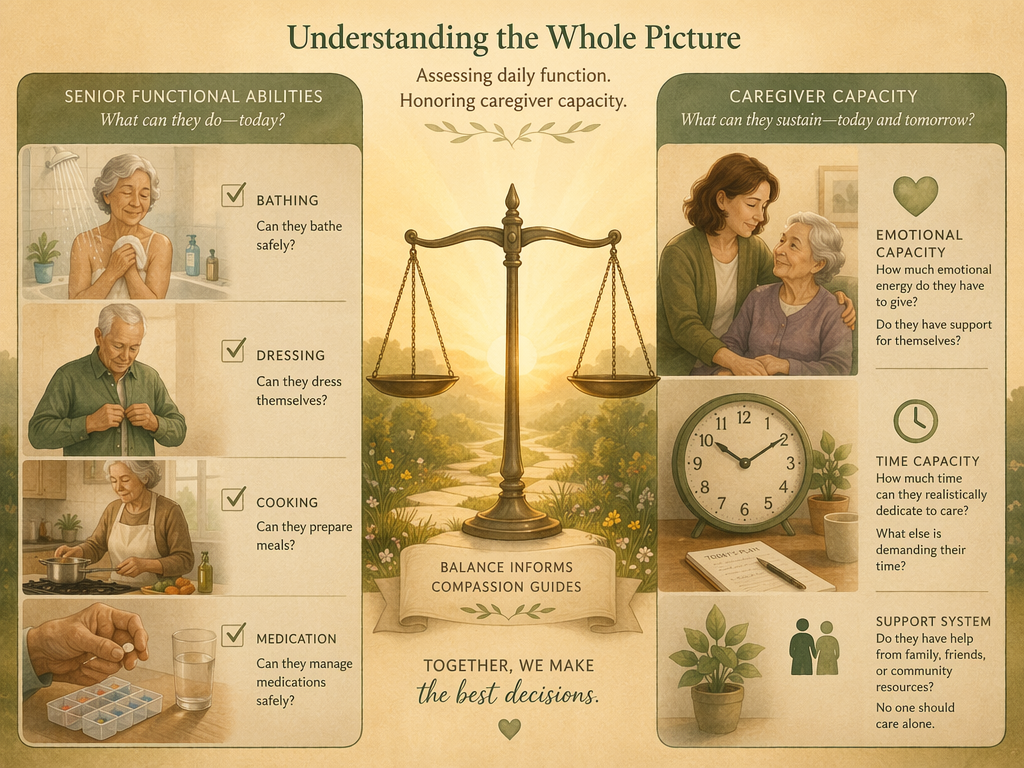
The second axis of this decision is often the one families are least willing to examine: the caregiver's own capacity. The Alzheimer's Association provides a set of self-check questions that every family caregiver should answer honestly — not as a test of devotion, but as a reality check on sustainability.
- Is the person becoming unsafe? Have there been falls, wandering episodes, or near-misses with medication?
- Is the health of the person or caregiver at risk? Have you missed your own medical appointments, or has your loved one's condition declined because care is inconsistent?
- Are care needs beyond my physical abilities? Can you safely lift, transfer, or bathe your loved one without injuring yourself or them?
- Am I becoming stressed, irritable, and impatient? Are you snapping at your loved one, dreading caregiving tasks, or feeling resentful?
- Am I neglecting work, family, and myself? Have your job performance, relationships with your spouse or children, or your own health suffered?
- Would structure and social interaction benefit the person? Does your loved one seem isolated, bored, or anxious at home?
If you answered "yes" to even two of these questions, it is time to take the possibility of residential care seriously. This is not a failure. It is a recognition that the current arrangement is not working for either of you.
Safety Thresholds: When the Home Environment Becomes Unsafe
Beyond functional decline and caregiver capacity, there are specific safety thresholds where residential care is no longer a preference — it becomes a necessity. These are the events and conditions that the CDC and other authoritative sources track because they are both common and preventable.
- Falls: According to CDC data cited by A Place for Mom, 13.8% of adults aged 75 and older already need personal care assistance. Falls are the leading cause of injury-related hospitalization in this age group, and a single fall can permanently alter a senior's ability to live independently.
- Medication errors: Misuse of prescription medications is the leading cause of emergency room visits among people over 65, sending more than 600,000 seniors to the ER each year (CDC). Missed doses, double-dosing, and dangerous drug interactions are all preventable in a setting where medication management is supervised.
- Wandering: For seniors with dementia, wandering is a critical safety risk. A person with Alzheimer's who wanders can become lost, injured, or exposed to extreme weather. Memory care facilities are designed with secured doors, enclosed outdoor areas, and tracking bracelets to prevent this.
- Nutrition and hygiene neglect: Skipping meals, losing weight, wearing soiled clothing, or refusing to bathe are signs that the senior can no longer manage basic self-care. These conditions lead to infections, pressure sores, and malnutrition.
- Unsafe home environment: Stairs that can no longer be navigated, narrow hallways that cannot accommodate a walker, or a bathroom without grab bars all become hazards. When the home itself is the source of risk, modifications may help — but only if the senior can reliably use them.
Matching the Level of Need to the Right Type of Residential Care
Once the decision to pursue residential care is made, the next question is which type of facility best matches the senior's functional profile. The National Institute on Aging defines the main options clearly.
| Facility Type | Best For | Key Features |
|---|---|---|
| Assisted Living | Seniors who need help with daily care (bathing, dressing, medication) but do not require 24/7 skilled nursing | Private or shared apartments; meals, housekeeping, social activities; 24-hour supervision; most pay out-of-pocket |
| Memory Care | Seniors with Alzheimer's or other dementias who need a secure environment and specialized staff training | Secured doors, enclosed outdoor areas, tracking bracelets; staff trained in dementia care; structured routines; often a dedicated wing within assisted living or a nursing home |
| Nursing Home (Skilled Nursing Facility) | Seniors who need 24-hour skilled nursing care, rehabilitation services, or help with multiple ADLs including toileting and transferring | On-site nurses and doctors; physical, occupational, and speech therapy; more medical focus than assisted living; inspected and regulated by states |
| Group Home (Board and Care Home) | Seniors who need personal care and meals in a small, home-like setting (20 or fewer residents) | At least one caregiver on-site; may not be inspected or regulated; less medical care than nursing homes |
For a more detailed comparison of facility types, including how to evaluate specific communities, see the site's When Is It Time for Long-Term Care? A Decision Framework for Families article.
The Financial Reality Check: Comparing Costs of In-Home Care, Assisted Living, and Memory Care
Cost is often the factor that families assume will make residential care impossible. But the 2026 data tells a more nuanced story: in many regions, the cost of assisted living is comparable to — or even lower than — the combined cost of in-home care.
| Care Type | National Median Monthly Cost (2026) | Source |
|---|---|---|
| In-home homemaker services | $6,675/month | SeniorLiving.org (May 2026) |
| In-home health aide services | $6,878/month | SeniorLiving.org (May 2026) |
| Assisted living | $6,313/month | SeniorLiving.org (May 2026) |
| Assisted living (alternative source) | $5,419/month | A Place for Mom / Stacker (April 2026) |
| Memory care | $6,690/month | A Place for Mom / Stacker (April 2026) |
| Nursing home (private room) | $10,798/month ($129,575/year) | Alzheimer's Association / Genworth Cost of Care Survey |
| Nursing home (semi-private room) | $9,581/month ($114,975/year) | Alzheimer's Association / Genworth Cost of Care Survey |
The key takeaway: if a senior needs 20 or more hours of in-home care per week, the cost of assisted living is often comparable. And assisted living includes room, board, meals, social activities, and 24-hour supervision — costs that are separate line items when care is provided at home.
For a deeper dive into how these costs compare and how to plan for them, see Aging in Place vs. Assisted Living: A Family Decision Framework for 2026.
Making the Transition: Practical Guidance for Moving Day and Beyond
Once the decision is made, the transition itself requires careful planning. The National Institute on Aging offers guidance that applies whether the move is to assisted living, memory care, or a nursing home.
- Prepare the senior in advance. Talk about the move in concrete, positive terms. Focus on what the new setting offers — social activities, help when needed, no more stairs — rather than what is being left behind.
- Get to know the staff. Introduce yourself and your loved one to the caregivers, nurses, and activities director. Share information about the senior's preferences, routines, and personality. The more the staff knows, the better they can provide personalized care.
- Be an advocate, not a visitor. Attend care plan meetings, ask questions about medications and meals, and check in regularly. Your role shifts from hands-on caregiver to advocate and monitor — but it remains essential.
- Be supportive without arguing. If your loved one expresses anger or sadness about the move, validate their feelings rather than defending the decision. "I know this is hard" is more helpful than "This is for your own good."
- Share your feelings with someone. The guilt does not disappear on moving day. Talk to a social worker, a support group, or a trusted friend. The NIA recommends sharing feelings as part of the adjustment process.
- Check in regularly, but give space. Visit often at first, then establish a rhythm that works for both of you. Some seniors adjust quickly; others take months. Your consistent presence — even if brief — signals that the relationship has not ended.
For families whose decision was driven by a recent crisis — a fall, a hospitalization, a wandering episode — the When Home Is No Longer Safe: A Crisis-to-Plan Transition Guide for Dementia Caregivers provides step-by-step guidance for navigating the transition under pressure.

Related reading
Noticed something outdated or inaccurate on this page? Flag a correction. We review every report against CDC, NIA, and AARP HomeFit guidance before updating a page.
Part of the Fall Prevention section.