
Caregiver decision guide
Aging in Place vs. Assisted Living: A Family Decision Framework for 2026
A structured, proactive framework to help families weigh the decision between aging in place and assisted living. Covers care needs, home readiness, total costs, caregiver capacity, and the key financial tipping point.

Introduction: The Weight of the Decision
Few caregiving decisions carry as much emotional weight as whether a parent or spouse can remain safely at home or needs to move to an assisted living community. The question rarely arrives as a single, clear moment. More often it surfaces gradually — after a hospital discharge, a series of near-misses in the bathroom, or a phone call from a worried neighbor. And because the stakes involve safety, dignity, finances, and family relationships, the pressure to get it "right" can feel paralyzing.
The good news is that this decision does not have to be made on instinct or under duress. A structured framework — one that examines care needs, home readiness, total costs, caregiver capacity, and quality of life — can transform an overwhelming choice into a manageable set of questions. This guide walks through each of those five dimensions and then shows how they converge at a practical tipping point: the moment when the math, the care burden, and the emotional factors all point in the same direction.
Dimension 1: Care Needs Assessment — What Level of Support Is Required?
Every decision about senior living begins with a clear-eyed assessment of the care that is actually needed — not what was needed last year, and not what everyone hopes will be enough. The most practical way to do this is to evaluate the Activities of Daily Living (ADLs) and Instrumental Activities of Daily Living (IADLs) that the older adult can and cannot perform independently.
According to the National Center for Health Statistics, the most common ADL needs among residents in residential care are bathing (75%), ambulating or moving around (71%), and dressing (60%). These are the tasks that, when they become difficult, signal a shift from independent living to needing regular hands-on help.
| Category | Specific Tasks | What It Signals |
|---|---|---|
| Basic ADLs | Bathing, dressing, toileting, transferring, continence, feeding | Physical assistance needed multiple times per day |
| Instrumental ADLs (IADLs) | Medication management, meal preparation, transportation, housekeeping, money management, phone use | Supervision or cueing needed; safety risk if tasks are missed |
| Health monitoring | Blood pressure checks, glucose monitoring, wound care, oxygen management | Skilled nursing or trained caregiver oversight required |
Once you have identified which tasks need support, estimate the total hours of care required per week. A family member who needs help with bathing, dressing, and medication management might require 15–25 hours per week. Someone who also needs assistance with toileting, transfers, and meal preparation could need 40 hours or more. This number — the weekly care hours — becomes the single most important input for the financial comparison in Dimension 3.
It is worth noting that 70% of adults aged 65 and older will need some form of long-term care in their lifetime, according to the Assistant Secretary for Planning and Evaluation (ASPE) and the Administration for Community Living. Most of that care is provided at home by unpaid family members. If you are reading this and realizing that your family is already providing significant care without a formal plan, you are not alone — and you are in exactly the right place to start building one.
Dimension 2: Home Readiness — Can the Home Be Made Safe?
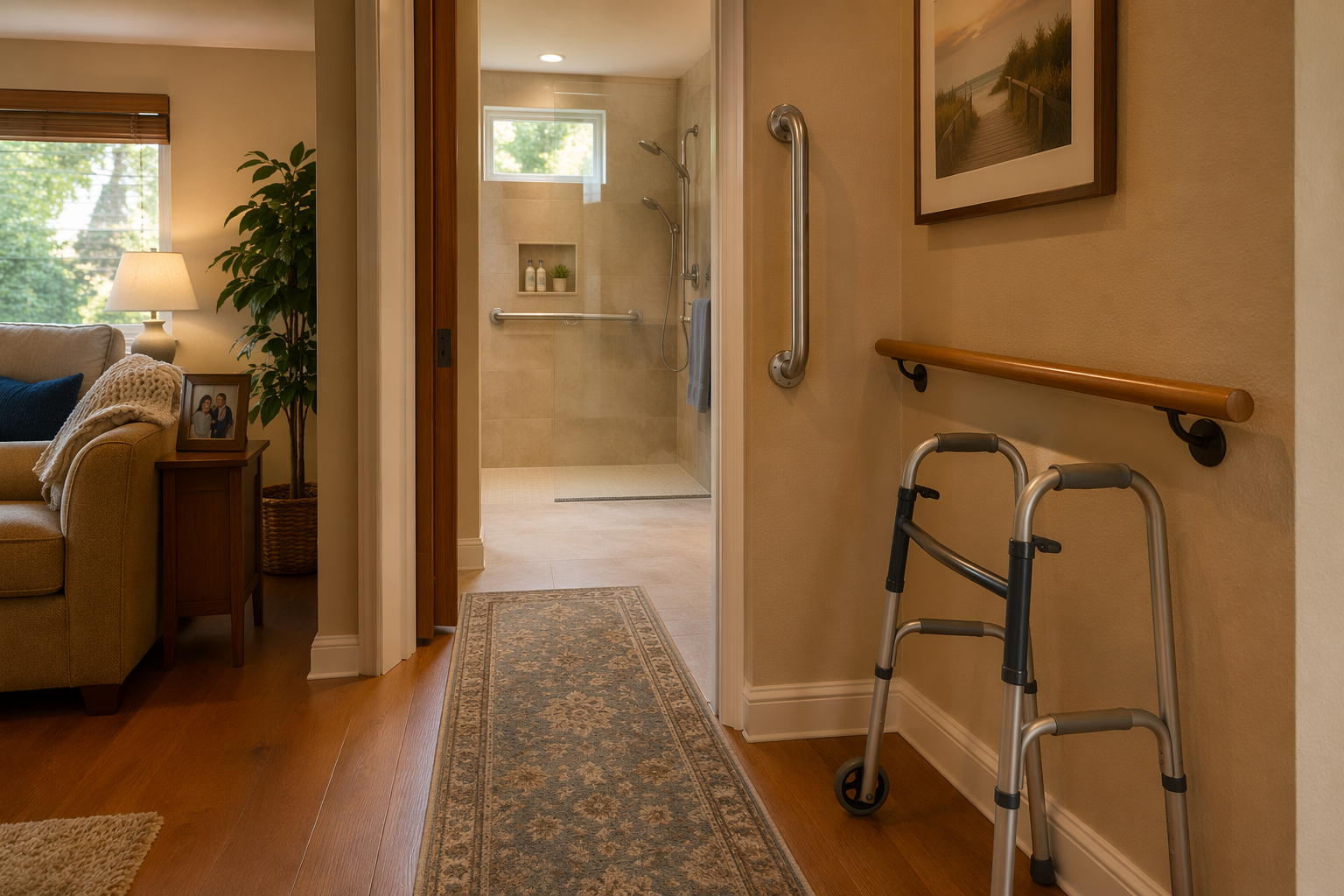
The second dimension asks a deceptively simple question: can the current home support safe, dignified living for someone with changing mobility and care needs? The answer depends on the home's existing layout, the types of modifications required, and the budget available to make those changes.
A 2024 AARP survey found that 75% of adults aged 50 and older want to remain in their current homes as they age, but 43% believe their homes need modifications to be safe. The gap between desire and readiness is substantial — and closing it requires a realistic look at what modifications cost.
| Cost Tier | Examples | Typical Cost Range |
|---|---|---|
| Low-cost safety upgrades | Grab bars, lever-style door handles, handheld showerheads, improved lighting, non-slip mats | $25 – $500 |
| Mid-range accessibility projects | Walk-in shower, stair lift ($2,500–$8,000), modular ramp, raised toilet, widened doorways | $1,000 – $10,000 |
| High-cost structural changes | First-floor bedroom or bathroom addition, through-floor elevator, full kitchen remodel, extensive hallway widening | $10,000 – $50,000+ |
The critical insight here is that proactive planning saves money. Emergency modifications — the grab bar installed after a fall, the ramp built during a hospital discharge — typically cost more and offer fewer options than planned renovations. A room-by-room assessment, starting with the bathroom and entryway (the two highest-risk areas), can identify the most impactful changes first.
Dimension 3: Total Cost Comparison — The Hidden Costs of Both Options
This is the dimension where most families expect a clear winner. The reality is more nuanced. When you compare the published rates for home care and assisted living, a clear financial tipping point emerges — but only if you account for the hidden costs that both options carry.
The Published Numbers
According to U.S. News (updated June 2026), non-medical home care averages $35 per hour. At 40 hours per week — roughly the point where a family caregiver's schedule becomes unsustainable — that works out to about $1,400 per week, or approximately $6,062 per month. Assisted living, by comparison, averages $1,550 per week, or about $6,200 per month, on an all-inclusive basis.
The crossover is clear: below roughly 40 hours of paid care per week, home care is less expensive. At 40 hours or more, assisted living becomes the more cost-effective option — and the gap widens as care needs increase.
| Care Hours per Week | Home Care Cost (at $35/hr) | Assisted Living Cost (all-inclusive) | More Affordable Option |
|---|---|---|---|
| 10 hours | $350/week ($1,517/month) | $1,550/week ($6,200/month) | Home care |
| 20 hours | $700/week ($3,033/month) | $1,550/week ($6,200/month) | Home care |
| 30 hours | $1,050/week ($4,550/month) | $1,550/week ($6,200/month) | Home care |
| 40 hours | $1,400/week ($6,062/month) | $1,550/week ($6,200/month) | Approximately equal |
| 50 hours | $1,750/week ($7,583/month) | $1,550/week ($6,200/month) | Assisted living |
| 60 hours | $2,100/week ($9,100/month) | $1,550/week ($6,200/month) | Assisted living |
The Hidden Costs of Aging in Place
The $35/hour home care rate does not include several significant expenses that families often overlook:
- Home modifications: As discussed in Dimension 2, even mid-range projects like a walk-in shower or stair lift can cost $1,000–$10,000. Major structural changes can exceed $50,000.
- Ongoing household costs: Utilities, property taxes, home maintenance, and food continue at full rate — and may increase if the older adult is home all day.
- Transportation: Medical appointments, grocery trips, and social outings require either paid transportation services or a family member's time and vehicle costs.
- Caregiver burnout costs: When a family caregiver reduces work hours, leaves a job, or incurs health expenses from stress, the financial impact can be substantial. The AARP 2025 Caregiving in the U.S. survey found that nearly half of family caregivers experienced at least one major financial impact, including taking on debt, stopping personal savings, or being unable to afford basic necessities.
The Hidden Costs of Assisted Living
Assisted living also carries costs that may not appear in the monthly rate:
- Entrance or community fees: Some facilities, particularly Continuing Care Retirement Communities (CCRCs), charge entrance fees that can reach $300,000 or more.
- Level-of-care add-ons: The base rate typically covers a set number of care hours. Additional assistance with bathing, medication management, or mobility is billed separately.
- Inflation: At a 3.80% annual inflation rate, a facility costing $74,400 per year today could cost approximately $157,000 per year in 20 years (U.S. News, 2026).
- Second-person fees: For couples, the national median additional fee is about $1,200 per month (A Place for Mom, 2026).
For a detailed breakdown of home modification costs, see our CAPS home modification cost guide.

Dimension 4: Caregiver Capacity — Can You Sustain This?
This is the dimension that families most often minimize — and that later becomes the reason the original plan collapses. Caregiver capacity is not a measure of love or dedication. It is a measure of what one person (or a small group of family members) can realistically sustain over months and years without breaking their own health, finances, or relationships.
The national data is sobering. The AARP 2025 Caregiving in the U.S. survey found that nearly half of family caregivers experienced at least one major financial impact from caregiving. Approximately 63 million Americans provided unpaid care in the past year — an increase of 20 million since 2015. And family caregivers collectively provided 49.5 billion hours of care in 2024, valued at over $1 trillion.
These numbers translate into real human costs: lost sleep, postponed medical care, strained marriages, and careers put on hold. If the primary family caregiver is already feeling stretched, adding more hours of hands-on care — or continuing at the current level indefinitely — is not a sustainable plan. This is not a failure. It is a data point that belongs in the decision framework alongside the cost comparison and the home safety assessment.
Dimension 5: Social and Emotional Factors — Quality of Life for Everyone
The final dimension is the one that resists easy quantification but often determines whether a living arrangement actually works over time. Social connection, autonomy, and emotional well-being matter as much as safety and cost.
For the older adult, the key questions are:
- Isolation vs. community: Does the older adult currently have regular social contact? If aging in place means spending most days alone, the social structure of assisted living — group meals, activities, and built-in companionship — may offer a meaningful quality-of-life improvement.
- Autonomy and control: For many older adults, staying home represents independence. For others, the maintenance burden of a house (yard work, repairs, cleaning) becomes a source of stress that erodes that independence. Assisted living can trade one kind of burden for another: less responsibility for the physical home, but more adjustment to communal living.
- The older adult's own preference: This is the most important — and most easily overlooked — factor. A 2024 AARP survey found that 75% of adults aged 50 and older want to remain in their current homes. But that statistic also means 25% are open to or prefer a move. The older adult's voice in this decision is not just a courtesy; it is a predictor of how well any arrangement will work.
For the family, the emotional factors are equally real:
- Guilt and relief: Many adult children feel guilty about the idea of a parent moving to assisted living, even when it is clearly the safer or more practical option. It helps to recognize that guilt is not a decision signal — it is an emotional response to a difficult transition.
- Family dynamics: Siblings may disagree about what is best. One may live nearby and bear the daily burden; another may live far away and underestimate the challenges. A structured framework like this one can help depersonalize the debate by focusing on objective factors.
- The caregiver's own life: If the primary caregiver is sacrificing their own health, marriage, or career to keep a loved one at home, that cost belongs in the decision. A move to assisted living can sometimes preserve the relationship by removing the caregiving dynamic from it.
The Tipping Point: When Assisted Living Makes More Sense
When you lay the five dimensions side by side, a pattern emerges. The decision to move to assisted living is rarely driven by a single factor. It is driven by the convergence of several: care needs that exceed what the home and family can provide, costs that tip in favor of all-inclusive care, and a caregiver who is approaching their limit.
The financial tipping point — roughly 40 hours of paid care per week — is a useful benchmark, but it is only one signal. A family might choose assisted living at 30 hours of care if the home requires $40,000 in modifications, the primary caregiver is experiencing burnout, and the older adult is open to the move. Another family might choose to stay home at 45 hours of care if the home is already modified, the family can afford round-the-clock help, and the older adult strongly prefers to remain.
| Factor | Weighs Toward Aging in Place | Weighs Toward Assisted Living |
|---|---|---|
| Weekly care hours needed | Under 30 hours | 40 hours or more |
| Home modification cost | Under $5,000 (basic upgrades) | Over $20,000 (structural changes needed) |
| Caregiver capacity | Caregiver is healthy, has support, and can sustain the role | Caregiver is experiencing burnout, health issues, or financial strain |
| Social engagement | Older adult has strong local social network and transportation | Older adult is isolated or would benefit from built-in community |
| Older adult's preference | Strongly prefers to stay home and is willing to accept help | Is open to or prefers a move to a community setting |
| Financial resources | Can afford home care plus modifications plus household costs | Assisted living is comparable or cheaper than home care at needed hours |
If your assessment across these dimensions lands predominantly on the right side of the table, it is worth exploring assisted living seriously. For a detailed guide on evaluating specific communities and making the transition, see our senior residential homes decision framework.
Next Steps: Making Your Decision Confident
The goal of this framework is not to push you toward one option or the other. It is to replace anxiety with clarity — to give you a structured way to gather the information you need, weigh the factors that matter most to your family, and make a decision you can feel confident about.
Here are the immediate next steps:
- Complete a care needs assessment: List the ADLs and IADLs that require support. Estimate the total hours of care needed per week. Be honest about what is currently being provided by family and what would need to be paid for.
- Conduct a home safety evaluation: Walk through each room using the room-by-room priority guide. Get quotes for the most critical modifications. Separate what you can do now from what would be needed in the future.
- Run the numbers: Calculate the monthly cost of home care at the needed hours, plus home modification amortization, plus household costs. Compare that to the all-inclusive monthly cost of assisted living in your area. Use multiple sources for cost data.
- Assess caregiver capacity honestly: If you are the primary caregiver, ask yourself whether you can sustain the current level of care for another year. If the answer is no, that is not a failure — it is a signal.
- Have the conversation: Include the older adult in the decision as early and as fully as possible. Their preferences, fears, and hopes are not just emotional considerations — they are practical predictors of how well any plan will work.
If you are at the very beginning of this journey and feeling overwhelmed, start with our 5-step triage framework for new caregivers. It is designed for families who need orientation before they can begin evaluating specific options.
Questions to bring to a clinician or OT
This is not medical, legal, or a family's final decision — only a framework. Bring these questions to a clinician, occupational therapist, or your local Area Agency on Aging.
Find Local HelpRelated reading
Noticed something outdated or inaccurate on this page? Flag a correction. We review every report against CDC, NIA, and AARP HomeFit guidance before updating a page.