
STEADI: intervene
Build a Severe Weather Emergency Kit Your Older Parent Really Needs
Generic emergency checklists miss life-critical items for older adults. This guide provides a condition-specific severe weather safety kit organized by medical needs and severe weather scenarios, so seniors and caregivers can prepare properly.
A caregiver can print a standard emergency kit list in five minutes. Water, flashlight, batteries, radio, canned food, copies of documents. Useful, yes. But then the tote sits half-packed in the hallway and the real questions start: Where is the backup power for the CPAP? How long will insulin stay safe if the refrigerator is off? Are the hearing aid batteries the right size? Can the walker make it across a wet threshold with those worn tips?
That is why a severe weather safety checklist for seniors at home cannot be a longer version of a camping list. It has to be built around the older adult who will actually use it when power, transportation, pharmacy access, heating, cooling, or safe movement through the house suddenly fails.
For fall prevention, severe weather does not only create outdoor danger. It turns familiar rooms into low-light obstacle courses, interrupts medical routines, and makes leaving home harder for people with mobility limitations. The National Council on Aging notes that disasters disproportionately affect older adults, with mobility issues making it much more difficult to leave home safely during an emergency. [1]
Build from the person outward
Start with the parent, not the weather headline. A hurricane kit, tornado kit, flood kit, and power-outage kit all look different, but the same medical reality follows the person through each one. The most useful kit is modular: one core set of household supplies, then add the pieces that match the older adult’s medications, devices, mobility, senses, and cognition.
| Kit layer | What it protects against | Examples |
|---|---|---|
| Household baseline | Being without normal utilities or easy store access | Water, shelf-stable food, flashlight, radio, chargers, first aid, sanitation, documents |
| Medical continuity | Missed doses, unsafe storage, closed pharmacies, lost medication information | 30-day medication supply, medication list, refill plan, cooler plan for temperature-sensitive medication |
| Powered and body-function supports | Loss of CPAP, oxygen, hearing, vision, glucose monitoring, toileting routines | Backup power, correct batteries, chargers, tubing, incontinence supplies, communication aids |
| Mobility and safe movement | Falls during evacuation, sheltering, bathroom trips, or nighttime movement | Spare cane tips, walker glides, wheelchair-accessible exit plan, lightweight go-bag |
| Weather overlays | Heat, cold, flood, tornado, hurricane, or long outage stressors | Cooling towels, electrolyte drinks, emergency blankets, waterproof pouches, shelter-room duplicates |
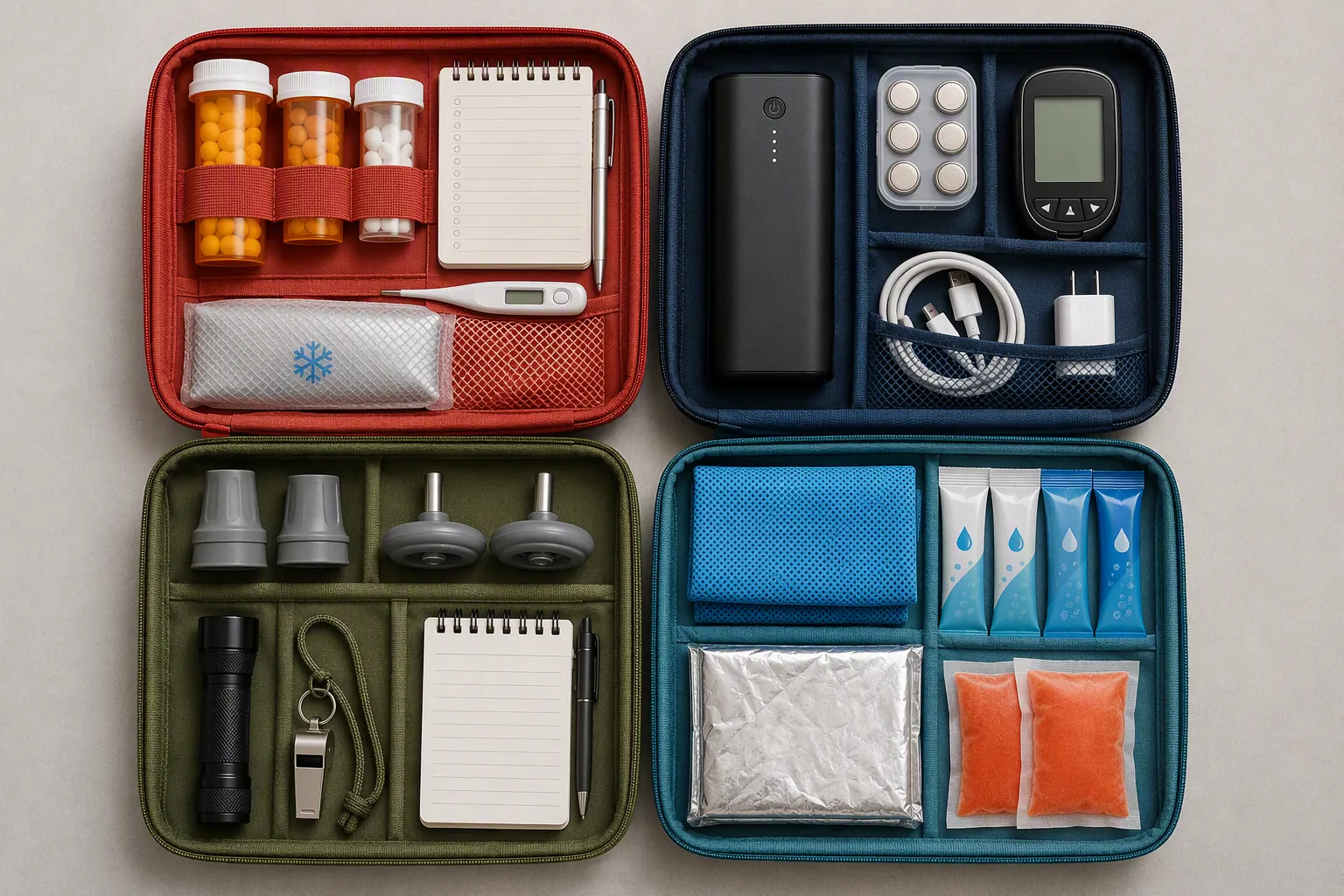
One boundary matters before the packing starts: medication storage, oxygen use, CPAP settings, and medical-device backup power are not areas for guessing. The kit can and should hold the supplies, numbers, labels, and backup plans. The prescriber, pharmacist, or durable medical equipment provider still needs to confirm device-specific and medication-specific requirements.
Keep the generic baseline, but do not stop there
The ordinary kit still matters. A parent cannot manage medical needs well if there is no water, light, phone power, or way to hear emergency updates. Ready.gov’s basic kit guidance includes items such as water, food, a battery-powered or hand-crank radio, flashlight, first aid kit, extra batteries, sanitation supplies, cell phone with chargers and backup battery, and important family documents. [2]
- Water and shelf-stable food that the older adult can open, chew, swallow, and prepare without normal appliances.
- Flashlights or lanterns placed where nighttime bathroom trips actually happen, not only in the garage.
- Phone chargers, backup battery packs, and a paper contact list in case the phone is dead or locked.
- Copies of identification, insurance cards, medication list, emergency contacts, and key medical information in a waterproof pouch.
- Sanitation supplies, trash bags, gloves, hand sanitizer, wipes, and toilet paper.
- A small amount of cash, spare keys, glasses, and any household-specific supplies for pets or service animals.
Now comes the part most generic lists flatten into one line: “medications.” For an older adult, that single word can decide whether a family spends the outage managing calmly or making urgent calls to closed pharmacies.
The medical continuity module
The American Red Cross tells older adults to keep at least a 30-day supply of prescription medications and to plan for at least two weeks of sheltering at home. [3] That is a very different standard from the familiar three-day emergency kit. A three-day kit may cover a short road closure. It does not cover a long outage, delayed delivery, flooded pharmacy route, caregiver who cannot get across town, or refill that was due the same week the storm arrived.
Pack medications as a working system, not a loose pile of bottles
A useful medication module should let another person step in without decoding the medicine cabinet. Keep the current supply where the older adult normally takes it, but build an emergency medication folder and refill routine around it.
- A current medication list with medication name, dose, schedule, reason taken if known, prescriber, pharmacy, and start or stop notes.
- Allergy information and past serious reactions.
- A copy of insurance cards, pharmacy information, and prescriber phone numbers.
- A refill calendar that flags which medications cannot safely run low during storm season.
- A small pill organizer only if it is already part of the person’s routine and can be kept accurate.
- A note on which medications need refrigeration, must stay dry, should not be exposed to heat, or have other storage instructions.
The refill plan is where many kits quietly fail. If the parent usually refills when there are two pills left, the emergency kit is already fragile. During severe weather season, build a habit of checking whether the 30-day reserve is still real, whether any medication has expired, and whether a recently changed prescription makes the printed list wrong.
Temperature-sensitive medication needs its own plan
Insulin is the obvious example, but it is not the only medication where storage matters. For insulin, the emergency kit needs a cooler plan that keeps insulin cold without freezing it. Ice packs should not touch insulin directly, and the cooler is a time-limited bridge, not a magic refrigerator for a multi-day outage in extreme heat. [2]
- Use a clearly labeled insulated bag or cooler for refrigerated medication.
- Add a small thermometer if temperature-sensitive medication is part of the household’s reality.
- Keep a barrier between ice packs and medication so the medication does not freeze.
- Store medication instructions and pharmacy contact information with the cooler, not in a different drawer.
- If medication may have been overheated, frozen, contaminated by floodwater, or held at an uncertain temperature too long, call the pharmacist, prescriber, or manufacturer guidance line before using it.
This is one place where “ask your doctor” is not a lazy ending; it is the safety boundary. The kit can hold the cooler, thermometer, labels, and phone numbers. It cannot turn an unknown medication temperature history into a safe dose.
Diabetes supplies belong with the medication plan
For a parent with diabetes, do not separate insulin from the items needed to use it and monitor safely. Put the glucose meter, test strips, lancets, control solution if used, alcohol swabs, sharps container or puncture-resistant backup container, extra meter batteries or charger, fast-acting sugar source, and written dosing instructions together. If a continuous glucose monitor is used, include its charger, sensor supplies if available, adhesive patches if part of the routine, and a backup finger-stick plan confirmed with the care team.
Heart, lung, pain, and neurological medications need the same seriousness
The list should not privilege the most visible condition and forget the rest. Blood pressure medication, heart medication, inhalers, seizure medication, Parkinson’s medication, blood thinners, pain medication, eye drops, and rescue medications all need to be visible in the emergency plan if they are part of the parent’s daily or urgent care. If a medication has strict timing, make that timing readable to a tired caregiver working by flashlight.
For a broader medical-needs planning layer beyond the kit itself, CareWise also has guidance on severe weather safety for elderly people with medical needs.
Powered devices and body-function supports
A power outage is not an inconvenience if the older adult sleeps with CPAP, uses an oxygen concentrator, charges a hearing aid, depends on an electric lift chair to stand, or needs a powered monitor to manage glucose. This part of the kit should be labeled by device, because the person troubleshooting at midnight should not have to guess which cord goes with which machine.
Use tiers for backup power
Not every household can buy a generator, a medical-grade battery system, and duplicate devices. A practical kit should still move in the right direction.
| Resilience level | What to prepare | Best fit |
|---|---|---|
| Basic | Fully charged phones, small power banks, labeled charging cords, paper phone numbers for equipment providers | Short outages and devices that do not provide life-sustaining support |
| Better | Device-compatible backup battery or adapter confirmed with the equipment provider, plus a charging routine before severe weather | CPAP, rechargeable hearing aids, monitors, and other equipment used daily |
| Highest resilience | Whole-home or portable generator plan, fuel safety plan, and provider-confirmed backup arrangement | Households with oxygen concentrators, multiple powered devices, or high risk from long outages |
The important word is compatible. A battery that charges a phone is not automatically appropriate for a CPAP machine or oxygen equipment. Ask the durable medical equipment provider what backup power is required, how long it lasts under the parent’s actual settings, what accessories are needed, and whether the device can be safely used with a generator or battery system.
CPAP and oxygen supplies
For CPAP, the kit may need the machine’s power cord, backup battery or adapter, mask, tubing, filters, cleaning supplies, and written settings. If distilled water is part of the usual humidifier routine, include it in the shelter-at-home supplies, but confirm with the device provider what to do if water is unavailable.
For oxygen, write the equipment provider’s emergency number on paper and store it with the equipment. If the parent uses a concentrator, portable oxygen, backup tanks, cannulas, or other oxygen accessories, the emergency plan should identify what can travel, what cannot, and how long each backup option is expected to last under the prescribed flow. Do not invent an oxygen workaround during a storm.
Hearing, vision, and communication
Hearing aid supplies are small enough to forget and important enough to derail everything. Pack batteries in the correct size, a charger if the hearing aids are rechargeable, a cleaning tool if used, and a labeled container so they do not disappear into a dark drawer. Add spare glasses, magnifiers, eye drops if prescribed or routinely used, and a bold-print contact sheet.
If the parent has trouble speaking, hearing, remembering, or explaining medical history under stress, add a communication card. It can list name, emergency contacts, medical conditions, allergies, medications, mobility needs, hearing or vision needs, and preferred communication method. A small notebook and thick pen can do more good than a dead phone.
Incontinence and personal care are not optional extras
Pack enough incontinence briefs, pads, wipes, gloves, disposal bags, barrier cream if used, and a change of clothing. If the parent is embarrassed by these supplies, label the pouch privately rather than leaving them out. During a power outage or evacuation delay, toileting problems quickly become skin problems, fall risks, and caregiver strain.
Cognitive supports reduce panic and repeated explanations
For a parent with memory loss, confusion, anxiety, or dementia, the emergency kit should include more than medical information. Add a familiar comfort item, current photo, identification, simple written routine, caregiver contact card, and labels for critical supplies. If the parent may leave the house unexpectedly, make identification and contact information easy for a helper to find.
Mobility supplies: small parts, big consequences
Mobility equipment fails in boring ways: a cane tip splits, walker glides wear down, wheelchair tires lose air, the only accessible exit is blocked by a heavy patio chair. Ready.gov specifically tells older adults to consider spare cane tips and walker glides and to know which exits are wheelchair-accessible. [4]
- Spare cane tips in the correct size.
- Walker glides, tennis-ball replacements if used, or other routine walker parts.
- Wheelchair charger, manual backup plan if applicable, tire or cushion supplies if part of normal use.
- Non-slip shoes or sturdy slippers near the bed, not buried in the kit.
- A headlamp or hands-free light for the caregiver who may need both hands to assist.
- A written note naming the safest exit and the wheelchair-accessible exit.
Weight matters. A go-bag that a frail adult cannot lift and a caregiver cannot carry while also steadying a walker is not a go-bag; it is storage. Put heavy shelter-at-home items in a bin. Keep the portable version limited to documents, critical medications, small medical supplies, device cords, hearing or vision aids, hygiene basics, and a few weather-specific items.
For more detail on fall-specific kit items during storms, see CareWise’s guide on what to add to a parent’s hurricane kit to prevent falls and the senior power outage fall-prevention checklist.
Add weather overlays without rebuilding the whole kit
Once the medical and mobility core is built, severe weather becomes an overlay. Do not make five separate kits that all forget the medication list. Make one core kit, then add or move supplies based on the season and local threat.
Heat and long summer outages
Older adults do not adjust as well as younger people to sudden temperature changes, and chronic medical conditions or medications can affect normal body temperature regulation. [5] In a severe weather kit, that turns cooling supplies from “nice to have” into part of the health plan.
- Battery-operated fan with spare batteries or a charged power source.
- Cooling towels or cloths.
- Electrolyte drinks or packets if appropriate for the parent’s medical conditions and diet.
- Thermometer for the room and, if needed, the medication cooler.
- A written cooling plan naming where the parent can go if the home becomes unsafe.
Fans and cooling towels do not make an overheated home safe in every condition. If the parent has heart disease, breathing problems, diabetes, kidney disease, dementia, limited mobility, or takes medication that affects heat tolerance, the kit should support a larger plan for cooling and relocation. CareWise covers warning signs and response planning in heatstroke prevention for seniors after a disaster.
Cold weather and heating interruptions
Cold planning is also medical planning. AARP, citing the National Institute on Aging, recommends setting home heat to at least 68–70°F for older adults during cold weather. [6] If the home cannot stay near that range during an outage, the emergency kit alone is not enough.
- Warm layers that are easy to put on with stiff hands or limited shoulder movement.
- Emergency blankets, regular blankets, hats, socks, and gloves.
- Hand warmers if the parent can use them safely.
- A safe backup heat plan that does not rely on improvising with ovens, grills, or unsafe indoor fuel use.
- A relocation contact if the home cannot be kept warm enough.
Floods
For flood risk, the kit needs waterproofing and portability. Put documents, medication list, hearing aid supplies, chargers, and small medical items in waterproof pouches. Keep footwear and mobility aids where the parent can reach them without walking through water. If evacuation becomes necessary, the go-bag should already be light enough to move with the person, not dragged out after the water is rising.
For flood-specific movement and evacuation preparation, use CareWise’s flood preparedness checklist for seniors and caregivers and senior flood safety and fall-prevention guide.
Tornadoes
A tornado kit is less about carrying everything and more about having the right items in the shelter area before the warning. Keep a duplicate flashlight, shoes, whistle, medication list, emergency contacts, hearing aid batteries, glasses, small first aid supplies, and any must-have quick medical items near the safest accessible shelter location.
For the sheltering sequence itself, see the tornado watch safety checklist for seniors.
Hurricanes and extended power outages
For hurricanes and other storms likely to produce long outages, stretch the shelter-at-home side of the kit: more water, more shelf-stable food, more sanitation supplies, stronger medication refill discipline, and a more serious backup power plan. This is where the 30-day medication supply and two-week shelter planning standard stop sounding excessive and start sounding realistic.
After a hurricane or major storm, the kit also needs restocking and the home needs a hazard check. CareWise’s post-hurricane fall-prevention guide covers the recovery side.
Split the kit into stay-home and go-bag versions
The same older adult may need two versions of the same plan. One stays at home and can be heavier. The other has to move with the person. Do not make the portable bag responsible for carrying the whole household.
| Stay-home bin | Go-bag |
|---|---|
| Full water and food supply | Small water bottle and easy snack if medically appropriate |
| Medication reserve and full medication folder | Critical medications, medication list, allergies, prescriber and pharmacy contacts |
| Cooler, ice packs, thermometer, and storage instructions for temperature-sensitive medication | Portable insulated medication pouch if needed, with clear limits and instructions |
| Backup power options, larger batteries, generator-related supplies if used | Chargers, small power bank, essential device cords |
| Incontinence supplies in larger quantity | Briefs or pads, wipes, disposal bags, gloves, change of clothing |
| Extra mobility aid parts and lighting for the home | Spare cane tip or small part if practical, glasses, hearing aid batteries, communication card |
Label both versions plainly. “Mom’s medical go-bag” is more useful than “emergency supplies.” Put the date of the last review on the outside. If several caregivers rotate, add a one-page sheet that says where the medication reserve, cooler, oxygen supplies, CPAP battery, documents, and mobility parts are stored.
Review it before the season, after changes, and after use
A severe weather kit expires quietly. The parent gets a new prescription. The hearing aids change. A walker tip wears down. A battery no longer holds a charge. The caregiver who knew where everything was moved away. The review does not need to be elaborate, but it does need to happen before the weather is already on the radar.
- Before each severe weather season, check medication quantities, expiration dates, storage instructions, and the printed medication list.
- After any medication or device change, update the kit immediately instead of waiting for the next storm.
- Charge and test backup batteries on the schedule recommended by the device or equipment provider.
- Check cane tips, walker glides, wheelchair parts, footwear, and hands-free lighting.
- Replace used incontinence supplies, wipes, gloves, batteries, snacks, and water after any event.
- Make sure every caregiver knows where the stay-home bin and go-bag are stored.
The safest kit for an older parent is not the biggest kit. It is the one built around the exact needs that become urgent when the refrigerator warms, the pharmacy closes, the lights go out, the house gets too hot or too cold, the oxygen equipment needs power, or the walker has to cross a wet doorway.
References
- Emergency Preparedness 101: What to Do Before, During and After a Disaster, National Council on Aging
- Build A Kit, Ready.gov
- Older Adults, American Red Cross
- Disaster Preparedness Guide for Older Adults, Ready.gov
- Heat and Older Adults Aged 65+, Centers for Disease Control and Prevention
- Extreme Cold Weather Safety, AARP
Related reading
Noticed something outdated or inaccurate on this page? Flag a correction. We review every report against CDC, NIA, and AARP HomeFit guidance before updating a page.
Part of the Fall Prevention section.