
STEADI: intervention
What Permanent DST Means for Your Elderly Parent’s Fall Risk
Permanent daylight saving time will create darker winter mornings that overlap with seniors’ peak activity window, increasing fall risk. This article explains why and provides a targeted, under-$200 home lighting checklist to help caregivers improve safety before the change takes effect.
The first fall-risk question about permanent daylight saving time is not what happens in Washington. It is where your parent’s feet land on a January morning.
Picture the ordinary version: an older parent wakes before sunrise, sits up, reaches for slippers, and starts toward the bathroom before the hallway has enough light to show the edge of the rug. A few minutes later, they may turn toward the kitchen, step near a stair tread, or open the outside door for a newspaper or a pet. Nothing dramatic has changed about the routine. The room is simply darker for longer.
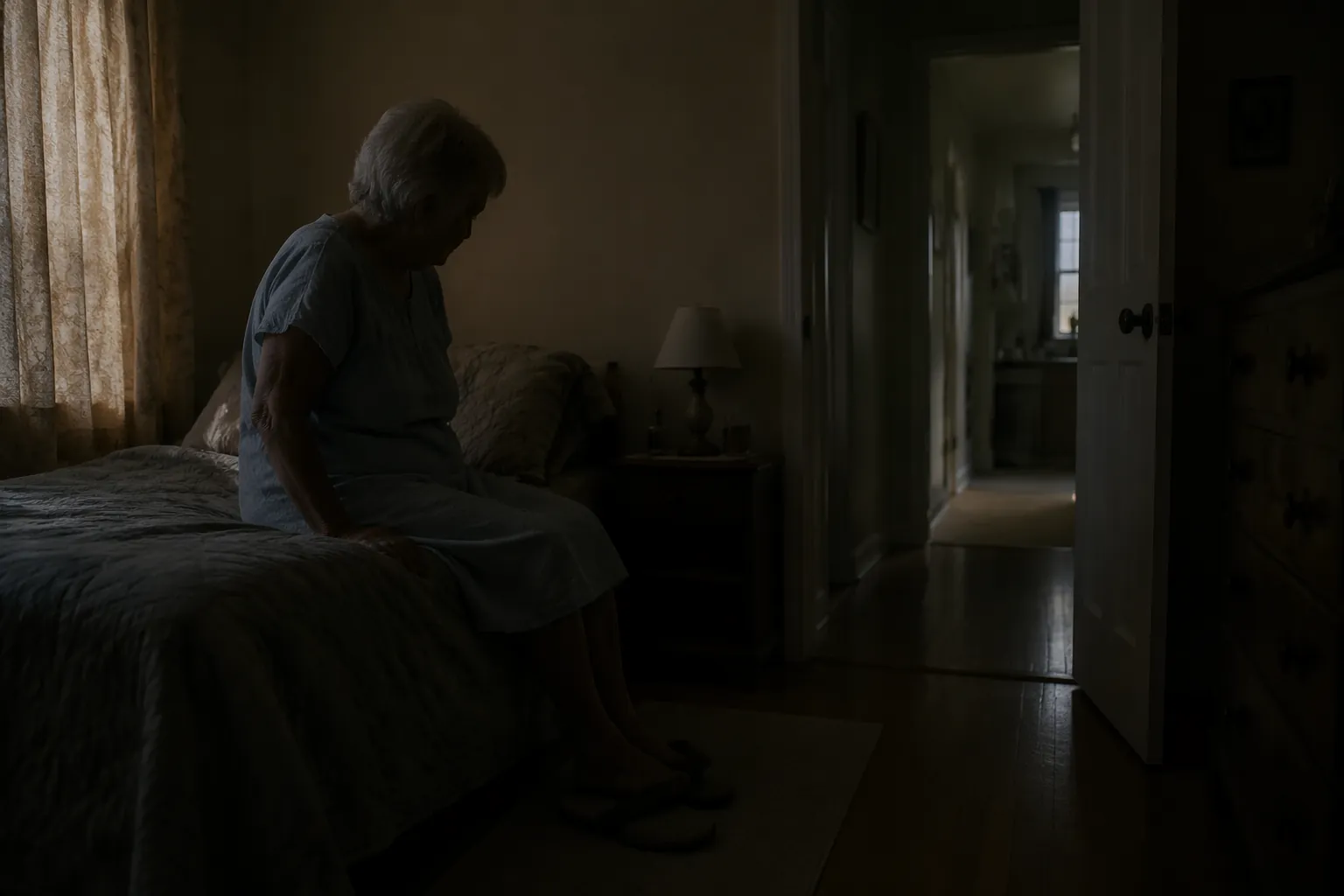
That is what permanent daylight saving time means for elderly parents in practical fall-prevention terms. It would keep winter mornings darker later, and those darker mornings would overlap with the time many older adults are already out of bed. As of June 2026, the Sunshine Protection Act was still moving through Congress, so this is preparation for a possible change rather than a response to a finalized law. Modeled January examples make the shift easier to see: under permanent daylight saving time, sunrise would be around 8:20 a.m. in New York City, around 9 a.m. in Minneapolis, and around 8 a.m. in Los Angeles, with exact times varying by location and geography [1][2].
The useful caregiver question is smaller than the national debate: if morning stays dark longer, where does that darkness meet your parent’s actual route?
Where the added darkness meets the house
For an older parent, morning darkness is not just an inconvenience. Aging eyes often need more light and more time to adjust between dark and bright areas. The National Institute on Aging’s room-by-room fall prevention guidance treats lighting as a practical home safety issue: keep a lamp within reach of the bed, use nightlights in halls and bathrooms, improve kitchen and bathroom lighting, and make important supports easier to see, including grab bars with contrast [3].
The lighting data are especially relevant in the rooms where many morning falls start. A 2024 study in New Zealand long-term care facilities found that 57.7% of bedrooms and 68.5% of bathrooms were below the 300-lux recommended minimum for focused activities. In adjusted models, each 100-lux increase in dining and bathroom lighting was associated with an 8% to 13% reduction in fall rates [4].
That study should not be stretched into a promise about every U.S. private home. It was conducted in long-term care facilities, and it showed associations, not proof that changing a bulb will prevent a specific fall. Still, it gives caregivers something more useful than “be careful in the dark.” It points to a measurable problem: many senior living spaces are not bright enough in exactly the rooms where older adults stand up, turn, reach, and transfer weight.
CDC’s STEADI approach to older-adult fall prevention is built around screening, assessment, and intervention rather than one magic fix [5]. Lighting belongs in that intervention mindset. It does not replace medication review, balance work, vision care, footwear, or medical evaluation. It is the Saturday-afternoon part: the change a family can see immediately when the hallway no longer disappears between the bed and the bathroom.
A one-afternoon lighting pass for the first trip out of bed
Treat the under-$200 goal as a targeting rule, not a guarantee. If a home needs electrical work, broken fixtures replaced, stair repairs, or new grab bars installed by a professional, the project can cost more. But for many homes that already have working outlets and fixtures, the highest-impact lighting pass can stay focused on bulbs, plug-in motion lights, battery-powered lights, and one reachable bedside lamp.
| Place to check | What to change | What you are trying to prevent |
|---|---|---|
| Bedside | Put a stable lamp or easy-touch light within arm’s reach before feet hit the floor. | Standing up in the dark, searching for slippers, or walking before eyes adjust. |
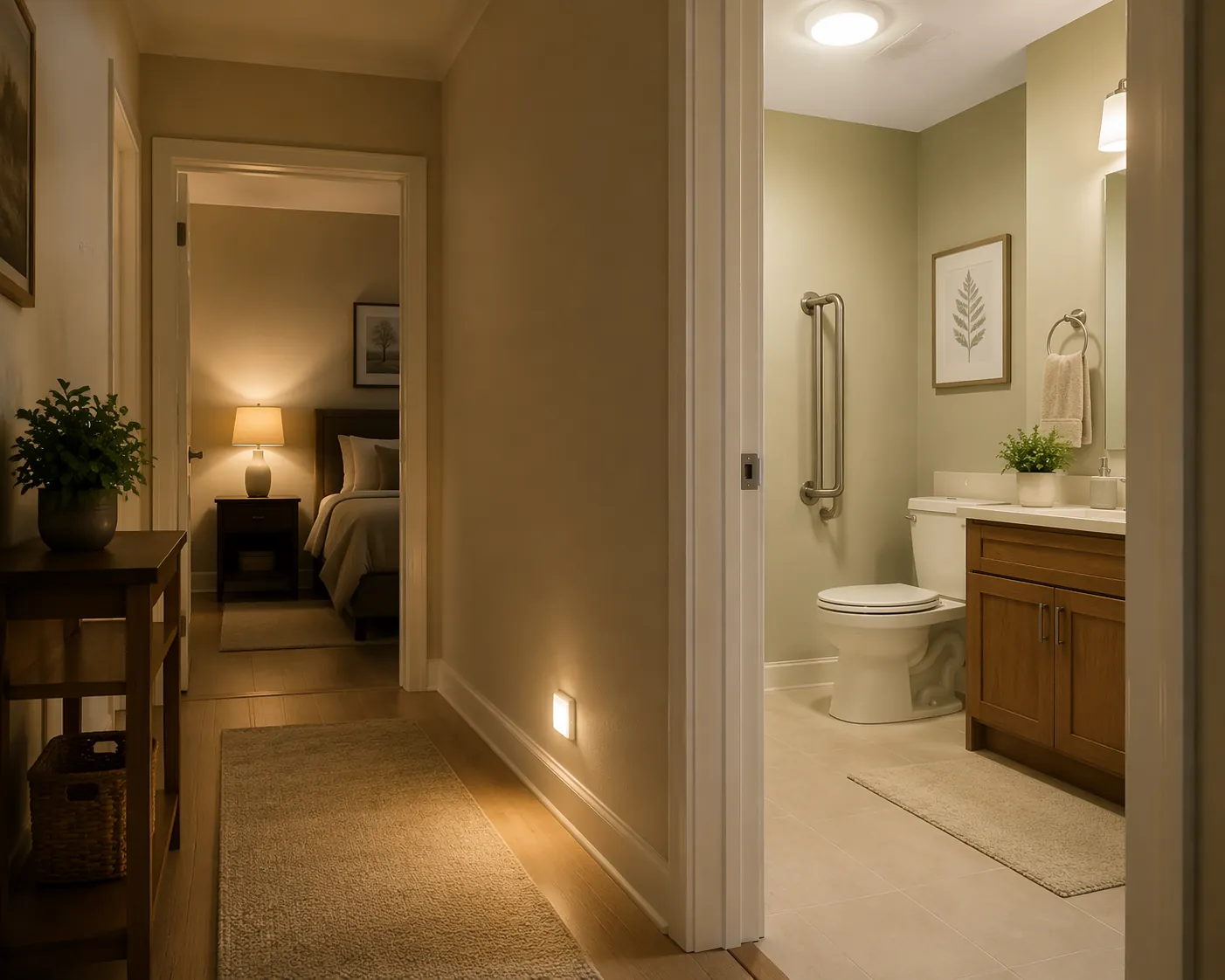
| Bed-to-bathroom route | Add motion-activated nightlights low along the route, especially near turns and thresholds. | Missing the edge of a rug, doorway, bathmat, or hallway transition. |
| Bathroom | Use brighter overhead lighting and make the toilet, sink, shower edge, and grab bars visible. | Turning, reaching, or transferring weight in a room with shadows and shiny surfaces. |
| Kitchen | Improve overhead or task lighting where breakfast, medication, and coffee routines happen. | Handling hot items, pills, cabinet doors, or pet bowls in dim light. |
| Hallways and stairs | Make sure switches are reachable at both ends where possible; add battery or motion lights where they are not. | Starting down a hallway or stair before the next switch is visible. |
| Outage-prone areas | Add battery-powered backup lights near the bed, bathroom, hallway, and exit path. | A sudden dark route during a power outage or winter storm. |
Start at the bed, not at the breaker panel
Stand where your parent’s feet land first. Can they turn on a light without leaning, twisting, or taking a step? If the lamp is across the room, it is decoration from a fall-prevention standpoint. Move it to the side they actually use. If the switch is small or stiff, use an easier control: a touch lamp, a large-button lamp, or a plug-in remote that does not require fumbling.
Then look down. The first hazard may be a dark slipper, a curled rug corner, a black charging cord, or a pet bed that blends into the floor. Better light helps only if it falls where the first step happens. A lamp that brightens the wall but leaves the floor in shadow is not doing the job.
Make the bathroom path automatic
The bed-to-bathroom route deserves the most attention because it combines sleepiness, urgency, bare or slippered feet, and a lot of small visual decisions. A parent has to judge the doorway, the hallway edge, the bathmat, the toilet position, and often a turn on the way back. Permanent daylight saving time does not create those hazards, but it can keep them in darkness during more winter mornings.
Use motion-activated nightlights so the route appears before your parent has to search for a switch. Place them low enough to show the floor, but not where they shine directly into the eyes. Check the route at the same hour your parent usually gets up; a hallway that seems fine at 2 p.m. can hide a threshold at 6:30 a.m.
Do not stop at one nightlight near the outlet that happens to be available. The light needs to cover decision points: the bedroom doorway, the hallway turn, the bathroom entrance, and the return path. If the outlet is in the wrong place, a battery-powered motion light may be safer than leaving the darkest corner untouched.
Give the bathroom enough light to show edges
Bathrooms are full of low-contrast edges: white tub against white tile, pale bathmat against pale floor, chrome grab bar against a light wall, clear shower door against glare. Brighter overhead light helps, but visibility is not only brightness. The question is whether your parent can tell where one surface ends and another begins.
If there is a grab bar, make sure it stands out from the wall. If there is a bathmat, choose one that contrasts with the floor and lies flat. If the toilet area is dim because the overhead fixture is behind the person, add a safe supplemental light. NIA specifically includes motion-activated nightlights in bathrooms and halls, bright lighting in bathrooms, and contrasting grab bars among its home fall-prevention recommendations [3].
Do not leave the kitchen as the dim reward at the end of the route
A parent who gets safely to the kitchen still has to read labels, measure coffee, open drawers, handle hot water, reach into cabinets, and possibly take morning medication. If the kitchen light is weak or slow to turn on, the risk changes shape rather than disappearing. Upgrade the bulbs in existing fixtures where appropriate, add under-cabinet or plug-in task lighting if counters are shadowed, and make the path to the main switch obvious.
Pet bowls, throw rugs, and low stools deserve a second look in winter morning light. They are easy to see when family visits after lunch. They are not always easy to see when the room is gray, the parent is hungry, and the coffee maker is the destination.
Hallways, stairs, and the outside door
Hallways need light at the beginning and the end. If the only switch is on the far side, the first steps are still dark steps. Where wiring already provides switches at both ends, make sure your parent uses them easily. Where it does not, motion lights or battery-powered stair lights can close the gap without turning the weekend into an electrical project.
Stairs need light that shows tread edges, not just a glow from a distant ceiling fixture. If the handrail disappears into the wall color, improve contrast. If the landing is dim, light the landing. A stair is a sequence of judgments; the eye has to read each one in time.
Outdoor winter mornings add another layer. The National Committee to Preserve Social Security and Medicare has raised concerns about older adults navigating dark mornings under permanent daylight saving time, including risks such as icy sidewalks before dawn [7]. For a parent who steps outside early, the porch light, path light, railing visibility, and door threshold belong in the same walkthrough as the bedroom and bathroom.
Plan for sudden darkness, too
Permanent daylight saving time is about predictable morning darkness. Power outages are about sudden darkness. The fix overlaps: battery-powered lights near the bed, along the bathroom path, and near exits keep the route visible when a storm or grid failure turns off the usual fixtures.
This is worth separating from general emergency planning because the fall hazard starts immediately. A flashlight in a kitchen drawer does not help a parent who wakes in a dark bedroom and has to cross the room to find it. For a more detailed darkness-specific setup, use our power outage fall prevention checklist alongside the daylight-saving walkthrough.
Use a fall-risk lens without making your parent feel managed
The easiest way to make this conversation go badly is to lead with control: “You cannot get up in the dark anymore.” Most parents hear the loss before they hear the safety point. Start with the house instead. “I want the bathroom path to light up before you have to look for the switch” is a different conversation from “I do not trust you to walk.”
Walk the route together if your parent is willing. Ask which side of the bed they use, which bathroom trip happens first, whether the kitchen light feels harsh, and whether any nightlight would bother their sleep. The best fall-prevention fix is the one they will leave plugged in after you go home.
On Rehabmart, occupational therapist Mike Price identifies darkness as a major modifiable fall-risk factor at home [6]. That does not mean lighting is the only thing to fix. It means darkness is one of the rare hazards a caregiver can often reduce without asking a parent to give up the morning routine that makes the day feel normal.
When the lighting walkthrough should become a medical conversation
If your parent has fallen recently, nearly fallen, started holding walls or furniture, changed medications, developed dizziness, or begun avoiding parts of the house, lighting changes should not be the whole plan. They are a home-safety layer. A clinician can look at balance, blood pressure, medications, vision, foot problems, strength, and other contributors that a lamp will not fix.
CDC’s STEADI materials are built for that broader fall-risk process: identify risk, assess what is contributing, and intervene in more than one way when needed [5]. If you need a way to start the formal conversation, our Medicare fall prevention coverage guide can help you prepare for a covered fall-risk discussion and home-safety assessment questions.
Permanent daylight saving time may or may not become the law on the timeline people expect. The darker-morning hazard is still worth preparing for now because the fixes are visible, modest, and useful even if the clock policy stalls. A bedside lamp within reach, a bathroom route that lights itself, a brighter bathroom, a kitchen that does not hide its floor, and backup lights where darkness could arrive suddenly: those are not predictions. They are changes you can see when you stand in the doorway and look at the path your parent will take tomorrow morning.
This is fall-risk education, not individual medical advice. If your parent’s risk is changing, or if you are unsure whether lighting is enough, bring the walkthrough to their clinician and ask what else should be assessed.
References
- FactCheck.org June 2026 — FactCheck.org, June 2026
- AASM experts advocate for permanent standard time — American Academy of Sleep Medicine
- Preventing Falls at Home: Room by Room — National Institute on Aging
- Shedding Light on Falls — PMC, 2024
- STEADI — Older Adult Fall Prevention — Centers for Disease Control and Prevention
- Preventing Elderly Falls at Home — Rehabmart
- Is Permanent DST Healthy for Seniors? — National Committee to Preserve Social Security and Medicare
Related reading
Noticed something outdated or inaccurate on this page? Flag a correction. We review every report against CDC, NIA, and AARP HomeFit guidance before updating a page.
Part of the Fall Prevention section.