
STEADI: intervene
Heat Wave Preparedness for Seniors Also Prevents Falls
Learn how extreme heat increases fall risk for older adults through dehydration, medication interactions, and orthostatic hypotension, and discover an integrated strategy to keep seniors safe during heat waves.
A heat wave can turn an ordinary movement into the risky part of the day. An older adult stands up from a recliner, pauses, reaches for the wall, and says, “I’m fine.” Maybe they are. But in hot weather, that moment deserves more attention than it usually gets.
Heat wave preparedness for seniors is often framed as avoiding heat stroke: stay indoors, drink water, use air conditioning, and watch for emergency symptoms. Those steps matter. They are not the whole plan. Extreme heat can also make the home more fall-prone by changing hydration, blood pressure, alertness, medication effects, and even floor conditions.
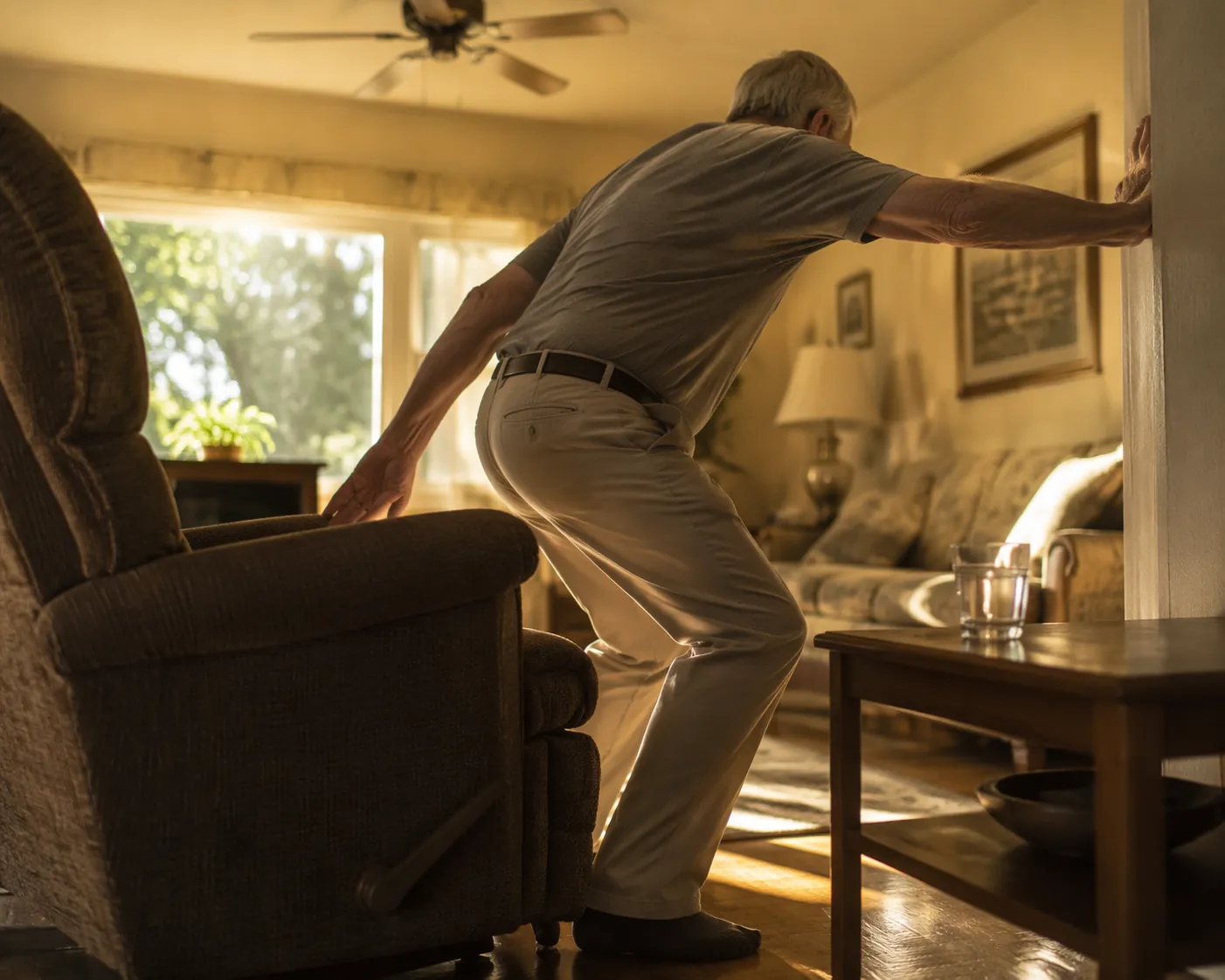
That is the useful shift: treat a heat wave not only as a weather emergency, but as a temporary increase in fall risk. The question becomes more concrete. Can the person stand up safely after sitting? Can they get to the bathroom at night? Are they taking medications that make dehydration, dizziness, sedation, or blood-pressure drops more likely? Is the coolest room also the safest room to walk through?
How heat can make balance less reliable
The fall risk starts before anyone looks dramatically ill. Older adults are more vulnerable to heat because aging affects temperature regulation, sweating, circulation, and the ability to sense thirst. Harvard Medicine Magazine notes that thirst sensation declines with age, which means an older person may not feel thirsty until dehydration is already affecting the body.[1]
That matters for falls because dehydration is not just about comfort. It can interfere with coordination, concentration, and steadiness. A person who is mildly dehydrated may rise too quickly, misjudge a step, forget to use a cane, or feel suddenly weak halfway to the bathroom. The danger is not always a collapse. Sometimes it is one missed correction.
Heat also changes blood pressure. The CDC’s heat and medication guidance explains that high temperatures can dilate blood vessels and lower blood pressure, increasing the risk of light-headedness, especially when someone moves from sitting or lying down to standing.[2] That standing-up drop is the part families often see but do not name: a few seconds of wobbling, a hand to the wall, a pause before walking.
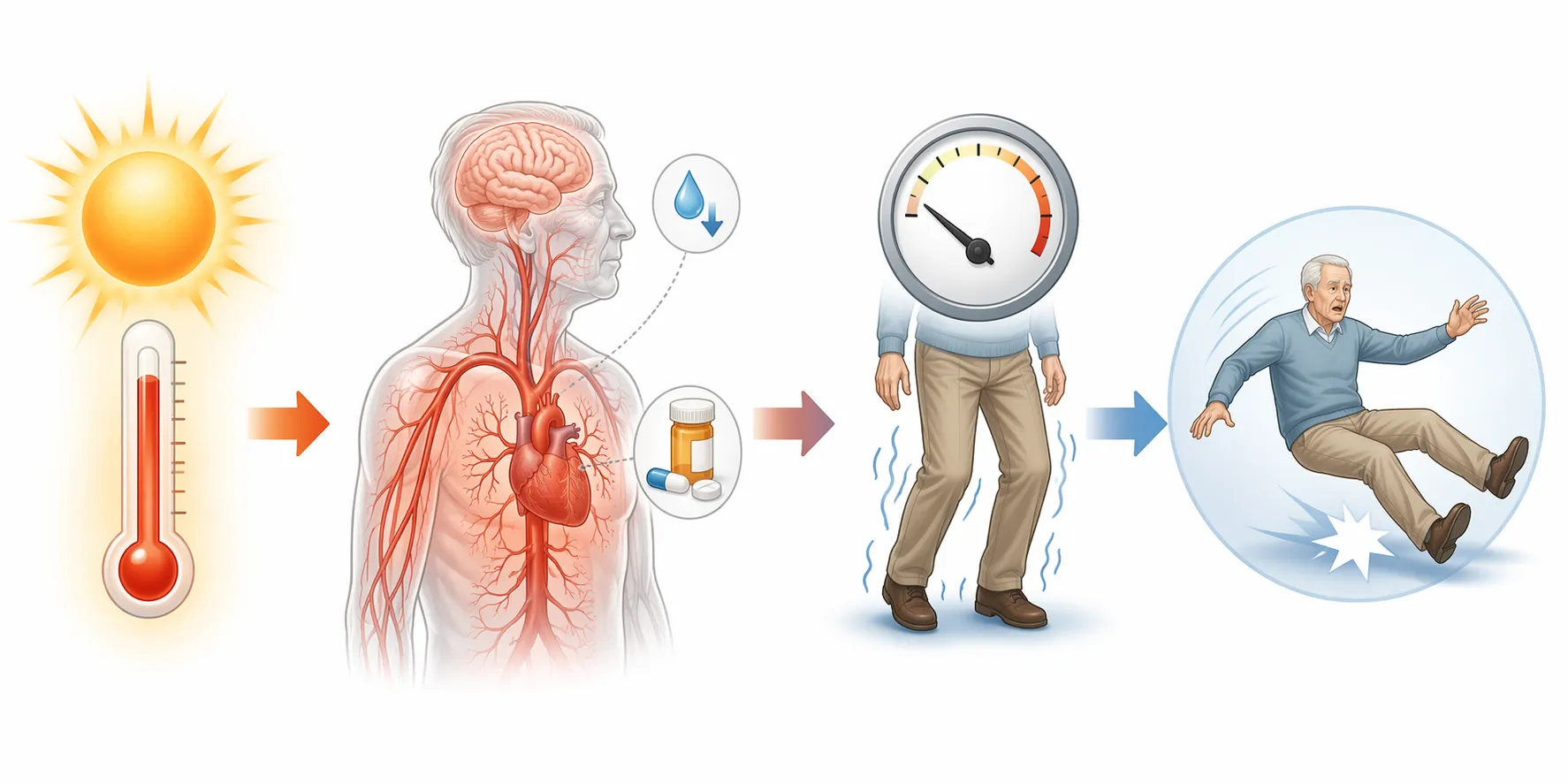
This is why orthostatic hypotension deserves a place in summer planning. It is not a seasonal buzzword. It describes a practical problem: blood pressure may not adjust fast enough when the body changes position. During hot weather, dehydration and blood-vessel dilation can make that adjustment harder. The result can be dizziness, blurred vision, weakness, or a near-fall at exactly the moment someone starts moving.
Fatigue adds another layer. Injury Matters, an Australian injury-prevention organization, explicitly connects hot weather with fall risk by pointing to dehydration, dizziness, tiredness, and reduced concentration during everyday activity.[3] The location matters less than the mechanism. Heat fatigue can slow reactions while a person is bathing, carrying laundry, using stairs, preparing food, or stepping over a threshold.
None of this means heat waves cause every fall. Individual risk depends on health conditions, medications, hydration, cooling access, mobility, vision, footwear, and the layout of the home. But the pathway is clear enough to plan around: heat can reduce the margin for error.
The medication list belongs in the heat plan
A summer safety plan that ignores medications is incomplete. The CDC identifies several medication classes that can increase heat sensitivity, including diuretics, anticholinergic agents, beta blockers, ACE inhibitors and ARBs, SSRIs and SNRIs, antipsychotics, and benzodiazepines.[2] These medications are not “bad” medications. Many are necessary. The concern is that heat may amplify side effects that already matter for falls: dehydration, low blood pressure, electrolyte changes, sedation, slower reaction time, and confusion.
This is especially important when an older adult takes several prescriptions, over-the-counter sleep aids, allergy medications, or bladder medications. The risk may come from the combination, not from one obvious culprit. A diuretic may increase fluid loss. A sedating medication may make a nighttime bathroom trip less steady. A blood-pressure medication may be perfectly appropriate in normal conditions but worth discussing before a stretch of extreme heat.
One third-party senior safety resource cites a BMC Geriatrics study of elderly hip fracture patients in which 41% of falls were suspected to be medication-related.[4] That figure should be treated carefully because the original study details should be checked before using it as a broad population estimate. Still, it points to a practical lesson already familiar in fall prevention: medication review is not paperwork. It can change the risk profile of a hallway, a bathroom, and a bedroom at night.
The safe action is not to stop or reduce medications at home. Abrupt changes, especially to blood-pressure, heart, psychiatric, or seizure medications, can be dangerous. The useful heat-wave step is to prepare a current medication list and ask the prescriber or pharmacist specific summer questions: Which of these can worsen dehydration, dizziness, blood-pressure drops, sleepiness, or confusion during extreme heat? Are there warning signs that should prompt a call? Should fluid intake be handled differently because of heart, kidney, or blood-pressure conditions?
The emergency numbers are large, but the home details are where prevention happens
The scale of heat illness is not small. A CDC MMWR report documented 119,605 heat-related emergency department visits in the United States from May through September 2023.[5] The CDC also notes that heat-related deaths are likely undercounted, which means official totals may miss some of the true burden.[5]
But a family cannot prevent an emergency department visit with a number. They prevent it by noticing what heat changes inside the house. The recliner is too low. The water is across the room. The bathroom mat slides. The bedroom is cooler but farther from the toilet. The person who usually walks without a cane becomes unsteady after a hot afternoon. These details are not small; they are the working parts of prevention.
The CDC identifies adults aged 65 and older as a group at higher risk during heat because they may not adjust as well to sudden temperature changes, may be more likely to have chronic medical conditions, and may take medications that affect temperature regulation.[6] That does not make older adults passive. It means the plan should reduce avoidable strain before the hottest hours arrive.
What changes when a heat wave is treated as a fall-risk event
The usual heat advice still applies: stay in air conditioning when possible, avoid outdoor exertion during the hottest part of the day, keep up with local weather alerts, and check on older adults. The difference is that each step should also be judged by whether it makes standing, walking, toileting, bathing, and meal preparation safer.
| Heat-related change | Fall-risk consequence | Preparation move |
|---|---|---|
| Reduced thirst and dehydration | Less steady walking, slower thinking, weakness | Place drinks within reach and schedule hydration check-ins before thirst |
| Blood-vessel dilation and lower blood pressure | Dizziness when standing | Pause before walking; use chairs, grab bars, or stable supports near transfer points |
| Medication heat sensitivity | More dizziness, sedation, dehydration, or electrolyte problems | Ask a prescriber or pharmacist to review the medication list before extreme heat |
| Heat fatigue | Slower reactions during bathing, stairs, cooking, or errands | Move hard tasks to cooler hours and reduce unnecessary trips through the house |
| Humidity and damp floors | Slips in bathrooms, kitchens, and entryways | Remove loose mats, dry floors promptly, and improve ventilation where safe |
This table is not meant to turn the home into a clinic. It is a way to make the invisible effects of heat visible enough to act on. If heat increases dizziness, then the first few steps after standing matter. If heat increases fatigue, then showering at the end of a hot day may be a poor choice. If thirst is unreliable, then “drink when you feel thirsty” is not enough.
Move water to the person, not the person to the water
A glass of water on the kitchen counter is less useful if the risky moment is getting up from the chair to reach it. Put water where the person already sits, sleeps, and takes medication. Use containers that are easy to grip and not so heavy that they create another hazard. If the person has fluid restrictions because of heart, kidney, or other medical conditions, follow the clinician’s instructions rather than using generic hydration targets.
Hydration check-ins should sound ordinary, not like an inspection. “Did you have something with lunch?” is often easier to accept than “You need to drink more water.” Food with fluid content can help too, but the medical details depend on the person’s conditions, diet, and prescriptions.
Slow down the first minute after standing
The first minute after standing deserves its own plan. A person can sit at the edge of the bed before standing, stand still before walking, and keep a stable support within reach. This is not about making someone dependent. It is about giving blood pressure and balance a few seconds to catch up.
Check the places where standing begins: bed, recliner, dining chair, toilet, shower seat, and car. Low, soft furniture can make the first push harder. A wobbly side table is not a safe support. A cane that sits across the room is decoration, not fall prevention. During a heat wave, supports need to be where the movement starts.
Put the medication review on the calendar before the forecast turns dangerous
Medication questions are easier to handle before a heat alert than during one. Keep an updated list that includes prescriptions, over-the-counter drugs, supplements, sleep aids, allergy medicines, and as-needed medications. Bring that list to the prescriber or pharmacist and ask about heat sensitivity and fall risk together, not as separate concerns.
- Ask whether any medication may increase dehydration, dizziness, sleepiness, confusion, or low blood pressure during extreme heat.
- Ask which symptoms should prompt a same-day call, especially if the person becomes weak, unusually sleepy, confused, faint, or unable to keep fluids down.
- Ask whether hydration advice needs to be individualized because of heart failure, kidney disease, blood-pressure treatment, or electrolyte concerns.
- Do not stop, skip, or change doses without medical direction.
Choose the cool room for safety, not just temperature
The coolest room is not automatically the safest room. If it is down a flight of stairs, far from the bathroom, crowded with cords, or dimly lit, it may create another problem. A better heat-wave room has cooling, a clear walking path, a reachable phone, water within arm’s reach, stable seating, needed mobility aids, and a route to the bathroom that does not require rushing.
If air conditioning is limited to one room, set that room up before the hottest days. Move commonly used items there: glasses, phone charger, medication schedule, hearing aids, snacks if appropriate, and a light blanket if the person tends to feel chilled by air conditioning. The goal is fewer unnecessary trips, especially in the afternoon and overnight.
Treat bathrooms and entryways as summer fall zones
Humidity can make floors feel slightly slick, especially in bathrooms, kitchens, and entryways. Oakley Home Access describes heat and humidity as home-safety issues for older adults because damp surfaces and condensation can increase slip hazards.[7] The fix is usually simple, but it has to be checked: remove loose mats, dry wet areas quickly, keep towels off the floor, use non-slip backing where appropriate, and make sure bath mats do not slide underfoot.
Bathroom timing matters too. A hot shower in a warm bathroom can combine heat exposure, standing, wet surfaces, and postural blood-pressure changes. A shower chair, grab bars, cooler timing, ventilation, and a no-rush routine can reduce several risks at once. If the person is already light-headed, bathing should wait until they are stable and help is available if needed.
Cooling access is part of fall prevention
Air conditioning is often discussed as heat-illness prevention, but it also protects mobility. A cooler body is less likely to be fighting dehydration, fatigue, and blood-pressure strain. The CDC advises older adults to stay in air-conditioned places during hot weather when possible and to use cooling centers or other cooled locations if home cooling is not available.[6]
Power outages complicate the plan. The Center for American Progress describes older adults as especially vulnerable to extreme heat when outages, high energy costs, or poor housing conditions limit cooling access.[8] For fall prevention, the outage question is not only “How will we keep cool?” It is also “How will we move safely if the lights, elevator, phone charger, fan, or medical device stops working?”
- Keep flashlights where walking begins, not only in a drawer.
- Charge phones and backup batteries before heat alerts.
- Know the nearest cooled location the person can realistically reach.
- Plan transportation before the person is already weak or dizzy.
- Check whether mobility devices, oxygen equipment, stair lifts, or elevators depend on power.
The American Red Cross also recommends checking on older adults, people who live alone, and people with chronic conditions during extreme heat, and it emphasizes staying in air-conditioned places, avoiding strenuous activity, and recognizing signs of heat illness.[9] Those checks become more useful when they include movement: Are you dizzy when you stand? Have you walked to the bathroom safely? Is the floor dry? Is your cane or walker beside you?
A practical heat-wave fall check
A caregiver does not need to turn every call into a medical interview. A short, repeatable check is more likely to survive a real week of heat.
| When | What to check | Why it matters |
|---|---|---|
| Before the heat wave | Medication list, cooling plan, clear paths, bathroom surfaces, water placement | The safest fixes are easier before fatigue and dizziness begin |
| Morning | Hydration, room temperature, weather alert, planned errands or chores | The day can be adjusted before the hottest hours |
| Afternoon | Dizziness, weakness, confusion, indoor temperature, need for a cooler location | Heat strain often builds as the day goes on |
| Evening | Bathroom route, lighting, phone access, nighttime water and mobility aid placement | Many falls happen during tired, low-light trips |
| After any near-fall | Standing dizziness, medication timing, fluid intake, heat exposure, wet floors | A near-fall is a warning, not an embarrassment to ignore |
If an older adult reports fainting, chest pain, severe weakness, confusion, very high body temperature, or symptoms of heat stroke, treat it as urgent and seek emergency care. Fall prevention does not replace heat-illness response. It adds an earlier layer: noticing the dizziness, fatigue, and unsafe walking conditions before the emergency.
Keep independence in the plan
The hardest part of heat-wave planning is not always the checklist. It is asking someone who has managed their own home for decades to accept extra attention. The tone matters. “Let’s make the bathroom less slippery before the heat hits” lands differently than “You are going to fall.” So does “Can we put water by your chair?” instead of “You never drink enough.”
Good preparation should make the home feel easier to live in, not watched. Place supports where they are useful. Reduce unnecessary trips. Ask medication questions before there is a crisis. Keep the coolest room walkable. Make standing up slower and safer. Those are not dramatic interventions, but they match the way heat-related falls often develop: gradually, through ordinary tasks that become harder than they looked.
A complete heat-wave plan for seniors does more than prevent heat illness. It reduces dizziness, unsafe standing, medication-related risk, fatigue, and slippery home conditions. That is the difference between telling someone to stay cool and actually making the next walk across the room safer.
References
- The Effects of Heat on Older Adults — Harvard Medicine Magazine
- Heat and Medications – Guidance for Clinicians — CDC
- Supporting older adults to beat the heat — Injury Matters
- Senior Home Safety Checklist — AllThrive365
- Heat-Related Emergency Department Visits — United States, May–September 2023 — CDC MMWR
- Heat and Older Adults (Aged 65+) — CDC
- How Heat and Humidity Can Impact Senior Safety at Home — Oakley Home Access
- Protecting Older Adults from Extreme Heat — Center for American Progress
- Extreme Heat Safety — American Red Cross
Related reading
Noticed something outdated or inaccurate on this page? Flag a correction. We review every report against CDC, NIA, and AARP HomeFit guidance before updating a page.
Part of the Fall Prevention section.