
Severe Weather Fall Risks for Seniors and How to Prevent Them
This guide connects specific severe weather events — from winter ice to summer heat waves to power outages — to the fall hazards they create for older adults, with actionable prevention steps for caregivers to use before, during, and after each event.
An ice warning rarely sounds like a fall warning. Families hear school delays, salted roads, maybe a grocery run before the temperature drops. In an older adult’s house, the same forecast changes the walking surface at the porch, the stiffness in knees and hands, the light available at 5 p.m., and the timing of ordinary errands like taking out trash or bringing in mail.
That is why severe weather safety tips for seniors need to include fall prevention from the start. Falls caused more than 38,000 deaths among adults 65 and older in 2021 and led to about 3 million emergency department visits, according to CDC fall prevention data.[1] The point is not to turn every forecast into a crisis. It is to notice, before the weather arrives, which familiar route is about to become less forgiving.
Start With The Fall Chain, Not The Forecast
Most weather preparation asks whether the person has supplies. Fall prevention asks a different set of questions: What will they walk on? What will they be carrying? Will they be rushing? Can they see the path? Will heat, cold, medication timing, or a disrupted routine make balance worse?
Those questions respect independence better than vague warnings to “be careful.” An older adult who still lives alone may not want a daughter or son taking over the house every time clouds gather. Fair enough. But the porch can be salted, the flashlight can move from the kitchen drawer to the bedroom and hallway, and the path to the safest interior room can be cleared without turning a capable person into a passive patient.
| Weather change | Fall mechanism to look for | Caregiver action that matters |
|---|---|---|
| Ice, snow, freezing rain | Slippery steps, stiff joints, reduced daylight, cane or walker tips losing grip | Treat entrances before the event, stage traction supplies at exits, delay nonessential outdoor trips |
| Heat wave | Dehydration, dizziness, fatigue, medication-related vulnerability | Plan fluids, cooling, check-ins, and safer timing for necessary movement |
| Power outage | Dark hallways, unseen clutter, cords, furniture edges, stairs | Put flashlights and outage-safe lights in the rooms where walking actually starts |
| Thunderstorm, hurricane, heavy rain | Rushing to shelter, wet floors, debris, unfamiliar evacuation setting | Clear shelter routes, slow the movement plan, inspect entrances before normal routines resume |
Winter Ice And Snow: The Porch Is Part Of The Safety Plan
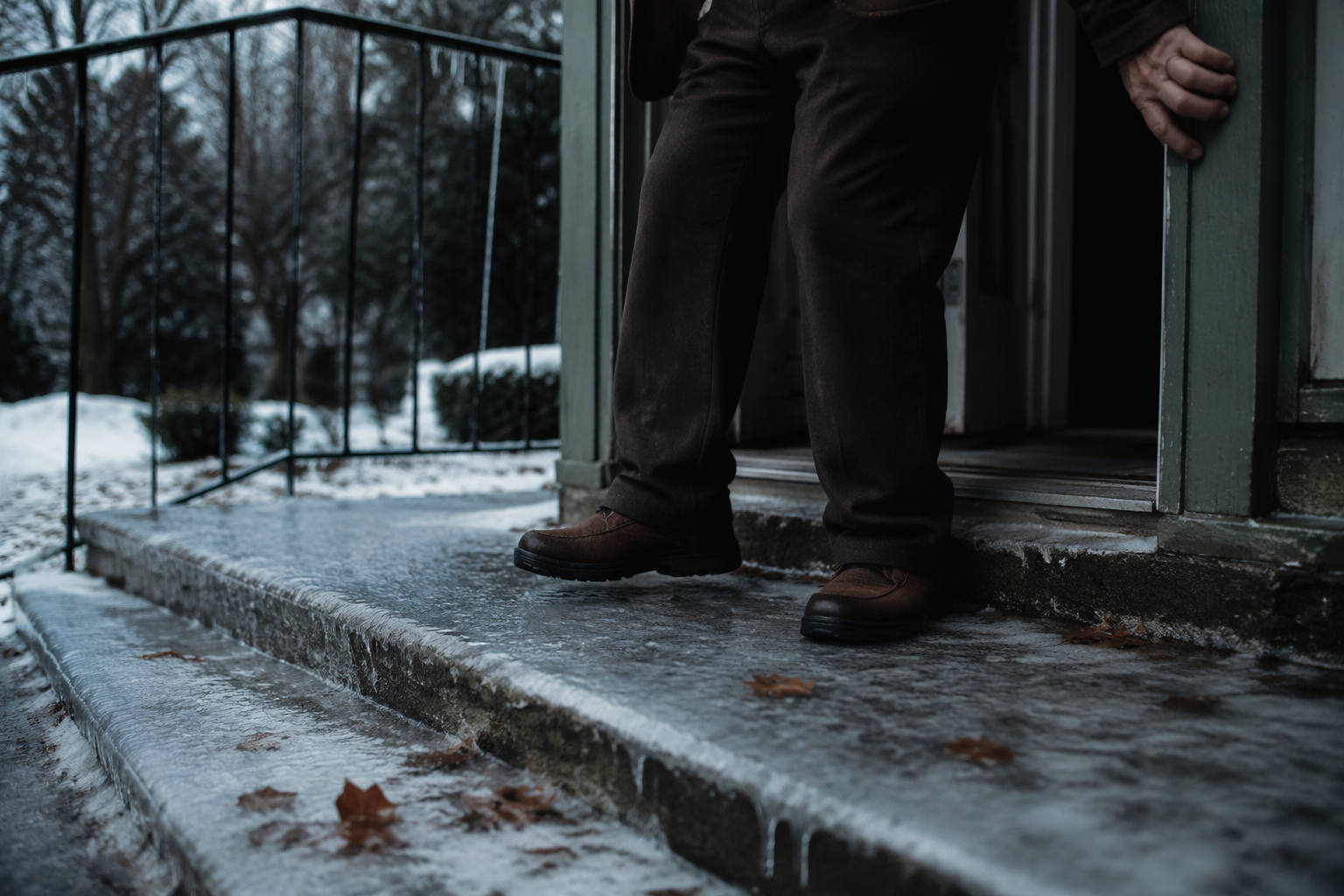
Winter fall risk often begins before anyone “goes out.” It begins at the threshold: the porch that looked wet but froze, the mat that slid on tile, the mailbox trip after sunset, the cane tip that worked on dry pavement but skates on ice. NCOA’s winter fall prevention guidance points to the familiar hazards of snow and ice and recommends practical traction measures, including ice grippers for canes and using materials such as cat litter to improve grip on slick surfaces.[2] Ohio’s seasonal falls guidance also highlights winter hazards such as ice, snow, and reduced daylight.[3]
Cold itself changes movement. A person who normally walks carefully may take shorter, stiffer steps when joints are cold. Gloves can make it harder to hold a railing. A bulky coat can change balance. The task may be small, but the body is not moving under ordinary conditions.
Before Ice Arrives
- Move traction supplies to the exit, not the garage shelf. Salt, sand, or cat litter belongs where the older adult or a neighbor can reach it before stepping onto the slick area.
- Check every entrance the person actually uses: front door, side door, garage step, patio door, ramp, and path to the mailbox.
- Replace loose or decorative mats with non-slip mats that do not bunch at the edge.
- Add or test railings and grab points near exits. A strong door frame is not the same as a secure handhold.
- Put a flashlight or battery lantern near each exit if the storm may affect power or if evening ice is expected.
- Agree on which outdoor tasks will wait. Mail, trash, newspapers, and package pickup are common reasons older adults step onto ice “just for a minute.”
Footwear needs the same practical treatment. Shoes with smooth soles do not become safe because the walk is short. If the person uses a cane, ask whether the tip is worn and whether an ice gripper attachment is appropriate. If they use a walker, the question is not only whether it fits indoors; it is whether the outdoor surface will catch, slide, or sink.
During Winter Weather
The safest winter errand is often the one delayed until someone can clear the surface. That does not mean forbidding all outdoor movement. It means separating necessary movement from habit. A medical appointment may require a plan. The mail can wait.
If the older adult must walk on a potentially slick surface, slow the task down before the door opens. The “penguin walk” technique recommended in winter fall-prevention guidance uses small steps, feet turned slightly outward, and a center of gravity kept over the feet rather than leaning forward.[2] It looks less graceful than a normal stride. It is also better suited to ice than pretending the sidewalk is dry.
- Keep both hands as free as possible; use a cross-body bag or ask someone else to carry items.
- Do not let the person rush because they are cold. Rushing is a fall risk, not a time-saving strategy.
- Use the entrance with the best lighting, railing, and cleared surface, even if it is not the usual door.
- Pause at the threshold. Many falls happen when the body expects indoor footing and meets outdoor ice.
After The Snow Stops
After winter weather, the dangerous surface is often patchy. A walkway may be cleared in the middle but icy at the edge. Wet shoes bring water onto tile. A mat that helped at the door may now be saturated and sliding underneath.
- Inspect entrances before the older adult resumes normal routines.
- Remove wet leaves, slush, and refrozen patches from steps and landings.
- Dry indoor flooring just inside the door, especially tile, laminate, and hardwood.
- Check cane tips, walker feet, and shoe soles for packed snow or worn traction.
- Ask about near-falls, not just falls. A grab at the door frame is useful information.
Heat Waves: Dizziness Can Arrive Before Thirst
Heat does not leave ice on the steps, so families sometimes miss the fall risk. The walking surface may be dry, but the person walking across it may be lightheaded, fatigued, or less steady. CDC notes that older adults do not adjust as well as younger people to sudden temperature changes and are more likely to have chronic medical conditions or take medications that affect body temperature regulation.[4]
For fall prevention, the key word is not only “heat illness.” It is balance. Dehydration can show up as weakness or dizziness before a parent says they are thirsty. A person who stands quickly from a recliner in a hot room, walks to the bathroom, and turns without a light on has more than one risk factor working at the same time.
For a deeper heat-specific discussion, see how heat waves increase fall risk in older adults. The practical home plan begins with ordinary movement: bathroom trips, kitchen trips, medication routines, and getting to a cooler room.
Before A Heat Wave
- Set a hydration routine that does not depend on thirst. Use visible cups, preferred drinks, and regular prompts if the person accepts them.
- Review medications with a clinician or pharmacist if heat, dizziness, urination, or blood pressure changes are concerns.
- Move commonly used items closer to the coolest safe room so the person makes fewer trips through hot areas.
- Check that pathways to the bathroom and kitchen are clear, because heat-related urgency and fatigue can make small obstacles less tolerable.
- Plan check-ins around the hottest part of the day, not only morning greetings.
This is also where medical needs matter. If a parent uses equipment, refrigerated medication, oxygen, or routines that affect balance, weather planning and fall planning are the same conversation. Readers managing those dependencies may want the more specific guide to severe weather safety for elderly adults with medical needs.
During Extreme Heat
During heat, the caregiver’s job is not to police every step. It is to reduce the number of unnecessary steps and make the necessary ones slower and better supported. Encourage sitting before standing, standing before walking, and pausing before turning. That sequence is not fussy; it gives dizziness a chance to declare itself before the person is halfway across the room.
- Keep water within reach of the chair, bedside, and medication area.
- Avoid nonessential outdoor chores during the hottest hours.
- Use sturdy seating near places where the person may need to pause, such as the bedroom, kitchen, and entry.
- Watch for dizziness, unusual fatigue, confusion, or unsteadiness rather than waiting for a complaint of thirst.
After Heat Breaks Or Storms Roll Through
Summer heat often ends with sudden storms. Ohio’s seasonal guidance notes that summer can bring mud-slick surfaces and storm debris that create trip hazards.[3] After rain, the fall risk moves back to the ground: wet leaves, branches, puddled entryways, and shoes that track water inside.
- Clear branches, loose pots, downed twigs, and wet leaves from walking paths before the person resumes outdoor routines.
- Dry entry floors and replace soaked mats.
- Check whether the person ate, drank, and slept normally during the heat; weakness after the event still affects balance.
- Delay cleanup jobs that require bending, carrying, or stepping around debris.
Power Outages: One Flashlight In The Kitchen Is Not A Lighting Plan
A familiar hallway becomes a different room when the power goes out. Shoes left near the bedroom door, a curled rug edge, a laundry basket, the oxygen tubing or charging cord someone usually steps over without thinking — all of it changes when depth perception disappears.
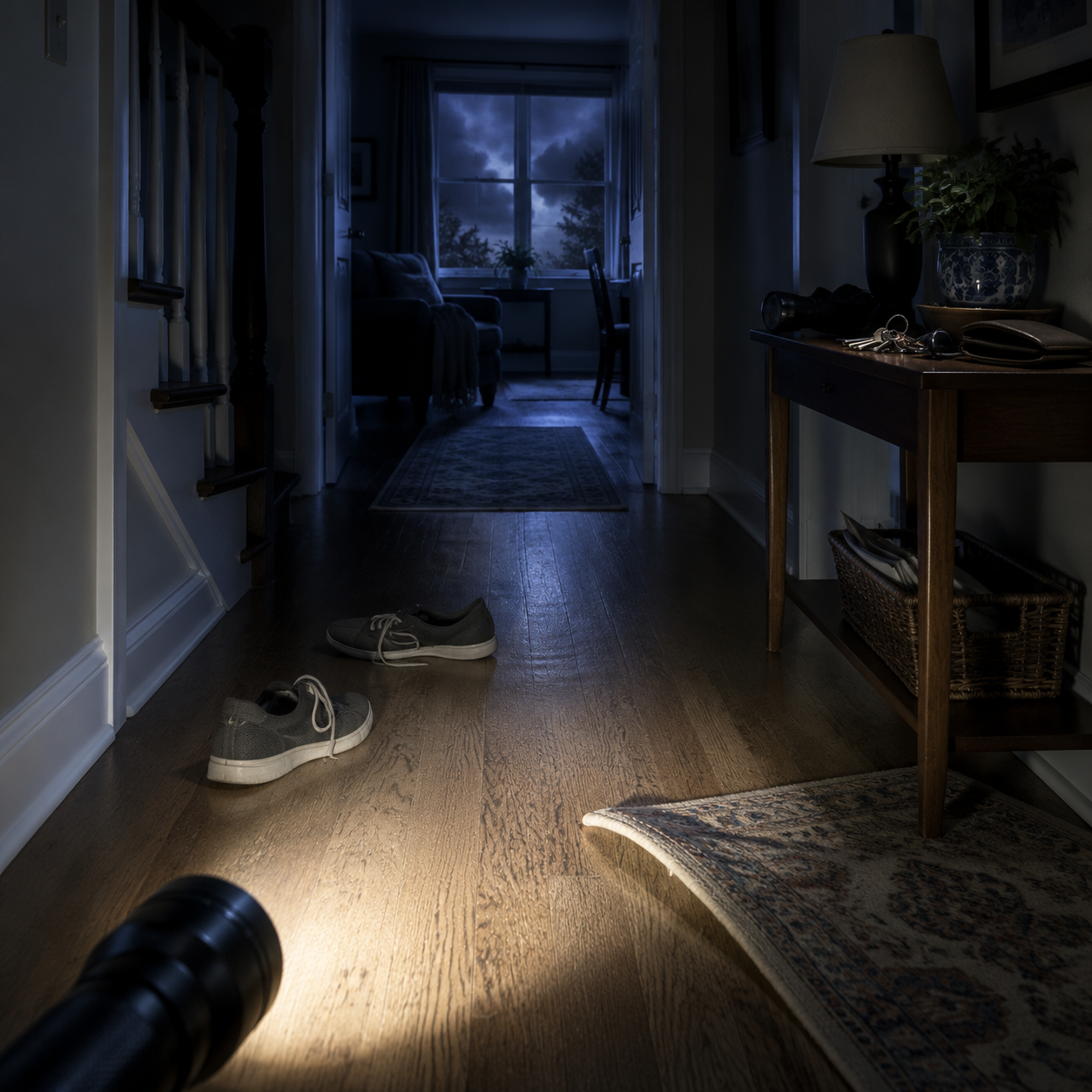
Ready.gov’s older adult guidance recommends keeping flashlights near doorways and staircases.[5] That detail matters. A flashlight stored in one central drawer helps only if the person can safely reach that drawer in the dark. For fall prevention, lights belong where movement begins: bedside, bathroom, hallway, favorite chair, kitchen, and each exit.
For a room-by-room version, use a dedicated power outage fall prevention checklist for seniors. The shorter version is simple: if the person has to walk before finding the light, the light is in the wrong place.
Before An Outage
- Place flashlights or battery lanterns in every room where the person may wake, sit, eat, use the bathroom, or exit.
- Use motion-sensor nightlights with battery backup where possible, especially between bedroom and bathroom.
- Remove low trip hazards before storms arrive: shoes, baskets, pet toys, loose cords, curled rug edges, and small tables in narrow paths.
- Charge phones, hearing aids, mobility-device batteries, and medical-device backup batteries.
- Tape or secure cords that must remain in use so they do not cross walking paths.
- Agree on a no-candle rule if there is any chance the person will carry a flame while walking.
Red Cross preparedness guidance for older adults emphasizes planning around medical equipment, mobility needs, and support networks.[6] Ready.gov also tells older adults to consider needs such as assistive devices, durable medical equipment, and power-dependent devices when making emergency plans.[5] From a fall-prevention angle, backup power is not only about the device staying on. It is about preventing the improvised, risky movement that starts when the device stops working or the charger is across the room.
During An Outage
The house rule during an outage should be boring: no unnecessary walking in the dark. If the person must move, they should turn on the nearest light source before standing, use the usual assistive device, and avoid carrying heavy or awkward items.
- Keep a phone or alert device on the body, not on a table across the room.
- Use battery lanterns to light the whole path when possible; a narrow flashlight beam can miss low obstacles.
- Do not rearrange furniture during the outage unless it blocks a path; unfamiliar layouts create new hazards.
- If the person is anxious about food, pets, or equipment, assign someone else to handle the task rather than letting them hurry through dark rooms.
After Power Returns
Power returning does not automatically restore safety. Extension cords may still cross the floor. Furniture may have been moved. A parent may be tired from a poor night’s sleep and ready to “put things back” too quickly.
- Walk the main routes in daylight or full lighting before normal routines resume.
- Remove temporary cords, lanterns, coolers, and supplies from walking paths.
- Recharge every flashlight, phone, battery pack, and medical-device backup battery.
- Ask whether the person stumbled, grabbed furniture, or avoided a room because it felt unsafe.
Storms And Hurricanes: The Dangerous Part May Be The Rush
Thunderstorms, tornado warnings, tropical storms, and hurricanes add a timing problem to the same fall mechanisms. The person may be moving in low light, over wet flooring, toward an interior room, while worried about wind, pets, windows, medications, or a phone alert. Rushing to shelter is a fall risk even when the floor itself is dry.
Ready.gov and Red Cross both emphasize planning ahead for older adults, including support networks, communication, supplies, mobility needs, and assistive or medical equipment.[5][6] For falls, the missing step is often the route rehearsal. It is not enough to name the safest room. The older adult has to be able to reach it without stepping around laundry, boxes, pet bowls, throw rugs, or a walker parked on the wrong side of the hallway.
For storm-specific preparation, see why storms create a dangerous fall risk for seniors. For hurricane planning with medical dependencies, use hurricane preparedness for seniors with medical needs.
Before Severe Storms
- Choose the safest practical room and clear the full route to it, including turns, door thresholds, and space for a walker or cane.
- Put shoes, glasses, hearing aids, phone, flashlight, and mobility device within reach before the warning arrives.
- Move patio furniture, planters, hoses, and loose outdoor items away from regular walking paths.
- Stage towels or absorbent mats at entrances likely to get wet.
- Make a medication and equipment plan before the storm, especially for anything that affects balance, alertness, blood pressure, or mobility.
- Assign who will call, who will come over if needed, and who has a key or access code.
Medication planning should be specific. Red Cross recommends keeping a 30-day supply of medications when possible for older adult emergency preparedness.[6] Some families may not be able to keep that much on hand because of prescribing, insurance, or controlled-substance limits. The fall-prevention question is still worth asking: what happens to balance, dizziness, sleep, pain, or mobility if this medication routine is interrupted?
During Warnings
A shelter plan should begin earlier than the last alert. If the parent waits until the warning feels urgent, they are more likely to move fast, forget the cane, skip shoes, or try to carry too much. The caregiver’s job is to make the safe choice the easy choice before adrenaline joins the room.
- Move to the designated safe area when watches or early warnings make it sensible, not at the final frantic minute.
- Keep the phone, water, medications, glasses, hearing aids, and mobility device in the safe area if the person may remain there for a while.
- Use seated waiting when possible. Standing in a hallway during a long warning adds fatigue without adding safety.
- Do not send the older adult to check windows, move outdoor objects, or look for a pet once conditions are unsafe.
After Heavy Rain, Wind, Or Evacuation
After a storm, people want to inspect damage. Older adults who are proud of their homes are no different. The safer compromise is not “don’t look.” It is “look after the route is checked.” Wet floors, fallen limbs, loose shingles, broken glass, displaced outdoor rugs, and power cords can turn the first inspection into the fall event.
Evacuation adds another layer. NCOA’s disaster guidance for older adults emphasizes planning before, during, and after disasters, including supplies, contacts, and knowing where to go.[7] In an evacuation setting, the fall risks may be unfamiliar bathrooms, different bed heights, crowded walkways, poor lighting, and the absence of the grab bars or routines the person relies on at home.
- Inspect entrances, ramps, steps, and indoor floors before the older adult resumes usual movement.
- Clear debris from the route to the car, mailbox, trash bins, and any generator area.
- At a shelter, hotel, or relative’s home, identify the bathroom route in daylight and add a night light or flashlight before bedtime.
- Keep mobility devices close, even if the older adult says the unfamiliar distance is “just a few steps.”
- Treat fatigue after evacuation as a balance risk. A tired person in a strange room is not moving with their usual margin of safety.
The Home Pass That Should Happen Before Every Severe Weather Event
Generic emergency kits have their place. Water, medications, documents, batteries, chargers, and contacts matter. But a kit in a closet does not prevent a fall on the way to the bathroom. Before severe weather arrives, walk the home the way the older adult will have to move through it.
| Area | What to check | What to change before weather hits |
|---|---|---|
| Bedroom | Path from bed to bathroom, slippers, phone, glasses, lighting | Place flashlight within reach; remove rugs or clutter; keep mobility device on the usual standing side |
| Bathroom | Wet floor risk, grab bars, night visibility, threshold | Add non-slip surface; keep light source nearby; check that towels or mats do not slide |
| Hallway | Shoes, cords, baskets, furniture edges, pet items | Clear a wide route; secure cords; add battery nightlights |
| Entrances | Mats, steps, railings, wet leaves, ice, debris | Use non-slip mats; stage traction supplies; improve lighting; clear the landing |
| Safe room | Route width, seating, supplies, phone signal, lighting | Clear the path; add chair, water, medications, flashlight, and charging option |
| Medication and devices | Refills, power needs, balance side effects, storage | Plan supply, backup power, and who to call if routines are disrupted |
This pass should be assigned, not admired. One person checks lights. One person handles exterior traction. One person confirms medication and device needs. One person calls the parent and asks about actual routines: which door they use, when they get the mail, where the cane is at night, whether the bathroom path is clear.
A Practical Before-During-After Pattern
- Before: clear routes, stage lighting, prepare traction, check hydration and medication vulnerabilities, charge devices, and decide which routines will pause.
- During: reduce unnecessary walking, slow necessary movement, keep assistive devices close, light the path before standing, and avoid last-minute rushing.
- After: inspect entrances, dry floors, remove debris and temporary cords, recharge supplies, and ask about stumbles or near-falls.
The language used with the older adult matters. “You can’t go outside” often starts an argument. “Let’s move the mail pickup to tomorrow because the steps will refreeze after dark” gives a reason tied to a specific hazard. “Keep a flashlight in every room” sounds less controlling than “don’t walk around,” and it gives the person a safer way to keep doing ordinary things.
What Caregivers Should Ask When The Forecast Changes
A useful caregiver call before severe weather does not have to be long. It should be concrete enough that both people can picture the next few hours.
- Which door will you use if you have to go out?
- Is the flashlight beside the bed, or is it still in the kitchen drawer?
- Where are your cane, walker, glasses, hearing aids, and phone right now?
- Can you get from the bedroom to the bathroom without stepping over anything?
- Are you drinking on a schedule today, especially if it is hot?
- If the warning comes, when will you move to the safer room?
- After the storm, will you wait until someone checks the steps, driveway, or yard?
These questions work because they stay close to behavior. They do not ask a proud parent to surrender independence. They ask whether the next walk through the house has been made safer.
The Forecast Is Also A Mobility Warning
Severe weather changes more than the sky. It changes friction underfoot, light in the hallway, body temperature, hydration, attention, timing, and the route a person must take through the home. Those changes are usually visible before anyone falls.
The habit to build is a fall-prevention pass whenever the forecast becomes serious: prepare the walking surfaces and lighting before the event, agree on safer behavior during it, and inspect the home and entrances afterward. The weather changes by season. The preventable fall chain is often the same: a changed surface, a changed body, a dark or cluttered path, and a rushed decision that could have been slowed down.
References
- CDC About Older Adult Fall Prevention. CDC. Last reviewed Jan. 27, 2026.
- NCOA Winter Fall Prevention Tips. National Council on Aging.
- Ohio Department of Aging Falls Prevention in Every Season. Ohio Department of Aging.
- CDC Heat and Older Adults (Aged 65+). CDC.
- Ready.gov Older Adults. Ready.gov.
- Red Cross Older Adults Emergency Preparedness. American Red Cross.
- NCOA What Older Adults Can Do If Disaster Strikes. National Council on Aging.
Related reading
Noticed something outdated or inaccurate on this page? Flag a correction. We review every report against CDC, NIA, and AARP HomeFit guidance before updating a page.
Part of the Fall Prevention section.