
Tornado Safety Tips for Seniors That Focus on Fall Prevention
Tornado warnings create a perfect storm of fall hazards for older adults — rushed movements in the dark, wet floors, and post-storm debris. This guide explains how caregivers can help seniors move safely during each phase of a tornado event.
A tornado warning asks people to do something that fall-prevention advice usually tells older adults not to do: move quickly, often in dim light, toward a place that may involve stairs, tight spaces, or getting down near the floor. NOAA describes the average tornado warning lead time as about 10 to 15 minutes, while noting that actual warning time varies by storm and location.[1] For a caregiver helping a parent with a walker, a spouse with poor balance, or a neighbor who uses a wheelchair, that short window changes the meaning of ordinary safety advice.
The main question behind tornado safety tips for seniors is not whether shelter matters. It does. The harder question is how to reach the safest usable shelter without creating a fall, transfer injury, or stair accident on the way there.
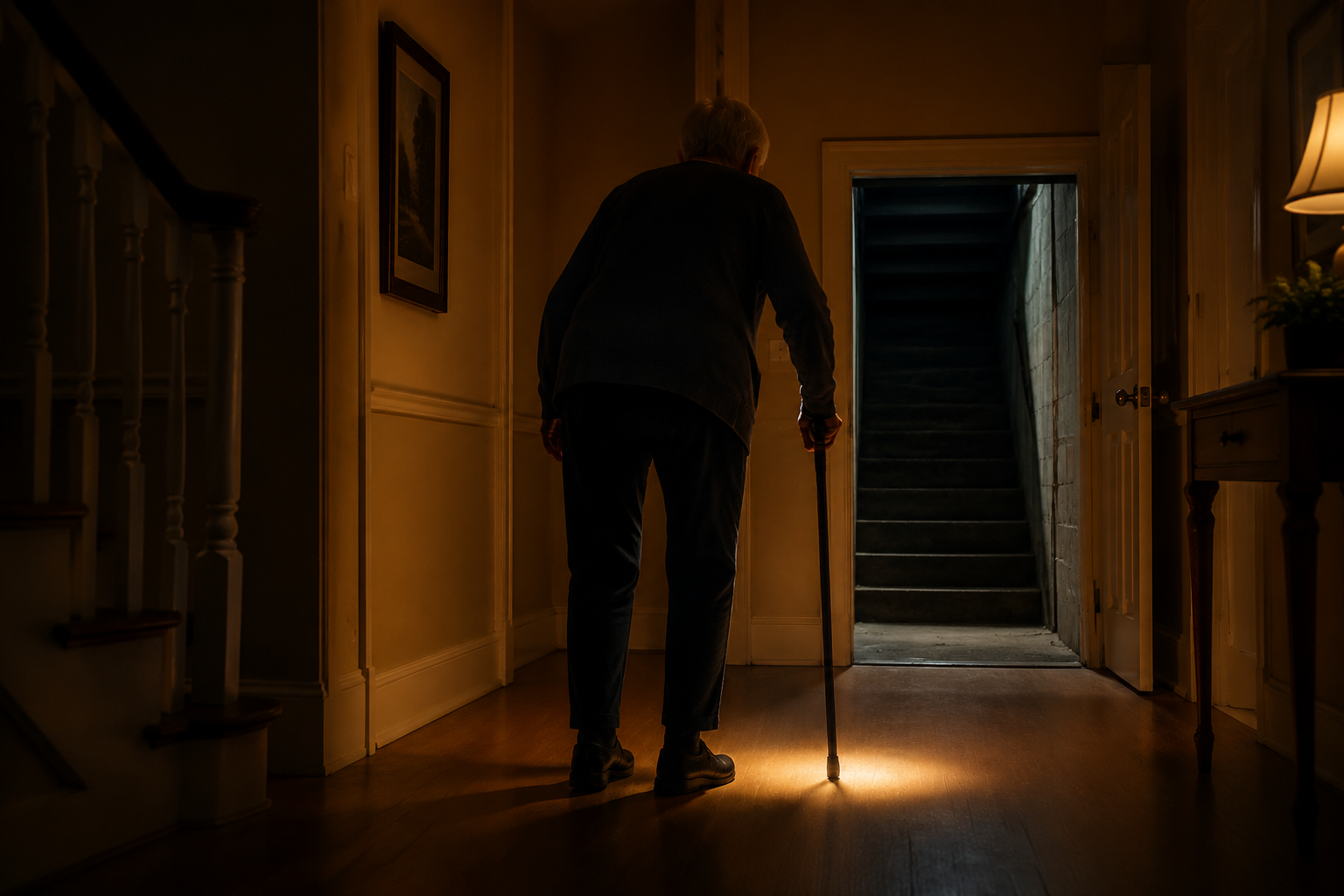
That means the tornado plan has to be physical. It has to account for the route from the recliner to the hallway, the throw rug near the bedroom door, the battery in the flashlight, the walker that does not fit cleanly through the closet opening, and the basement stairs that look reasonable in daylight but become a different problem when the power is out.
Start With the Shelter Path, Not the Siren
The most useful fall-prevention work happens before the weather turns. Once a warning is issued, there is rarely time to debate which room is best, move laundry baskets out of the hallway, hunt for shoes, find the cane, and convince someone not to rush. The path has to be ready before the warning window begins.
Walk the route an older adult would actually take from the places they spend the most time: bed, favorite chair, bathroom, kitchen table. Do it with the same mobility aid they use on a bad day, not the one they use when they feel steady. If they use a walker, check whether it clears doorframes and turns into the shelter space. If they use a cane, look for places where they may need a free hand. If they use a wheelchair, measure whether the chosen interior room can be entered and positioned without a tight transfer.
- Remove throw rugs, loose mats, cords, pet bowls, shoe piles, and low furniture from the shelter route.
- Keep the route wide enough for the walker, rollator, wheelchair, or caregiver-assisted movement that will actually be used.
- Place night-lights, battery lights, or glow tape where the older adult can follow them without guessing in the dark.
- Store sturdy shoes, a flashlight, a charged phone or power bank, glasses, hearing aids if safe to store there, and essential medication information in or near the shelter area.
- Keep the cane, walker, transfer belt, wheelchair cushion, or other mobility aid on the shelter side of the route when storms are forecast, not across the room.
Shoes deserve special attention. Bare feet and slippers are poor matches for broken glass, splintered wood, wet flooring, and yard debris. A pair of closed-toe shoes already waiting in the shelter area can prevent the first careful steps after impact from becoming the next emergency.
Choose the Safest Accessible Shelter
A basement may be the preferred tornado shelter in many homes, but preferred does not mean physically reachable for every older adult. Guidance aimed at elderly and mobility-limited people warns that wheelchair users may be safer sheltering in an interior room than attempting to reach a basement, and that getting down to the floor should only be attempted if it can be done easily and without rushing.[2] United Spinal Association also emphasizes planning around accessible shelter locations for people with mobility disabilities, rather than assuming standard shelter options will work for everyone.[3]
For many homes, the workable choice is an interior room on the lowest accessible level: a bathroom, closet, hallway, or small room away from windows. The decision should be made before severe weather arrives. A caregiver should not be making the basement-versus-hallway decision while the older adult is halfway to the stairs.
This is especially important in houses with exterior storm shelters or underground shelters reached by steep steps. Reporting from KCUR and NPR on Tornado Alley residents with disabilities documented a persistent gap between standard storm-shelter advice and shelters that disabled residents can actually use, including underground options that are inaccessible for many wheelchair users and others with mobility limitations.[4]
| If the older adult uses... | Plan the shelter choice around... |
|---|---|
| A cane | Lighting, one-hand support, dry flooring, and enough time to avoid rushing |
| A walker or rollator | Door width, turning space, removed rugs, and a route without clutter |
| A wheelchair | An accessible ground-floor interior room if stairs or transfers are unsafe |
| Hands-on caregiver help | A route that protects both people from falling, especially at thresholds and stairs |
| Poor vision or hearing | Lights, tactile cues, reachable phone alerts, and a pre-practiced route |
The shelter does not have to be perfect to be better. It has to be reachable without a dangerous transfer, a panicked stair descent, or a dark search through clutter. If the ideal shelter requires a movement the older adult cannot safely perform under pressure, the plan needs an accessible alternative.
During the Warning, Slow the Movement Just Enough to Keep It Safe
A caregiver’s instinct during a tornado warning is to hurry. That instinct is understandable, but rushing an older adult can cause the exact delay everyone is trying to avoid. A fall in the hallway, on the basement stairs, or during a floor transfer can stop the sheltering process completely.
The better goal is controlled urgency: move now, but do not turn the route into a scramble. Turn on the flashlight before the hallway goes dark if the power flickers. Put shoes on if they are within reach and doing so will not consume the whole warning window. Keep the mobility aid with the person, even if it feels slower than holding their arm and pulling them along.
- Give one clear instruction at a time: “Stand up,” then “Take the walker,” then “Turn toward the hallway.”
- Avoid pulling from the arm or shoulder; support balance without twisting the person off center.
- Let the older adult use the rail, walker, cane, or wall support they normally rely on.
- Watch thresholds, bathroom tile, garage entries, and wet spots tracked in from rain or hail.
- Close the route behind pets if possible so they do not cross underfoot.
If Stairs Are Unavoidable
Basement stairs are one of the places where tornado safety and fall prevention collide. If the older adult can use the stairs safely, slow the descent enough that one hand remains available for the rail. Do not load both hands with bags, blankets, pets, or supplies. The flashlight should be clipped, carried by the caregiver, or positioned so the person using the rail does not have to choose between balance and light.
If the stairs are unsafe on an ordinary day, they are not likely to become safe during a warning. A wheelchair user should not be carried down basement stairs by a panicked family member unless that is a practiced, safe emergency procedure with enough help. For many wheelchair users and some walker users, the safer tornado plan is a ground-floor interior room with as much protection as possible, rather than a risky stair attempt.[2][3]
Do Not Rush Floor Transfers
Many tornado instructions tell people to crouch low, cover their head, or get under something sturdy. Those positions can help protect against flying debris, but they are not simple movements for every older adult. Getting down to the floor may be easy for one person and dangerous for another.
If an older adult cannot get down and up without help on a normal day, the warning window is not the time to force the transfer. Use the strongest protection available in the accessible shelter position: sit away from windows, lock wheelchair brakes, keep the walker from becoming a trip hazard, cover the head and neck with a pillow, folded blanket, mattress, or helmet if one is already nearby, and stay low only to the extent the person can do safely.
The same applies to caregivers. A spouse who is also unsteady should not attempt a lift that would put both people on the floor. If a transfer cannot be done calmly and safely, the plan should protect the older adult where they are rather than creating a second patient.
After the Tornado, Treat the House and Yard as a Fall Zone
The fall risk does not end when the warning expires. It often changes shape. A familiar hallway may be dark. A porch step may be wet. Branches, insulation, shingles, glass, and power lines may be scattered across the path that looked clear an hour earlier.
CDC’s report on tornado-related fatalities in the southeastern United States during April 25-28, 2011, found that approximately one-third of the fatalities were among older adults. The same report identified falls during cleanup as an indirect cause of death, along with asphyxiation from generator-related carbon monoxide exposure.[5] For caregivers, that confirms the post-storm period is not just inconvenient. It can be lethal.
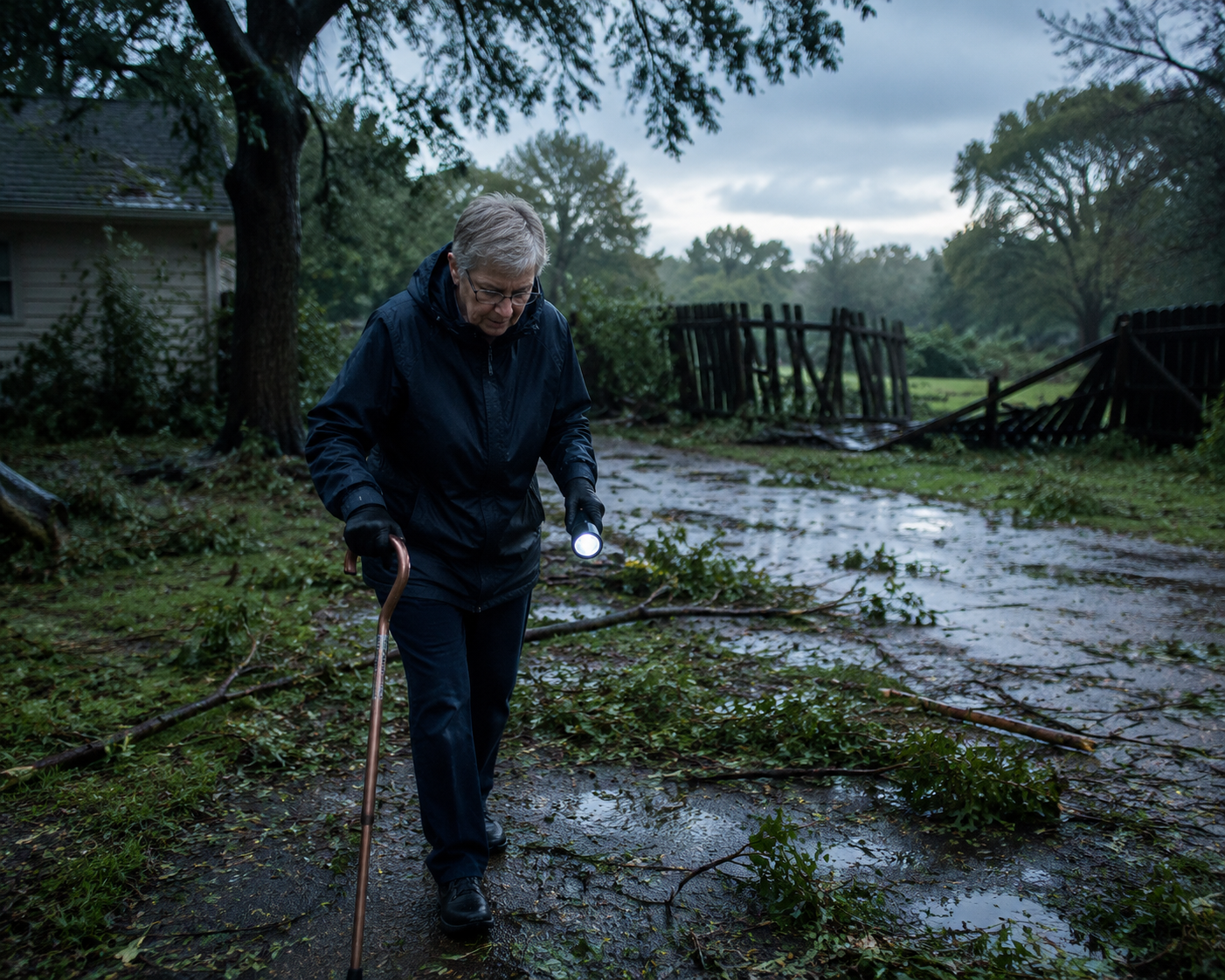
If there is no immediate danger inside the shelter area, wait before walking through damage. Daylight is safer than darkness. A flashlight is safer than memory. Closed-toe shoes are safer than slippers. The first trip out should be slow, short, and purposeful: check for urgent hazards, call for help if needed, and avoid cleanup until the path has been inspected.
- Do not let an older adult walk through debris in bare feet, socks, or loose slippers.
- Assume wet flooring, leaves, mud, and broken materials can hide a slip or puncture hazard.
- Stay away from downed or sagging lines and report them instead of stepping around them.
- Use a flashlight before entering hallways, garages, porches, yards, or stairwells.
- Delay sweeping, branch removal, ladder use, and carrying heavy items until a steadier helper is available.
- Keep generators outdoors and away from windows, doors, and attached spaces to reduce carbon monoxide danger.
Cleanup is where many families quietly take on too much. An older adult who avoided injury during the storm may still try to move branches, step over insulation, carry wet belongings, or inspect a roofline from a ladder. Those are fall-risk activities, not housekeeping. They should be treated with the same seriousness as the shelter route.
When Housing Makes the Plan Harder
Some older adults face a shelter problem that cannot be solved by moving a rug. Tornado Hub’s fatality statistics page reports, using aggregated data and citing NOAA/NWS sources, that 43% of tornado deaths occur in mobile or manufactured homes despite those homes representing less than 8% of the housing stock.[6] The same page reports that people over 65 have about five times the per-capita tornado fatality rate of children under 18, attributing the comparison to a 2022 article in Weather, Climate, and Society.[6]
Those figures should be verified against primary sources before they are used for policy decisions, but they point in the same practical direction caregivers already see: some seniors are asked to follow shelter advice that does not match their building, mobility, or transportation reality.
For an older adult in a mobile home, a caregiver may need a different pre-warning plan: a nearby accessible community shelter, a neighbor’s site-built home, a senior housing common area, or a transportation arrangement that starts when a tornado watch is issued rather than after the warning. That plan only works if the destination is open, reachable, and accessible with the person’s mobility aid. A locked shelter, gravel path, steep stairs, or long walk across a parking lot can turn a good idea into a fall hazard.
A Caregiver-Ready Tornado Fall-Prevention Plan
A printable plan does not need to be long. It needs to be honest about what the older adult can physically do under stress.
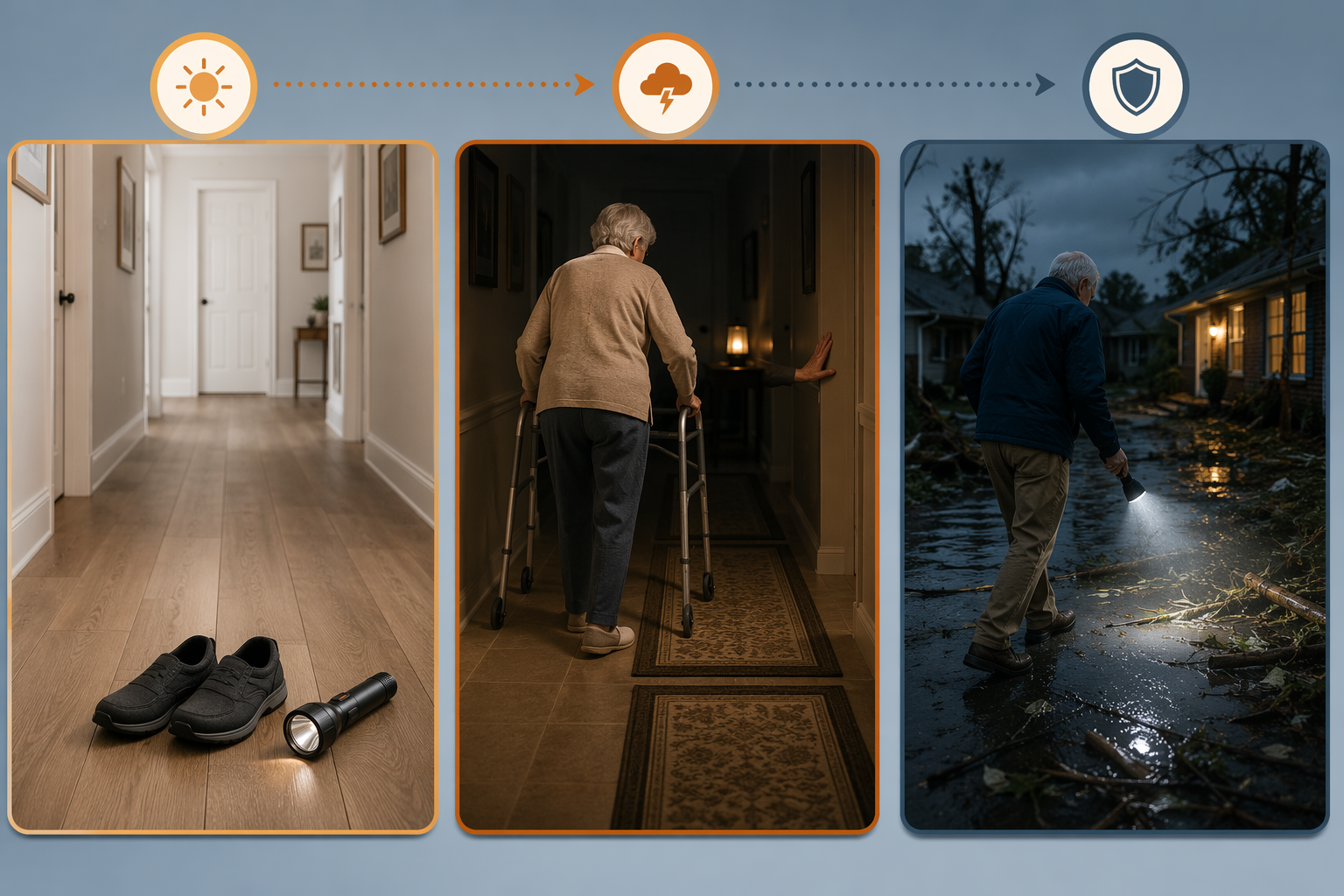
| Phase | Caregiver focus | Fall-prevention decision |
|---|---|---|
| Before severe weather | Prepare the route and supplies | Clear the path, choose an accessible shelter, place shoes, light, phone, and mobility aids where they will be used |
| During the warning | Move with controlled urgency | Avoid rushing, protect balance on stairs, do not force unsafe floor transfers, use an accessible interior room when stairs are unsafe |
| After the tornado | Delay risky movement and cleanup | Use light, shoes, and help before crossing debris, wet surfaces, uneven ground, or damaged stairs |
Caregivers can make this plan more reliable by practicing it once in calm weather. The practice does not have to be dramatic. Start from the chair or bed, move to the shelter area with the usual mobility aid, sit or position the wheelchair where the person would stay, and check what gets in the way. If the older adult becomes winded, unsteady, confused, or stuck at a turn, the plan has shown you exactly what to fix.
The difference between having a tornado plan and having a tornado plan an older adult can execute is usually found in small details: the cleared hallway, the reachable flashlight, the decision not to attempt unsafe stairs, the shoes waiting in the shelter area, and the patience to treat post-storm cleanup as a fall hazard. In a 10-to-15-minute warning window, those details are not extras. They are the plan.
References
- Tornadoes 101, NOAA
- Tornado Safety for Elderly and Mobility-Limited People, Tornado Hub
- Tornado Preparedness for the Disability Community, United Spinal Association
- Many Tornado Alley Residents With Disabilities Lack Safe Options In A Storm, NPR/KCUR, 2020
- Tornado-Related Fatalities — Five States, Southeastern United States, April 25–28, 2011, CDC MMWR
- Tornado Fatality Statistics, Tornado Hub
Related reading
Noticed something outdated or inaccurate on this page? Flag a correction. We review every report against CDC, NIA, and AARP HomeFit guidance before updating a page.
Part of the Fall Prevention section.